HOPPR has introduced the HOPPR EF Chest CT Narrative Model, a medical imaging foundation model designed to process three-dimensional chest computed tomography volumes and produce descriptive language covering structures and findings across the chest. Announced on July 23, 2026, the model is initially being made available through HOPPR Forward Deployed Services, where customers can evaluate, modify and integrate it with clinical and technical support from the company.
The release extends HOPPR’s proprietary medical imaging portfolio beyond chest radiography and mammography into a substantially more complex three-dimensional imaging modality. However, the announcement should be viewed as a developer-platform expansion rather than the commercial launch of an independently authorised diagnostic product. HOPPR has not disclosed clinical performance metrics, an external validation study, a regulatory submission or evidence that use of the model improves radiologist productivity, diagnostic accuracy or patient outcomes.
That distinction is central to understanding the opportunity. HOPPR is not simply attempting to sell another algorithm that identifies one abnormality on a scan. It is positioning the model as a configurable foundation component that developers, healthcare organisations and imaging technology companies can adapt into their own applications, subject to additional validation, workflow design and regulatory work.
What does the HOPPR EF Chest CT Narrative Model add to the company’s imaging AI portfolio?
The HOPPR EF Chest CT Narrative Model generates descriptive imaging language from complete chest CT volumes. According to the company, its output can cover pulmonary, mediastinal, cardiac, upper abdominal, osseous and soft-tissue regions, including tasks such as lung nodule characterisation and aortic measurement. HOPPR said its training data deliberately included less common but potentially serious findings such as pulmonary embolism, aortic injury, rib fracture and pneumothorax.
The launch gives HOPPR five proprietary foundation-model components across three imaging modalities. Its portfolio includes classification and narrative-generation models for chest radiography and mammography, followed by the newly released narrative model for chest CT. The company’s AI Foundry also provides access to third-party models from organisations including NVIDIA, Google, Microsoft and Stanford AIMI.
This portfolio approach could be more strategically valuable than a single-task algorithm because developers may need several model types to build a useful medical imaging application. A reporting product, for example, could combine image representation, abnormality classification, anatomical measurement, narrative generation and workflow integration. HOPPR is attempting to place its platform beneath that development stack rather than competing only at the final application layer.
The model also complements HOPPR Presto Agent, the company’s commercially available draft-reporting product. Presto is designed to insert AI-generated draft content into existing radiology reporting systems while allowing practices to select commercial, open-source or internally developed models. The presence of both a development platform and a reporting-integration product gives HOPPR potential routes to serve model developers, imaging vendors and radiology practices without relying on one distribution strategy.
Why is narrative generation from three-dimensional chest CT harder than narrow abnormality detection?
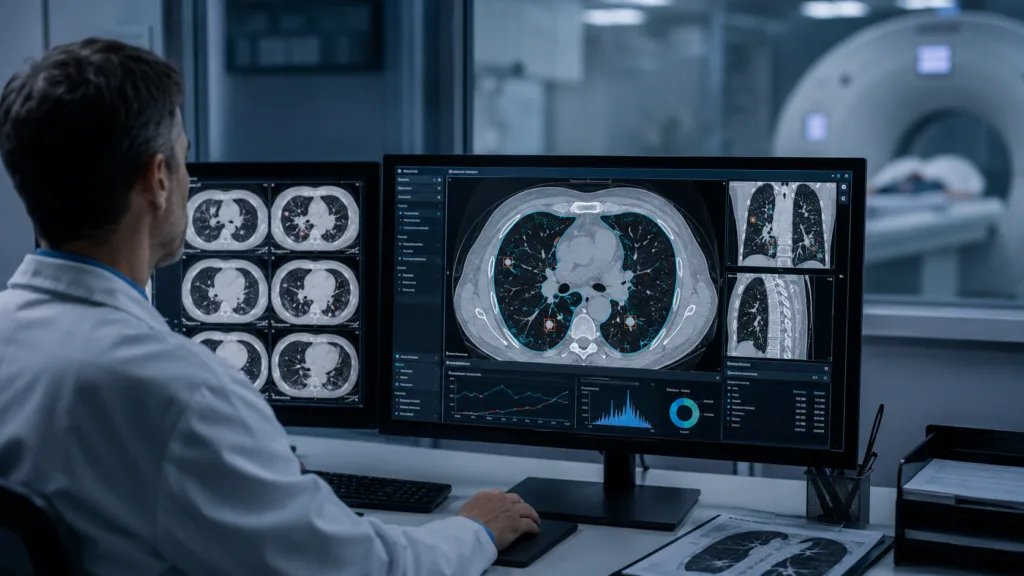
Chest CT studies contain hundreds of image slices and frequently capture clinically relevant information across several anatomical systems. A model must maintain spatial and contextual relationships as it moves through the volume, distinguish normal variation from potentially significant findings and describe observations without creating unsupported or internally inconsistent statements.
That is a different challenge from training a narrow algorithm to detect one predefined finding. A single-task model can be optimised around a specific label, such as pulmonary embolism, pneumothorax or lung nodules. A narrative model is expected to recognise a broader range of findings, organise them coherently and express them in language that can eventually be incorporated into downstream applications.
The difficulty is not merely producing fluent medical language. A report can sound professionally written while containing a clinically important omission, incorrect laterality, fabricated measurement or contradiction between the findings and impression. The usefulness of HOPPR’s model will therefore depend on whether its generated descriptions remain clinically faithful across routine studies, complex multimorbidity and relatively uncommon emergency findings.
HOPPR has recognised a similar evaluation problem in its chest radiography narrative work. The company has stated that conventional text-overlap measures such as BLEU and ROUGE-L do not adequately establish clinical correctness, and it has used additional measures intended to capture disease labels, radiological entities and clinically significant reporting errors. The chest CT announcement, however, did not disclose comparable benchmark results or describe whether radiologists independently reviewed generated CT narratives.
What does HOPPR’s training dataset reveal, and which validation details remain undisclosed?
HOPPR said the chest CT model was trained on a large proprietary dataset assembled from multiple clinical sites in the United States. It also said that the dataset was intentionally constructed to include serious but less frequently encountered conditions, an important consideration because models trained mainly on routine examinations may perform poorly when presented with clinically consequential edge cases.
Yet the company has not publicly disclosed the number of studies, number of patients, scanner manufacturers, acquisition protocols, contrast phases or geographic distribution represented in the chest CT dataset. It has also not reported how the dataset was divided between training, tuning and testing, whether patients were separated across those groups or whether performance was evaluated on a fully independent external dataset.
These omissions do not imply that the model lacks value, but they prevent an independent assessment of how well it may generalise. Chest CT protocols can differ by institution, scanner, reconstruction method, slice thickness, contrast timing and patient population. A model that performs well at the sites contributing training data may still require extensive testing before it can be relied upon in a different imaging environment.
Performance across uncommon findings will deserve particular scrutiny. Deliberately including conditions such as pulmonary embolism and aortic injury in the training set is useful, but representation alone does not establish sensitivity, specificity, measurement reliability or robustness. Developers will need condition-level validation and error analysis, especially when an output could influence triage, reporting or follow-up recommendations.
Population diversity will be another material question. HOPPR described the data as coming from multiple United States clinical sites, but it did not provide demographic breakdowns or performance by age, sex, race, comorbidity or imaging setting. Developers adapting the model will have to determine whether their own patient and scanner populations differ materially from those represented during development.
Why could Forward Deployed Services be as important as the chest CT model itself?
HOPPR is providing initial access through Forward Deployed Services rather than positioning the chest CT model as an unattended, self-service clinical application. The service brings together machine-learning specialists, software engineers, clinical experts and integration support to help customers evaluate the model on their data, modify it for a defined use case and connect it with existing systems.
That delivery model addresses a practical weakness in healthcare artificial intelligence. Many hospitals, radiology groups and medical technology developers have access to general machine-learning tools but lack the specialised personnel required to curate DICOM data, develop reliable labels, test across scanners, document model changes and prepare a regulated clinical product.
The service approach may also help HOPPR learn which applications customers are actually prepared to buy. A general narrative model could be adapted for draft reporting, structured measurements, quality assurance, retrospective research, clinical trial imaging, incidental-finding workflows or specialised triage. Working directly with early customers allows the company to identify use cases where the technology produces measurable operational value rather than merely impressive demonstrations.
The trade-off is scalability. Professional services can accelerate adoption and generate customer knowledge, but they can also create labour-intensive implementations, longer sales cycles and dependence on scarce clinical and technical staff. HOPPR will eventually need to show that successful deployments can be standardised without losing the customisation that makes the model attractive.
RadiologyOne has evaluated the chest CT model against its own data with support from HOPPR’s Forward Deployed Services team. RadiologyOne’s management said the arrangement allowed it to test and adapt the model without building the required machine-learning infrastructure internally. That experience provides evidence of customer interest, but it is not equivalent to an independent clinical validation study or broad commercial deployment.
How does regulatory status shape the path from foundation model to clinical application?
The HOPPR EF Chest CT Narrative Model is best understood as a development component. HOPPR’s model-library disclaimer states that developers remain responsible for modifying models as necessary, validating performance in the final product and obtaining applicable regulatory marketing authorisations before commercialisation.
The model does not appear under HOPPR’s name on the United States Food and Drug Administration’s current list of authorised AI-enabled medical devices. The agency describes that list as a resource covering products that have completed the applicable premarket requirements for their intended uses, while acknowledging that updates may lag some recently authorised devices.
A developer could potentially use the foundation model in a research tool, workflow-support product or regulated medical device, depending on the final intended use and claims. An application that merely assists with formatting or administrative workflow may face a different regulatory analysis from software that detects disease, prioritises cases, recommends clinical action or generates findings relied upon for diagnosis.
The regulatory burden will consequently fall on the complete downstream product, not merely on the presence of a foundation model. Developers will need to define the intended user, clinical environment, patient population, output, required human review and risk controls. They must also document training and validation data, failure modes, cybersecurity protections, change-management procedures and the effect of subsequent model updates.
The United States Food and Drug Administration’s good machine-learning-practice principles emphasise representative datasets, separation of training and testing data, performance of the human-AI team, clinically relevant testing and monitoring of deployed models. Those principles are particularly relevant to adaptable foundation models because fine-tuning or changing a model can alter performance in ways that require new validation and documentation.
Can HOPPR’s AI Foundry become a defensible infrastructure layer for medical imaging development?
HOPPR’s commercial proposition extends beyond proprietary algorithms. The AI Foundry combines curated imaging data, model access, fine-tuning tools, secure infrastructure, version control and traceable development workflows. The company says the platform operates in a HIPAA-compliant environment, holds SOC 2 Type II attestation and HITRUST e1 certification, and is maintained under a quality management system.
The Foundry became available through Amazon Web Services Marketplace in June 2026, initially for United States customers. This allows organisations to procure HOPPR through existing Amazon Web Services relationships, work with data already held in their cloud environments and potentially apply committed cloud spending to the platform. Procurement convenience may sound less exciting than a new model, but hospital and enterprise purchasing friction often determines whether promising technology progresses beyond a pilot.
HOPPR raised $31.5 million in Series A financing in 2025 from investors including Kivu Ventures, Greycroft, PSG Equity, Morningside Capital, Fortitude Ventures and Health2047. The company said the capital would support platform development, foundation-model expansion, operations and recruitment across engineering, artificial intelligence and compliance.
Its defensibility will depend on whether the combination of data, models, compliance infrastructure and expert services proves difficult for customers or competitors to recreate. Foundation models themselves may become increasingly available from large technology companies and open-source communities. HOPPR’s more durable opportunity may therefore lie in providing the governed environment, medical imaging data, clinical expertise and documentation needed to turn those models into usable healthcare products.
Which milestones will determine whether HOPPR’s chest CT strategy produces lasting value?
The immediate milestone will be publication of a more complete technical and validation package. Developers and prospective clinical partners will need information on dataset size, test-site separation, external validation, finding-level performance, measurement accuracy, reporting errors and performance across scanner types and patient subgroups.
Evidence from prospective workflow studies would be even more important. The commercial case will strengthen if HOPPR or its customers can show that applications built with the model reduce reporting time, improve report completeness, increase measurement consistency or help identify clinically significant findings without causing unacceptable false positives, omissions or automation bias.
The next test is conversion. HOPPR must demonstrate that customer evaluations through Forward Deployed Services lead to repeatable deployments, licensing revenue or regulated applications rather than remaining bespoke experimentation projects. Greater access through the AI Foundry and Amazon Web Services Marketplace could help, but healthcare organisations will still demand integration, governance and measurable return on investment.
The EF Chest CT Narrative Model gives HOPPR a broader and technically ambitious portfolio, and it moves the company closer to supporting multimodality radiology applications from a common development environment. Its importance will ultimately be determined not by how many anatomical regions it can describe in a demonstration, but by whether developers can validate those descriptions, control clinically important errors and carry resulting applications through procurement, regulation and real-world use.