IceCure Medical Ltd. has selected West Cancer Center & Research Institute in Germantown, Tennessee, as the first U.S. clinical site for its ChoICE post-marketing study of the ProSense System in low-risk, early-stage breast cancer. The Nasdaq-listed medical device company plans to enrol up to 400 patients across 30 U.S. sites, collecting long-term evidence on cryoablation in eligible patients aged 70 years or older who are receiving adjuvant endocrine therapy.
The site activation moves ProSense into a different phase of its U.S. development. IceCure Medical is no longer trying only to demonstrate that the device can meet the threshold for marketing authorization. It must now show that cryoablation can be introduced consistently across multiple clinical settings, that eligible patients can be identified reliably and that longer-term outcomes remain acceptable when the technology is used outside the controlled environment of its original pivotal evidence programme.
The United States Food and Drug Administration granted IceCure Medical’s De Novo request for the ProSense System on October 3, 2025, creating a Class II device category for cryoablation devices used in the local treatment of low-risk breast cancer. The authorization applies to a narrowly defined population rather than breast cancer broadly, an important distinction as the company expands its clinical and commercial footprint.
Why does activating the first ChoICE site matter beyond a routine study announcement?
West Cancer Center represents the first operational step in a study structure that combines post-market evidence collection with commercial deployment. Under the approved design, participating institutions can function as ChoICE research sites while also offering ProSense to eligible patients who are not enrolled in the study. This creates a dual pathway through which IceCure Medical can gather structured clinical data and build routine procedural experience at the same institutions.
Dr. Richard Gilmore, a breast surgical oncologist at the Margaret West Comprehensive Breast Center, will lead the study at the Tennessee site. His involvement provides continuity with IceCure Medical’s earlier evidence base because he was also among the authors of the five-year ICE3 publication evaluating cryoablation without surgical excision in selected patients with early-stage breast cancer.
The announcement does not by itself establish that the first patient has been treated or that enrolment is progressing across the wider network. The ClinicalTrials.gov record, last updated on June 5, listed an estimated study start in July 2026, with primary completion expected in July 2034 and final completion in September 2034. Activating the first institution therefore marks the beginning of site execution rather than evidence generation at scale.
For IceCure Medical, successful site activation will depend on more than signing research agreements. Hospitals and cancer centres will need trained physicians, appropriate imaging capabilities, defined patient-selection procedures, follow-up protocols and coordination between breast surgeons, radiologists, oncologists and research teams. The pace at which the company moves from one active site to a functioning 30-site network will be an early indicator of whether interest in breast cryoablation is translating into institutional commitment.
What evidence will ChoICE collect that the earlier ICE3 study could not fully answer?
IceCure Medical’s regulatory case was supported substantially by the prospective, multicentre ICE3 study, which evaluated ProSense cryoablation without surgical excision in patients with small, ultrasound-visible, low-risk invasive breast cancers. The final peer-reviewed analysis included 194 patients who received successful cryoablation according to the protocol. At five years, the reported ipsilateral breast tumour recurrence rate was 4.3% in the overall analysis population. Among the 124 patients who also received endocrine therapy, the recurrence rate was 3.7%. No serious device-related adverse events were reported in the publication.
Those findings supported the clinical rationale for avoiding surgery in a carefully selected population, but ICE3 was a single-arm, non-randomised study. It did not directly compare ProSense with lumpectomy in a randomised head-to-head design, and its results cannot automatically be extended to younger patients, larger tumours or biologically higher-risk disease.
A systematic review published in 2026 found that breast cancer cryoablation studies had reported encouraging local recurrence and cosmetic outcomes in selected low-risk patients. However, the authors also highlighted the small number of comparative studies, methodological heterogeneity and the need for rigorous multicentre research with long-term follow-up before cryoablation could be considered for routine use across broader populations.
ChoICE is intended to address part of that evidence gap by examining ProSense in a larger post-market population treated across multiple U.S. institutions. Its primary outcomes include the confirmed ipsilateral breast tumour recurrence rate and a combined measure covering confirmed and suspected recurrence for up to five years after cryoablation.
The secondary measures extend beyond recurrence. The study will examine whether the target tumour was completely ablated at the six-month assessment, procedural duration, hospitalisation, locoregional recurrence, disease-free survival, overall survival, breast cancer survival, serious adverse events and discontinuation of routine breast-related follow-up. Patient-reported cosmetic satisfaction and quality of life will be assessed using domains from the BREAST-Q instrument.
IceCure Medical also plans to link study information with claims data to evaluate subsequent breast cancer surgeries, mammography, additional imaging, biopsies and all-cause mortality. That component could provide a more detailed view of the healthcare activity occurring after cryoablation, including whether patients require additional procedures or interventions that are not fully captured through conventional study visits.
How narrow is the FDA-authorized population for ProSense breast cancer treatment?
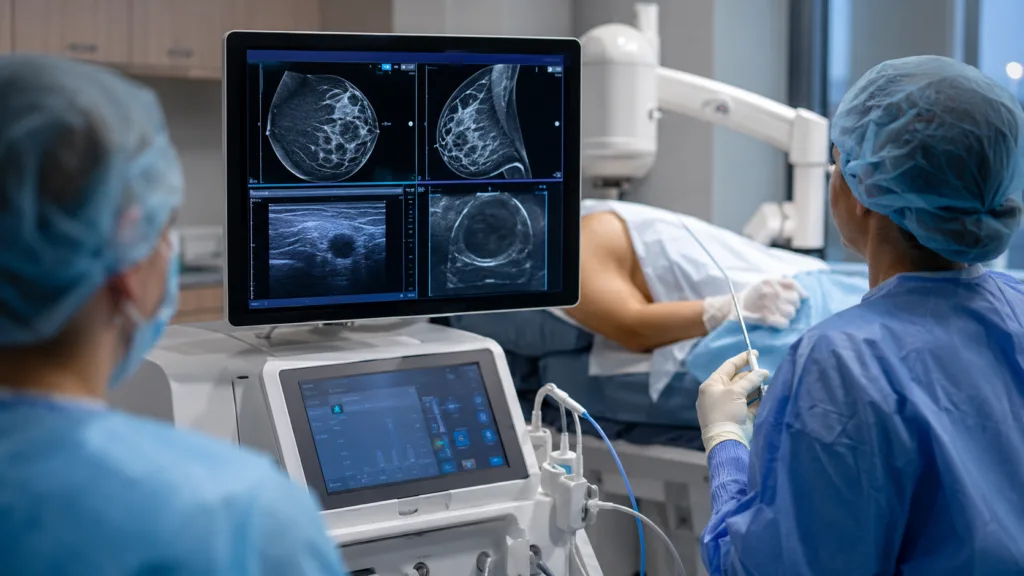
The ProSense authorization is not a general approval of cryoablation for every form of breast cancer. It covers local treatment in patients aged 70 years or older with biologically low-risk tumours measuring no more than 1.5 centimetres who are treated with adjuvant endocrine therapy. The indicated population includes patients who may not be eligible for surgery.
The FDA’s newly created device classification describes the technology as a prescription cryoablation device intended to destroy a breast tumour and surrounding tissue through controlled cold temperatures. It may be used with adjuvant treatments, including endocrine therapy or radiation therapy, to reduce the risk of local disease progression.
The classification also makes clear that the technology is not intended for breast cancers carrying a high risk of local recurrence, including lobular cancers, aggressive tumours with inflammatory features or cases in which targeted systemic therapy is indicated. These limitations reinforce the importance of patient selection and prevent the ChoICE programme from being interpreted as evidence for cryoablation across the wider breast cancer population.
ProSense is also a local treatment. It does not eliminate the need for endocrine therapy in the authorized population, nor does it remove the requirement for long-term imaging and clinical surveillance. The success of cryoablation as a de-escalation strategy will therefore depend partly on whether patients continue their recommended adjuvant treatment and complete follow-up over several years.
Can the hybrid study model turn clinical participation into wider commercial adoption?
The structure of ChoICE has direct commercial significance for IceCure Medical. Participating centres can use the same infrastructure for enrolled patients and for other eligible patients treated commercially. Each activated site could therefore become a reference centre, training location and recurring customer for IceCure Medical’s disposable cryoprobes.
The model may shorten the distance between clinical investigation and commercial utilisation. Physicians gaining experience through the study can develop patient-selection procedures, refine imaging follow-up and establish internal referral pathways. Successful programmes could then expand across other facilities within the same healthcare networks.
However, participation in a post-market study is not equivalent to broad commercial adoption. Hospitals must still complete purchasing reviews, credential clinicians, allocate procedure time and determine how responsibilities will be divided among surgeons, radiologists and oncologists. Patients must also be identified early enough in the diagnostic pathway to be considered for cryoablation before conventional surgery is scheduled.
Reimbursement remains another execution variable. IceCure Medical has said participating facilities can use a Category III Current Procedural Terminology code. Such a code supports administrative processing and data collection, but it does not guarantee universal insurer coverage or a consistent payment rate. Local payer policies, medical-necessity reviews and hospital economics may continue to influence access.
Clinical follow-up may prove equally important. Unlike surgical excision, cryoablation does not produce a complete resection specimen that can be examined after the procedure. Physicians must instead rely on imaging, biopsies where required and longitudinal surveillance to determine whether local control has been maintained. Consistency in these follow-up pathways will be essential if the ChoICE data are expected to influence clinicians and payers.
What do IceCure Medical’s finances and share performance reveal about the commercial stakes?
IceCure Medical entered the post-authorization period with improving U.S. sales but a relatively small revenue base. Revenue increased by 26% year over year to $911,000 in the first quarter of 2026. North American sales increased by 84%, while U.S. sales rose by 31%. The company reported 19 active U.S. accounts at the end of the quarter, compared with 13 before the FDA’s breast cancer decision.
The company nevertheless remained loss-making. Research and development expenditure increased to $2.21 million during the quarter, partly reflecting ChoICE-related activity, while the quarterly net loss widened to $4.27 million. Cash and cash equivalents stood at $8.12 million on March 31, 2026.
These figures underline why ChoICE has become more than a regulatory commitment. IceCure Medical needs the programme to produce clinical evidence, expand its account base and stimulate recurring cryoprobe utilisation. The company must pursue those objectives while funding site activation, physician education, commercial infrastructure and long-term data collection.
Investor sentiment has remained fragile despite the FDA authorization and early U.S. revenue growth. IceCure Medical shares closed at $2.88 on July 27, down 6.5% for the session. The stock had declined by approximately 13.5% over the preceding five trading days and by around 45% from its June 29 closing level. The July 27 decline coincided with the ChoICE site announcement, but the available information does not establish that the study update caused the movement.
IceCure Medical implemented a one-for-30 reverse share split on June 4 as part of its effort to regain compliance with Nasdaq’s minimum bid-price requirement. Nasdaq had previously given the company until November 9, 2026, to cure the deficiency. The reverse split improved the nominal share price but did not change IceCure Medical’s operating economics, revenue scale or funding requirements.
The market appears to be treating ProSense as a potentially valuable platform whose commercial trajectory remains unproven. FDA authorization reduced a major regulatory risk, but investors are now looking for evidence that hospitals will purchase systems, physicians will perform procedures and disposable-probe revenue will grow quickly enough to support the company’s expanding cost base.
Which ChoICE milestones will determine whether ProSense gains wider clinical acceptance?
The first milestones will be operational rather than clinical. IceCure Medical must add the remaining study sites, train participating teams, initiate patient treatment and demonstrate that enrolment can progress toward the 400-patient target. The number of commercially active sites and the volume of cryoprobes used may provide earlier evidence of adoption than the study’s long-term recurrence results.
The six-month complete-ablation assessments will offer an early clinical indicator, although they will not substitute for the five-year recurrence endpoints. Industry observers will also examine serious adverse events, post-procedure imaging patterns, additional biopsies and the proportion of patients requiring subsequent breast surgery.
Long-term success will depend on whether the results remain consistent across institutions rather than being concentrated among highly experienced cryoablation specialists. A wider spread of investigators could strengthen the relevance of the evidence, but it could also reveal differences in patient selection, probe placement, imaging interpretation and follow-up compliance.
The final ChoICE outcomes are many years away. Until then, IceCure Medical will be judged through a combination of site expansion, procedural activity, recurring sales, reimbursement progress and interim evidence quality. Activating West Cancer Center is a necessary beginning, but the decisive test will be whether IceCure Medical can turn a narrowly authorized breast cancer procedure into a reproducible, financially sustainable care pathway across the planned 30-site network.