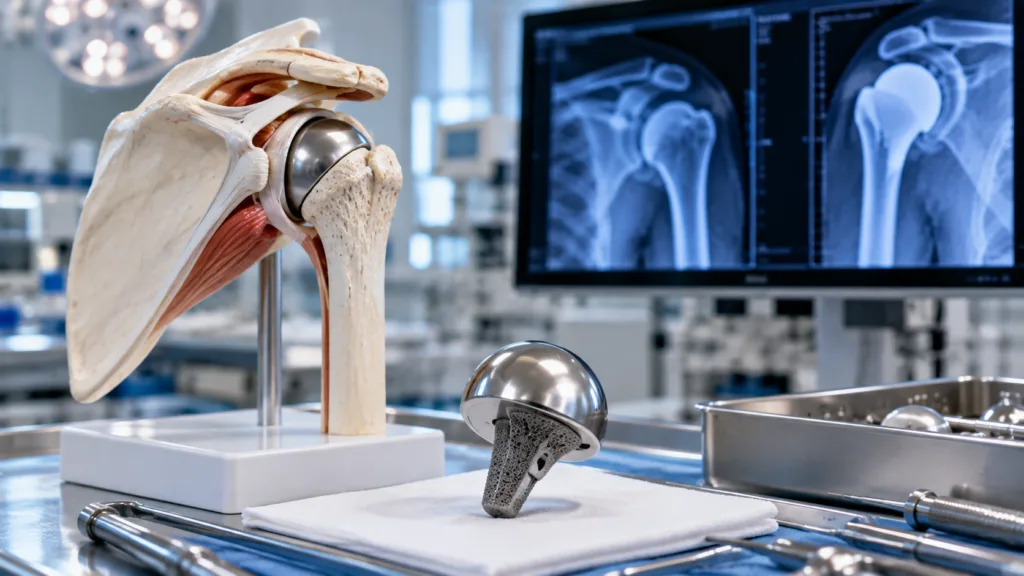
Shoulder Innovations Inc. has received United States Food and Drug Administration 510(k) clearance for its N-22 Humeral Head, a titanium implant option intended for patients with metal hypersensitivity undergoing anatomic total shoulder arthroplasty, and has moved directly into full commercial launch. The New York Stock Exchange-listed orthopaedic device manufacturer now has metal-sensitive implant options spanning both anatomic and reverse shoulder arthroplasty configurations.
The new humeral head complements the N-22 Glenosphere, a titanium component cleared earlier in 2026 for selected patients undergoing reverse shoulder replacement who are suspected of sensitivity to constituents of conventional cobalt-chromium alloy. Together, the products allow surgeons using Shoulder Innovations systems to address patients in whom material sensitivity is a significant preoperative concern.
This is a 510(k) clearance rather than a premarket approval decision. The regulatory pathway reflects the FDA’s determination that the product meets applicable substantial-equivalence requirements for U.S. marketing. It does not establish that titanium produces better clinical outcomes than cobalt-chromium implants in the general shoulder arthroplasty population.
That distinction is particularly important because Shoulder Innovations is not positioning N-22 as the preferred material for every patient. The commercial value lies in giving surgeons another option for a relatively small but clinically important subset while making the company’s overall implant system more comprehensive.
Why can metal hypersensitivity create problems in shoulder replacement surgery?
Orthopaedic implants commonly use cobalt-chromium, titanium and other metal alloys because these materials combine mechanical strength, corrosion resistance and long-term implant performance. Most patients tolerate these materials without clinically significant problems.
A subset of people, however, show hypersensitivity to metals such as nickel, cobalt or chromium. Shoulder Innovations estimates that roughly 10% to 15% of the general population may test positively for some form of metal hypersensitivity, although a positive allergy test does not mean every patient will experience an implant-related reaction.
The clinical relationship between metal sensitivity and joint-replacement symptoms is complex. Persistent pain, dermatitis, inflammation or implant problems after arthroplasty can have many causes, including infection, loosening, instability, soft-tissue failure and mechanical positioning. Metal hypersensitivity is consequently generally considered only after more common causes have been evaluated.
For patients with a well-documented history or a strong suspicion of sensitivity to conventional alloy constituents, surgeons may prefer materials that reduce exposure to the suspected allergen. Titanium-based alternatives can therefore broaden surgical options even if they are not necessary for most patients.
The N-22 Humeral Head addresses that niche within anatomic total shoulder arthroplasty. Its companion N-22 Glenosphere provides a titanium option in reverse procedures, allowing Shoulder Innovations to cover both major reconstruction configurations.
How does anatomic shoulder replacement differ from reverse shoulder arthroplasty?
Anatomic total shoulder arthroplasty attempts to reproduce the shoulder’s normal geometry. The humeral side receives a ball-shaped component while the glenoid side receives the socket, making successful function dependent on an adequately functioning rotator cuff to stabilize and move the joint.
Reverse shoulder arthroplasty changes the geometry. A ball is placed on the glenoid side and a socket-like component on the humeral side, allowing the deltoid muscle to assume more responsibility for raising the arm when the rotator cuff is severely deficient.
These different constructions explain why a single metal-sensitive component cannot serve the entire shoulder replacement market. Anatomic procedures need an appropriate humeral head, while reverse systems use a glenosphere on the scapular side.
Shoulder Innovations’ N-22 strategy therefore fills two different component needs. The Glenosphere creates the titanium option for selected reverse cases, while the new Humeral Head extends the material choice to selected anatomic replacements.
From a surgeon’s perspective, portfolio completeness can matter. If a preferred implant system lacks an option for a patient with suspected metal allergy, the surgeon may need to use another manufacturer’s system for that case. Adding specialized components reduces those gaps.
That commercial effect can be disproportionate to unit volume because surgeon relationships are built around confidence that a platform can handle both routine and less common clinical scenarios.
Does titanium automatically make the N-22 Humeral Head safer than conventional implants?
No. Material selection needs to be understood in relation to the individual patient and the mechanical requirements of the implant. Titanium offers useful biocompatibility characteristics and can provide an alternative when cobalt or chromium sensitivity is a concern, but it is not inherently superior for every articulating surface or every shoulder replacement.
FDA documentation for Shoulder Innovations’ previously cleared N-22 Glenosphere explicitly notes that the wear characteristics of titanium and titanium alloys are inferior to cobalt alloy and recommends a cobalt-alloy glenosphere for patients without material sensitivity to cobalt-chromium constituents. That illustrates the trade-off involved in material substitution.
The clinical objective is therefore not to replace cobalt-chromium broadly. It is to provide a reasonable alternative where avoiding certain metals may outweigh the material advantages of a conventional alloy.
Long-term implant performance depends on much more than allergy status. Component positioning, fixation, bone quality, joint loading, polyethylene wear, infection, rotator-cuff function and surgical technique all contribute to outcomes.
For Shoulder Innovations, the appropriate commercial message is consequently precision rather than universality. N-22 broadens surgeon choice for a defined patient need without implying that standard implant materials are unsuitable for the wider population.
Why could a relatively small product extension matter commercially to Shoulder Innovations?
Shoulder Innovations remains much smaller than the largest global orthopaedic device manufacturers, so building share depends partly on persuading surgeons that its implant ecosystem is broad enough to support a substantial portion of their shoulder practice.
A surgeon who adopts a platform does not want to encounter frequent clinical situations requiring a switch to another vendor. Product-line extensions addressing metal sensitivity, complex reconstruction or variations in patient anatomy can therefore strengthen retention even when each individual component generates modest revenue.
The company’s recent operating performance suggests that surgeon adoption is already accelerating. Second-quarter 2026 net revenue rose 56% year over year to $17.2 million, while implant-system volume increased approximately 50% to 2,238 units. Average selling price increased 5% to $7,674.
Shoulder Innovations raised its full-year 2026 revenue guidance to between $67 million and $69 million, which would represent approximately 42% to 46% growth compared with 2025. Gross margin also increased to 78.3% during the second quarter.
Those figures put the N-22 launch in context. The product does not need to create an entirely new shoulder replacement category to contribute strategically. If it helps the company win or retain surgeons, the resulting value can extend across the rest of the implant system used in those surgeons’ procedures.
This is particularly relevant in orthopaedics, where purchasing relationships often involve instrument trays, implants, preoperative planning, sales support and operating-room familiarity rather than isolated component selection.
How does the N-22 launch fit with Shoulder Innovations’ wider product expansion?
Shoulder Innovations has been increasing the breadth of its portfolio alongside rapid growth in its core implant systems. The company has also launched a titanium plasma spray baseplate extension for reverse shoulder procedures and is working on additional enabling technologies and specialized reconstruction solutions.
Its ecosystem includes the InSet anatomic and reverse shoulder systems, ProVoyance planning software, instruments and surgeon support. The broader objective is to compete not merely on one implant feature but on the entire surgical workflow.
That strategy reflects the structure of the shoulder arthroplasty market. Large incumbents can bundle implants with planning platforms, instruments, service teams and complementary products, creating a significant competitive barrier for smaller companies.
Shoulder Innovations therefore needs differentiation and completeness at the same time. Its inset glenoid philosophy and implant designs create the differentiation, while line extensions such as N-22 reduce the number of cases in which surgeons need to leave the system.
The September clearance also came one day after the company announced an exclusive partnership with ALM Ortho for bespoke solutions targeting complex shoulder reconstruction. Taken together, those developments show a company attempting to move beyond standardized primary arthroplasty into harder cases and specific patient needs.
Execution will determine whether expanding complexity strengthens the business or creates unnecessary inventory and commercial burden. Every additional implant configuration adds manufacturing, inventory, training and instrument-management requirements.
What will determine whether the N-22 products gain meaningful clinical adoption?
Patient identification is the first constraint. Metal hypersensitivity is not routinely synonymous with implant-related disease, and there is continuing debate around which patients benefit from preoperative testing and how test results should influence orthopaedic implant selection.
Surgeons therefore need clear criteria for when the titanium option is appropriate. Overuse could add complexity without proven clinical benefit, while under-recognition of genuine hypersensitivity could leave a small subset without a suitable option.
Real-world evidence will also matter. Because the target population is relatively limited, large randomized trials comparing titanium and cobalt-chromium components specifically in metal-sensitive shoulder patients may be difficult to conduct. Registries and post-market follow-up could become important sources of durability and revision information.
Operational simplicity is another issue. A specialized component is more attractive if it fits seamlessly into the same instruments and surgical workflow already used for the company’s standard implants. Requiring substantial additional equipment for a low-volume indication would make hospital adoption more difficult.
Cost will influence purchasing decisions as well. Hospitals may accept a premium for a clinically necessary specialty implant, but payers generally reimburse the overall arthroplasty procedure rather than rewarding the use of a more expensive material.
Shoulder Innovations consequently needs N-22 to function as a practical extension of its existing system rather than as a complicated specialty product.
What does the clearance signal for Shoulder Innovations’ growth story?
The immediate revenue impact of one titanium humeral component is unlikely to transform a company targeting $67 million to $69 million of full-year sales. The larger implication is that Shoulder Innovations is adding depth to its product portfolio while its commercial base is expanding quickly.
Revenue growth above 50% and increasing implant volumes indicate that the company is capturing additional procedures, but sustaining that pace becomes progressively harder as the comparison base grows. Product extensions can support continued expansion by increasing the proportion of each surgeon’s caseload addressable with the platform.
The company also retains substantial investment requirements. Sales expansion requires more representatives and clinical support, while new products consume research, regulatory and manufacturing resources. High gross margins provide useful economic headroom, but Shoulder Innovations remains in a scale-building phase rather than operating like a mature orthopaedic incumbent.
N-22 therefore matters more strategically than its niche indication might initially suggest. Shoulder Innovations can now offer a titanium alternative across both anatomic and reverse shoulder arthroplasty for selected metal-sensitive patients, removing another reason for surgeons to use a competing system.
The commercial test is whether that additional flexibility actually strengthens surgeon adoption and implant utilization. If it does, the value of the N-22 Humeral Head will come less from the number of titanium components sold and more from the wider shoulder arthroplasty business that a more complete portfolio can help Shoulder Innovations capture.