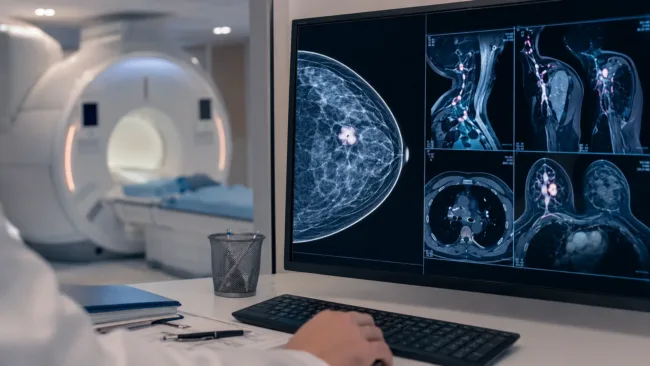
GE HealthCare Technologies Inc. has secured multiple United States Food and Drug Administration clearances for its next-generation SIGNA magnetic resonance imaging systems, expanding its advanced MRI portfolio with upgraded hardware and artificial intelligence-enabled workflow capabilities. The regulatory milestone strengthens the United States-based medical imaging manufacturer’s position in a competitive high-field MRI market defined by precision imaging, scan efficiency, and integrated software intelligence.
The importance of this development lies less in the regulatory formality and more in the strategic direction it confirms. Magnetic resonance imaging remains a core diagnostic modality across neurology, oncology, cardiology, and musculoskeletal medicine, yet the market is shifting from hardware competition toward workflow optimization, reproducibility, and AI-driven reconstruction. The Food and Drug Administration clearances validate GE HealthCare Technologies Inc.’s effort to position the SIGNA MRI platform as both a diagnostic engine and an operational efficiency tool.
What this regulatory milestone signals about MRI’s shift from hardware competition to integrated intelligence platforms
For decades, MRI innovation focused on gradient performance, coil sensitivity, and field strength. While these parameters remain critical, differentiation now hinges on software-defined capabilities, particularly artificial intelligence-assisted reconstruction and automated exam planning. The next-generation SIGNA MRI systems appear designed to integrate these elements into the core platform rather than treat them as optional enhancements.
Artificial intelligence-based reconstruction techniques aim to reduce scan times while preserving spatial resolution and signal integrity. In principle, this allows higher patient throughput without compromising diagnostic confidence. Automated slice positioning and protocol standardization may also reduce operator variability, a longstanding challenge in multi-site health systems.
The more meaningful evolution appears to be the co-optimization of data acquisition and reconstruction. Instead of layering algorithms onto legacy hardware, the platform architecture suggests deeper integration between gradient design, radiofrequency systems, and reconstruction software. Industry analysts suggest that this type of system-level refinement can produce incremental yet durable performance gains.
Still, regulatory clearance does not automatically translate into clinical transformation. The Food and Drug Administration pathway confirms safety and performance standards but does not establish superiority. Radiologists will expect peer-reviewed evidence demonstrating improved lesion detectability, reduced artifacts, or enhanced quantitative reliability before large-scale adoption.
How improved scan efficiency could reshape radiology economics under staffing and reimbursement constraints
Operational efficiency has become central to imaging strategy. Radiology departments across the United States are managing rising imaging volumes alongside technologist shortages and relatively flat reimbursement. If next-generation SIGNA MRI systems consistently reduce scan duration per patient, the financial implications could be meaningful.
Shorter exam times can increase daily scan capacity, affecting revenue per system in high-volume settings. Academic medical centers and outpatient imaging networks may find that throughput improvements strengthen return on investment calculations. Industry observers note that MRI purchasing decisions increasingly depend on workflow modeling rather than image quality metrics alone.
Automation features such as intelligent positioning and protocol selection may also mitigate workforce strain. By reducing dependency on highly specialized technologist expertise, these tools can help standardize imaging quality across shifts and sites. In community hospitals with limited staffing flexibility, such capabilities may be particularly attractive.
However, the economic equation is nuanced. MRI reimbursement rates have experienced sustained pressure. Volume gains must therefore offset fixed payment levels, and capital expenditures remain substantial. Installation costs, facility modifications, and service agreements add to total ownership expense. Hospitals will weigh these factors carefully against projected efficiency gains.
Supply chain stability and service reliability also influence purchasing decisions. High-field MRI systems rely on complex components, and uptime is critical to revenue continuity. The ability of GE HealthCare Technologies Inc. to deliver systems on schedule and maintain consistent service performance will shape customer confidence.
What this enables clinically in neurology, oncology, and cardiology while highlighting remaining evidence gaps
Clinically, the value proposition centers on enhanced image quality combined with reduced scan time. In neurology, faster acquisition may reduce motion artifacts in patients with acute stroke, epilepsy, or neurodegenerative conditions. High-resolution structural and diffusion imaging could support earlier detection of subtle abnormalities.
In oncology, precise tumor delineation remains essential for staging and treatment planning. Artificial intelligence-enhanced reconstruction may improve small lesion conspicuity in liver, prostate, and brain imaging. Clinicians following the field believe that greater consistency across serial scans could strengthen longitudinal disease monitoring.
Cardiac MRI, one of the more technically demanding applications, may benefit from accelerated sequences and improved signal-to-noise ratios. Reduced breath-hold requirements could improve patient tolerance and expand eligibility for advanced cardiac protocols.
Yet evidence gaps persist. Food and Drug Administration clearance does not require proof of improved patient outcomes relative to existing systems. Radiologists and hospital committees will likely seek comparative studies assessing diagnostic accuracy and reproducibility across diverse populations.
Artificial intelligence integration introduces additional scrutiny. Algorithm transparency, validation across demographic groups, and post-market monitoring are increasingly important considerations. Regulators and quality assurance teams will monitor whether AI-assisted reconstructions maintain consistent performance over time.
How competitive dynamics and enterprise integration shape the commercial stakes in the MRI market
The MRI market remains concentrated, with Siemens Healthineers AG and Koninklijke Philips N.V. competing aggressively in artificial intelligence-enabled imaging. The regulatory clearances for next-generation SIGNA MRI systems ensure that GE HealthCare Technologies Inc. maintains technological parity in a high-margin segment.
Competition is extending beyond hardware specifications toward enterprise integration. Imaging vendors increasingly offer fleet-wide analytics, remote monitoring, and centralized protocol management. If the SIGNA MRI portfolio integrates effectively into broader enterprise ecosystems, it could strengthen long-term customer retention.
Global positioning also matters. While the United States represents a major MRI market, growth opportunities in Asia-Pacific and emerging regions remain significant. Coordinated regulatory approvals and scalable production will determine how effectively GE HealthCare Technologies Inc. can capture international demand.
Replacement cycles provide another opportunity. Many health systems operate MRI scanners approaching a decade in service. Incremental yet meaningful improvements in efficiency and image consistency may justify replacement decisions, particularly if operational gains are demonstrable.
How real-world performance data, AI oversight scrutiny, and capital budgeting decisions will determine the next phase of SIGNA MRI adoption
Clinicians will prioritize real-world data. Peer-reviewed studies demonstrating measurable improvements in diagnostic performance or workflow efficiency will carry greater weight than regulatory announcements alone. Multicenter validation may influence adoption in academic and tertiary care settings.
Regulators will continue monitoring artificial intelligence integration, particularly with respect to transparency and post-market performance tracking. Consistent outcomes across patient populations will be essential to sustaining regulatory confidence.
Health system executives will evaluate financial impact. If throughput gains and workflow improvements produce tangible economic benefits, procurement momentum could build. If efficiency gains prove marginal, purchasing decisions may favor incremental upgrades rather than full system replacement.
The broader strategic question is whether intelligence-driven MRI platforms can redefine precision imaging in a resource-constrained healthcare environment. GE HealthCare Technologies Inc. has aligned its next-generation SIGNA MRI systems with both clinical performance and operational efficiency. The regulatory milestone enables commercialization, but sustained success will depend on clinical validation, economic justification, and competitive execution.
As imaging technology evolves, the balance between hardware innovation and software intelligence will shape the next phase of MRI adoption. The Food and Drug Administration clearances mark a platform reinforcement rather than a disruptive leap, yet incremental integration can accumulate into durable advantage. The coming cycle will reveal whether this alignment of precision and efficiency meets the expectations of clinicians, regulators, and health system leaders seeking measurable value in advanced diagnostic imaging.