Xenix Medical has received U.S. Food and Drug Administration 510(k) clearance and moved to full commercial launch for the Lux Expandable Lumbar Interbody Fusion System. The orthopedic device is cleared for lumbar interbody fusion procedures in skeletally mature patients with degenerative disc disease at one or two contiguous levels from L2 to S1, placing Lux in the competitive U.S. spinal fusion implant market.
Why Xenix Medical’s Lux system could matter in the crowded expandable lumbar interbody fusion market
The strategic importance of Lux is less about Xenix Medical entering spinal fusion and more about how the medical device manufacturer is attempting to sharpen its position within a highly device-sensitive part of spine surgery. Lumbar interbody fusion is already a mature category, with surgeons able to choose from static cages, expandable cages, titanium implants, porous architectures and systems designed for posterior or transforaminal approaches. That makes every new entrant face the same uncomfortable question. Is the product genuinely changing the surgical equation, or is it simply another implant asking distributors and surgeons to make shelf space?
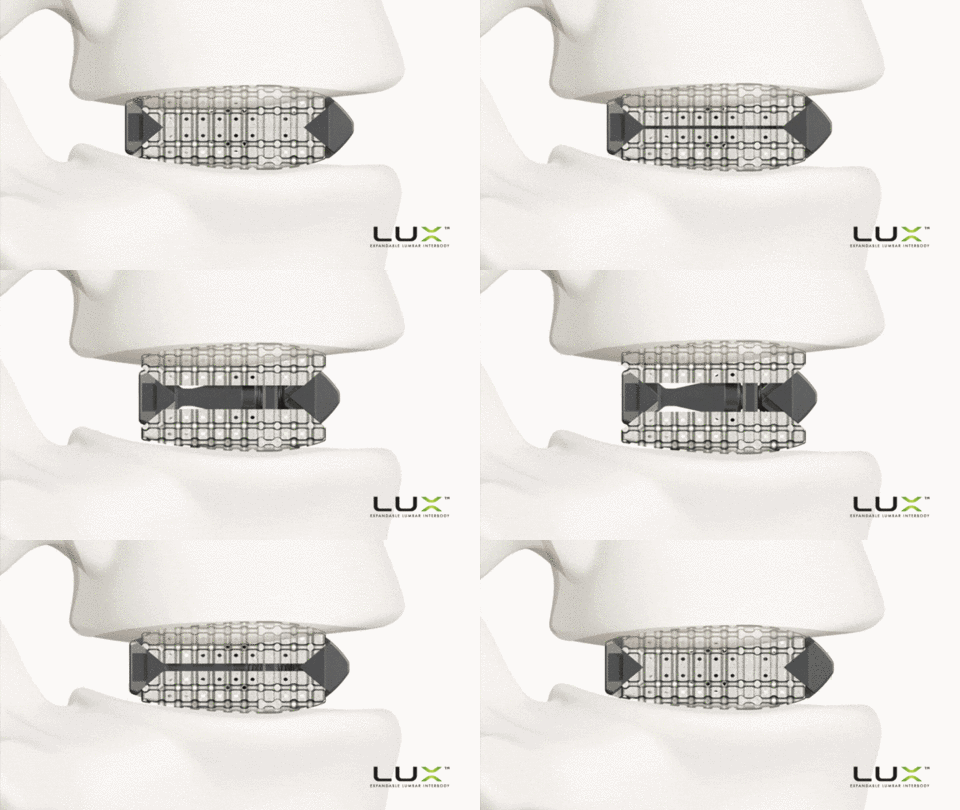
Lux is positioned around a familiar but commercially meaningful tension in lumbar fusion. Expandable interbody devices are designed to enter the disc space with a smaller profile and then expand in situ to restore disc height, support alignment and accommodate patient anatomy. The potential benefit is procedural flexibility, particularly when working through constrained posterior or transforaminal access corridors. The limitation is that expandable mechanisms can create engineering trade-offs, including reduced graft volume, mechanical complexity and questions about how reliably the final construct supports fusion biology over time.
That is where Xenix Medical is trying to differentiate Lux. The system combines an expandable lumbar interbody design with the manufacturer’s NanoACTIV surface technology and NeoWave structural concepts. The commercial message is clear: Xenix Medical wants surgeons to view Lux not merely as an expandable spacer, but as an implant that attempts to balance access, graft packing, surface biology and endplate support. The unresolved question is whether surgeons will see that balance as clinically meaningful in routine practice, especially when many already have established workflows with competing expandable implants.
How the Lux design targets the fusion, graft packing and subsidence trade-off in lumbar surgery
The main clinical logic behind Lux rests on a problem that spine surgeons already understand well. Fusion is not driven by device geometry alone. It depends on patient selection, bone quality, graft biology, fixation strategy, endplate preparation, implant positioning and postoperative healing. An expandable device can improve intraoperative flexibility, but it must avoid creating a mechanical solution that compromises the biological environment needed for successful fusion.
Xenix Medical is framing Lux around the ability to allow post-expansion bone graft packing while incorporating a nano-scale surface intended to support bone growth across the implant. That matters because one of the recurring criticisms of some expandable cages is that the internal expansion mechanism can occupy space that might otherwise support graft material. In a field where surgeons weigh cage height, lordosis, footprint, porosity, surface roughness and graft windows, even small design choices can affect product preference.
The risk is that surface and structure claims can travel faster than clinical proof. The Lux regulatory summary supports the device through mechanical performance and substantial equivalence to predicate devices, not through a large prospective clinical trial showing superior fusion rates, lower subsidence or better patient-reported outcomes versus established competitors. In vitro surface data and mechanical testing are useful parts of device validation, but they do not replace real-world evidence in patients with variable bone density, comorbidities, smoking history, revision anatomy or multi-level degenerative disease.
Why the 510(k) pathway gives regulatory clarity but leaves clinical differentiation unresolved
The 510(k) clearance gives Xenix Medical the regulatory right to market Lux in the United States, but it should not be read as the same thing as proof of clinical superiority. The U.S. Food and Drug Administration clearance reflects a substantial equivalence determination for the intended use, design, materials, function and performance profile compared with predicate devices. For industry observers, that is an important regulatory milestone, but it is also a reminder that the commercial burden now shifts from clearance to evidence, surgeon trust and execution.
Lux is classified as a Class II intervertebral body fusion device with bone graft for lumbar use. The cleared indication covers skeletally mature patients with degenerative disc disease of the lumbar spine at one or two contiguous levels from L2 to S1. The device is intended for use with autogenous bone graft and/or allograft and supplemental fixation. These details matter because they place Lux within a defined surgical ecosystem rather than as a standalone solution. The cage is one component of a fusion construct, not the entire treatment strategy.
The limitation is that the regulatory pathway does not answer the questions hospitals and surgeons eventually ask in practice. Does Lux reduce operative steps? Does it improve graft delivery after expansion? Does it maintain height under load? Does it reduce subsidence in patients with weaker endplates? Does it improve radiographic fusion rates or clinical outcomes? Does it fit cleanly into existing instrument sets and operating room workflows? Regulatory clearance opens the door. It does not guarantee that surgeons will change behaviour.
How Xenix Medical’s broader spine portfolio may influence surgeon adoption and distributor traction
The timing of Lux is notable because Xenix Medical has also been expanding its fixation portfolio, including the Riva Posterior Fixation System. That broader portfolio context may matter more commercially than a single product clearance. Spine surgeons rarely think about cages in isolation. They often evaluate the implant, fixation system, instruments, access route, sales support, tray efficiency and distributor reliability together. If Xenix Medical can offer a more integrated lumbar solution around interbody fusion and posterior fixation, Lux may have a stronger adoption pathway than it would as a standalone cage.
For Xenix Medical, this creates a potential portfolio story. Lux can serve as an expandable interbody option, while posterior fixation systems can support construct completion. That may help the medical device manufacturer compete for surgeon attention in a market where hospital purchasing committees and ambulatory surgery centers increasingly scrutinise inventory burden, implant standardisation and vendor overlap. A device that fits within a broader procedural offering can have a better chance of gaining repeat use, provided the instruments are intuitive and support is dependable.
The commercial risk is that portfolio breadth can also raise execution demands. Distribution expansion, surgeon training, inventory availability, instrument sterilisation logistics and case support can make or break early launch momentum. A technically interesting implant will not build loyalty if the right sizes are unavailable, if trays are cumbersome, or if the learning curve slows operating room flow. For a smaller spine device manufacturer, the challenge is not just proving that Lux works. It is proving that the company can support Lux consistently across surgeons, hospitals and geographies.
Where reimbursement, surgeon preference and operating room logistics could slow commercial uptake
Lux enters a U.S. spine market where reimbursement pressure and hospital economics are increasingly relevant to device adoption. Lumbar fusion remains a major procedural category, but payers, hospitals and ambulatory surgery centers are more sensitive to cost, length of stay, revision risk and evidence quality. Expandable cages can command interest because of procedural flexibility, but they must justify their value against static cages, competing expandable platforms and broader efforts to control implant spending.
Surgeon preference remains one of the strongest forces in spine device adoption. If a surgeon is comfortable with an existing expandable platform, Lux must offer more than a new surface or design language. It must deliver a practical reason to switch, such as easier insertion, better graft packing, reliable expansion control, clear radiographic visibility, fewer tray demands or stronger confidence in endplate support. In spine, small workflow advantages can matter. Small workflow annoyances can matter even more.
There is also an evidence gap that Xenix Medical will need to close over time. Industry observers are likely to watch whether Lux generates post-market data on fusion rates, subsidence, implant migration, revision rates, neurologic complications, operative efficiency and patient-reported outcomes. The system’s nano-scale surface may be an important talking point, but clinicians will ultimately care about whether it changes what they see on imaging and in patient recovery. Until that evidence matures, adoption may depend heavily on surgeon experience, early case feedback and distributor relationships.
What clinicians and industry observers are likely to watch as Lux moves into routine use
The next stage for Lux is not regulatory. It is behavioural. Clinicians will watch how the device handles real anatomy, including collapsed disc spaces, spondylolisthesis, variable endplate quality and revision cases. They will also assess whether post-expansion graft packing is simple and reproducible, because a theoretical design advantage only becomes meaningful if it can be executed consistently during surgery. In a time-pressured operating room, elegance on paper must become reliability in hand.
Regulatory watchers will likely focus on post-market performance signals rather than the clearance itself. As Lux moves into broader commercial use, adverse event reporting, complaint trends, labeling discipline and any future design modifications will matter. The 510(k) route gives a predictable pathway for market entry, but it also places responsibility on the manufacturer to maintain quality systems, monitor field performance and manage product changes carefully. That is especially important for expandable implants, where moving components and deployment mechanics add complexity compared with simpler static cages.
For the spine device market, Lux reflects a broader industry direction. Manufacturers are not only competing on whether a cage expands. They are competing on how expansion interacts with fusion biology, surface engineering, sagittal alignment, graft access and procedural efficiency. Xenix Medical’s opportunity is to persuade surgeons that Lux brings those elements together in a way that is not merely incremental. The hard part is that the market will not reward engineering language alone. The system will need repeat cases, surgeon advocacy, operational reliability and credible outcomes evidence before Lux can become more than another cleared implant in a crowded lumbar fusion category.
Why Xenix Medical’s Lux launch is best viewed as a platform test, not just a product launch
The most useful reading of the Lux launch is that Xenix Medical is testing whether its fusion engineering approach can scale across a more complete spine surgery portfolio. Lux brings the medical device manufacturer into a commercially important expandable lumbar interbody segment, but the long-term value depends on whether the technology can anchor broader procedural relationships with surgeons. If Lux supports strong early case experience and pairs well with Xenix Medical’s fixation systems, the launch could strengthen the company’s visibility in a competitive orthopedic device market.
The downside is equally clear. Spine surgery is crowded with technically sophisticated devices, many backed by larger companies with deeper sales networks, broader hospital contracts and long-standing surgeon relationships. Lux has regulatory clearance and a design story, but it now needs clinical credibility and commercial execution. The difference between a cleared device and an adopted device is usually found in repeat usage, outcomes confidence and operating room dependability.
For clinicians, Lux may be worth watching as another example of how expandable lumbar fusion systems are evolving beyond simple height restoration. For Xenix Medical, the launch creates a sharper test of whether its surface technology, structural design and portfolio strategy can convert engineering claims into surgeon loyalty. That is the real story now. The clearance is done. The harder part begins in the operating room.