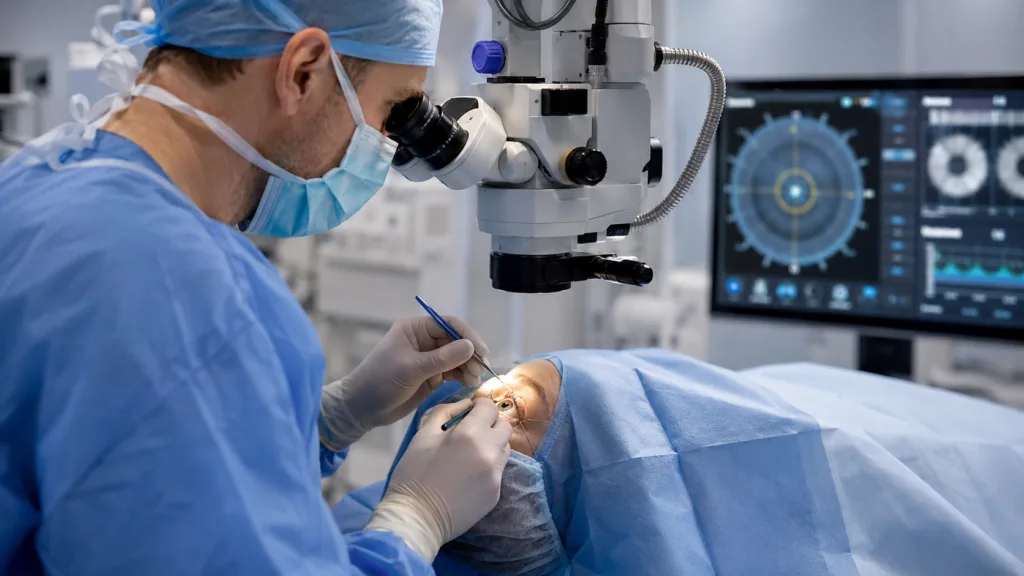
ZEISS Medical Technology has announced successful early clinical implantations of the ZEISS AT LUCIA toric 721P intraocular lens, a CE-marked cataract lens designed to correct astigmatism while replacing the eye’s natural lens during cataract surgery. Carl Zeiss Meditec AG is conducting an early-access clinical trial with experienced surgeons across six European countries, with selective European commercialization expected later in 2026.
Why does the AT LUCIA toric 721P lens matter for modern cataract surgery precision?
The significance of the ZEISS AT LUCIA toric 721P lens lies in how cataract surgery has evolved from a sight-restoring intervention into a refractive procedure where patients and surgeons increasingly expect more predictable visual outcomes. Cataract surgery still begins with the clinical need to remove a clouded natural lens, but the choice of intraocular lens now shapes whether patients may also reduce their dependence on glasses, especially when pre-existing corneal astigmatism is present.
A toric intraocular lens is designed to correct astigmatism at the same time as cataract treatment. That makes optical precision and rotational stability central to performance. If a toric lens rotates after implantation, the intended astigmatism correction can weaken, leaving patients with residual refractive error. ZEISS Medical Technology is positioning AT LUCIA toric 721P around a bitoric optic, non-constant aberration design, and fully preloaded hydrophobic c-Loop platform, all intended to support visual quality, handling, and long-term stability.
The limitation is that early implantations are not the same as broad clinical proof. Positive early surgeon impressions can support commercial momentum, but ophthalmologists will still look for structured clinical evidence, larger patient experience, long-term rotational stability data, refractive accuracy, posterior capsule behavior, and real-world consistency across diverse surgical settings. In premium cataract surgery, even small differences in lens performance can influence adoption, but those differences must hold up beyond early-access enthusiasm.
How could toric IOL stability become a stronger competitive battleground in ophthalmology?
Toric intraocular lenses compete in a category where stability is not a minor engineering detail. It is a clinical determinant of whether the astigmatism correction actually performs as planned. Surgeons need the lens to be easy to implant, position accurately, and remain stable after surgery. Patients judge the result less by the technical sophistication of the implant and more by whether their vision is clear, consistent, and aligned with preoperative expectations.
The ZEISS AT LUCIA toric 721P lens is designed to address this need through its optical and platform architecture. The bitoric design and hydrophobic c-Loop platform give ZEISS Medical Technology a precision-and-stability message in a segment where surgeons often compare lenses based on handling, alignment confidence, centration, axis stability, and predictability of refractive outcomes. If the lens performs consistently, it could strengthen the medical device manufacturer’s cataract surgery portfolio at a time when premium and advanced monofocal lenses are becoming more important for growth.
The risk is that toric IOL markets are already competitive and surgeon loyalty can be sticky. Many ophthalmologists rely on familiar lens platforms because predictable outcomes are built through repeated experience. A new lens must therefore do more than promise stability. It must show that its handling, preloaded delivery, optical quality, and postoperative performance fit smoothly into existing surgical routines. In cataract surgery, trust is earned one implantation at a time.
What is genuinely new and what remains incremental in ZEISS’s early-access rollout?
The genuinely new development is the early clinical implantation of the AT LUCIA toric 721P lens in Europe and the movement of a CE-marked product closer to selective commercial availability. The early-access trial spans the Czech Republic, Germany, Italy, Spain, Sweden, and the United Kingdom, giving ZEISS Medical Technology a multi-country pathway for surgeon experience before broader rollout. This is strategically useful because ophthalmology device adoption often depends on peer confidence, procedural familiarity, and practical evidence from respected cataract surgeons.
The incremental element is that toric intraocular lenses are already established. Cataract surgeons are not being introduced to a completely new therapeutic concept. Instead, ZEISS Medical Technology is trying to improve on familiar needs: astigmatism correction, rotational stability, optical performance, and preloaded surgical handling. That makes the product commercially relevant, but not disruptive in the way a first-in-category technology would be.
This distinction matters for market expectations. AT LUCIA toric 721P may not radically change cataract surgery, but it could improve ZEISS Medical Technology’s competitive position if it delivers reliable outcomes in a high-volume procedural market. Incremental device innovation can be powerful when it reduces variability, saves time, and builds surgeon confidence. The unanswered question is whether the lens’s design advantages will be large enough to shift purchasing behavior and surgeon preference in countries where competing platforms already have deep adoption.
Why does a preloaded hydrophobic c-Loop platform matter for surgical workflow?
The preloaded nature of the AT LUCIA toric 721P lens is commercially important because cataract surgery is a high-volume procedure where efficiency, consistency, and sterility are core operating room concerns. A fully preloaded system can reduce handling steps, limit lens manipulation, and support a more standardized implantation process. In busy ophthalmic surgical centers, even modest workflow improvements can matter when multiplied across large procedure volumes.
The hydrophobic c-Loop platform also fits surgeon expectations around long-term lens behavior. Hydrophobic acrylic materials are widely used in cataract surgery, and platform familiarity can help reduce adoption friction. For toric lenses, the platform must support stable positioning because the corrective axis is critical. ZEISS Medical Technology’s commercial challenge will be to show that the lens is not only optically sophisticated, but also practical and predictable during implantation.
The limitation is that surgical workflow advantages are often hard to separate from surgeon technique. An experienced surgeon may achieve excellent outcomes with several lens platforms, while less experienced users may depend more heavily on delivery system design. ZEISS Medical Technology will need to demonstrate that the preloaded system performs consistently across different surgeons, incision preferences, operating room setups, and patient anatomies. Ease of use can influence adoption, but only if it is matched by refractive reliability.
How could the new lens strengthen Carl Zeiss Meditec AG’s ophthalmology strategy?
Carl Zeiss Meditec AG is already one of the major medical technology groups in ophthalmology, spanning diagnostic systems, surgical visualization, implants, and digital workflow solutions. The AT LUCIA toric 721P lens fits into that broader strategy because cataract surgery increasingly depends on an integrated chain of preoperative measurement, surgical planning, lens selection, implantation, and postoperative assessment. A differentiated toric IOL can strengthen that chain if it works well within the company’s broader ophthalmic ecosystem.
This matters because ophthalmology is becoming more connected and data-driven. Surgeons want accurate biometry, reliable IOL calculations, guided surgical execution, and predictable refractive results. A toric lens that supports precision outcomes can reinforce ZEISS Medical Technology’s broader position in cataract and refractive surgery. It may also help the medical device manufacturer compete more effectively against companies with strong premium IOL portfolios and deep surgeon relationships.
The risk is that an IOL product alone may not be enough to reverse broader investor concerns around Carl Zeiss Meditec AG. The group has faced pressure in the market, with its market capitalization around €2.25 billion and its stock materially lower over the past year. A new lens can support product momentum, but investors will likely want evidence of revenue acceleration, margin recovery, China stabilization, and improved demand across ophthalmology equipment and consumables before sentiment improves meaningfully.
Why could European commercialization be a useful first test for AT LUCIA toric 721P?
Europe is a logical early market test because the lens is CE marked and the early-access trial is already taking place across multiple European countries. Selective commercialization later in 2026 would allow ZEISS Medical Technology to build surgeon familiarity, collect user experience, and refine launch strategy before pursuing broader rollout. This staged approach can be useful in ophthalmology because procedure-based device adoption often benefits from early reference users rather than immediate mass-market push.
The European setting also offers a diverse cataract surgery landscape. Reimbursement models, private-pay premium lens adoption, public healthcare purchasing, and surgeon preferences vary widely across countries. That diversity can help ZEISS Medical Technology understand where AT LUCIA toric 721P resonates most strongly, whether in premium refractive cataract settings, high-volume clinics, or surgeon groups seeking better astigmatism correction predictability.
The limitation is that European success does not automatically translate into global commercial strength. Market access, pricing, regulatory requirements, and competitive dynamics differ across regions. The United States, for example, would require its own regulatory pathway and market strategy. Emerging markets may be more price-sensitive. ZEISS Medical Technology will need to balance premium positioning with affordability and reimbursement realities if the product is to scale beyond selected European centers.
What clinical evidence gaps should ophthalmologists watch after early implantation?
Ophthalmologists will likely watch rotational stability first. A toric lens must stay aligned to maintain astigmatism correction, so postoperative rotation data over time will be crucial. The second area is refractive predictability, including how closely patients achieve intended residual cylinder and spherical equivalent targets. The third area is visual quality, including contrast sensitivity, dysphotopsia profile, patient satisfaction, and performance under varied pupil sizes and lighting conditions.
The early-access trial may help generate practical experience, but broader evidence will matter. Surgeons will want to see how the lens performs in routine cases and more complex eyes, including patients with higher astigmatism, ocular surface disease, prior refractive surgery, capsular bag variability, or coexisting ocular conditions. In cataract surgery, the ideal lens performs reliably across ordinary and challenging cases, not only in carefully selected early-use patients.
The unresolved question is whether ZEISS Medical Technology will support the launch with comparative clinical data. Toric IOL competition is strong, and surgeons often compare outcomes against their current preferred platforms. Without comparative evidence, the lens may still gain adoption through user experience, but a stronger data package would help support premium positioning and payer or clinic purchasing decisions.
How does the stock market backdrop shape the importance of this product launch?
Carl Zeiss Meditec AG’s stock market position makes the AT LUCIA toric 721P rollout more important than a routine product update might suggest. The company’s market capitalization is around €2.25 billion, and its market value has declined sharply over the past year. That backdrop means investors are likely to view new ophthalmology products through a recovery lens: can innovation help stabilize growth and rebuild confidence?
The answer is likely to be gradual rather than immediate. A new toric IOL can support the consumables and implants side of the business, which may be attractive because recurring procedural products can complement capital equipment cycles. If the lens gains surgeon traction, it could help Carl Zeiss Meditec AG strengthen its cataract surgery offering and deepen customer relationships across ophthalmic surgical workflows.
However, the stock sentiment risk remains broader than one lens launch. Investors will look at whether the company can improve operating performance, protect margins, and compete effectively in ophthalmic diagnostics, microsurgery, and surgical consumables. AT LUCIA toric 721P may become a useful product-level catalyst, but it will not by itself settle questions about group-level growth. For shareholders, the product is encouraging. For ophthalmologists, the more important question is whether it delivers consistently better refractive outcomes.
What should surgeons, regulators, and medtech observers watch next?
Surgeons should watch the first wave of structured clinical data from the early-access trial, especially outcomes related to rotational stability, axis alignment, residual astigmatism, visual acuity, patient satisfaction, and ease of implantation. The most meaningful adoption signal will come when early users move beyond first impressions and begin reporting reproducible outcomes across larger patient groups.
Regulators and market-access observers will watch how ZEISS Medical Technology expands the lens beyond select European countries. Although the lens is CE marked, availability can vary by market, and local product labeling, commercialization timing, and reimbursement context will shape uptake. The company’s ability to convert early clinical use into broader access will determine whether the product remains a selective premium lens or becomes a stronger franchise component.
For the medtech sector, the broader signal is that cataract surgery innovation is increasingly about precision refinements that reduce outcome variability. The AT LUCIA toric 721P lens is not trying to redefine cataract surgery from scratch. It is trying to solve one of its most commercially important problems: making astigmatism correction more predictable while fitting smoothly into high-volume surgical workflow. If ZEISS Medical Technology can prove that promise beyond early implantation, the lens could strengthen its position in one of ophthalmology’s most valuable procedure categories.