Penumbra, Inc. has received U.S. Food and Drug Administration clearance for THUNDERBOLT, a computer assisted vacuum thrombectomy platform for acute ischemic stroke. The clearance expands Penumbra’s CAVT technology into neurovascular care, positioning the medtech company to compete more deeply in large vessel occlusion stroke intervention as hospitals continue to prioritise faster and more complete clot removal.
Why does Penumbra’s THUNDERBOLT clearance matter for acute ischemic stroke care?
The importance of THUNDERBOLT lies in the treatment environment it enters. Acute ischemic stroke caused by large vessel occlusion is one of the most time-sensitive emergencies in medicine. Mechanical thrombectomy has already changed the standard of care for eligible patients by allowing specialists to remove obstructing clots and restore blood flow to the brain. Penumbra’s new clearance does not create the thrombectomy market from scratch. It enters a high-stakes field where incremental gains in speed, clot capture, first-pass success, and procedural confidence can carry major clinical and commercial significance.
THUNDERBOLT is designed to bring computer assisted vacuum thrombectomy into stroke treatment through modulated aspiration. In practical terms, this means Penumbra is trying to move aspiration thrombectomy beyond continuous suction toward a more responsive system that can help detect, fatigue, and ingest clot at the occlusion site. That is strategically relevant because neurointerventionalists are constantly balancing speed, vessel safety, clot fragmentation risk, distal embolisation, and the need to restore durable reperfusion as quickly as possible.
The limitation is that FDA clearance is not the same as proof of broad superiority in daily stroke practice. Hospitals and stroke teams will want to see how THUNDERBOLT performs across clot types, vessel anatomies, patient ages, tandem lesions, transfer patients, and real-world workflow constraints. The device may be technically compelling, but adoption will depend on whether it improves procedural efficiency and patient outcomes without adding complexity, cost, or training burden.
What does computer assisted vacuum thrombectomy change compared with standard aspiration?
Computer assisted vacuum thrombectomy changes the discussion by adding an active technology layer to aspiration-based clot removal. Traditional aspiration thrombectomy relies on catheter positioning and suction to engage and remove thrombus. THUNDERBOLT adds modulated aspiration, which is intended to interact dynamically with the clot rather than simply applying a fixed suction profile. That could matter if it helps operators achieve more complete clot ingestion with less manipulation or fewer procedural passes.
The clinical context is important because first-pass effect has become a major focus in stroke thrombectomy. A device that clears the vessel quickly on the first attempt may reduce procedure time, lower the risk of clot fragmentation, limit endothelial trauma, and accelerate reperfusion. Even when final reperfusion is successful, longer procedures and repeated device passes can increase procedural complexity. If THUNDERBOLT can improve clot capture consistency, it could fit naturally into the direction of modern stroke intervention.
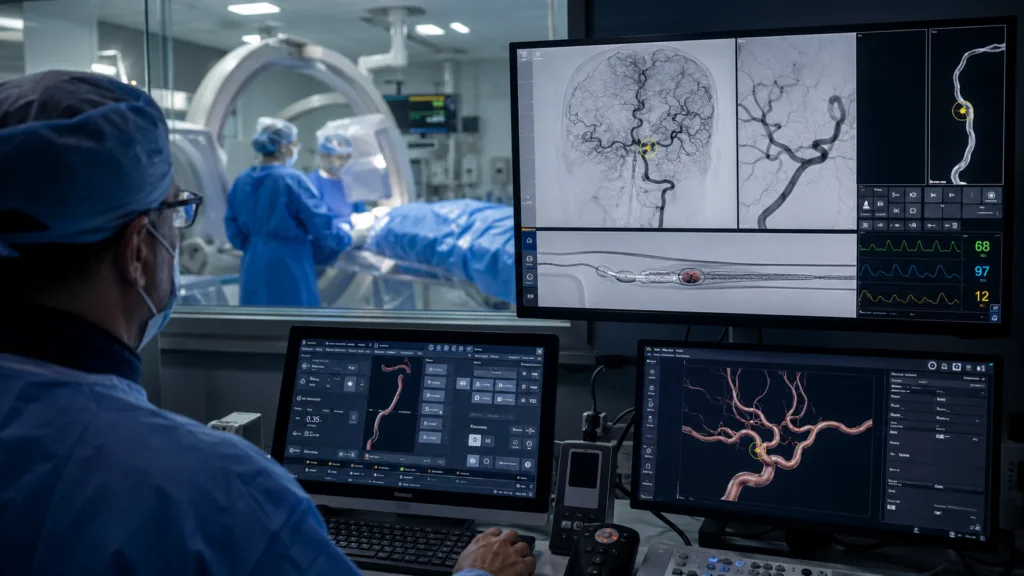
The unresolved question is whether computer assistance produces a meaningful advantage across the messy realities of stroke care. Clots differ by composition, age, fibrin content, red blood cell content, calcification, and response to aspiration. Patients also differ by anatomy, collateral circulation, pre-stroke function, time from onset, and use of thrombolytic therapy. Penumbra’s next challenge is to show that the technology performs consistently outside selected cases and selected operators.
How could THUNDERBOLT affect hospital stroke workflows and procedural economics?
The commercial value of THUNDERBOLT will be tied closely to workflow. Stroke systems are built around speed, with emergency medical services, emergency departments, imaging teams, neurologists, anesthesiology, and neurointerventional suites all working under intense time pressure. A device that helps shorten thrombectomy procedures or improve procedural predictability could be valuable to hospitals because stroke intervention is both clinically urgent and operationally resource-intensive.
From a hospital perspective, the question is not only whether THUNDERBOLT removes clots. It is whether the platform can support faster room turnover, reduce device escalation, lower the need for adjunctive tools, improve operator confidence, and fit into existing catheter-based workflows. Penumbra plans to package THUNDERBOLT with its RED aspiration catheters, which may help adoption because neurointerventionalists are already familiar with Penumbra’s aspiration portfolio.
The risk is that hospitals are increasingly disciplined about medtech spending. New thrombectomy systems must justify their cost against existing aspiration catheters, stent retrievers, combined techniques, and competing stroke devices. If THUNDERBOLT is perceived as an expensive upgrade without clear procedural or outcome gains, adoption may be gradual. If it demonstrates faster, more complete, and more reliable clot removal in everyday practice, the commercial case becomes much stronger.
Why does this clearance matter to Boston Scientific Corporation’s pending Penumbra acquisition?
The THUNDERBOLT clearance strengthens the strategic logic behind Boston Scientific Corporation’s pending acquisition of Penumbra, Inc. Boston Scientific has agreed to acquire Penumbra in a major medtech transaction designed to expand its cardiovascular and vascular intervention portfolio. A newly cleared stroke thrombectomy platform gives the buyer a more current innovation story in neurovascular care and reinforces the value of Penumbra’s clot-removal franchise.
For Boston Scientific, the attraction is broader than one device. Penumbra brings a portfolio across stroke, pulmonary embolism, acute limb ischemia, and other vascular conditions where mechanical thrombectomy is becoming increasingly important. THUNDERBOLT adds a differentiated technology layer to that platform by extending CAVT into acute ischemic stroke. If Boston Scientific completes the acquisition, it may gain not only established thrombectomy revenue but also a fresh product cycle in one of the highest-acuity areas of vascular medicine.
The limitation is that acquisition value still depends on execution. Integrating a fast-moving neurovascular device business into a larger medtech organisation requires protecting sales momentum, physician relationships, manufacturing continuity, and innovation speed. THUNDERBOLT may increase the strategic appeal of Penumbra, but it also increases the need for disciplined rollout. A promising technology can lose momentum if integration slows training, commercial focus, or clinical evidence generation.
What clinical evidence questions will shape confidence in THUNDERBOLT?
The most important clinical questions will focus on procedural and patient-level outcomes. Stroke device adoption is heavily influenced by metrics such as successful reperfusion, first-pass effect, procedure time, symptomatic intracranial haemorrhage, distal embolisation, rescue therapy use, mortality, and functional independence at 90 days. FDA clearance allows the product to enter the market, but clinicians will want detailed data that show where THUNDERBOLT performs best and how it compares with established thrombectomy approaches.
The THUNDER study context gives the platform a stronger foundation than a purely engineering-led launch, but post-clearance data will be decisive. Neurointerventionalists will want to understand performance by occlusion location, including internal carotid artery, middle cerebral artery, and other relevant large vessel territories. They will also want clarity on how the system behaves in tortuous anatomy, hard clots, tandem occlusions, and patients requiring rapid rescue strategies.
The risk is that early experience can look stronger in expert hands than in broader practice. Stroke intervention is operator-dependent, and device performance can vary across centres. Penumbra will need training, data transparency, and real-world registries to build confidence. A device that appears powerful in selected cases must prove that it can be used safely and effectively across the wider stroke intervention ecosystem.
How does THUNDERBOLT fit into the competitive thrombectomy device landscape?
The thrombectomy market is competitive because acute ischemic stroke intervention has become a major medtech category. Device companies compete across aspiration systems, stent retrievers, balloon guide catheters, access systems, imaging support, and combined techniques. THUNDERBOLT gives Penumbra a differentiated message by emphasizing computer assisted vacuum thrombectomy rather than only catheter design or aspiration force.
This matters because the market has moved beyond whether mechanical thrombectomy works. The current competition is about improving speed, consistency, ease of use, safety, and performance in difficult clot scenarios. Penumbra’s ability to connect THUNDERBOLT to its RED catheter family could help it defend and expand share in aspiration-led stroke intervention. The platform also supports Penumbra’s broader “head-to-toe” clot-removal positioning across vascular territories.
The limitation is that competitors will not stand still. Other medtech companies are also investing in next-generation thrombectomy, imaging integration, robotics, and procedural workflow tools. To maintain an advantage, Penumbra will need to show that THUNDERBOLT is more than a clever aspiration system. It must become a preferred procedural option backed by evidence, physician experience, and hospital economics.
Why does stroke burden make medtech innovation commercially attractive but clinically unforgiving?
Stroke burden makes innovation attractive because the need is enormous and urgent. Acute ischemic stroke remains a leading cause of death and disability, and large vessel occlusion strokes can leave patients with severe neurological impairment if blood flow is not restored quickly. Health systems have therefore invested heavily in stroke networks, comprehensive stroke centres, transfer protocols, imaging triage, and mechanical thrombectomy capability.
That creates a large opportunity for medtech companies that can improve treatment speed and consistency. A better thrombectomy platform can affect not only device sales but also hospital reputation, stroke centre performance, and patient outcomes. In a field where time directly affects brain tissue survival, even procedural improvements can carry weight.
The same urgency also makes the market unforgiving. Devices must work reliably under pressure, often in patients who arrive late, unstable, or with complex anatomy. A device failure, procedural delay, or safety concern can quickly affect clinician trust. Penumbra’s challenge is to convert the promise of computer assisted aspiration into dependable performance when every minute matters.
How is investor sentiment likely to read Penumbra’s FDA clearance?
Penumbra’s latest share price movement looked muted, with the stock nearly flat around the latest available trading level. That restrained reaction likely reflects the fact that investors are already evaluating Penumbra through the lens of the pending Boston Scientific acquisition. In that context, a product clearance may reinforce strategic value but may not produce a dramatic standalone stock reaction unless it changes deal assumptions or revenue expectations.
Still, the clearance is positive from a portfolio perspective. It strengthens Penumbra’s innovation pipeline, extends CAVT technology into stroke, and gives Boston Scientific a more current growth asset if the transaction closes. It also helps Penumbra maintain commercial momentum during the acquisition period, when companies can sometimes face customer uncertainty or internal distraction.
The risk is that investors may wait for launch execution rather than reward clearance alone. Revenue contribution, adoption speed, pricing, training uptake, and clinical feedback will matter more than the headline. For now, sentiment appears measured rather than euphoric. That is sensible because THUNDERBOLT’s long-term value will be determined in catheter labs and stroke centres, not only in regulatory announcements.
What risks could slow THUNDERBOLT adoption despite FDA clearance?
The first risk is training and workflow integration. Neurointerventionalists are skilled but highly particular about device feel, catheter trackability, aspiration behaviour, and procedural control. A new computer assisted platform must feel intuitive under pressure. If the system requires meaningful workflow change, adoption may concentrate first in high-volume stroke centres before spreading more broadly.
The second risk is evidence differentiation. Hospitals may ask whether THUNDERBOLT improves outcomes enough to justify switching or adding inventory. Stroke centres already use multiple device strategies, and procurement committees may require comparative data, real-world experience, or economic modelling. A device can be clinically respected but commercially constrained if value is not clearly documented.
The third risk is acquisition timing. Penumbra’s pending sale to Boston Scientific creates strategic opportunity but also integration uncertainty. Customers may ask how product support, contracts, training, and commercial teams will evolve after closing. Boston Scientific and Penumbra will need to manage that transition carefully so that THUNDERBOLT’s launch does not lose momentum during corporate integration.
What should clinicians, hospitals, and medtech observers watch next?
Clinicians should watch for detailed THUNDER trial results, real-world registry data, first-pass effect performance, safety outcomes, and user experience across different stroke centre types. The most useful evidence will show how the system performs in difficult clot and anatomy scenarios, not only in ideal cases. Stroke specialists will also want clarity on how THUNDERBOLT fits with stent retrievers, balloon guides, aspiration-only strategies, and combined approaches.
Hospitals should watch workflow data and economic impact. If THUNDERBOLT can reduce procedure time, lower rescue-device use, or improve procedural predictability, the platform could become attractive even in cost-conscious environments. If benefits are mainly technical and difficult to measure, adoption may be slower.
Medtech observers should watch the Boston Scientific transaction timeline, launch plans, sales integration, and whether THUNDERBOLT becomes a flagship product in a broader thrombectomy strategy. Penumbra has achieved an important regulatory milestone. The next stage is the harder one: proving that computer assisted vacuum thrombectomy can change stroke intervention at scale.
What is the main takeaway from Penumbra’s THUNDERBOLT clearance?
The main takeaway is that Penumbra’s THUNDERBOLT clearance brings a new technology layer into acute ischemic stroke thrombectomy at a time when hospitals are seeking faster, safer, and more predictable clot removal. The product gives Penumbra a differentiated neurovascular message and strengthens the strategic backdrop to Boston Scientific’s pending acquisition.
The opportunity is significant because stroke intervention is clinically urgent, commercially attractive, and still evolving. The risk is that FDA clearance only opens the door. Penumbra must now show that THUNDERBOLT improves procedural performance, supports clinician confidence, and fits hospital economics in real-world stroke systems.
This is a medtech story about more than one clearance. It is about whether computer assistance can make thrombectomy more consistent in a field where speed and precision can define recovery. If THUNDERBOLT delivers in practice, it could become a meaningful addition to stroke care and a stronger asset inside Boston Scientific’s future vascular device portfolio.