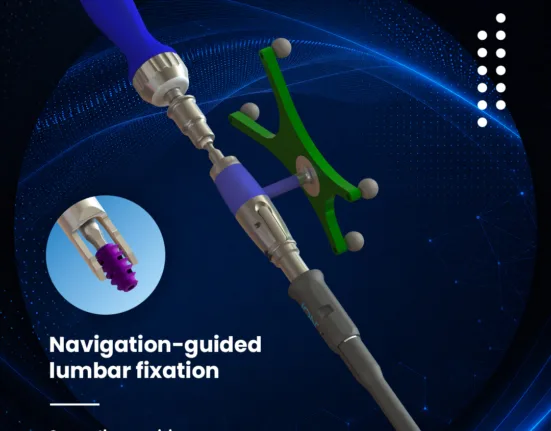
SurGenTec has received FDA clearance for the ION-L Lumbar Facet Fixation System, a posterior lumbar facet fixation device for skeletally mature patients with degenerative disc disease from L3 to S1 who have failed conservative care. The clearance moves the medical device manufacturer into commercial launch mode for a minimally invasive spine surgery system positioned around bilateral facet joint fixation, fusion support, and workflow compatibility across hospitals and ambulatory surgery centers.
The strategic importance of ION-L is not simply that SurGenTec has added another device to the crowded spine surgery market. The more consequential issue is whether a smaller, facet-based fixation system can win confidence in a field where surgeons, payers, and hospital value committees increasingly ask whether new implants reduce surgical burden without diluting durability. Lumbar fusion remains one of the most scrutinized areas in orthopedics and neurosurgery because the clinical rationale can vary by patient selection, imaging findings, instability, pain generator, and failure of conservative treatment. That makes any new lumbar fixation platform commercially interesting, but also exposed to a familiar hurdle: technical elegance alone rarely drives adoption unless outcomes, workflow savings, and reimbursement logic align.
Why ION-L matters in lumbar fusion despite a crowded spine implant landscape
ION-L enters a market already shaped by pedicle screw constructs, interbody fusion systems, decompression procedures, navigation-enabled instrumentation, biologics, and a growing push toward less invasive access. What appears genuinely new in SurGenTec’s latest lumbar push is the emphasis on a zero-profile facet fixation approach that spans the facet joint interspace, uses controlled non-impact insertion, and aims to reduce the need for extensive posterior exposure. That is a meaningful design proposition because posterior lumbar surgery often forces surgeons to balance stabilization goals against tissue disruption, operative time, blood loss, radiation exposure, infection risk, and the practical constraints of outpatient surgery.
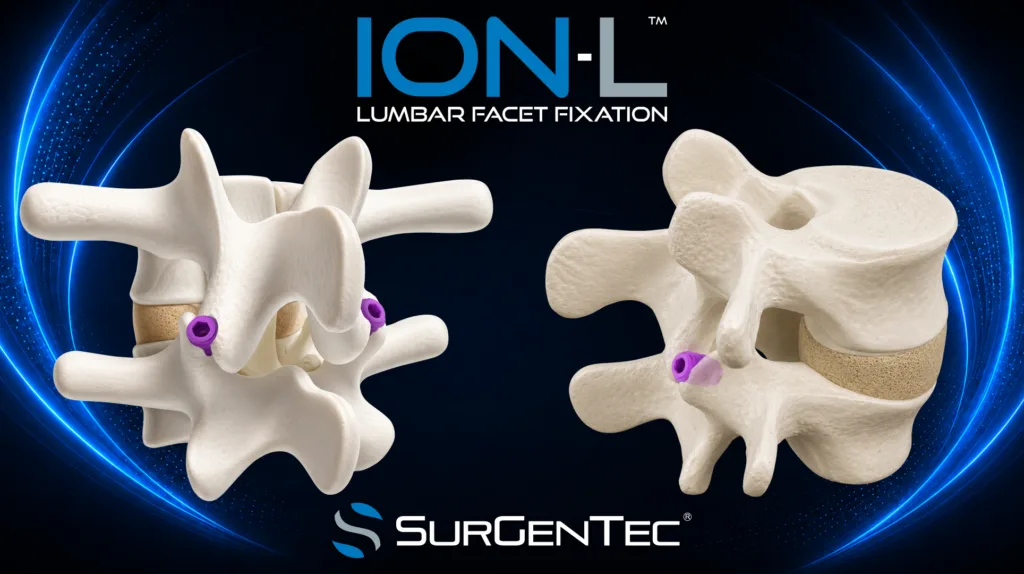
However, the distinction between novel positioning and clinical transformation matters. Facet fixation itself is not a brand-new concept, and FDA clearance through the 510(k) route does not mean a device has proven superiority over established lumbar fusion approaches. It means the device has satisfied the regulatory standard for substantial equivalence to legally marketed predicate technology. For clinicians, that makes ION-L more of an execution story than a regulatory breakthrough story. The commercial question is whether SurGenTec can convert a differentiated form factor into repeatable surgical utility, especially in patients where less invasive posterior stabilization is attractive but long-term fusion durability remains the decisive outcome.
The device’s indicated use in degenerative disc disease from L3 to S1 after failed conservative care also places it in a complex clinical category. Degenerative disc disease is common, heterogeneous, and often difficult to link cleanly to symptoms without careful patient selection. That creates opportunity for a less invasive fixation system in appropriately selected patients, but it also raises the bar for evidence. Surgeons tracking the category are likely to look beyond the clearance language and ask whether ION-L can consistently support radiographic fusion, maintain stability, avoid implant migration or expulsion, and fit into revision strategies if a patient does not respond as expected.
What SurGenTec’s facet fixation strategy reveals about the shift toward smaller spine surgery systems
SurGenTec’s broader direction appears to be platform-led rather than single-product-led. ION-L extends the medical device manufacturer’s facet fixation strategy into the lumbar spine, following related activity in cervical facet fixation and navigation-compatible instrumentation. That matters because spine surgeons tend to adopt systems, not isolated implants, when they can standardize workflow, training, instrumentation, implant handling, and procedural planning across anatomical regions. A broader facet fixation platform gives SurGenTec a more coherent commercial story than a one-off lumbar implant would have offered.
The design features also speak to a larger movement in spine surgery: reducing the physical footprint of fixation without abandoning the mechanical goals of fusion. A zero-profile implant may be attractive if it reduces soft tissue irritation, implant prominence, or hardware-related complexity. Fenestrations and open barrels intended to support bone graft integration could appeal to surgeons focused on fusion biology, while controlled insertion could reduce the intraoperative force associated with more traditional techniques. These attributes are clinically plausible advantages, but they still require outcome proof in real-world use, particularly across varied bone quality, body habitus, deformity, degeneration severity, and surgeon experience.
The unresolved issue is whether a smaller device can carry the same confidence as larger constructs in the minds of surgeons who have spent years relying on pedicle screw-based stabilization. In spine, less invasive does not automatically mean less risky, cheaper, or easier. Limited exposure can make visualization more challenging, while small implants must still withstand mechanical demands in a mobile, load-bearing segment. ION-L’s adoption curve will therefore depend on whether the system can show that its lower-profile approach preserves the essential goals of fusion while reducing procedural friction.
Why the evidence package will matter more than the clearance headline
SurGenTec has positioned the ION-L clearance as supported by long-term clinical evidence from an Institutional Review Board-approved multicenter study, with independent radiographic assessment and no reported adverse events in the evaluated cohort. That is a useful credibility layer because spine surgeons are rarely persuaded by engineering claims alone. Independent imaging review is particularly relevant in fusion procedures because radiographic interpretation can influence whether a device is seen as biologically and mechanically successful.
Even so, the evidence base will need careful interpretation. Multicenter real-world data can provide insight into clinical performance outside a tightly controlled development environment, but it is not the same as a large randomized comparison against standard fusion approaches. The most important questions will involve patient selection, sample size, duration of follow-up, fusion criteria, revision rates, pain and disability outcomes, and whether outcomes are consistent across sites rather than concentrated among highly experienced users. No adverse events in a study cohort is encouraging, but industry observers usually treat such claims as an early signal rather than a definitive safety conclusion until broader post-market use accumulates.
This is where SurGenTec’s commercial challenge becomes more nuanced. The device manufacturer does not only need to show that ION-L can be placed successfully. SurGenTec needs to demonstrate that the system produces outcomes meaningful to surgeons, patients, payers, and facilities. Fusion rates matter, but so do functional improvement, complication avoidance, procedural time, length of stay, reoperation rates, and the ability to integrate into existing surgical pathways. If the device performs well only in carefully selected cases, it may still become commercially useful. If SurGenTec can support broader reproducibility, ION-L could become a more important part of the minimally invasive lumbar fusion conversation.
How ION-L could fit into hospital and ambulatory surgery center economics
The inclusion of sterile, single-use disposable instruments and sterile, ready-to-use implants gives ION-L a workflow angle that may matter as spine procedures continue shifting toward ambulatory surgery centers. Single-use systems can reduce instrument reprocessing demands, simplify logistics, and potentially lower contamination risk. For outpatient settings, that can be appealing because operational predictability is often as important as implant design. A streamlined kit can help standardize setup, reduce tray complexity, and support faster turnover when procedure volumes grow.
The economics are not automatically favorable, however. Disposable instrumentation can shift costs from sterilization and logistics into per-case consumable expense. Hospital procurement teams and ambulatory surgery center operators will likely compare ION-L not just against open constructs, but against the total episode cost of competing minimally invasive options. That comparison will include implant price, facility time, anesthesia duration, postoperative resource use, payer coverage, denial risk, and the cost of revisions if fusion fails. A system that looks efficient in the operating room still has to survive the scrutiny of value analysis committees.
Reimbursement will also shape adoption. Degenerative lumbar spine procedures often face payer review because of variability in indications and outcomes. If ION-L is used within established fusion coding pathways, SurGenTec may face fewer reimbursement barriers than a procedure that requires entirely new payment logic. Still, payer confidence will depend on evidence that the approach is medically necessary, appropriately selected, and not merely a premium-priced substitute for existing fixation. For device manufacturers in spine, clinical differentiation and reimbursement defensibility now have to mature together.
What clinicians will watch before changing lumbar fixation behaviour
Surgeons evaluating ION-L are likely to focus first on technical control. The system’s promise of controlled, non-impact insertion could be attractive in patients where minimizing posterior disruption is a priority, but the technique must be intuitive, teachable, and forgiving across anatomical variation. If placement requires a steep learning curve or heavy reliance on a narrow group of early adopters, commercial uptake may be slower. In spine surgery, elegant instrumentation only becomes commercially meaningful when it can be replicated safely by a wider base of surgeons.
The second watch point is fusion reliability. Because ION-L is intended to support posterior lumbar facet fixation with bone graft material, clinicians will want clarity on how consistently the device supports osseointegration and bridging bone formation. The Nanotex surface technology, fenestrations, and open architecture may create a biologically attractive design story, but the market will judge the device by radiographic and clinical outcomes. Fusion biology can be influenced by smoking, diabetes, obesity, steroid use, bone quality, graft selection, surgical preparation, and the mechanical environment. That makes post-market evidence particularly important.
The third issue is failure management. Every spine implant must be assessed not only by how it works in ideal cases, but by what happens when the case is not ideal. Surgeons will need to understand whether ION-L complicates revision surgery, whether implant positioning limits future posterior or interbody options, and how the device behaves in patients with adjacent segment disease or progressive degeneration. If SurGenTec can provide clear guidance on revision pathways and compatible surgical strategies, clinician confidence may rise faster.
Why FDA clearance is commercially valuable but not enough to settle clinical debate
FDA clearance gives SurGenTec the regulatory basis to commercialize ION-L in the United States, but it should not be confused with broad clinical consensus. The 510(k) pathway is built around substantial equivalence, not a claim that the new device is clinically superior to existing alternatives. That distinction matters in spine because many devices enter the market with plausible engineering logic, while the harder question of comparative value emerges only after wider use.
For SurGenTec, the advantage is that clearance allows the medical device manufacturer to compete now rather than wait for years of randomized evidence. That timing matters in a spine market where surgeons are already searching for approaches that reduce tissue disruption, support outpatient migration, and simplify instrumentation. The risk is that early commercial enthusiasm can run ahead of evidence maturity. If outcomes are inconsistent, if payers challenge medical necessity, or if surgeons view the device as suitable only for a narrow subset of patients, ION-L could remain a niche tool rather than a platform driver.
The most balanced reading is that ION-L gives SurGenTec a credible and timely commercial opening, not a guaranteed category shift. Its real test will come from the next layer of evidence and adoption: how many surgeons use it repeatedly, how patients perform beyond early follow-up, whether ambulatory surgery centers see operational value, and whether payers accept its role in lumbar degenerative disease care. In a field where hype ages quickly, durable data will decide whether the device becomes an important minimally invasive spine surgery option or another incremental entrant in a competitive implant market.
PDN expert view on what happens next for SurGenTec and ION-L
SurGenTec’s strongest opportunity lies in the convergence of three trends: minimally invasive spine surgery, outpatient procedural migration, and surgeon interest in fixation systems that reduce surgical footprint. ION-L sits directly in that zone. The device manufacturer has a plausible platform strategy, a commercially relevant indication, and a design that speaks to real workflow pain points in lumbar fusion.
The caution is that spine surgery is unforgiving for technologies that are easier to describe than to prove. ION-L will need evidence that connects design features to clinical outcomes, not just operative convenience. The most persuasive future data would show durable fusion, low revision rates, meaningful patient-reported improvement, reproducibility across multiple surgeons, and economic advantages that hold up outside early specialist centers. If SurGenTec can build that evidence base, ION-L could strengthen its position in minimally invasive lumbar fixation. If not, the device may be seen as a clever implant fighting the same adoption barriers that have slowed many spine technologies before it.