Galmed Pharmaceuticals Ltd. has completed its acquisition of Colospan Ltd. after restructuring the transaction to remove an immediate $2 million share payment and increase the cash consideration by $800,000. The acquisition gives the Nasdaq-listed micro-cap company ownership of CG-100, a temporary intraluminal bypass device intended to protect colorectal anastomoses and reduce the need for diverting stomas after rectal cancer surgery.
Why Galmed restructured the deal to limit immediate dilution without eliminating capital risk
The revised acquisition terms address the most obvious concern facing existing Galmed Pharmaceuticals shareholders. Under the original agreement, Colospan shareholders and financing holders were due to receive $2.5 million in cash and $2 million of Galmed Pharmaceuticals shares at closing.
The companies replaced the immediate equity consideration with an additional $800,000 cash payment and a sales-based earnout capped at $2 million beginning in the third quarter of 2027. The earnout is structured at 7% of net sales above $5 million and 9% once net sales exceed $12 million.
Removing the closing share issuance avoids increasing Galmed Pharmaceuticals’ share count at a time when GLMD trades below $1 and carries a market capitalisation of less than $4 million. Issuing $2 million of stock at that valuation could have transferred a substantial portion of the company to Colospan’s former owners.
The revised terms do not make the transaction inexpensive. Galmed Pharmaceuticals had approximately $15.6 million in cash at the end of March 2026 and has previously indicated that European commercialisation could require around $6 million of additional investment. The increased cash payment, launch spending and ongoing United States pivotal study could consume a meaningful portion of the available balance.
The earnout also contains an acceleration mechanism. Payment may be triggered earlier if Galmed Pharmaceuticals completes a strategic transaction involving Colospan or raises at least $17.5 million through equity financings. That provision protects the sellers, but it means a large future capital raise could bring additional acquisition obligations alongside shareholder dilution.
The revised structure is therefore anti-dilutive at closing rather than permanently dilution-free. Galmed Pharmaceuticals still needs enough capital to launch CG-100, fund clinical work, establish manufacturing and maintain the rest of its gastrointestinal pipeline.
How CG-100 attempts to protect colorectal surgery without creating a temporary abdominal stoma
Colorectal cancer surgery often requires surgeons to remove a diseased section of bowel and reconnect the healthy ends. The new connection is known as an anastomosis.
The most feared complication is an anastomotic leak, which occurs when intestinal contents escape through the healing connection. Leakage can cause infection, abscess formation, sepsis, reoperation, prolonged hospitalisation and death.
Surgeons may create a diverting stoma when they believe the newly formed anastomosis carries a substantial risk of leakage. Part of the intestine is brought through an opening in the abdomen, allowing waste to collect in an external ostomy bag while the internal connection heals.
The approach protects the anastomosis from direct exposure to digestive waste, but it introduces another surgical pathway. Patients must manage an ostomy bag for several months and may later undergo an additional operation to reverse the stoma and restore ordinary bowel continuity.
CG-100 is designed to provide an internal alternative. The single-use device consists of a flexible silicone sleeve placed inside the bowel so that it extends above and below the newly created anastomosis.
The sleeve redirects intestinal contents through the protected channel, reducing contact between waste and the healing connection. Balloons and an external ring are used to maintain positioning and prevent the device from moving through the bowel.
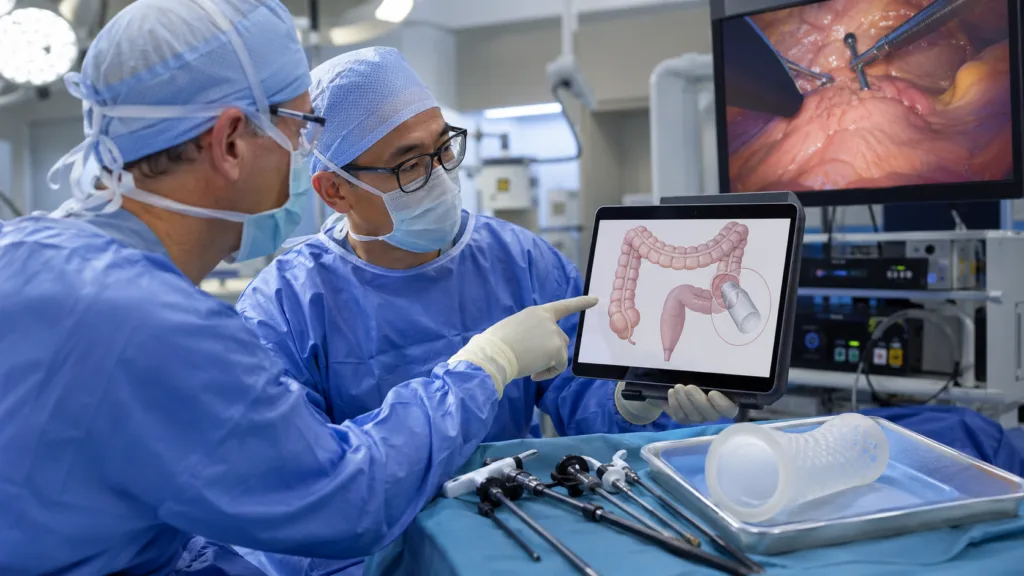
After approximately ten days, when the period of greatest leakage risk has passed and the integrity of the anastomosis has been assessed, the device can be removed without another abdominal operation.
The clinical proposition is straightforward. CG-100 aims to deliver temporary protection during healing without requiring an abdominal opening, an external bag and a later stoma-reversal procedure.
Why avoiding a diverting stoma could matter beyond patient convenience and cosmetic preference
Living with a temporary stoma can affect nutrition, sleep, clothing, mobility, work, travel, intimacy and psychological wellbeing. Some patients experience leakage from the ostomy appliance, skin irritation, dehydration, infection or difficulty learning how to manage the bag.
The burden does not necessarily end after the planned reversal. Some temporary stomas become permanent because the patient’s health deteriorates, cancer progresses or surgeons conclude that reversal carries excessive risk.
Reversal surgery creates its own possibility of infection, bowel obstruction, hernia, leakage and another recovery period. It also consumes operating-room capacity and increases the overall cost of colorectal cancer care.
A temporary intraluminal bypass could therefore generate value across several dimensions. Patients could avoid an external appliance and second operation, while hospitals could reduce readmissions, stoma-related complications and reversal procedures.
That value remains conditional on CG-100 providing protection comparable with a diverting stoma. Surgeons will not abandon a familiar approach merely because an internal device is more convenient.
The device must show that avoiding stoma creation does not increase clinically significant leakage, sepsis, reoperation or mortality. A reduction in patient burden is valuable only when the colorectal anastomosis remains adequately protected.
The eventual commercial case will also depend on which patients qualify. CG-100 may be appropriate for selected low or mid-rectal resections, but it may not replace stomas in every high-risk patient, emergency operation or technically difficult anastomosis.
What the existing 97-patient clinical experience suggests and why it remains insufficient
Galmed Pharmaceuticals reported that 97 patients have received CG-100 across four European and Israeli clinical studies conducted between 2014 and 2024. The company said that approximately 90% avoided stoma creation, no device migration was observed and the device was tolerated by all treated patients.
The company also reported relatively low rates of anastomotic leakage and serious device-related complications. These findings provide an encouraging clinical foundation because a temporary implant inside the bowel must remain stable, avoid obstruction and be removable without causing additional injury.
The dataset also suggests that surgeons can deploy and retrieve CG-100 in real clinical settings rather than only under laboratory conditions. Procedural feasibility is particularly important for a device that must be positioned precisely around a fresh colorectal connection.
The evidence should not be interpreted as proof that CG-100 is safer or more effective than diverting stoma. The reported comparisons include patients treated in different studies and may rely partly on external or historical control data.
Differences in tumour location, surgical technique, patient health, surgeon experience and anastomotic risk can materially affect leakage and complication rates. A device group containing carefully selected participants may appear favourable against a broader stoma population even when the treatments have not been compared under identical conditions.
The 97-patient experience is valuable for identifying common safety issues and supporting European commercialisation. It does not replace the need for a randomized pivotal trial capable of comparing CG-100 directly with the current standard pathway.
What the ongoing United States pivotal study must establish before FDA marketing
CG-100 has received Food and Drug Administration Breakthrough Device designation and is being evaluated under an approved Investigational Device Exemption. Neither status permits commercial sale in the United States.
The pivotal programme is a prospective, open-label and randomized study involving patients undergoing colorectal or coloanal anastomosis following mesorectal excision. Participants are assigned to treatment with CG-100 or a diverting stoma.
The central question is whether CG-100 can reduce stoma creation without producing an unacceptable increase in anastomotic complications. Patients are followed for as long as 39 weeks, allowing investigators to assess healing, adverse events, reintervention and quality of life.
The randomized design is important because it places the device and standard treatment inside the same clinical protocol. Comparable eligibility criteria, surgical follow-up and endpoint definitions should make the eventual results more reliable than comparisons across separate studies.
The open-label structure cannot be avoided easily because patients and surgeons know whether an abdominal stoma has been created. Independent adjudication of leaks, reoperations and serious complications will therefore be important to reduce assessment bias.
Trial execution has already taken longer than initially expected. The study began in 2020, and the pandemic disrupted colorectal surgery and clinical-trial enrolment across many centres. Current registry information indicates that completion is expected by the end of 2026.
Galmed Pharmaceuticals plans to supplement pivotal evidence with real-world European data. That strategy could strengthen the submission if the European launch generates well-documented outcomes across a broader range of hospitals.
Real-world evidence cannot rescue an unsuccessful randomized trial. It can support durability, procedural learning and performance outside specialised investigational centres when the pivotal study provides a credible primary efficacy and safety result.
Can Germany provide the reimbursement foundation needed for a broader European launch?
CG-100 is CE marked under the European Union Medical Device Regulation and approved for use in Israel. These authorisations give Galmed Pharmaceuticals a faster path to revenue than its pharmaceutical pipeline, which remains dependent on additional clinical development and regulatory review.
The company intends to begin European commercialisation with Germany, Austria and Switzerland. Germany is particularly important because CG-100 has received a dedicated procedure code that can support hospital documentation and reimbursement discussions.
A procedure code is useful but does not guarantee attractive payment. Hospitals still need to determine whether the available reimbursement covers the device, insertion, imaging, removal and related clinical care.
Galmed Pharmaceuticals must also persuade hospital administrators that the initial device cost can be offset by avoiding stoma surgery, ostomy supplies, complication treatment and reversal procedures. This health-economic argument may be stronger than a simple comparison of device prices.
European healthcare systems vary substantially. Evidence and reimbursement achieved in Germany may not transfer automatically into France, Italy, Spain or other markets.
The company will need country-specific distribution, surgeon training and payer engagement. A micro-cap organisation with limited personnel may struggle to establish a pan-European commercial network without experienced local partners.
Generating revenue during 2026 would provide valuable validation, but the early sales base is likely to be small. Investors should focus on the number of trained centres, procedures performed, repeat orders and clinical outcomes rather than treating the first reported revenue as proof of large-scale adoption.
Why surgeon training and procedural consistency could decide CG-100 adoption
CG-100 is conceptually simple but procedurally specialised. Surgeons must position the silicone sleeve correctly, secure it without damaging bowel tissue and verify that the device remains stable during the healing period.
Removal must also occur at the appropriate time and under suitable imaging or endoscopic guidance. A device that performs well in experienced hands may produce different outcomes when adopted by hospitals with limited training.
The launch therefore requires more than shipping inventory. Galmed Pharmaceuticals must build a physician-education programme, support initial cases and establish clear patient-selection protocols.
Early European centres are likely to function as reference sites. Positive outcomes from recognised colorectal surgeons could influence adoption more effectively than broad commercial advertising.
Negative early experiences would travel just as quickly through the surgical community. Device migration, obstruction, difficult removal or unexpected leakage could slow adoption even when the pivotal trial remains statistically positive overall.
Manufacturing consistency will be another requirement. Each single-use device must meet specifications for material strength, balloon function, fixation and biocompatibility. Galmed Pharmaceuticals must ensure that commercial scaling does not introduce variability into a product placed inside a newly operated bowel.
Supply-chain resilience matters because colorectal surgery schedules cannot depend on an unreliable specialist-device supplier. Hospitals may hesitate to redesign treatment pathways around CG-100 until inventory and technical support are dependable.
What the Colospan acquisition changes about Galmed Pharmaceuticals’ business model
Galmed Pharmaceuticals has historically operated as a clinical-stage biopharmaceutical company centred on Aramchol, an oral synthetic fatty acid and bile acid conjugate. Development initially focused heavily on metabolic liver disease before expanding toward gastrointestinal oncology and fibrosis-related opportunities.
Acquiring Colospan transforms the business into a hybrid gastrointestinal medtech and drug-development company. CG-100 offers a potential near-term commercial product, while Aramchol provides longer-duration pharmaceutical optionality.
The strategic connection is the gastrointestinal specialist market. Colorectal surgeons, gastroenterologists, oncologists and hospital systems could become relevant to both sides of the portfolio.
The operational requirements are very different. Drug development depends on clinical pharmacology, pharmaceutical manufacturing and regulatory trials. Medical devices require surgeon training, hospital procurement, procedure reimbursement and physical inventory management.
Galmed Pharmaceuticals must demonstrate that it can manage both businesses without spreading its limited resources too thinly. The company reported only a small employee base before the acquisition and may need to retain Colospan personnel or hire commercial and device-quality specialists.
The transaction could create a more balanced company if CG-100 begins producing revenue while Aramchol advances. It could also create two underfunded programmes if European sales develop slowly and the United States trial requires additional capital.
Why GLMD remains a highly speculative retail-investor stock after the acquisition
Galmed Pharmaceuticals shares traded near $0.56 following the completed transaction, leaving the company with a market capitalisation below $4 million. The stock declined roughly 5% over five trading days and was approximately flat over one month.
GLMD remains near the lower end of its 52-week range of approximately $0.41 to $2.34. The company’s cash balance is therefore several times larger than its quoted equity value, although the acquisition, planned European launch and continuing operating losses will consume part of that cash.
This unusual relationship between cash and market capitalisation can attract retail investors searching for asset-value dislocations. It can also indicate that the market expects substantial future spending, dilution or programme failure.
Trading around the original Colospan announcement illustrated the risk. GLMD initially attracted heavy volume but fell sharply as investors weighed the acquisition price, launch commitment and possibility of additional financing.
The revised terms reduce immediate share issuance, which could support sentiment. They do not remove Nasdaq listing risk associated with a sub-$1 share price or the possibility of a reverse split if compliance is not restored.
The low valuation and limited public float can produce large percentage moves on modest trading volume. That makes GLMD suitable for Stocktwits and short-term catalyst discussion, but it also increases volatility and execution risk.
The stock’s more durable rerating will probably require evidence that CG-100 is generating repeat European procedures or that the United States pivotal study is nearing a positive completion. Transaction language alone is unlikely to create lasting value.
What clinicians and GLMD investors should watch after the Colospan deal closes
The first commercial indicator will be the timing and scale of the European launch. Galmed Pharmaceuticals must identify initial hospitals, train surgeons and convert the German procedure code into paid clinical use.
The second issue will be procedure-level evidence. Investors need to know how many patients receive CG-100, how many avoid stomas and whether leakage, migration or removal problems emerge in routine care.
The third issue will be progress in the United States pivotal trial. Completion, patient numbers, endpoint timing and regulatory discussions will determine whether Breakthrough Device designation can become a marketing application.
The fourth issue will be cash use. The company must fund the increased acquisition payment, European commercialisation, the pivotal study and pharmaceutical development from a limited balance sheet.
The fifth issue will be share structure. Any financing approaching the $17.5 million earnout-acceleration threshold could substantially dilute investors while also triggering additional payment obligations.
Galmed Pharmaceuticals has acquired a device addressing a genuine clinical problem. A temporary internal bypass that protects colorectal anastomoses without creating an external stoma could reduce patient burden, additional surgery and healthcare costs.
The scientific and commercial opportunity is larger than Galmed Pharmaceuticals’ current valuation implies. The execution demands are also larger than its current organisation and capital base.
CG-100 must now move from promising European clinical experience into repeatable commercial use and a successful randomized United States programme. Until that happens, the Colospan acquisition is a potentially transformative micro-cap catalyst rather than a proven medtech turnaround.