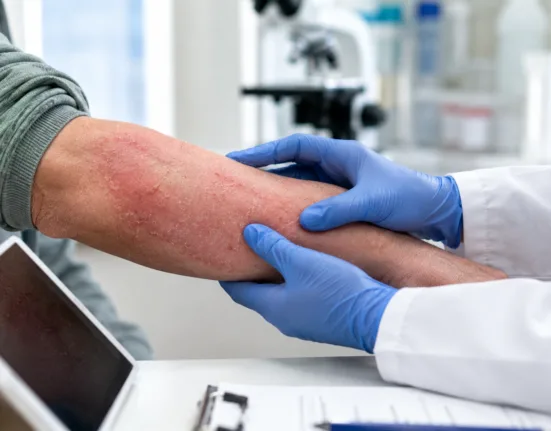
Turn Therapeutics Inc. will host a live webcast on July 7, 2026, to present a comprehensive interim analysis and optimized Stage 2 design for GX-03, its extended-release topical polyhexanide candidate being studied in adults with moderate-to-severe atopic dermatitis. The update follows an analysis of the first 50 completed participants that showed rapid improvements in eczema severity but also substantial responses among participants receiving the petrolatum-based vehicle control.
The decisive question is no longer whether GX-03 generated signs of activity. It did. The more difficult question is whether Turn Therapeutics can translate those descriptive responder rates into a statistically reliable, clinically meaningful and regulator-ready treatment effect once baseline disease severity, vehicle performance, endpoint selection and trial population variability are more tightly controlled.
Why does the early GX-03 efficacy signal look promising yet remain difficult to interpret?
The initial interim findings showed that 92.6% of GX-03-treated participants achieved at least a 50% reduction in Eczema Area and Severity Index scores by week 4, compared with 65.2% in the vehicle group. Turn Therapeutics also reported a week 4 EASI-75 response rate of 70.4% among GX-03 recipients, although the corresponding vehicle response was not included in the initial disclosure.
Deeper responses were visible but again accompanied by meaningful control-arm improvement. At week 4, 44.4% of GX-03-treated participants reached EASI-90, compared with 30.4% of vehicle recipients. By week 8, EASI-90 responses had increased to 51.9% with GX-03 and 34.8% with vehicle.
The speed of improvement is potentially important because patients with moderate-to-severe atopic dermatitis frequently need relief from inflammation and itching before slower maintenance benefits become apparent. A topical candidate producing measurable improvement within four weeks could support a differentiated profile, particularly if itch, sleep disruption and patient-reported symptoms improve alongside investigator-assessed skin clearance.
However, the percentages come from only the first 50 completed participants. Detailed confidence intervals, statistical comparisons, baseline balance, missing-data methods, rescue-treatment handling and subgroup distributions have not yet been presented publicly. Without those elements, the responder rates provide an encouraging clinical signal but not yet a dependable estimate of GX-03’s true treatment effect.
The large improvement in the vehicle arm further narrows the difference attributable specifically to GX-03. That does not establish that the treatment is ineffective, but it does mean the apparent activity cannot be evaluated by looking at the active group in isolation. Stage 2 must demonstrate that the candidate consistently outperforms a control formulation that is already producing substantial improvement.
What does the strong vehicle response reveal about the trial design rather than GX-03 alone?
The vehicle used in the study is not necessarily biologically neutral. Petrolatum-based formulations can support skin-barrier function, reduce water loss and improve dryness, all of which may reduce visible eczema severity. In a disease where barrier disruption is central to symptoms and inflammation, a well-tolerated emollient vehicle may deliver genuine clinical benefit even without the investigational active ingredient.
The challenge becomes more pronounced when participants enter a study with variable baseline disease burden. Atopic dermatitis classified as moderate or severe can differ considerably by EASI score, affected body surface area, lesion location, previous treatment exposure and current flare intensity. Participants entering during an unusually severe flare may improve naturally over the following weeks, producing regression toward their usual disease level in both treatment groups.

Turn Therapeutics has indicated that the interim review identified opportunities to refine enrollment criteria, particularly around baseline EASI scores and body surface area involvement. A narrower population could reduce variability and create a more comparable starting point between the GX-03 and vehicle groups. It could also prevent participants with limited affected surface area or unusually responsive disease from disproportionately influencing responder rates.
The current study’s documented single-center execution adds another consideration. Investigator scoring can be highly consistent within one experienced center, but site-specific recruitment, assessment habits and patient management can also limit the generalizability of results. A later multicenter trial would need to show that GX-03’s effect survives broader differences in clinical practice, demographics, adherence and disease presentation.
Trial optimization after an interim review is legitimate within a prospectively designed adaptive framework. The regulatory risk arises if changes appear to select the subgroup or endpoint that performed most favorably after unblinded data were examined. Turn Therapeutics will therefore need to explain which adaptations were permitted in advance, which decisions were made after the comprehensive review and how statistical independence between Stage 1 and Stage 2 will be protected.
Why is the revised endpoint hierarchy pivotal to GX-03’s regulatory credibility?
The registered trial evaluates multiple established atopic dermatitis measures, including EASI, the Validated Investigator Global Assessment for Atopic Dermatitis, the Peak Pruritus Numeric Rating Scale and the Patient-Oriented Eczema Measure. This provides a broad view of investigator-assessed disease severity, itching and patient experience, but it also creates a need for a clearly defined endpoint hierarchy.
EASI-50 may detect an early reduction in disease burden, yet it represents a less demanding response threshold than EASI-75 or EASI-90. Treatments for moderate-to-severe atopic dermatitis are increasingly judged by their ability to produce substantial clearance, improve itch and move patients toward clear or almost-clear skin. A high EASI-50 rate can be clinically encouraging, but it may not be sufficient to define competitive efficacy or support a pivotal development programme.
The optimized Stage 2 design will need to establish which endpoint is primary, which time point is decisive and how secondary outcomes will be tested without increasing the risk of a false-positive conclusion. Regulatory reviewers will also expect prespecified rules covering multiplicity, missing data, treatment discontinuation, rescue medication and participants who fail to adhere to topical application requirements.
Turn Therapeutics has suggested that earlier inflammatory-burden measures may become more prominent after rapid responses were observed. Earlier endpoints could highlight GX-03’s speed, but they must still correspond to meaningful patient benefit and demonstrate sufficient separation from the vehicle. Selecting an earlier time point mainly because the treatment difference appears larger there would create questions unless the biological and statistical rationale is clearly established.
The webcast should also clarify whether Stage 1 and Stage 2 data will be pooled for the principal analysis or treated as distinct cohorts. Combining them could increase statistical power, but changes to eligibility criteria or endpoints may make the populations less directly comparable. Keeping them separate could improve interpretability while reducing the effective sample size available for formal conclusions.
Can a topical treatment realistically compete in moderate-to-severe atopic dermatitis?
The strongest strategic argument for GX-03 is its attempt to deliver meaningful disease control without injections or systemic immune modulation. Moderate-to-severe atopic dermatitis is commonly treated with injectable biologics or oral targeted therapies when topical prescriptions are inadequate. These options have transformed care, but administration preferences, monitoring requirements, safety considerations and access restrictions can still shape treatment selection.
A non-systemic topical therapy capable of approaching systemic-level efficacy could occupy several positions in the treatment sequence. It might be considered before biologic initiation, used as an adjunct for residual lesions, deployed during flares or offered to patients who prefer to avoid injections and oral immunomodulators. It could also provide a maintenance option if repeated application produces durable control without cumulative local toxicity.
Clinical efficacy alone would not guarantee adoption. Patients with moderate-to-severe disease can have extensive body surface area involvement, making twice-daily topical treatment burdensome. The quantity of ointment required, ease of spreading, residue, clothing transfer, treatment time and willingness to continue application for months could affect real-world adherence.
GX-03 will also need longer follow-up than the current eight-week treatment period. Atopic dermatitis is chronic and relapsing, so clinicians will want evidence on sustained disease control, time to flare, repeated-treatment safety and whether benefits persist when application frequency is reduced. The absence of treatment-related serious adverse events or discontinuations in the interim cohort is reassuring, but a small short-duration dataset cannot establish long-term tolerability.
How credible is the proposed cytokine-modulating mechanism at this development stage?
GX-03 is an extended-release topical formulation containing polyhexanide, also known as PHMB. Turn Therapeutics is developing the formulation to create sustained local exposure at the skin surface while affecting inflammatory signalling associated with epithelial stress, microbial imbalance and the itch-scratch cycle.
Preclinical work has shown activity in a Staphylococcus aureus-induced murine dermatitis model associated with IL-36 expression. The broader development hypothesis proposes that GX-03 may influence pathways involving IL-36, IL-31, IL-4 and IL-13 while also addressing microbial conditions that can worsen barrier disruption.
This creates a potentially differentiated mechanism, particularly because IL-36 signalling sits closer to epithelial stress and barrier injury than several downstream systemic targets. Atopic dermatitis is biologically heterogeneous, however, and cytokine changes in animal skin do not establish that the same pathway is responsible for the clinical responses observed in humans.
The next stages should incorporate human translational evidence where feasible. Skin biomarkers, microbial assessments, exposure measurements and relationships between biological changes and EASI or itch responses could help determine whether GX-03 is acting through the proposed mechanism rather than primarily through the supportive effects of its ointment base.
Dose and formulation questions also remain. If the current formulation uses a single active concentration and fixed application schedule, the programme may lack information about whether greater exposure improves efficacy or merely increases local irritation. Regulators frequently look for dose-response evidence because it strengthens the conclusion that the active ingredient, rather than background variability, caused the observed effect.
What could the optimized Stage 2 design enable in future FDA discussions?
Turn Therapeutics has previously obtained medical device clearances for formulations based on its core technology, including clearance related to managing skin and symptoms associated with dermatitis. Those clearances may contribute useful manufacturing, tolerability and prior-use information, but they do not establish GX-03 as an approved drug treatment for moderate-to-severe atopic dermatitis.
The drug programme requires its own evidence of efficacy, safety, product quality and consistent manufacturing. Polyhexanide has also not previously been approved as a drug active ingredient in the United States, creating questions that extend beyond whether the ointment improves EASI scores. The development package will need to characterize exposure, impurities, stability, chronic use and the suitability of the final commercial formulation.
Turn Therapeutics has indicated that it is preparing for FDA interactions concerning the next regulatory steps. A well-designed Stage 2 cohort could reduce uncertainty before a larger pivotal trial by identifying the appropriate disease population, treatment duration, response threshold and sample size. It could also determine whether GX-03 should be developed as monotherapy or in combination with background topical corticosteroids.
The FDA discussion will be especially important because the sponsor has described earlier regulatory interactions that could support an efficient transition toward pivotal development. Efficiency should not be confused with a lower evidence standard. Any Phase 3 programme would still need independent, adequately controlled and clinically interpretable evidence that GX-03 provides benefit beyond its vehicle.
What commercial position could GX-03 pursue if the efficacy signal is confirmed?
GX-03 would enter a highly competitive market containing inexpensive topical corticosteroids, topical calcineurin inhibitors, newer non-steroidal creams, injectable biologics and oral Janus kinase inhibitors. Its commercial opportunity would depend on proving a specific advantage rather than simply joining the list of available topical products.
A credible combination of rapid response, broad body-area usability, low systemic exposure and favourable long-term tolerability could support positioning between conventional topicals and systemic therapy. This middle position remains attractive because many patients experience disease that is too burdensome for intermittent topical steroids but may not yet warrant, qualify for or accept systemic treatment.
Reimbursement will nevertheless be challenging. Payers may require failure of generic topicals before covering a premium topical product, while patients with severe disease may already be eligible for biologics with extensive clinical evidence. GX-03 would need a pricing strategy that reflects its topical convenience without approaching systemic-therapy costs unless the efficacy evidence is unusually strong.
Manufacturing scalability and intellectual-property durability will also matter. Petrolatum-based ointments are operationally familiar, but consistent distribution of the active ingredient, extended-release performance and commercial batch reproducibility must be demonstrated. The programme’s value will ultimately depend on whether the formulation can be protected and manufactured consistently at a cost compatible with chronic dermatology use.
What must the July 7 GX-03 webcast disclose to strengthen confidence in Stage 2?
The most important information will be the complete active and vehicle results across EASI-50, EASI-75, EASI-90, vIGA, itch and patient-reported outcomes. Baseline EASI scores, body surface area, prior treatment exposure and group balance will help determine whether the apparent responses arose from comparable patient populations.
Statistical confidence intervals and treatment differences will be more informative than active-arm percentages alone. The presentation should also explain missing observations, discontinuations, rescue treatment, application adherence and whether all randomized participants were included in the efficacy analysis.
For Stage 2, clinicians and regulatory observers will be watching the revised eligibility thresholds, primary endpoint, assessment time point, sample size, number of study sites and statistical relationship between the two stages. Clarity on the planned FDA meeting and the conditions required to advance into pivotal development would further establish whether GX-03 is approaching a regulatory programme or remains an exploratory clinical asset.
GX-03 has produced enough activity to justify continued investigation, particularly given the potential value of an effective non-systemic topical therapy for patients with substantial disease. The strong vehicle response and limited interim cohort prevent firm conclusions, however. Turn Therapeutics’ next task is to show that adaptive optimization can convert a promising signal into reproducible comparative evidence rather than merely improve the appearance of the dataset.