
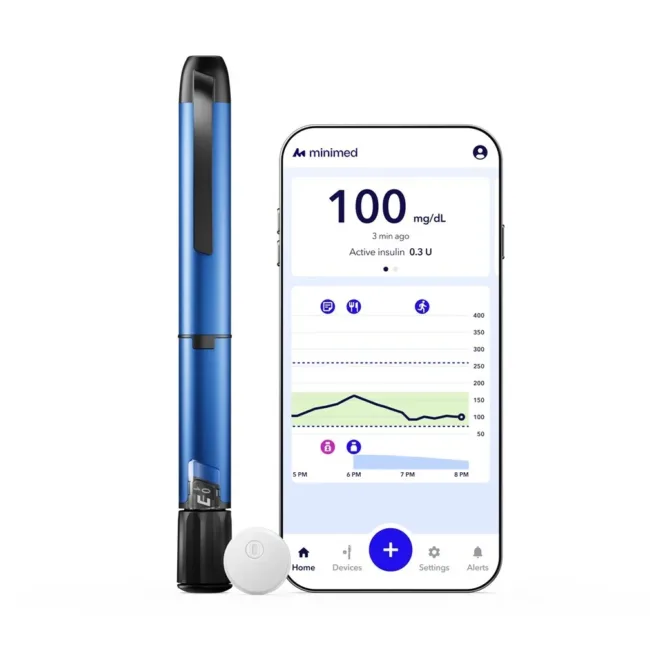
Medtronic plc has received U.S. Food and Drug Administration (FDA) clearance for its MiniMed Go smart multiple daily injection (MDI) system, a platform that integrates the InPen smart insulin pen with Abbott’s Instinct continuous glucose monitoring (CGM) sensor through a unified mobile application. The clearance allows use in insulin-requiring patients aged seven and older, and extends to children as young as two under adult supervision. With this regulatory milestone, Medtronic aims to bring real-time algorithmic insulin guidance to patients who rely on injections rather than pumps—a population that remains both clinically significant and technologically underserved.
What the MiniMed Go clearance changes for the smart MDI segment in 2026
The introduction of the MiniMed Go system represents a significant broadening of smart insulin delivery beyond the closed-loop pump ecosystem. For years, insulin pump users have had access to automated insulin delivery (AID) systems that adjust basal rates or deliver boluses based on real-time glucose data. In contrast, individuals on MDI regimens—who globally number in the tens of millions—have largely depended on manual calculations, static correction formulas, and intermittent glucose measurements.
MiniMed Go seeks to close that capability gap without requiring a switch to pump therapy. By connecting the InPen’s Bluetooth-enabled insulin delivery data with CGM insights from Abbott’s Instinct sensor, and processing this through the MiniMed Go app, the system offers missed dose alerts, personalized bolus calculations, and time-sensitive guidance. It essentially delivers algorithmic support that mimics AID logic, while maintaining the flexibility and familiarity of injection-based regimens.
For Medtronic, this clearance advances its “full-stack” diabetes strategy. Instead of forcing users into a single device pathway, the company is positioning itself as a platform that supports choice—whether through pumps, injections, or hybrid models. This approach is increasingly relevant as real-world data confirms wide variability in patient preferences, adherence, and access across both developed and emerging healthcare systems.
Why integrating Abbott’s Instinct sensor adds differentiation in a crowded CGM market
The technical core of MiniMed Go’s value proposition lies in the real-time, app-integrated feedback loop created by Abbott’s Instinct sensor. Instinct boasts a 15-day wear duration, a slim design, and is currently marketed as one of the smallest CGMs available. For injection users, who typically prioritize discretion, convenience, and skin-wear comfort, this form factor could prove decisive.
More importantly, this is the first time Medtronic is publicly centering a third-party CGM product—especially one made by a competitor—within its own integrated system. Historically, Medtronic has emphasized closed ecosystems such as Guardian and Simplera sensors paired with its own pumps. The decision to anchor MiniMed Go to Abbott’s CGM architecture suggests a strategic pivot toward interoperability and hybrid device ecosystems.
This partnership also comes at a time when Abbott is facing rising competition from Dexcom’s G7 and Senseonics’ implantable CGMs. Instinct’s integration into a smart MDI platform gives Abbott an additional channel of deployment—particularly relevant as the CGM market moves beyond pump users and into broader endocrinology and primary care settings.
How real-world evidence is shaping Medtronic’s bet on MDI-guided automation
Medtronic’s clearance is backed by internal real-world evidence that highlights outcome improvements tied to patient behavior and app engagement. According to aggregated CareLink data, users who responded promptly to Missed Dose alerts saw their Time in Range (TIR) improve from 55.7 percent to 67.2 percent. Users who acted on Correct High Glucose alerts achieved a further increase to 71.5 percent TIR.
This type of insight-driven MDI therapy reflects the growing clinical recognition that dose timing and accuracy—not just insulin quantity—play a central role in managing glucose variability. But the results also reveal a dependency on user response. In contrast to fully closed-loop pump systems, MiniMed Go requires behavioral compliance. Patients must act on prompts and make timely injection decisions, or the algorithmic benefits are muted.
This introduces a nuanced trade-off for clinicians and caregivers. While MiniMed Go may reduce cognitive burden and improve decision support, it does not remove patient agency from the loop. For some, this balance will be empowering. For others—particularly those with diabetes burnout or executive function challenges—it may fall short of automation’s promise.
What payers, providers, and clinicians may scrutinize post-clearance
From a reimbursement perspective, the MiniMed Go platform straddles multiple device categories, which may complicate billing and authorization workflows. Clinicians and payers will want to understand whether MiniMed Go requires separate reimbursement for the InPen hardware, the Instinct CGM, the app license, and the software services tied to CareLink data reporting.
Coverage parity with insulin pumps remains a major sticking point in MDI technology adoption. If payers classify the platform as “non-essential,” coverage gaps could emerge—especially for patients on Medicaid or high-deductible plans. On the clinical front, endocrinologists are likely to probe the system’s usability in younger patients and its training burden for caregivers. While MiniMed Go is approved down to age two with supervision, app navigation, alert fatigue, and injection adherence in toddlers remain complex issues.
Furthermore, health systems evaluating population-level impact will seek evidence of HbA1c reductions, hospitalization avoidance, and long-term outcomes. FDA clearance via 510(k) implies safety and substantial equivalence but does not inherently validate superior effectiveness. Post-market data will be critical in convincing value-based care organizations, integrated delivery networks, and endocrinology groups of the platform’s ROI.
Competitive implications for insulin delivery players and CGM ecosystem rivals
The timing of MiniMed Go’s clearance places Medtronic squarely in the middle of an intensifying contest among smart injection platforms. Bigfoot Biomedical’s Unity system has been a first-mover in bringing CGM-linked decision support to insulin pen users. Meanwhile, Novo Nordisk and Eli Lilly continue to invest in their respective connected pen ecosystems, although neither has reached full algorithmic integration with real-time CGM.
MiniMed Go’s differentiator is its full-stack unification of CGM data, dose history, and algorithmic insights in a single app experience. Unlike Bigfoot Unity, which connects Dexcom CGMs with disposable pens, MiniMed Go builds a reusable, software-upgradable loop anchored on familiar Medtronic tools. Moreover, the company’s massive installed base in pump therapy could drive user migration across modalities over time.
That said, Dexcom’s G7, Omnipod’s DASH and 5 systems, and Tandem’s t:slim X2 and Mobi platforms continue to dominate the automated insulin delivery conversation. Medtronic’s bet is that a significant subset of users—those hesitant to adopt pumps—will find a smarter injection option preferable. If the company executes well on training, support, and payer alignment, it could carve out a differentiated lane in a bifurcated insulin tech market.
What risks remain around real-world use, scale-up, and regulatory harmonization
Despite its promise, MiniMed Go faces several headwinds. First is the risk of inconsistent user engagement. If patients ignore alerts or delay responses, the system’s clinical advantage diminishes. This raises questions about onboarding protocols, training design, and how well the app interfaces with diverse user literacy levels and cultural attitudes toward diabetes tech.
Second, regulatory harmonization is not yet complete. The Instinct-based version is cleared, but Medtronic’s internal pipeline includes pending Simplera sensor integration. If FDA review of Simplera compatibility is delayed or denied, the company could face interoperability bottlenecks and a fractured device roadmap. Conversely, a successful integration could position Medtronic to consolidate CGM and MDI innovation under a single commercial umbrella.
Third, there are challenges around data protection. As the MiniMed Go app channels behavioral and glucose data into the CareLink platform, Medtronic must maintain full compliance with U.S. and EU privacy regulations, including HIPAA and GDPR. Any misstep—either technical or reputational—could limit provider trust and adoption, especially among institutional partners.
Finally, competitive pressure will only intensify. As AI algorithms improve and digital health investments accelerate, newer entrants may offer lower-cost or more modular smart MDI options, particularly for Medicaid and low-income markets. Medtronic’s challenge will be to scale MiniMed Go without pricing itself out of reach.


