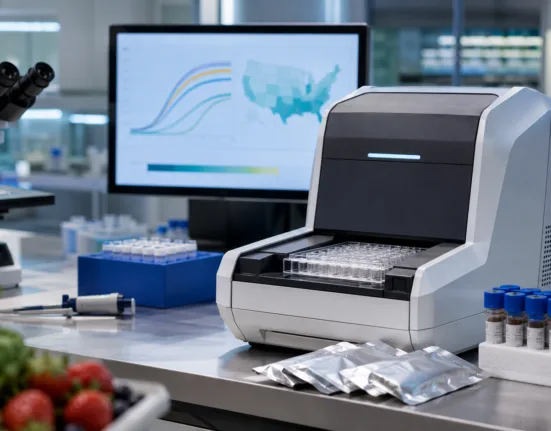
QIAGEN N.V. announced that the United States Food and Drug Administration has cleared the QIAstat-Dx Gastrointestinal Panels for use on the fully automated QIAstat-Dx Rise syndromic testing system, expanding the platform’s diagnostic menu to include both respiratory and gastrointestinal pathogen panels on a single automated instrument. The clearance allows clinical laboratories to run multiplex gastrointestinal tests capable of detecting multiple bacterial, viral, and parasitic pathogens from a single stool sample using real-time PCR technology.
The decision represents another incremental but strategically important step in QIAGEN N.V.’s effort to strengthen its position in the increasingly competitive syndromic molecular diagnostics market. Over the past decade, multiplex PCR testing has shifted infectious disease diagnostics away from traditional culture-based methods toward faster molecular panels that can identify multiple pathogens simultaneously. The addition of gastrointestinal panels to the QIAstat-Dx Rise platform reinforces the trend toward integrated testing systems capable of handling a broader spectrum of infectious disease indications within a single laboratory workflow.
What this clearance reveals about the direction of automated syndromic diagnostics platforms
The regulatory clearance highlights how molecular diagnostics vendors are racing to build automated platforms that combine high throughput, minimal hands-on time, and broader test menus. The QIAstat-Dx Rise platform was designed specifically to address laboratory demand for higher testing capacity while maintaining the rapid turnaround associated with cartridge-based molecular diagnostics systems.
According to the company, the platform can process up to 160 tests per day through a modular architecture that supports multiple analytical modules while enabling urgent sample prioritization.
This type of architecture reflects a wider shift in laboratory automation where systems must handle both routine diagnostic demand and urgent clinical samples without sacrificing workflow efficiency.
Clinical laboratories increasingly face the challenge of balancing high testing volumes with staffing constraints and rising expectations for rapid results. Automated multiplex platforms attempt to address these pressures by reducing manual steps, shortening turnaround times, and allowing laboratories to consolidate different diagnostic assays onto a single system. For infectious disease diagnostics in particular, the ability to test for multiple pathogens associated with similar symptoms can significantly shorten diagnostic pathways for clinicians.
The syndromic testing approach also aligns with broader clinical practice trends where physicians increasingly rely on rapid molecular diagnostics to guide treatment decisions. Respiratory and gastrointestinal infections often present with overlapping symptoms, making it difficult to identify causative pathogens using traditional diagnostic methods. Multiplex PCR panels allow clinicians to detect a range of pathogens within roughly an hour, enabling more targeted treatment strategies and infection control measures.
Why expanding panel menus has become a critical competitive factor in multiplex diagnostics
For platform developers, the expansion of test menus has become a key differentiator in the syndromic diagnostics market. Instruments that support only a limited number of panels may struggle to justify their installation in hospital laboratories that must manage diverse infectious disease testing needs.
By enabling both respiratory and gastrointestinal panels on the QIAstat-Dx Rise system, QIAGEN N.V. is effectively positioning the platform as a more comprehensive infectious disease testing solution. The U.S.-based molecular diagnostics business has been expanding its panel portfolio steadily, with the latest clearance marking the ninth regulatory authorization for the QIAstat-Dx portfolio within two years.
Industry observers note that this strategy mirrors the competitive positioning adopted by other multiplex PCR platforms in the syndromic diagnostics segment. Companies operating in this space often compete not only on instrument performance but also on the breadth of available panels and the ease with which laboratories can add new assays to existing systems.
Expanding the panel menu also has implications for laboratory economics. A platform that supports multiple diagnostic panels can potentially increase utilization rates, making the capital investment more attractive for hospitals and diagnostic laboratories. Consolidating respiratory and gastrointestinal testing on a single system can also simplify procurement, training, and workflow management.
What the gastrointestinal panel capabilities could mean for clinical diagnostics
The newly cleared gastrointestinal panels detect up to 16 bacterial, viral, and parasitic pathogens from a single stool sample.
The inclusion of pathogens such as Shiga toxin producing Escherichia coli subtypes reflects the growing emphasis on identifying organisms associated with severe gastrointestinal disease and foodborne outbreaks.
Gastrointestinal infections remain a significant global healthcare burden, particularly among pediatric and immunocompromised populations. Traditional diagnostic workflows often rely on multiple separate tests to identify pathogens, which can delay diagnosis and complicate treatment decisions. Syndromic panels streamline this process by enabling simultaneous detection of a broad pathogen range within a single test.
Clinicians tracking the field often emphasize that multiplex PCR diagnostics can significantly improve pathogen detection rates compared with culture-based approaches. However, the clinical interpretation of multiplex results can also introduce complexity, particularly when co-infections or low-level pathogen detection occur. Platforms that provide additional data such as cycle threshold values and amplification curves may offer clinicians and laboratory professionals more context when interpreting results.
How automation and throughput are shaping adoption in clinical laboratories
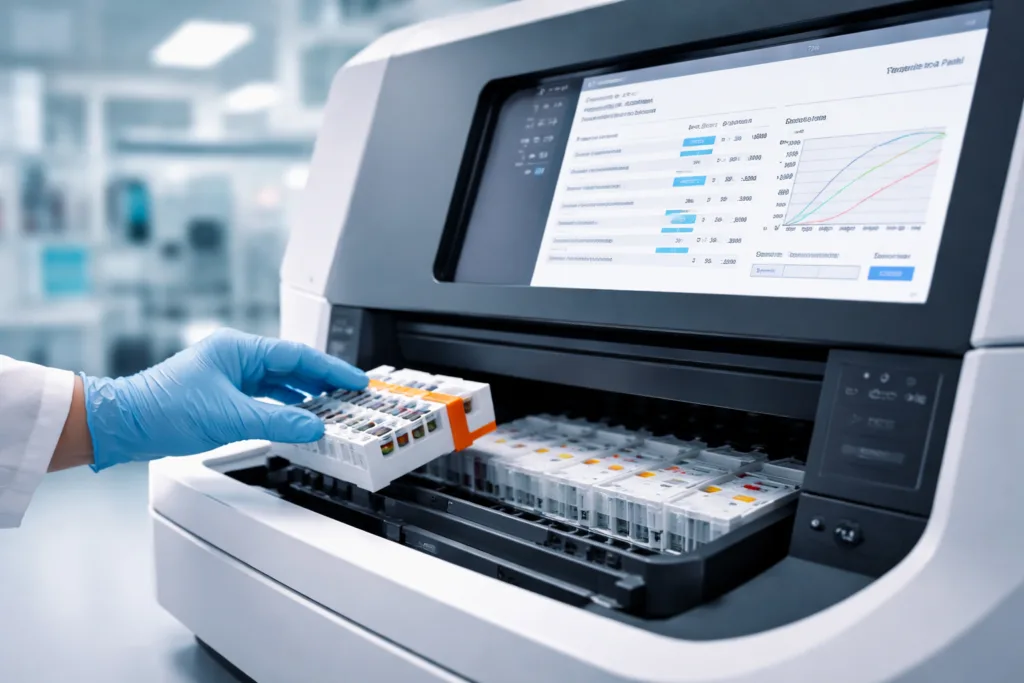
One of the central selling points of the QIAstat-Dx Rise system is its automation capability. The platform features a cartridge-based system with automated loading and unloading that reduces manual handling requirements. According to QIAGEN N.V., the test workflow requires less than one minute of hands-on time per test.
Laboratories increasingly prioritize automation features that reduce labor intensity and allow staff to manage larger test volumes without proportional increases in staffing. This trend has accelerated in recent years as diagnostic laboratories face workforce shortages and growing testing demand.
Automation also influences the adoption of syndromic diagnostics in hospital environments where rapid turnaround can affect patient management decisions. Emergency departments and infectious disease units often require test results quickly to guide treatment and isolation protocols. Platforms capable of delivering results within roughly one hour may therefore have a clinical advantage compared with slower diagnostic workflows.
At the same time, higher throughput platforms aim to bridge the gap between rapid cartridge-based systems and large centralized molecular testing instruments. Systems like QIAstat-Dx Rise attempt to combine the speed of syndromic testing with the scalability required for larger hospital laboratories.
What regulatory momentum suggests about QIAGEN’s diagnostics strategy
The pace of regulatory clearances for the QIAstat-Dx portfolio suggests that QIAGEN N.V. is pursuing an aggressive expansion strategy for its syndromic testing platform. The company has positioned the platform as part of its broader Sample to Insight ecosystem, which integrates sample preparation, molecular testing, and data interpretation technologies.
Regulatory approvals play a particularly important role in the diagnostics industry because they determine which clinical tests laboratories can legally perform within specific markets. Each additional panel approval expands the clinical utility of a platform and can improve the system’s attractiveness to prospective laboratory customers.
Regulatory watchers often view frequent panel approvals as a sign that a diagnostics company is investing heavily in assay development and validation. In multiplex PCR diagnostics, continuous menu expansion is often necessary to maintain competitive positioning as new pathogens emerge and clinical testing requirements evolve.
What risks and unanswered questions remain for syndromic testing platforms
Despite the growing adoption of multiplex PCR diagnostics, several challenges continue to shape the long term trajectory of the syndromic testing market. Cost remains a central concern, particularly for healthcare systems operating under reimbursement constraints. Multiplex panels can be significantly more expensive than traditional diagnostic methods, which may limit their use to specific clinical scenarios.
Another challenge involves the clinical interpretation of multiplex results. Detecting multiple pathogens in a single sample can complicate clinical decision making, particularly when low levels of pathogen DNA are identified that may not represent active infection.
Manufacturing scalability also remains a factor for diagnostics companies. Cartridge-based molecular testing platforms depend on reliable production capacity for consumables, and supply disruptions can affect instrument utilization rates.
Finally, competition in the syndromic diagnostics segment continues to intensify as more companies develop multiplex testing platforms targeting similar clinical indications. Laboratories often evaluate instruments based on throughput, panel breadth, workflow integration, and cost efficiency, which means that incremental improvements in any of these areas can influence purchasing decisions.
What clinicians and industry observers are likely to watch next
With respiratory and gastrointestinal panels now available on the QIAstat-Dx Rise platform, industry observers will likely monitor how quickly laboratories adopt the system and whether additional panels are introduced to expand its diagnostic menu further.
Future developments may include panels targeting bloodstream infections, antimicrobial resistance markers, or other infectious disease indications where rapid molecular diagnostics could significantly influence clinical decision making.
As healthcare systems increasingly emphasize faster diagnostics and more automated laboratory workflows, platforms that combine multiplex pathogen detection with scalable automation are likely to remain a focal point of investment and innovation across the molecular diagnostics industry.