Aidoc has received United States Food and Drug Administration Breakthrough Device Designation for First Read, an investigational artificial intelligence system designed to analyse chest X-rays and generate preliminary radiology report text for four life-threatening findings.
The designation moves Aidoc closer to a regulated product that could influence not only how radiologists prioritise images, but how the final clinical report is created. First Read is intended to produce a draft that a radiologist reviews, edits and approves rather than independently issuing a diagnosis to the referring physician.
That distinction is central to understanding both the opportunity and the risk. Artificial intelligence systems have already been used to flag suspected abnormalities, reorder worklists and draw attention to urgent scans. Drafting the report moves the technology deeper into the physician’s cognitive workflow because the AI’s interpretation becomes the starting point for the radiologist’s written conclusion.
Aidoc believes First Read could reduce the time spent translating image findings into structured report language. The system could help radiologists absorb rising examination volumes and focus more attention on difficult cases. However, the product remains investigational and has not received FDA clearance or approval.
Breakthrough Device Designation provides closer regulatory interaction and potentially prioritised review. It does not establish that First Read is accurate, safe or ready for clinical deployment.
What exactly is Aidoc’s First Read system designed to do with chest X-rays?
First Read is being developed to examine chest radiographs and create preliminary report text describing findings identified by the software. The FDA designation covers four life-threatening findings, although Aidoc has not publicly disclosed the complete list in its announcement.
A chest X-ray can contain evidence of multiple urgent and non-urgent conditions, including pneumothorax, pneumonia, pleural effusion, pulmonary oedema, misplaced tubes, enlarged cardiac structures and other abnormalities. Radiologists must evaluate the full image, compare it with prior studies and incorporate the patient’s clinical history before producing an interpretation.
Traditional radiology artificial intelligence typically focuses on one part of that process. A system might detect a suspected pneumothorax and move the examination higher in the reading queue. The radiologist still performs the full interpretation and writes the report.
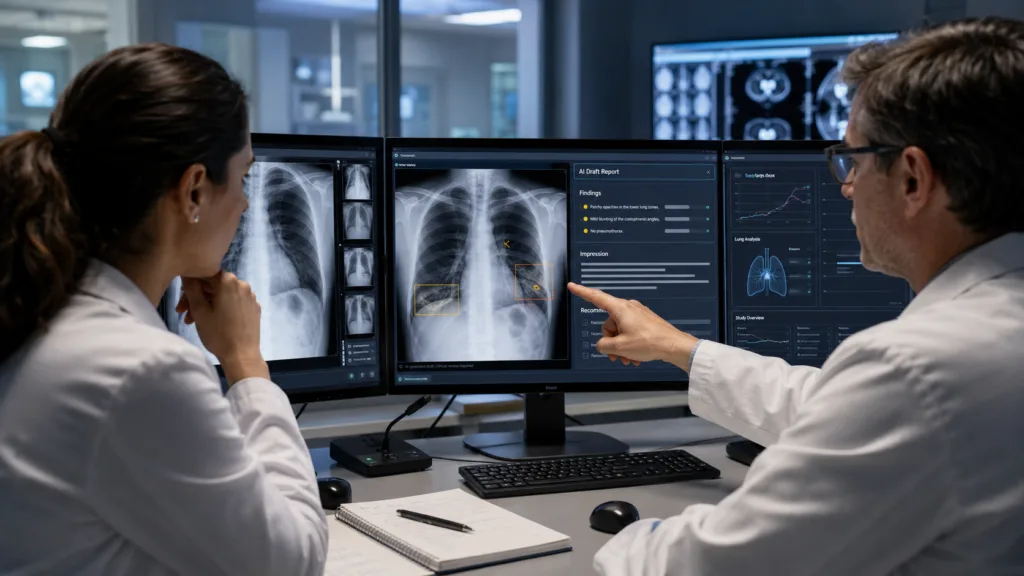
First Read attempts to perform a broader task. It analyses the image and converts its findings into natural-language report text that the radiologist can accept, modify or reject.
This could reduce repetitive documentation work, especially for high-volume examinations with relatively standardised findings. A draft may allow the radiologist to spend less time dictating routine descriptions and more time verifying accuracy, reviewing comparisons and resolving uncertainty.
The risk is that the draft becomes psychologically influential. Once a plausible report appears on the screen, the radiologist may begin from the AI’s interpretation rather than independently examining every part of the image.
The value of First Read will therefore depend not only on how often the system reaches the correct conclusion, but also on how its interface affects human attention and decision-making.
Why is report drafting more consequential than conventional radiology triage software?
Triage tools usually operate behind the scenes. They identify a suspected urgent abnormality and adjust the order in which examinations appear on a radiologist’s worklist.
Report-generation systems produce language that may eventually become part of the permanent medical record. The report can influence emergency treatment, hospital admission, follow-up imaging, specialist referral and future interpretation of the patient’s condition.
A missed abnormality in an AI-generated draft could be carried into the final report when the radiologist overlooks the error. An invented or overstated finding could trigger unnecessary tests, anxiety or treatment.
The problem is not limited to dramatic hallucinations. Minor phrasing differences can alter clinical meaning. Describing a finding as possible, suspicious, likely or definite may lead referring physicians toward different actions.
Laterality, measurement and comparison also matter. A report that assigns a finding to the wrong side, incorrectly describes interval growth or overlooks a device-position problem can create substantial patient risk despite appearing linguistically polished.
Generative systems are particularly persuasive because their output can sound complete and professional. A grammatically strong report may encourage users to assume that the underlying image analysis is equally reliable.
Radiologists must therefore treat the draft as an unverified suggestion rather than a completed interpretation. Hospitals will need interfaces and training that reinforce active review instead of passive approval.
Does FDA Breakthrough Device Designation mean First Read has been cleared for clinical use?
No. First Read remains an investigational device and cannot be marketed in the United States as an FDA-cleared report-drafting system.
The Breakthrough Devices Program is intended for technologies that may provide more effective diagnosis or treatment for life-threatening or irreversibly debilitating conditions and address an unmet clinical need.
The designation gives manufacturers opportunities for more frequent communication with the FDA during product development. It can also support prioritised review when the company eventually submits a 510(k), De Novo or premarket approval application.
The programme does not lower the legal standards required for market authorisation. Aidoc must still provide evidence supporting the system’s safety and effectiveness for its proposed indication.
The distinction is especially important because the phrase breakthrough can be interpreted by patients, investors and hospital buyers as a declaration that a device has already demonstrated superior clinical performance.
In regulatory terms, the designation indicates that the technology may offer a meaningful advance and qualifies for an expedited development pathway. It is not an endorsement of commercial readiness.
Aidoc will need to disclose the final intended use, target population, workflow limitations and performance evidence when it seeks marketing authorisation.
Why are health systems increasingly interested in AI-generated radiology reports?
Radiology departments face a growing mismatch between imaging demand and specialist capacity. The number and complexity of examinations have increased, while recruitment and retention pressures continue across many radiology practices.
Research examining United States outpatient imaging found that the average time between an examination and its interpretation more than doubled between 2014 and 2023. The increase accelerated sharply during the final two years of the study period.
Longer interpretation times can delay treatment decisions, discharge planning and follow-up care. In emergency departments, imaging results may become one of several bottlenecks keeping patients in beds while clinicians await diagnostic confirmation.
Report drafting offers a direct productivity intervention. Instead of merely highlighting one suspected abnormality, the AI could reduce the documentation required for every eligible examination.
Research involving generative artificial intelligence for chest radiographs has produced encouraging results. One reader study involving five radiologists and 758 chest X-rays found that preliminary AI reports reduced average reading time from about 34 seconds to approximately 20 seconds while improving several measures of reporting quality and agreement.
Another multicohort validation study found that AI-generated chest X-ray reports achieved acceptability comparable with radiologist-written reports, although a substantial proportion still required minor revision.
These studies support the productivity thesis, but they do not establish that every system will perform equally across hospitals, imaging equipment, patient groups and disease patterns.
A product used in routine practice must perform reliably during night shifts, high-volume periods and unusual cases, not only within a curated evaluation dataset.
Could First Read create automation bias even when a radiologist remains responsible for the final report?
Automation bias occurs when users place excessive trust in a machine-generated recommendation or fail to identify errors because the automated output appears credible.
Radiologists reviewing a draft may devote more attention to verifying what the system mentioned than searching for findings it omitted. This can create a form of visual anchoring in which the AI determines where the reader looks and how the examination is framed.
An incorrect draft may also influence the radiologist’s interpretation of an ambiguous finding. When the system confidently describes pneumonia, for example, the reader may be more likely to interpret a subtle opacity as infection rather than atelectasis, technical artefact or another condition.
Experienced radiologists are not immune to this effect. Heavy workloads and time pressure increase the temptation to accept a polished draft when it appears consistent with the image.
Aidoc will need to demonstrate that First Read improves the combined performance of the radiologist and AI rather than merely showing that the algorithm performs well independently.
Human-factors testing should examine omission errors, false-positive suggestions, editing behaviour and the frequency with which radiologists accept incorrect language.
Hospitals may also need to consider whether AI-generated text should appear immediately or only after the radiologist has completed an initial image review. Delaying the draft could preserve independent observation but reduce the time-saving benefit.
The safest interface may not be the one that produces the fastest report.
What evidence should the FDA require before authorising AI-generated report drafting?
Aidoc should be expected to evaluate First Read across a large and diverse set of chest radiographs obtained from multiple hospitals, patient populations and imaging systems.
The study population should include emergency, inpatient and outpatient examinations, portable radiographs, technically limited images and cases with multiple simultaneous abnormalities.
Performance must be measured at the level of clinically important findings rather than only through text similarity. Two reports can use different wording while communicating the same clinical meaning, while nearly identical sentences can conceal a serious laterality or measurement error.
The FDA will also need evidence about the radiologist-AI combination. Relevant measures include sensitivity, specificity, reporting time, correction rates, missed urgent findings and whether performance varies according to reader experience.
Aidoc should test the system prospectively in real clinical workflows. Retrospective datasets can show technical performance, but they cannot fully reveal how radiologists interact with the draft under ordinary workload conditions.
Subgroup analysis will be important. The model should perform consistently across age groups, sex, race, body habitus, clinical settings and different equipment manufacturers.
The company must also explain how the system handles uncertainty, image-quality problems and findings beyond the four conditions covered by the Breakthrough Device Designation.
A chest radiograph may contain an unexpected cancer, fracture or misplaced medical device even when the software is focused on other life-threatening findings. The interface must make clear that silence from the AI does not mean the image is normal.
Can an AI draft report safely incorporate prior imaging and clinical context?
Radiology interpretation rarely depends on one image alone. A clinician may ask whether pneumonia has improved, whether a pleural effusion is increasing or whether a lung nodule has changed since an earlier examination.
A system analysing only the current image may identify an abnormality but fail to describe the trend that gives it clinical meaning.
First Read’s long-term value will depend on whether it can use previous reports, prior images, the reason for examination and relevant medical history without importing unrelated or incorrect information.
Clinical context can also change interpretation. The same opacity may have different implications in a patient with fever, recent surgery, cancer treatment or heart failure.
Connecting the system to electronic medical records creates additional technical and privacy risks. Data may be incomplete, contradictory or entered under time pressure.
Aidoc’s aiOS platform is designed to integrate clinical artificial intelligence into hospital imaging and electronic-record workflows. That enterprise position could make contextual integration easier than it would be for an isolated reporting application.
However, broader data access increases governance requirements. Health systems must know which information influenced the report and how the AI reached its conclusion.
The final product should provide sufficient traceability for radiologists to understand whether its language came from the image, prior records or a generated inference.
Who is legally responsible when the AI-generated draft contains a harmful error?
Aidoc states that radiologists will retain oversight and final approval. That means the physician remains responsible for reviewing the image and signing the report.
However, liability becomes more complicated when hospitals deploy a regulated system specifically to support diagnosis and reporting.
A radiologist could be criticised for accepting an incorrect AI suggestion. The hospital could face questions about training, monitoring and whether the system was used outside its authorised indication. The manufacturer could face scrutiny if the error resulted from a known software limitation or performance drift.
Legal exposure may also change depending on how the product is presented. A tool described as a drafting assistant creates different expectations from one marketed as a reliable first reader capable of identifying life-threatening disease.
Hospitals will need clear policies describing when First Read may be used, which cases require additional review and how errors should be reported.
They should also audit acceptance rates and identify radiologists who consistently rely on the system without making corrections. Near-perfect acceptance may indicate excellent performance, but it could also suggest insufficient independent review.
A safe commercial model will require responsibility to be distributed clearly without allowing every participant to assume that someone else is monitoring the risk.
Why does Aidoc’s enterprise strategy matter more than one report-generation product?
Aidoc says its technology is deployed across nearly 2,000 hospitals and has analysed more than 120 million patient cases. The company’s existing scale gives it a potential advantage over startups introducing a single artificial intelligence model.
Hospitals increasingly want centralised systems that can deploy, monitor and govern multiple algorithms rather than managing dozens of disconnected applications.
Aidoc’s aiOS platform is designed to act as that operating layer. The company can integrate triage, care coordination and report drafting within one enterprise relationship.
First Read therefore represents more than a new chest X-ray product. It could extend Aidoc from identifying urgent cases into producing part of the physician’s clinical documentation.
That expansion may strengthen customer retention because the platform becomes embedded across more steps of the radiology workflow. It could also increase switching costs and deepen hospital dependence on one vendor.
Aidoc raised $150 million in Series E financing in April 2026 in a round led by Growth Equity at Goldman Sachs Alternatives, bringing its total disclosed funding above $500 million. The capital is intended partly to expand its clinical foundation model and automated report-generation capabilities.
The company is privately held, so there is no public share-price reaction to the Breakthrough Device Designation. The financing indicates strong institutional confidence, but it also creates expectations that Aidoc will convert technical scale into recurring enterprise revenue and regulatory authorisations.
Could AI report drafting weaken radiology training and professional judgement?
Trainees develop expertise by reviewing images, forming an interpretation and comparing it with an attending radiologist’s conclusions.
When an AI-generated report appears before the trainee has completed that process, it may reduce the effort required to build independent pattern recognition and diagnostic reasoning.
The technology could become a valuable educational tool when used thoughtfully. Trainees could compare their own draft with the AI output, identify disagreements and study why corrections were necessary.
Poor implementation could create physicians who are highly efficient at editing machine-generated reports but less confident when the software is unavailable or wrong.
Training programmes may need separate workflows for residents and experienced radiologists. They may also require certain cases to be interpreted without AI assistance.
This concern is not an argument against automation. Radiology has long used structured templates, speech recognition and computer-aided detection.
The issue is whether the technology supports professional judgement or gradually replaces the cognitive work required to maintain it.
What must Aidoc prove before First Read can become a trusted clinical product?
The company must first show that First Read detects the designated life-threatening findings reliably across real-world chest X-rays.
It must then show that the generated language accurately reflects the images, uses appropriate uncertainty and avoids invented findings, incorrect laterality and misleading comparisons.
The most demanding test will be whether radiologists using the system perform better and faster without becoming more vulnerable to automation bias.
Aidoc should publish correction rates, serious-error rates and performance across demographic and institutional subgroups rather than relying only on aggregate accuracy.
Health systems will also want evidence that First Read shortens turnaround time after accounting for integration, verification and exception handling. A draft that requires extensive editing may move rather than eliminate the workload.
Post-market monitoring will be essential if the device receives authorisation. Imaging protocols, patient populations and clinical practice change over time, potentially affecting model performance.
The company’s enterprise platform gives it the infrastructure to monitor deployed systems, but hospitals will need transparency about updates, performance drift and reported failures.
Can First Read relieve radiology pressure without turning physicians into AI proofreaders?
Aidoc is targeting a real healthcare bottleneck. Radiologists face rising imaging volumes, growing case complexity and pressure to produce faster reports without sacrificing accuracy.
AI-generated drafts could reduce repetitive documentation and give clinicians more time for difficult interpretation, consultation and communication.
My assessment is that the technology has greater operational potential than narrow alert systems because it affects a task performed during nearly every examination. It also carries greater clinical risk because the generated language can directly enter the patient record.
The Breakthrough Device Designation indicates that the FDA sees enough potential to provide Aidoc with an expedited development pathway. It does not demonstrate that the system is ready for routine use.
First Read’s success will depend on whether Aidoc can design a workflow in which radiologists remain active decision-makers rather than passive editors of persuasive machine-generated text.
The strongest product will not be the one that writes the most complete-looking report. It will be the one that saves time while making uncertainty visible, encouraging independent review and reducing rather than redistributing diagnostic error.
Key takeaways from Aidoc’s First Read Breakthrough Device Designation
- Aidoc has received FDA Breakthrough Device Designation for First Read, an investigational system designed to analyse chest radiographs and generate preliminary report text for four life-threatening findings.
- The designation can accelerate regulatory interaction and review, but First Read has not received FDA marketing clearance or approval.
- Generative radiology reporting could reduce documentation time and help health systems manage increasing imaging demand.
- The main risks include automation bias, omitted findings, invented language, incorrect laterality, performance differences across patient populations and unclear accountability.
- Aidoc must demonstrate the combined performance of the radiologist and AI in prospective real-world settings, not merely the algorithm’s standalone accuracy.
- The company’s deployment across nearly 2,000 hospitals, $150 million Series E financing and aiOS platform provide significant commercial advantages, but safe adoption will depend on governance, transparency and post-market monitoring.