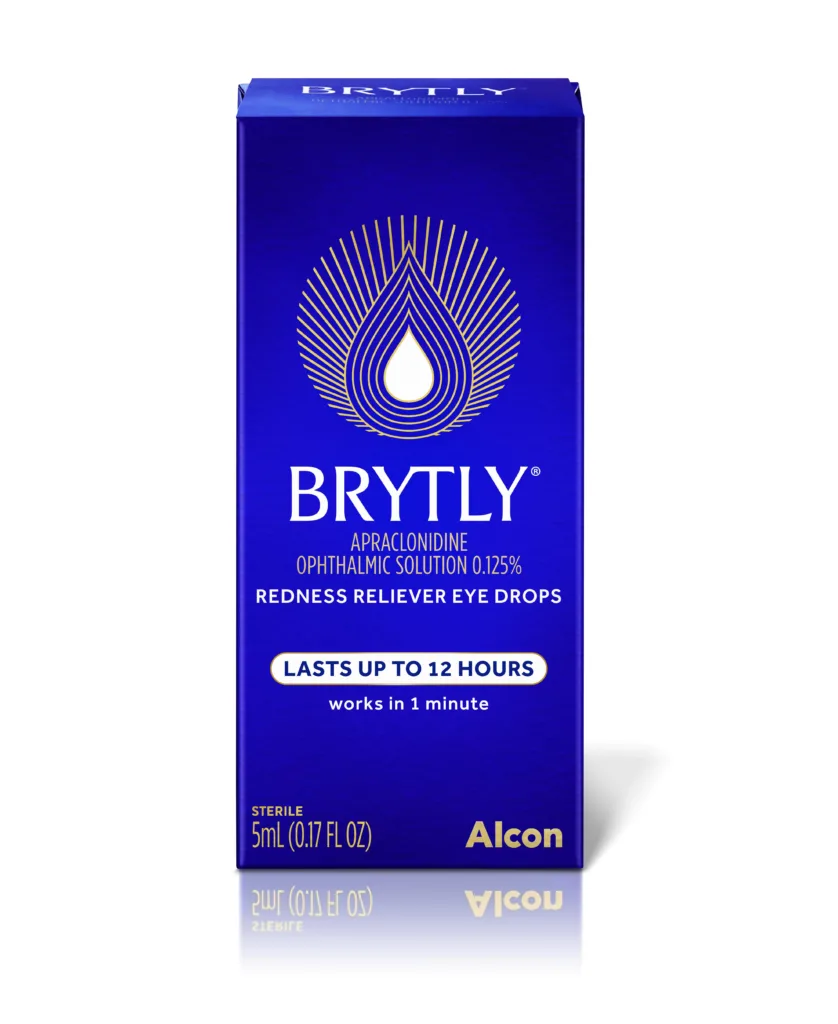
Alcon Inc. (SIX Swiss Exchange and NYSE: ALC), the Geneva-based eye care company, announced on October 16, 2026, that the United States Food and Drug Administration has approved BRYTLY, an apraclonidine ophthalmic solution containing 0.125% of the active ingredient, for temporary relief of eye redness caused by minor irritations. The medicine is authorized for adults and children aged 12 years and older and becomes the first nonprescription ophthalmic product containing apraclonidine available under an FDA approval.
Alcon says a single application can begin reducing visible redness within one minute, with effects lasting up to 12 hours. The company positions BRYTLY as a longer-lasting alternative in the over-the-counter redness-relief category and states that the product can provide up to 50% greater duration than Lumify, the brimonidine-based eye drops marketed by Bausch + Lomb. However, the comparison is based on the respective products’ maximum labeled durations of 12 and eight hours, rather than a newly disclosed head-to-head clinical trial.
The FDA independently confirmed the approval and specified important conditions for use. BRYTLY should not be administered more than twice daily, and users must remove contact lenses before application and wait at least ten minutes before reinserting them. Patients experiencing eye pain, changes in vision, persistent redness or worsening irritation should stop using the product and seek medical advice.
Alcon expects BRYTLY to become available through major United States retailers and online channels in the coming months, with possible expansion into additional markets subsequently. The approval strengthens its consumer eye care portfolio, which already includes established products for dry eye and contact lens care. Its commercial differentiation will depend on whether the longer labeled duration produces a meaningful advantage in convenience and customer satisfaction.
What has the FDA approved BRYTLY to treat?
The FDA authorized BRYTLY for relief of eye redness resulting from minor irritation. Such redness often occurs when blood vessels near the surface of the eye become dilated or more prominent, producing a visible change in the white portion of the eye. Dryness, dust and other everyday irritants can contribute to this appearance.
The approved indication is narrower than the treatment of every condition associated with red eyes. Conjunctivitis, corneal injury, glaucoma and other ocular diseases may cause redness requiring medical assessment. A product that reduces visible redness does not necessarily treat an underlying infection, inflammation or structural eye disorder.
BRYTLY is intended to provide temporary cosmetic and symptomatic improvement by reducing the appearance of dilated surface vessels. Alcon emphasizes its potential to make eyes appear whiter and brighter, positioning the product within the intersection of consumer wellness and ophthalmic care. However, the FDA-approved treatment purpose remains redness relief due to minor irritation rather than a general cosmetic authorization without medical limitations.
The product is available without a prescription, but that status does not eliminate the importance of using it correctly. The agency specifies an approved age range beginning at 12 years and restrictions on dosing frequency. Consumers with ongoing or unexplained redness should not rely on repeated application to avoid seeking appropriate eye care.
The FDA’s decision establishes that BRYTLY meets applicable requirements for its defined nonprescription use. It does not establish that the medicine is appropriate for every patient experiencing redness or that it improves visual acuity or other measures of eye health.
How does apraclonidine reduce the appearance of eye redness?
Apraclonidine is an alpha-adrenergic agonist, a class of compounds that act on receptors involved in regulating vascular and other physiological responses. In ophthalmic use, the drug can influence blood vessels and produce vasoconstrictive effects. Reducing dilation of superficial ocular vessels can lessen visible redness.
Apraclonidine has an established history in prescription ophthalmology at higher concentrations, including use in selected patients requiring reduction of intraocular pressure. However, BRYTLY uses a much lower 0.125% concentration and has a different approved purpose. The nonprescription product should not be described as a replacement for glaucoma medication.
The difference between concentration and indication is clinically important. A molecule may be used for more than one purpose depending on its formulation, dose and regulatory evidence. The FDA evaluated BRYTLY for temporary redness relief rather than for treating elevated intraocular pressure.
Alpha-adrenergic eye drops also require attention to tolerability and the possibility of changes with repeated use. Depending on the molecule and concentration, products in the broader class may cause irritation or changes in redness response over time. Evidence supporting one formulation cannot automatically establish the safety profile of another.
Alcon says BRYTLY’s clinical development demonstrated effectiveness with a low risk of rebound redness and tachyphylaxis when used as directed. Those claims should be interpreted according to the company’s supporting studies and approved labeling. The announcement does not provide a complete public numerical comparison of rebound events or reduced response with repeated dosing.
What supports Alcon’s one-minute onset and 12-hour duration claims?
Alcon describes BRYTLY as producing a significant reduction in visible redness beginning within one minute of application. The company also reports that the effect can last up to 12 hours. These claims are central to the product’s positioning because many consumers use redness-relief eye drops for convenience during ordinary daily activities.
The announcement identifies clinical evidence supporting onset and duration but does not reproduce the complete pivotal study dataset. It does not provide the number of participants contributing to every efficacy assessment, the distribution of response durations or complete statistical comparisons at each measured time point. Therefore, the headline duration should be interpreted as an approved upper-duration claim, not a guarantee that every user will experience 12 hours of noticeable improvement.
The distinction matters when evaluating a treatment used for appearance-related concerns. Some users may respond quickly but experience shorter duration, while others may achieve longer-lasting redness reduction. Individual eye conditions, irritation sources and medication use can influence the observed effect.
An effective product also needs to maintain acceptable tolerability during repeated administration. Rapid visible improvement is valuable, but it must be weighed against any discomfort or other adverse effects that could discourage continued use. Longer-term consumer experience will contribute information beyond the clinical evidence submitted for approval.
The 12-hour claim may support a practical twice-daily maximum-use framework, consistent with the FDA’s instructions. However, a permitted maximum does not mean that every user requires two applications each day.
Is BRYTLY actually 50% more effective than Lumify?
Alcon states that BRYTLY lasts up to 50% longer than Lumify, Bausch + Lomb’s established redness-relief product containing brimonidine tartrate 0.025%. The comparison is mathematically based on the respective labels: BRYTLY claims effects for up to 12 hours, while Lumify claims up to eight hours. The additional four hours represent 50% of Lumify’s stated maximum duration.
This is a duration comparison rather than proof of 50% greater redness reduction. It does not establish that BRYTLY produces a 50% larger clinical effect, works more quickly in every patient or causes fewer adverse reactions. It also should not be interpreted as a result from a randomized direct comparison unless such evidence is separately disclosed.
The two products have different active ingredients, although both act through alpha-adrenergic pathways. Lumify has been marketed for several years and has established brand recognition in the United States. BRYTLY enters the category with a different ingredient and a longer maximum labeled duration, offering Alcon a clear point of competitive distinction.
Actual purchasing decisions may depend on factors beyond duration. Consumers may consider price, availability, packaging, perceived comfort and previous treatment experience. Some may prefer a product they already use successfully even if another medicine has a longer stated duration.
Healthcare professionals may also consider the patient’s underlying reason for redness before recommending either product. Recurring red eyes can reflect conditions requiring treatment rather than repeated cosmetic suppression. Competitive comparisons should therefore remain grounded in approved indications, safety and adequately supported efficacy claims.
What do the FDA’s contact lens and dosing instructions mean for users?
The FDA specifies that BRYTLY may be used by adults and children aged 12 and older, with administration no more than twice daily. These requirements form part of the approved conditions for nonprescription use. Using the medicine more frequently than directed could increase exposure without establishing greater clinical benefit.
Contact lens wearers must remove their lenses before using the drops. The FDA recommends waiting at least ten minutes after applying BRYTLY before reinserting contact lenses. This interval is intended to support appropriate administration and reduce avoidable interactions between the product and lenses.
If another ophthalmic medicine is also being used, the agency advises waiting at least five minutes between products. Separating administration can help prevent one drop from immediately displacing another and supports adherence to each product’s instructions. Patients using prescription eye medicines should also consider advice from their eye care professional.
The FDA advises consumers to discontinue BRYTLY and seek medical assessment if they experience eye pain, visual changes, continued redness or irritation. Medical review is also appropriate if symptoms last more than three days or worsen. These precautions help distinguish minor transient redness from conditions that may require diagnosis.
The new over-the-counter status provides access without an initial prescription, but it does not replace clinical assessment for persistent or unexplained symptoms. The product should be used only according to its Drug Facts labeling and relevant professional guidance.
How does BRYTLY fit into Alcon’s wider consumer eye care business?
Alcon operates two major business segments, Surgical and Vision Care, supplying products used in ophthalmic procedures, vision correction and everyday eye health. Its consumer eye care portfolio includes Systane dry eye products and contact lens care solutions. BRYTLY adds a nonprescription medicine specifically focused on visible redness.
The addition broadens the company’s exposure to a category influenced by both medical need and consumer preferences. Eye redness can arise from minor irritation, but shoppers may also be motivated by the appearance of their eyes during work, social activities and other daily situations. Alcon’s announcement explicitly recognizes this overlap between consumer wellness and visual appearance.
The company reported approximately $10.3 billion in consolidated revenue for 2025, demonstrating the scale of its established business. BRYTLY represents a relatively targeted portfolio addition rather than a transaction likely to transform the company’s overall revenue base immediately. Alcon has not disclosed a standalone sales forecast or initial commercial revenue target for the product.
Its existing retail relationships and consumer eye care infrastructure could support the launch. Distribution through major retailers and online platforms may allow Alcon to reach customers already familiar with its other products. However, approval does not guarantee rapid market penetration or preferred shelf placement.
Commercial performance will depend on the price and marketing strategy announced closer to availability, as well as the response of competitors. The company has not disclosed BRYTLY’s recommended retail price or a confirmed nationwide launch date.
Why is FDA approval not the same as immediate commercial availability?
The FDA’s October 16 decision authorizes BRYTLY for marketing under the approved conditions, but Alcon says the product will reach major United States retailers and online channels during the coming months. This creates a distinction between regulatory authorization and the start of broad consumer sales. The announcement does not establish that BRYTLY was already available nationwide on the approval date.
Before a consumer launch, manufacturers must complete commercial activities involving packaging, labeling, distribution and supply planning. Retailers also need to incorporate the product into their inventory and sales channels. These steps can influence the timing and breadth of initial availability.
The FDA approval applies to the United States, while Alcon has expressed interest in additional markets. Other jurisdictions may have their own regulatory requirements and decisions concerning the active ingredient, concentration and nonprescription status. United States authorization should not be presented as automatic approval elsewhere.
Alcon will also need to educate consumers about appropriate use, particularly because apraclonidine is more familiar to some eye care professionals as a prescription ophthalmic drug at higher strengths. Clear labeling will be important to distinguish BRYTLY’s minor-irritation indication from treatment of eye pressure or other conditions.
The company’s post-launch evidence may eventually provide additional information about tolerability and consumer preference. However, its current claims must remain within the scope of the approved label and the clinical data supporting it.
What will determine whether BRYTLY becomes a significant Alcon product?
BRYTLY enters an established market with a clear differentiation claim based on onset and duration. The approval introduces the first nonprescription apraclonidine formulation and gives consumers another pharmacological option for temporary redness relief. These characteristics may support interest among shoppers seeking an alternative to existing products.
However, a longer maximum duration is only one element of commercial success. Real-world performance, comfort, price and frequency of use will influence whether customers continue purchasing the drops. The lack of a disclosed direct comparative trial also means Alcon’s 50% longer-lasting claim should not be expanded into broader superiority statements.
Clinical education will remain important because red eyes can sometimes signal medical conditions that should not be managed through repeated over-the-counter treatment alone. Appropriate use can support consumer confidence while preventing the product from being portrayed as a treatment for unrelated ocular diseases.
The FDA’s October 2026 decision is a genuine pharmaceutical approval, not simply a product branding announcement. It establishes an authorized new apraclonidine concentration for temporary redness relief in people aged 12 and older and creates a path toward retail commercialization. The next meaningful milestones will be product availability, initial consumer adoption and evidence of how BRYTLY performs during routine use.
For Alcon, the opportunity lies in combining a differentiated approved formulation with an established eye care distribution network. Whether the product can meaningfully challenge Lumify will depend on how its labeled 12-hour duration translates into consumer preference and sustained sales.