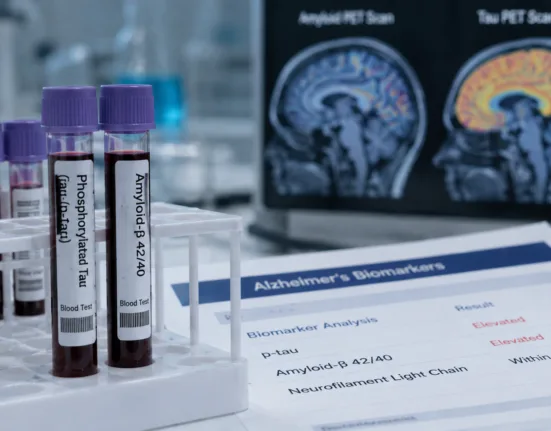
Alzheon will present nine analyses of oral valiltramiprosate, also known as ALZ-801, at the Alzheimer’s Association International Conference 2026, covering neurovascular safety, preserved brain microstructure, plasma biomarkers and long-term outcomes in people with early Alzheimer’s disease carrying two copies of APOE4. The presentations will also explore whether the investigational therapy could be used after plaque-clearing antibody treatment, extending its potential role beyond standalone disease modification.
Why does the AAIC evidence package matter after APOLLOE4 missed its primary endpoint?
The central issue surrounding valiltramiprosate is no longer whether it produces interesting imaging signals. The more consequential question is whether those biological signals can be connected convincingly to a clinically meaningful treatment effect. APOLLOE4 did not demonstrate statistically significant improvement on its primary cognitive endpoint across the combined population of patients with mild cognitive impairment and mild Alzheimer’s dementia. Secondary clinical measures also failed to establish significant efficacy in the overall population.
That outcome creates a high evidentiary barrier for every subsequent analysis. New diffusion tensor imaging, volumetric magnetic resonance imaging and plasma p-tau217 findings may help explain how valiltramiprosate affects Alzheimer’s pathology, but they cannot independently erase the negative primary analysis. Regulators generally place greater weight on prospectively defined clinical outcomes than on later biomarker interpretations, particularly when multiple analyses are conducted after a trial has failed its principal statistical test.
The opportunity for Alzheon lies in the prespecified mild cognitive impairment subgroup. Participants at this earlier disease stage showed nominal improvements in cognition and function, alongside statistically significant slowing of hippocampal, cortical and whole-brain atrophy. That consistency across several domains gives the subgroup more credibility than a purely retrospective finding. However, the subgroup was much smaller than the overall trial population, its clinical p-values were nominal, and the study was not powered to confirm efficacy specifically within that narrower group.
The AAIC presentations therefore need to do more than add attractive brain images. They must demonstrate that the microstructural, volumetric and fluid biomarker effects point in the same direction, emerge in the same patients and remain associated with slower clinical deterioration over time. Even then, the likely consequence would be a stronger rationale for a confirmatory trial rather than an immediate regulatory submission based on APOLLOE4 alone.
Could valiltramiprosate’s neurovascular profile differentiate it from amyloid antibodies?
Valiltramiprosate is designed to interfere with the formation of soluble amyloid oligomers rather than recruit immune cells to remove deposited amyloid plaques. This mechanistic distinction could be important because plaque-clearing antibodies such as lecanemab and donanemab can produce amyloid-related imaging abnormalities, including brain swelling, microhemorrhages and superficial siderosis. These complications are especially relevant in APOE4 homozygotes, who also have a greater underlying burden of cerebral amyloid angiopathy.
APOLLOE4 produced an unusual safety dataset because it enrolled patients who would frequently be excluded from antibody trials because of existing microhemorrhages or other vascular imaging findings. Rates of brain edema were similar between valiltramiprosate and placebo, while new microhemorrhages and superficial siderosis were numerically less frequent with the investigational drug. The absence of an apparent treatment-related ARIA increase supports Alzheon’s claim that oligomer inhibition may avoid some of the vascular disruption associated with rapid plaque clearance.
This could become a clinically meaningful advantage if efficacy is confirmed. An oral therapy without infusion appointments and with less intensive magnetic resonance imaging surveillance could expand treatment capacity beyond specialist centres. It could also offer an alternative for genetically high-risk patients, people with extensive cerebral amyloid angiopathy or those who are unsuitable for repeated antibody infusions.
The limitation is that safety differentiation does not compensate automatically for weaker efficacy. Lecanemab and donanemab secured approvals through positive, controlled Phase 3 trials showing statistically significant slowing of clinical decline. Valiltramiprosate must ultimately meet a comparable standard of clinical evidence, even if its risk profile and administration route are more convenient. A safer medicine with uncertain benefit is not necessarily a competitive disease-modifying therapy.
Can preserved brain microstructure strengthen the disease-modification argument?
Alzheon’s diffusion tensor imaging analyses may be among the most scientifically interesting elements of the AAIC programme. Diffusion tensor imaging evaluates water movement through brain tissue and can provide indirect information about the integrity of grey matter and white matter pathways. When assessed alongside volumetric magnetic resonance imaging, it may help distinguish genuine tissue preservation from temporary fluid changes that could complicate interpretation of brain-volume measurements.
The existing APOLLOE4 analysis found that mild cognitive impairment participants receiving valiltramiprosate experienced slower hippocampal atrophy, reduced cortical thinning and less whole-brain volume loss than those receiving placebo. Changes in selected imaging measures were also correlated with changes in cognition and function at the individual participant level. The new presentations are expected to expand these correlations and examine whether preservation of hippocampal microstructure accompanies the volumetric findings.
A coherent relationship among tissue integrity, brain volume and clinical performance would strengthen the hypothesis that valiltramiprosate is slowing neurodegeneration rather than merely changing a single biomarker. Plasma p-tau217 could add another independent layer because falling phosphorylated tau levels may indicate reduced downstream Alzheimer’s pathology. Concordant effects across amyloid-related biology, tau, tissue structure and cognition would form a more persuasive disease-modification narrative.
Nevertheless, imaging correlations require cautious interpretation. Correlation does not establish that the imaging change caused the clinical difference, and subgroup correlations can become unstable when participant numbers are modest. Brain-volume endpoints have also generated debate across the anti-amyloid field because some effective plaque-clearing therapies have been associated with accelerated volume changes in particular brain compartments. The regulatory importance of Alzheon’s imaging findings will depend on prespecification, effect consistency, measurement quality and replication in another adequately powered trial.
Why could the mild cognitive impairment subgroup determine valiltramiprosate’s future?
The contrast between the mild cognitive impairment and mild dementia groups suggests that valiltramiprosate may need to be administered before neuronal damage becomes too extensive. Preventing amyloid oligomer formation is biologically more likely to preserve vulnerable synapses and neural networks when substantial viable tissue remains. Once dementia is established and downstream tau pathology, inflammation and neuronal loss have advanced, blocking new oligomer formation may be insufficient to produce measurable clinical recovery or stabilisation.
This stage-dependent pattern is not unique to valiltramiprosate. Alzheimer’s drug development has progressively shifted toward earlier symptomatic disease and even presymptomatic intervention because modifying pathology after widespread neurodegeneration has repeatedly produced disappointing results. Alzheon’s data add to this trend, but the subgroup finding also forces the developer to narrow the target population and redesign its clinical strategy.
A future pivotal study would probably need to enrol biomarker-confirmed patients at the mild cognitive impairment stage, define a tighter cognitive range and use a clinical outcome capable of capturing subtle deterioration. Requiring amyloid or tau confirmation could reduce diagnostic noise, although it would increase screening costs and complicate recruitment. Stratification by baseline vascular disease, tau burden, concomitant symptomatic treatment and other prognostic variables would also be important after the heterogeneity observed in APOLLOE4.
Restricting development to early-stage APOE4 homozygotes creates a precision-medicine opportunity but also limits the initial commercial population. The genotype represents a meaningful segment of Alzheimer’s disease, yet the eligible market would become smaller after excluding patients with established dementia, uncertain biomarker status or medical factors affecting trial participation. Commercial viability would therefore depend on strong clinical differentiation, efficient genetic testing and identification of patients before significant functional decline.
Could oral maintenance after antibody therapy create a separate commercial pathway?
One of Alzheon’s more forward-looking AAIC analyses models valiltramiprosate as maintenance treatment after patients complete plaque-lowering therapy with lecanemab or donanemab. The concept recognises that antibody treatment may not need to continue indefinitely once amyloid has been substantially reduced, particularly as treatment protocols evolve toward less frequent maintenance dosing or discontinuation after achieving a defined plaque threshold.
An oral oligomer inhibitor could theoretically suppress the reformation of toxic soluble amyloid species after plaque clearance, allowing patients to move from resource-intensive antibody treatment to a simpler long-term regimen. Such a sequence could reduce infusion-centre demand, lessen continuing ARIA exposure and create a broader role for valiltramiprosate even if it does not replace antibodies as initial treatment.
For the pharmaceutical industry, this positioning could be strategically attractive. Alzheon would not need to prove that its small molecule clears plaques more effectively than established antibodies. It could instead demonstrate that the medicine maintains biological control after antibody-induced clearance and delays renewed clinical progression. Combination or sequential treatment models are likely to become increasingly relevant as Alzheimer’s care develops beyond single-drug competition.
However, the current maintenance argument is based on quantitative systems pharmacology rather than prospective clinical evidence. Mathematical modelling can generate testable hypotheses, but it cannot determine whether patients remain stable after switching therapies. A controlled clinical trial would need to define when antibody therapy ends, confirm baseline plaque reduction, track amyloid reaccumulation and measure clinical outcomes over several years. Drug interactions, adherence and the optimal duration of oral treatment would also remain unresolved.
What must Alzheon’s long-term extension results prove beyond short-term imaging changes?
Long-term extension studies are important in a slowly progressive condition because differences in cognition and function may become more visible over several years. Alzheon plans to report sustained outcomes extending beyond the original 78-week trial, including data suggesting continued Clinical Dementia Rating Sum of Boxes benefit in mild cognitive impairment and favourable safety over treatment periods approaching four years.
Durability would address one of the major uncertainties raised by the original trial. A transient imaging difference is less persuasive than a treatment effect that remains associated with slower functional decline as Alzheimer’s pathology advances. Long exposure also provides a larger window for detecting uncommon safety events, persistent gastrointestinal intolerance and adherence problems associated with twice-daily oral dosing.
Extension studies, however, are vulnerable to substantial bias. Participants who tolerate treatment and remain healthy enough to continue are not necessarily representative of the original randomised population. Dropout, treatment selection and the absence of a continuing blinded placebo comparator can exaggerate apparent stability. Comparisons against projected decline or historical controls are informative but cannot match the evidentiary strength of long-term randomised treatment.
The most useful AAIC disclosures will therefore include participant disposition, retention rates, baseline differences between continuers and non-continuers, handling of missing data and the comparator used to estimate sustained benefit. Without that information, claims of multi-year clinical stability may remain hypothesis-generating rather than confirmatory.
What will clinicians, regulators and Alzheimer’s drug developers watch after AAIC 2026?
The presentations could establish valiltramiprosate as one of the more differentiated oral candidates in Alzheimer’s development, particularly for APOE4 homozygotes who face elevated vascular risks with plaque-clearing antibodies. The combination of oral administration, low apparent ARIA liability and multimodal biomarker effects gives the programme a plausible clinical and commercial rationale.
The decisive issue remains prospective confirmation. Alzheon needs a trial designed specifically around the population that appeared to benefit, rather than relying on a favourable subgroup from a broader study that missed its primary endpoint. Clear biomarker entry criteria, sufficient statistical power, prespecified multiplicity control and clinically interpretable endpoints will determine whether valiltramiprosate can move from an intriguing precision-medicine programme to a viable registration candidate.
AAIC 2026 may clarify the drug’s mechanism and refine its development path, but it is unlikely to resolve the central efficacy question by itself. The strongest outcome for Alzheon would be a tightly aligned package in which neurovascular safety, p-tau217 reduction, preservation of microstructure, slower atrophy and sustained clinical performance all support the same early-stage treatment hypothesis. The next confirmatory study must then prove that the hypothesis holds in a new population under a statistical framework capable of supporting regulatory review.