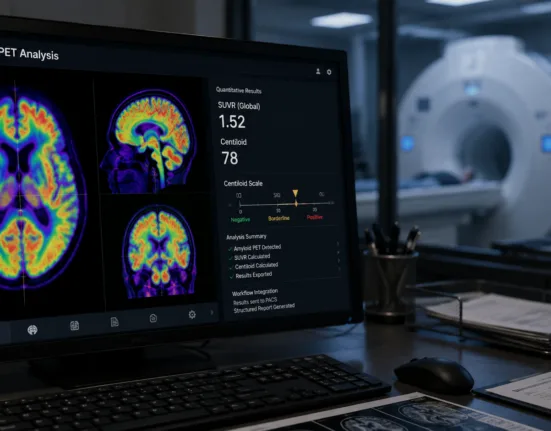
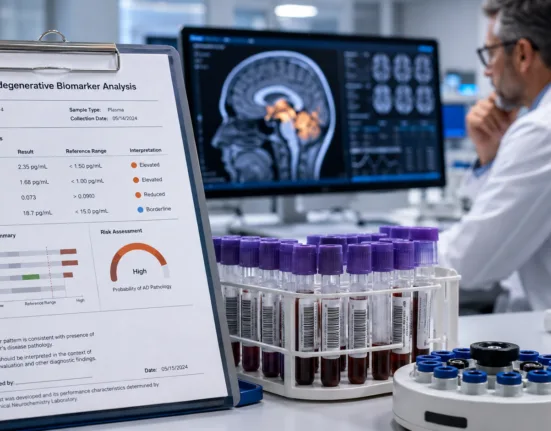
For decades, confirming the biological hallmarks of Alzheimer’s disease often required a positron-emission tomography scan or analysis of cerebrospinal fluid obtained through lumbar puncture. Both approaches are clinically useful but difficult to scale across the enormous population experiencing memory complaints, particularly outside specialist centers. Blood biomarkers are beginning to change that diagnostic architecture by detecting proteins associated with amyloid and tau pathology from an ordinary venous sample, potentially allowing clinicians to identify patients who need more specialized evaluation without sending everyone directly for advanced imaging or an invasive procedure.
The regulatory transition became concrete in May 2025 when FDA cleared Fujirebio Diagnostics’ Lumipulse G pTau217/beta-Amyloid 1-42 Plasma Ratio, the first blood-based in-vitro diagnostic device authorized in the United States to aid assessment of Alzheimer’s disease. The clearance was not for indiscriminate screening of healthy adults: FDA authorized the test for people aged 55 and older who have signs and symptoms of cognitive decline and emphasized that results must be interpreted alongside other clinical information.
What does p-tau217 have to do with Alzheimer’s disease?
Alzheimer’s disease is biologically characterized by accumulation of amyloid-beta plaques and abnormal tau pathology in the brain. Phosphorylated tau species measured in blood, particularly p-tau217, have emerged as strong biomarkers associated with Alzheimer’s-type amyloid and tau changes.
The Lumipulse blood test measures p-tau217 and beta-amyloid 1-42 in plasma and calculates a ratio intended to predict whether amyloid plaques are present. This approach does not visualize the brain directly. Instead, it uses measurable molecular signals in blood that correlate strongly with pathology established using amyloid PET or cerebrospinal-fluid testing.
That distinction matters because a biomarker test is answering a biological question rather than directly measuring memory or cognition. A person can have amyloid pathology without all cognitive impairment being caused by Alzheimer’s, while dementia itself can result from vascular disease, Lewy body disease, frontotemporal degeneration and other processes.
How accurate was the first FDA-cleared blood test?
FDA evaluated the Lumipulse assay using samples from 499 cognitively impaired adults in a multicenter study. Among people with a positive Lumipulse result, 91.7% had amyloid pathology confirmed through PET or cerebrospinal-fluid testing. Among people with a negative result, 97.3% had a negative amyloid PET or CSF result, while fewer than 20% of patients fell into the assay’s indeterminate category.
Those figures illustrate why the test can reduce reliance on PET and lumbar puncture, but they also show why it cannot function as an infallible stand-alone diagnosis. False positives can lead clinicians toward an incorrect Alzheimer’s explanation for cognitive decline, while false negatives can delay an appropriate diagnosis or trigger additional testing.
Predictive values also depend on the population being tested. A test used in a specialist memory clinic where Alzheimer’s pathology is relatively common will perform differently as a diagnostic pathway than the same test applied indiscriminately to young or asymptomatic people where disease prevalence is low.

Why did FDA explicitly say the test is not for population screening?
Screening asks a different clinical question from diagnosis. A diagnostic test is being used in someone who already has symptoms and therefore a meaningful prior probability of disease. Population screening would expose large numbers of asymptomatic people to testing, many of whom may have biomarker changes years before developing clinically important cognitive impairment.
A positive amyloid-associated blood result in a healthy person could therefore create uncertainty rather than an immediately useful treatment decision. Some individuals with amyloid pathology may never progress to dementia during their lifetime, particularly when pathology is detected at older ages or competing diseases intervene.
FDA consequently stated that the Lumipulse plasma test is not intended as a screening or stand-alone diagnostic test. Its authorized role is to assist clinicians evaluating symptomatic adults in specialized care settings, where clinical history, cognitive assessment and additional tests remain part of diagnosis.
Why are Alzheimer’s drugs making better blood diagnostics more valuable?
The value of biological diagnosis increases when the biological subtype changes treatment. Anti-amyloid medicines require evidence that amyloid pathology is actually present, turning biomarker confirmation from an academic classification exercise into part of therapeutic decision-making.
PET and CSF can provide that confirmation but create capacity constraints if every potentially eligible patient requires specialist imaging or lumbar puncture. Blood testing could act as a triage layer, identifying people with a sufficiently clear positive or negative result while reserving more expensive or invasive testing for indeterminate cases or circumstances where treatment decisions require additional confirmation.
This could substantially change memory-clinic workflows. Instead of neurologists receiving referrals after months of sequential testing, primary or specialty clinics may eventually obtain validated blood biomarkers earlier and refer patients according to biological probability.
Why are p-tau217 tests attracting more attention than older blood biomarkers?
Alzheimer’s research has investigated numerous blood proteins, including amyloid-beta species, neurofilament light chain and glial fibrillary acidic protein. Some indicate neurodegeneration or glial injury but are not sufficiently specific to Alzheimer’s pathology on their own.
p-tau217 has emerged as one of the strongest blood correlates of Alzheimer’s-type pathology, and research in 2026 continues extending its possible uses beyond conventional venous sampling. Nature Medicine reported that capillary p-tau217 measurements correlated with venous measures and accurately classified amyloid burden in a study examining minimally invasive sampling, raising the possibility that future biomarker collection could occur outside specialist phlebotomy settings.
That remains research rather than a blanket authorization for home Alzheimer’s diagnosis. The direction is nevertheless important because diagnostic scalability depends not only on assay accuracy but also on how easily samples can be collected, transported and analyzed.
Could one blood result predict when symptoms will start?
Research is increasingly examining whether quantitative biomarker levels contain prognostic information in addition to identifying current pathology. Nature Medicine highlighted 2026 work suggesting that plasma p-tau217 measurements could help predict timing of symptomatic Alzheimer’s disease, while population studies are beginning to use blood biomarkers to estimate pathology prevalence outside conventional memory-clinic cohorts.
Prediction is more demanding than diagnosis. Biological progression varies substantially between individuals, and converting one concentration into a personalized estimate of when cognitive decline will occur introduces uncertainty that can have major psychological consequences.
For this reason, future biomarker use may require different validated thresholds according to the clinical question. A test optimized for ruling out amyloid pathology in symptomatic patients is not automatically validated for predicting dementia ten years before symptoms.
What could go wrong as Alzheimer’s blood testing becomes routine?
Laboratory variability is one concern. Different assays may measure different tau epitopes or amyloid combinations, use different analytical platforms and apply different thresholds, meaning the phrase “an Alzheimer’s blood test” does not describe one interchangeable diagnostic product.
Comorbid disease can also influence biomarkers. Kidney function, age and other biological factors can alter circulating protein concentrations, while emerging work has even found that phosphorylated tau can rise in certain systemic amyloidoses, reinforcing the need to interpret biomarker results within a complete clinical context.
The greatest risk may be overconfidence. A highly accurate blood biomarker can feel simpler than a PET scan and therefore easier to treat as definitive, yet FDA’s first clearance explicitly preserved the need for clinical interpretation and additional evaluation where appropriate.
Will blood tests eventually replace Alzheimer’s PET and spinal-fluid testing?
They are more likely to change how often those tests are needed than eliminate them entirely. A patient with a clearly negative blood result may avoid further amyloid testing in some pathways, while a strongly positive result could substantially increase diagnostic confidence. Indeterminate or discordant cases may still require PET or CSF, and research settings will continue using advanced biomarkers to characterize disease in greater detail.
The most important change is scalability. Alzheimer’s disease is moving toward a biological diagnostic model at exactly the same time disease-modifying therapies require clinicians to identify pathology earlier. It is difficult to build that model around expensive scanners and specialist lumbar punctures alone.
Blood biomarkers offer a way to move the first stage of biological classification much closer to ordinary clinical care. Their success will depend on keeping the distinction between accessible and simplistic clear: drawing blood is easy, but deciding what one molecular result means for an individual patient remains a clinical problem considerably more complex than the sample itself.