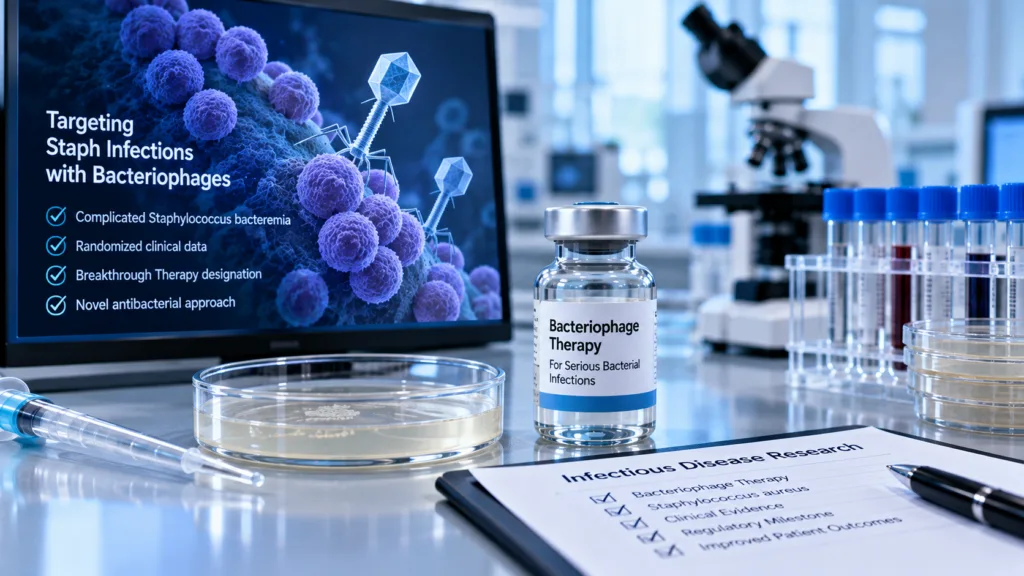
Armata Pharmaceuticals Inc. has received United States Food and Drug Administration Breakthrough Therapy designation for AP-SA02 as adjunct treatment for complicated Staphylococcus aureus bacteremia caused by either methicillin-sensitive or methicillin-resistant strains, providing the company’s bacteriophage platform with its strongest regulatory validation to date. The designation is supported by randomized Phase 1b/2a diSArm data in which AP-SA02 was added to best available antibiotic therapy rather than used as a replacement for standard antibacterial treatment.
The FDA decision does not constitute approval and does not establish that AP-SA02 improves survival or clinical cure in a broader patient population. Breakthrough Therapy designation is available when preliminary clinical evidence indicates that a medicine intended for a serious or life-threatening condition may offer substantial improvement over available therapy on clinically significant endpoints.
AP-SA02 already held Fast Track and Qualified Infectious Disease Product designations, giving Armata Pharmaceuticals several mechanisms for closer FDA interaction and potentially expedited development. The company is now preparing for a planned Phase 3 study, where a much larger randomized dataset will determine whether the bacteriophage signal survives confirmatory testing.
The program could become important beyond one bloodstream infection because bacteriophage therapy has spent decades on the margins of Western drug development. A successful pivotal program would help establish whether precisely manufactured phage cocktails can become conventional regulated antibacterial medicines rather than treatments used mainly through experimental or compassionate-access pathways.
What exactly is AP-SA02 and why use several bacteriophages instead of one?
Bacteriophages are viruses that infect bacteria rather than human cells. They attach to susceptible bacteria, introduce genetic material and replicate using the bacterial machinery, eventually causing bacterial destruction and releasing additional phage particles capable of attacking nearby organisms.
AP-SA02 is a fixed multi-phage product directed against Staphylococcus aureus. Armata Pharmaceuticals says its component phages collectively demonstrate activity against approximately 95% of tested clinical S. aureus isolates, including both methicillin-sensitive and methicillin-resistant strains.
Using multiple phages is intended partly to widen strain coverage and reduce the risk that bacteria are intrinsically resistant to the treatment. A bacterium that evades one phage may remain susceptible to another member of the cocktail.
The approach may also make it harder for resistance to emerge during therapy because several different viral pressures are being applied simultaneously. Bacteria can nevertheless evolve resistance to bacteriophages, so susceptibility and resistance dynamics will remain important as clinical exposure expands.
The commercial product also needs to remain standardized. Unlike personalized phage therapy, where individual phages may be matched to one patient’s isolate, AP-SA02 is intended as a predefined manufactured cocktail that can be stocked and administered rapidly.
That standardization is essential in bacteremia because patients with serious bloodstream infections cannot necessarily wait days for bespoke laboratory matching and production.
What did the randomized diSArm study show about adding AP-SA02 to antibiotics?
The diSArm trial was a multicenter, randomized, double-blind and placebo-controlled Phase 1b/2a study examining intravenous AP-SA02 in adults with complicated S. aureus bacteremia. All patients continued to receive best available antibiotic therapy, with the experimental group receiving AP-SA02 and the control group receiving placebo.
The Phase 2a portion enrolled 42 patients, including 29 assigned to AP-SA02 plus antibiotics and 13 assigned to placebo plus antibiotics. Methicillin-resistant S. aureus accounted for approximately 38% of infections in both treatment groups, giving the trial direct relevance to antibiotic-resistant disease as well as complicated methicillin-sensitive infections.
AP-SA02 was administered intravenously every six hours for five days. Armata Pharmaceuticals reported that this intensive dosing schedule was generally well tolerated and that no serious adverse event was attributed to the phage product.
The clinically interesting finding came during follow-up. At the end-of-study assessment, performed four weeks after completion of intravenous antibiotic therapy, Armata reported that all AP-SA02-treated patients reaching that assessment maintained clinical response without relapse, compared with 75% of placebo-treated patients.
Patients receiving AP-SA02 also showed favorable trends in markers including C-reactive protein and interleukin-10, which can reflect inflammatory activity and disease severity.
The study is still too small to establish a definitive treatment effect. With relatively few participants, several additional relapses or nonresponses could materially change the observed percentages, which is exactly why confirmatory Phase 3 testing is necessary.
Why is complicated Staphylococcus aureus bacteremia so difficult to treat even when antibiotics work in the laboratory?
Staphylococcus aureus bloodstream infection can seed bacteria into multiple tissues, including heart valves, bone, joints, implanted medical devices and deep abscesses. Patients can therefore remain at risk even after blood cultures become negative.
Biofilms create an additional problem. S. aureus can organize within protective extracellular structures on catheters, prosthetic joints, cardiac devices and damaged tissue, reducing antibiotic penetration and altering bacterial metabolism in ways that make eradication more difficult.
This helps explain why complicated bacteremia requires prolonged antibiotic treatment and careful investigation for metastatic sites of infection. Source control, including removal of infected devices or drainage of abscesses, can be as important as antimicrobial selection.
MRSA creates the additional problem of resistance to beta-lactam antibiotics traditionally used against sensitive strains. Effective alternatives exist, but persistent bacteremia, treatment toxicity and relapse continue to occur despite guideline-based therapy.
Armata Pharmaceuticals is not proposing that bacteriophages eliminate the need for those measures. AP-SA02 is being developed as an adjunct, meaning antibiotics and appropriate source control remain foundational.
The scientific rationale is that phages can attack bacteria through a mechanism entirely different from conventional antibiotics and may penetrate S. aureus biofilms. That could potentially help clear difficult bacterial reservoirs that contribute to persistent infection or recurrence.
Why is the absence of serious phage-related toxicity important?
One historical concern around intravenous bacteriophage therapy is whether repeated administration of biological particles could produce substantial immune reactions. AP-SA02 was given every six hours over five days, generating repeated systemic exposure rather than a single experimental dose.
Armata Pharmaceuticals reported no serious adverse events attributed to AP-SA02. Two adverse events were considered potentially treatment related in the development program, including transient liver enzyme elevation and a hypersensitivity event that resolved after discontinuation of vancomycin.
A larger trial is still necessary to define uncommon adverse events. Patients with complicated bacteremia are already severely ill and frequently receive several drugs, making attribution of fever, organ dysfunction or laboratory abnormalities difficult.
Phage preparations also place unusually high demands on manufacturing purity. Bacteriophages are amplified using bacterial hosts, creating a need to remove bacterial components such as endotoxins and other contaminants before intravenous administration.
Armata Pharmaceuticals says its proprietary manufacturing process produces high-purity, high-titer material suitable for repeated intravenous dosing. Consistent production at Phase 3 and eventual commercial scale will therefore be a central part of regulatory development.
Could phages work synergistically with antibiotics rather than merely adding another antibacterial agent?
Combining bacteriophages with antibiotics creates several potential biological advantages. The two modalities attack bacteria differently, reducing dependence on one mechanism and potentially limiting the ability of resistant subpopulations to dominate treatment.
Certain bacterial mutations that confer resistance to a phage can also produce biological trade-offs. For example, altering a surface structure needed for phage attachment may reduce bacterial virulence or change antibiotic susceptibility.
Phages also replicate preferentially where susceptible bacteria are present. This characteristic creates the theoretical possibility of local amplification at the site of infection, although the pharmacology of therapeutic phages in humans is much more complicated than describing them as self-replicating drugs.
The diSArm study does not establish the precise contribution of each mechanism. Because patients received antibiotics in both arms, the clinical signal measures the incremental effect of adding AP-SA02 rather than the independent activity of phages.
That design is appropriate for complicated bacteremia because withholding effective antibiotics simply to test bacteriophage monotherapy would generally be difficult to justify.
If Phase 3 succeeds, the practical treatment paradigm is therefore likely to involve phages alongside conventional antibiotics rather than a wholesale replacement of antibacterial drugs.
Why does Breakthrough Therapy designation matter for Armata Pharmaceuticals’ Phase 3 strategy?
Breakthrough Therapy status provides more intensive interaction with FDA review teams and senior agency involvement intended to make development more efficient when the available evidence supports that approach. Armata Pharmaceuticals can use those interactions to refine the confirmatory trial, statistical plan, manufacturing package and eventual regulatory submission.
The company has already received FDA agreement on an initial pediatric study plan, another requirement relevant to future Biologics License Application planning. AP-SA02 also carries QIDP designation, reflecting the public-health importance of developing treatments for serious bacterial infections.
These designations should not be confused with evidence that FDA has predetermined the result of a future application. A Phase 3 trial still needs to reproduce the clinical benefit with adequate statistical power and a sufficiently characterized safety profile.
Endpoint selection will be crucial. S. aureus bacteremia can be assessed through mortality, clinical response, persistent infection, microbiological clearance and relapse, with the relevance of each measure varying over time.
Armata Pharmaceuticals has suggested that a future program could potentially demonstrate superiority over best available therapy rather than simply non-inferiority. Such a result would be commercially important, but the company must first establish that the large apparent difference seen in the smaller diSArm study is reproducible.
Could AP-SA02 establish a regulatory template for other bacteriophage products?
That may ultimately be one of the most consequential implications of the program. Modern bacteriophage development faces questions involving product composition, potency assays, resistance, manufacturing consistency and what happens if one phage component needs to be updated.
A successful AP-SA02 approval process could provide practical precedent for how regulators treat fixed multi-phage cocktails manufactured as biologic medicines. Other developers could benefit indirectly from greater clarity around acceptable trial designs and chemistry, manufacturing and controls requirements.
Armata Pharmaceuticals itself has additional phage programs targeting Pseudomonas aeruginosa and other difficult infections. Manufacturing capabilities developed for AP-SA02 could therefore support a broader antibacterial pipeline.
The larger market opportunity is connected to antimicrobial resistance. Phages will not solve antibiotic resistance broadly because they are usually highly specific to particular bacteria, but that specificity can be useful when the pathogen is known and conventional options are failing.
Commercial economics will still be challenging. Acute infectious-disease drugs are administered for relatively short periods, while developing and manufacturing biologic products is expensive. Reimbursement and appropriate pricing will therefore have to reflect the clinical value of preventing relapse, prolonged hospitalization or severe complications.
What does the market reaction suggest about investor expectations?
Armata Pharmaceuticals shares had closed September 11 at $5.38, within a broad 52-week range of $2.86 to $16.34. The shares rose roughly 8% in early trading following the Breakthrough Therapy announcement, indicating that investors recognized the designation as additional regulatory de-risking.
The stock remains highly volatile, which is unsurprising for a smaller biotechnology company whose valuation depends heavily on one late-stage clinical program. Phase 3 design, financing needs and the timing of a potential Biologics License Application will remain material valuation variables.
Armata Pharmaceuticals has received external financial support for AP-SA02 development, including a $28.7 million award connected with U.S. Department of War-supported infectious-disease research. That reduces some development burden but does not eliminate the capital required for a pivotal trial, manufacturing scale-up and eventual commercialization.
Breakthrough Therapy designation can potentially make the path more efficient, but it cannot remove the core development risk.
What would make the planned Phase 3 trial genuinely convincing?
The pivotal study needs to reproduce improved clinical response and lower relapse rates across a larger and more diverse group of patients with complicated S. aureus bacteremia. Maintaining benefit in both MRSA and methicillin-sensitive infection would strengthen the commercial proposition.
Mortality, persistent bacteremia, metastatic infection and readmission may provide additional context beyond a composite clinical response. Investigators will also need to control for antibiotic choice, infection source and source-control procedures because those factors independently influence outcomes.
Safety must remain favorable with repeated intravenous dosing, and manufacturing needs to demonstrate that commercial-scale lots preserve the activity and purity of the product used in earlier trials.
The Phase 2 signal is encouraging precisely because it came from a randomized placebo-controlled comparison rather than uncontrolled compassionate use. It is still a small dataset, however, and the history of drug development is full of large apparent Phase 2 effects that became much smaller in confirmatory studies.
AP-SA02 has now advanced beyond the question of whether bacteriophage therapy can be administered experimentally to seriously ill patients. Armata Pharmaceuticals is approaching the more consequential test of whether a standardized phage cocktail can improve outcomes on top of modern antibiotics strongly enough to become an FDA-approved treatment. A successful Phase 3 program would therefore matter not only for complicated Staphylococcus aureus bacteremia, but for the credibility of bacteriophages as a mainstream pharmaceutical class.