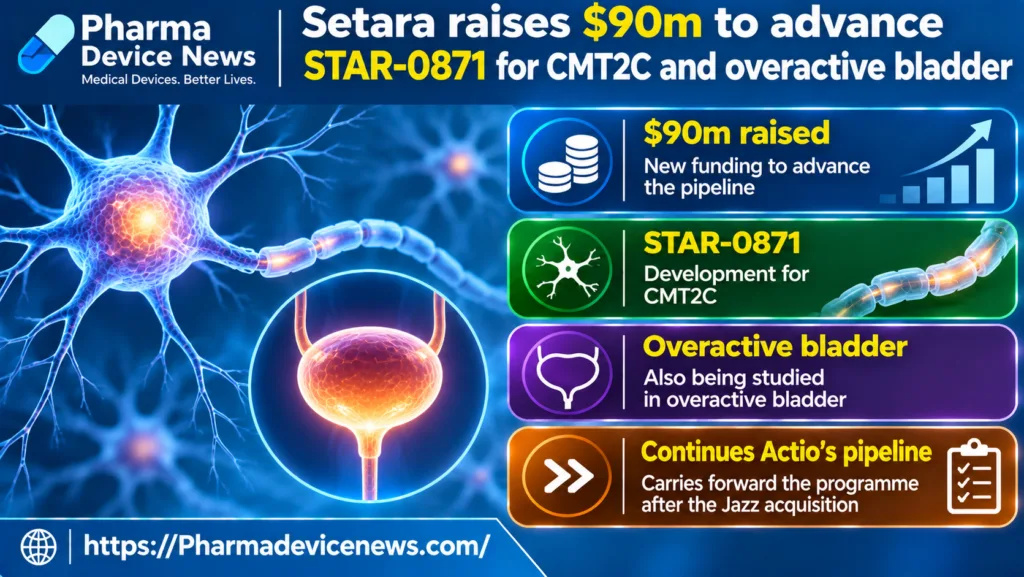
Setara Biosciences, Inc. has completed a $90 million Series A financing to advance precision medicines for rare genetic disorders and related conditions affecting larger patient populations. Announced on October 30, 2026, the San Diego biotechnology developer was established following Jazz Pharmaceuticals plc’s acquisition of Actio Biosciences, with Setara assuming responsibility for selected development programmes not acquired as part of Jazz’s lead epilepsy asset strategy.
The new company will prioritise STAR-0871, formerly known as ABS-0871, an investigational oral inhibitor of the TRPV4 ion channel being developed for Charcot-Marie-Tooth disease type 2C and overactive bladder. The asset has completed the healthy-volunteer portion of Phase 1 clinical testing, and Setara plans to initiate a Phase 1b study in patients with the inherited neurological disorder in 2027. A separate Phase 2a study in overactive bladder is also planned, allowing the company to investigate whether the same molecular target has applications beyond the original rare disease programme.
The financing was supported by Deerfield Management, Canaan, Droia Ventures, EcoR1, Euclidean Capital and Regeneron Ventures, with Jazz Pharmaceuticals also participating as a shareholder following the Actio transaction. However, STAR-0871 has not demonstrated clinical efficacy in patients with CMT2C or overactive bladder, and Setara has not received marketing approval for any medicine. The commercial opportunity remains dependent on translating a genetically supported disease mechanism into meaningful clinical outcomes.
Why has Setara Biosciences emerged following Jazz Pharmaceuticals’ acquisition of Actio Biosciences?
Setara Biosciences was formed through a corporate restructuring associated with Jazz Pharmaceuticals’ acquisition of Actio Biosciences. Jazz completed the acquisition on September 15, 2026, paying $820 million upfront to gain control of Actio and its lead investigational programme, ABS-1230. The transaction also includes up to $500 million in potential approval and sales milestone payments.
ABS-1230 is an investigational small-molecule inhibitor of the KCNT1 ion channel being developed for rare genetic epilepsies. Jazz acquired the programme to strengthen its development activities in severe neurological diseases, particularly conditions associated with difficult-to-control seizures. The candidate remains within Jazz’s acquired Actio business rather than Setara’s lead portfolio.
Setara was created to advance the remaining programmes and associated development capabilities. The restructuring allowed the original Actio scientific and management team to continue investigating additional genetics-driven therapeutic opportunities independently. Jazz retained a minority ownership position in the new business, providing continuity between the acquisition and subsequent spinout.
The arrangement illustrates a model in which a pharmaceutical acquisition can generate both an immediate strategic transaction and a separately financed biotechnology venture. Jazz obtained the asset most closely aligned with its epilepsy portfolio, while the remaining programmes were placed within a company structured to pursue further development. However, the $820 million acquisition consideration should not be interpreted as Setara’s valuation or the amount of capital transferred to the spinout.
Setara’s independent financing provides resources for development programmes that might otherwise have competed for investment within the acquired business. Whether this structure creates additional value will depend on the clinical progress of STAR-0871 and the commercial viability of the broader pipeline.
How will the $90 million Series A financing support Setara’s development of STAR-0871?
The financing is intended to advance Setara’s lead clinical asset and support earlier discovery programmes. STAR-0871 is already beyond the initial stage of human exposure assessment, making further patient studies a near-term priority. The company plans to use the funding to pursue clinical development in CMT2C and overactive bladder while maintaining work on additional genetic disease targets.
The investment syndicate includes several healthcare-focused venture capital organisations with experience supporting biotechnology research and development. Deerfield Management, Canaan, Droia Ventures, EcoR1, Euclidean Capital and Regeneron Ventures participated alongside Jazz Pharmaceuticals. The announcement does not identify a single lead investor or disclose the equity percentage acquired by each participant.
The transaction also establishes an institutional investor base for a business that has only recently emerged as an independent entity. This could support future strategic decisions involving additional clinical programmes, partnerships or financing. However, the availability of venture capital does not eliminate the substantial expenditure associated with mid-stage and late-stage pharmaceutical development.
Setara has not disclosed its post-money valuation or provided a detailed allocation of the $90 million among individual programmes. It also has not stated how long the funding is expected to support operations. Consequently, the financing cannot be translated into a reliable estimate of the company’s development runway.
The immediate value lies in supporting advancement of a clinical-stage asset while the company builds an independent operating structure. The longer-term return will depend on whether the candidate demonstrates sufficient clinical benefit to justify further investment.
How does STAR-0871 target the TRPV4 ion channel responsible for Charcot-Marie-Tooth disease type 2C?
Charcot-Marie-Tooth disease type 2C, or CMT2C, is a rare inherited neurological disorder associated with pathogenic variants in the TRPV4 gene. The condition affects peripheral nerves involved in movement and sensation, producing symptoms that can include progressive muscle weakness, walking difficulties and impaired motor function. Some patients also develop respiratory or vocal cord complications.
TRPV4 encodes a calcium-permeable ion channel that responds to several mechanical, chemical and physiological stimuli. The channel participates in cellular processes involving calcium signalling, which influences numerous functions within the nervous system and other tissues. Certain disease-associated mutations cause excessive TRPV4 activity, disrupting normal neuronal function.
STAR-0871 is an oral small-molecule inhibitor designed to reduce TRPV4 activity. By targeting the overactive channel, the medicine seeks to address the biological consequence of the underlying genetic defect. This differs from treatments focused exclusively on managing symptoms such as weakness or mobility impairment.
The mechanism is particularly attractive because the disease-associated variants generally produce gain-of-function effects. In principle, inhibiting the channel could counteract the abnormal activity that contributes to nerve dysfunction. However, the biological relationship between reduced channel activity and functional recovery in patients remains to be established.
The candidate is intended to act on the TRPV4 protein rather than correct the DNA sequence itself. Its effectiveness could therefore depend on how much pathological activity can be suppressed at tolerable doses and whether existing nerve damage is reversible. The distinction between preventing further deterioration and restoring lost function will become important during clinical evaluation.
Why is CMT2C a challenging condition for clinical development and treatment measurement?
Charcot-Marie-Tooth disease encompasses a broad family of inherited peripheral neuropathies with different genetic causes and disease mechanisms. CMT2C is one of the rarer forms and is associated specifically with TRPV4-related dysfunction. Its symptoms can vary considerably between affected individuals, creating difficulties for patient selection and outcome assessment.
The disorder can involve weakness in the hands, feet and other muscle groups, along with abnormalities in gait and balance. Vocal fold weakness may cause changes in speech or breathing difficulties, while respiratory involvement can introduce additional complications. The severity and pattern of disease may differ even among individuals carrying variants in the same gene.
Setara estimates that approximately 2,500 individuals in the United States have CMT2C. This figure provides an indication of the potential rare disease population, although the actual number of genetically diagnosed and treatment-eligible patients may be smaller. Underdiagnosis and variation in clinical presentation could influence the ability to identify participants for clinical studies.
A successful trial must determine whether treatment produces changes beyond normal variability in disease progression. Measures involving strength, motor function, respiratory performance or other relevant outcomes may be considered depending on the study population. However, the October announcement does not disclose the complete planned endpoint framework for the patient study.
Longer-term follow-up will also be important because the disease can progress gradually. A short study may demonstrate pharmacological activity without establishing whether nerve function or daily activities improve meaningfully. The development programme will need to balance the requirements of a small rare disease population with the need for clinically persuasive evidence.
What does completion of the healthy-volunteer Phase 1 study establish about STAR-0871?
Setara has confirmed that the healthy-volunteer portion of a Phase 1 study of STAR-0871 has been completed. This represents an important step in understanding the compound’s initial safety, tolerability and pharmacological characteristics in humans. It also provides a foundation for deciding how the medicine should be evaluated in patients with TRPV4-related disease.
However, the company has not disclosed detailed numerical safety results from the completed healthy-volunteer investigation. Adverse-event rates, maximum tolerated dose, pharmacokinetic parameters and exposure-response relationships were not provided in the October announcement. The completion of the study should therefore not be interpreted as proof that every dose is safe or that a therapeutic regimen has been established.
Healthy-volunteer studies also cannot demonstrate whether the medicine improves CMT2C. Participants without the disease do not have the same underlying genetic dysfunction or neurological impairment. Clinical benefit must be evaluated in affected individuals.
The next development step will be especially important because patients may have existing neurological, muscular or respiratory complications. Such characteristics can influence both treatment evaluation and safety monitoring. A favourable profile in healthy individuals does not eliminate the need for disease-specific assessment.
The results from the completed Phase 1 component may inform dose selection and clinical trial design. However, Setara will need to provide patient data before claims about treatment efficacy or disease modification can be supported.
What will the planned THERON Phase 1b trial investigate in patients with CMT2C?
Setara intends to initiate the THERON Phase 1b study in patients with CMT2C in 2027. The programme is expected to move STAR-0871 from initial healthy-volunteer testing into a population with genetically defined disease. This transition is important because it will allow researchers to examine the medicine’s effects in the biological setting for which it was originally developed.
The study will need to evaluate safety and tolerability while investigating whether TRPV4 inhibition produces measurable pharmacological or clinical effects. Depending on the final protocol, researchers may examine functional outcomes, disease characteristics and biomarkers associated with target engagement. The October announcement does not specify the complete endpoint list, planned enrolment or treatment duration.
The company has also disclosed that STAR-0871 received Rare Pediatric Disease, Orphan Drug and Fast Track designations from the United States Food and Drug Administration for its rare disease development programme. These designations recognise aspects of the condition and development opportunity but do not establish the medicine’s efficacy. They also do not represent approval for routine treatment.
Fast Track designation can facilitate communication with the FDA and provide access to certain development and review mechanisms when relevant criteria are satisfied. Orphan Drug designation may offer development incentives, while Rare Pediatric Disease designation relates to the applicable rare disease framework. None removes the requirement for adequate safety and efficacy evidence.
A successful Phase 1b study could help determine whether further controlled evaluation is warranted. However, the probability of regulatory approval will depend on the quality of subsequent clinical results. At present, the development programme remains focused on establishing whether the genetically supported mechanism produces meaningful effects in patients.
Why is Setara also pursuing overactive bladder as a broader development indication for STAR-0871?
Overactive bladder is a common clinical syndrome involving urinary urgency, often accompanied by increased frequency and nocturia, with or without urgency urinary incontinence. The condition can substantially affect quality of life, sleep and daily activity. Existing treatments include behavioural approaches and medicines that influence bladder muscle activity or associated signalling pathways.
TRPV4 has a physiological role in mechanosensation and cellular signalling, including processes relevant to bladder function. This creates a rationale for investigating whether inhibiting the channel can modify mechanisms associated with urinary urgency and abnormal bladder activity. However, the biological contribution of TRPV4 to overactive bladder is not necessarily the same as its role in inherited CMT2C.
Setara plans to initiate a Phase 2a study evaluating STAR-0871 in patients with overactive bladder. The decision reflects the company’s intention to develop medicines initially identified through rare genetic disease biology for potentially larger patient populations. The therapeutic hypothesis will need to be tested independently because most patients with overactive bladder do not have the TRPV4 mutations responsible for CMT2C.
The overactive bladder market is substantially larger than the population affected by the rare inherited neuropathy. However, this does not automatically translate into a greater probability of commercial success. The candidate would face established pharmacological treatments and alternative care options with known clinical profiles.
To compete effectively, STAR-0871 would need to demonstrate clinically meaningful improvements in urgency, frequency or other relevant outcomes alongside acceptable safety. The October announcement does not disclose human efficacy data for overactive bladder or a confirmed patient enrolment date for the planned Phase 2a study. Its potential in this indication remains a development hypothesis.
How does Setara’s rare-to-common strategy differ from conventional precision medicine development?
Precision medicine programmes often begin by identifying genetic alterations that define a subgroup of patients. Developers then design or select therapies intended to address the associated molecular abnormality. This approach can provide a clearer biological rationale than investigating a treatment in a broad population without a defined mechanism.
Setara describes its strategy as moving from rare genetic diseases towards additional conditions involving the same target biology. CMT2C offers a relatively direct relationship between pathogenic TRPV4 gain-of-function variants and disease. Overactive bladder represents a broader application in which TRPV4 may influence symptoms even without the same inherited genetic defect.
The strategy is commercially attractive because a rare disease programme may provide strong target validation while a broader indication offers access to a larger patient population. However, evidence supporting target involvement in one disorder cannot automatically establish therapeutic effectiveness in another. Different diseases may depend on the same protein through distinct biological mechanisms.
Clinical trial design must therefore reflect the specific indication rather than simply reuse evidence from the original disease programme. A rare neuropathy study might focus on motor or neurological outcomes, while an overactive bladder investigation would examine urinary symptoms and related clinical measures. Safety considerations could also differ because the intended treatment populations are substantially different.
The strategy could generate valuable scientific insights even if only one indication succeeds. However, Setara must allocate development resources between programmes with different commercial opportunities and clinical risks. The benefits of this approach will depend on whether the shared target biology proves sufficiently relevant across both settings.
Why is the company retaining Actio Biosciences’ management and genetics research expertise?
Setara is led by David Goldstein, who serves as co-founder, president and executive chair. Goldstein previously helped establish Actio Biosciences and has extensive experience in human genetics and precision drug discovery. Several members of Actio’s leadership team have transitioned to Setara, preserving experience associated with the development of the original pipeline.
The management group also includes David Breckenridge as co-founder and chief scientific officer, Pete Condon as chief business officer and Cayce Denton as chief financial officer. These roles support the combination of drug discovery, clinical development, business strategy and financial management required for an independent biotechnology company. The company has also assembled a board including representatives from its investor syndicate and experienced biomedical researchers.
Goldstein will maintain responsibilities at Jazz Pharmaceuticals at least through acceptance of the New Drug Application submission for ABS-1230, according to Setara’s announcement. This provides continuity for the acquired epilepsy programme while Setara develops independently. The arrangement reflects the ongoing relationship between the two businesses following the acquisition.
Institutional knowledge can be important when advancing programmes already supported by earlier drug discovery and clinical research. Transferring expertise may reduce the need to reconstruct scientific assumptions, manufacturing information and regulatory history from the beginning. Nevertheless, experienced leadership does not eliminate the inherent uncertainty of clinical development.
Setara’s future performance will depend on whether the team can execute patient trials, manage available capital and establish sufficient evidence to support later-stage development. The continuity of the Actio team provides an operational foundation, but the new entity must still demonstrate its own clinical and commercial progress.
What do the Jazz Pharmaceuticals acquisition and Setara financing reveal about investor interest in genetic medicine?
Jazz Pharmaceuticals’ acquisition of Actio Biosciences and the subsequent financing of Setara represent two separate investment decisions within the same scientific platform history. Jazz paid $820 million upfront to obtain an established development asset in KCNT1-related epilepsy, with additional consideration tied to future milestones. Setara’s $90 million financing supports a different portfolio focused initially on TRPV4 and selected earlier-stage programmes.
The transactions suggest that investors see value in medicines developed through genetically supported target selection. However, the financial amounts should not be interpreted as interchangeable valuations of the underlying technology. ABS-1230 and STAR-0871 have different clinical evidence packages, target populations and development requirements.
For Jazz Pharmaceuticals, the acquisition added a rare epilepsy candidate to an established neuroscience portfolio. Its minority participation in Setara provides continued exposure to other programmes without placing the entirety of their development within the acquired company. The commercial effect of that minority investment will depend on Setara’s future performance and the terms of the ownership arrangement.
For the venture investors, the opportunity is to support a newly independent clinical-stage business with a lead asset and an established research approach. The investment also creates exposure to potential development in a common condition through the overactive bladder programme. However, neither opportunity has been validated through patient efficacy results.
The $90 million financing does not establish that Setara has sufficient resources to complete all future registrational studies. Larger trials, manufacturing and potential commercial preparation could require additional investment. Future financing needs will depend on the pace and results of the clinical programmes.
What must happen before STAR-0871 can become a meaningful treatment option for CMT2C or overactive bladder?
The first requirement is successful initiation and execution of the planned patient studies. In CMT2C, researchers must establish whether selective TRPV4 inhibition produces a relevant biological effect in individuals with confirmed disease. The trial must also provide sufficient information about tolerability and dose selection to support subsequent development.
Clinical outcome measurement will be particularly important because the inherited neuropathy can produce variable combinations of weakness, sensory changes and respiratory or vocal complications. A meaningful treatment effect may involve slowing progression rather than restoring all lost function. Demonstrating such a benefit will require suitable endpoints and adequate follow-up.
The overactive bladder programme faces a different evidentiary challenge. Researchers must determine whether the proposed mechanism improves symptoms in a population without the specific pathogenic TRPV4 variants that define CMT2C. A favourable result in the rare disease study would strengthen confidence in target engagement but would not establish efficacy in overactive bladder.
Safety must be evaluated across both populations because TRPV4 participates in multiple normal physiological functions. Excessive or inappropriate inhibition could potentially produce effects outside the intended therapeutic pathway. The clinical programme will need to characterise the relationship between drug exposure, target activity and unwanted effects.
The next confirmed milestones will be the planned 2027 THERON Phase 1b study and the separate Phase 2a overactive bladder investigation. Their findings will help establish whether STAR-0871 can progress beyond target-based rationale into clinically meaningful treatment development. Until then, the programme remains a promising but unproven precision medicine opportunity.
Setara Biosciences has secured substantial financing and inherited a research portfolio with a clearly defined biological focus. The company now has an opportunity to test whether a rare genetic disease can provide the foundation for a therapeutic platform reaching larger patient populations. Its long-term value will depend on whether STAR-0871 demonstrates acceptable safety, reproducible efficacy and sufficient differentiation to justify continued clinical and commercial investment.