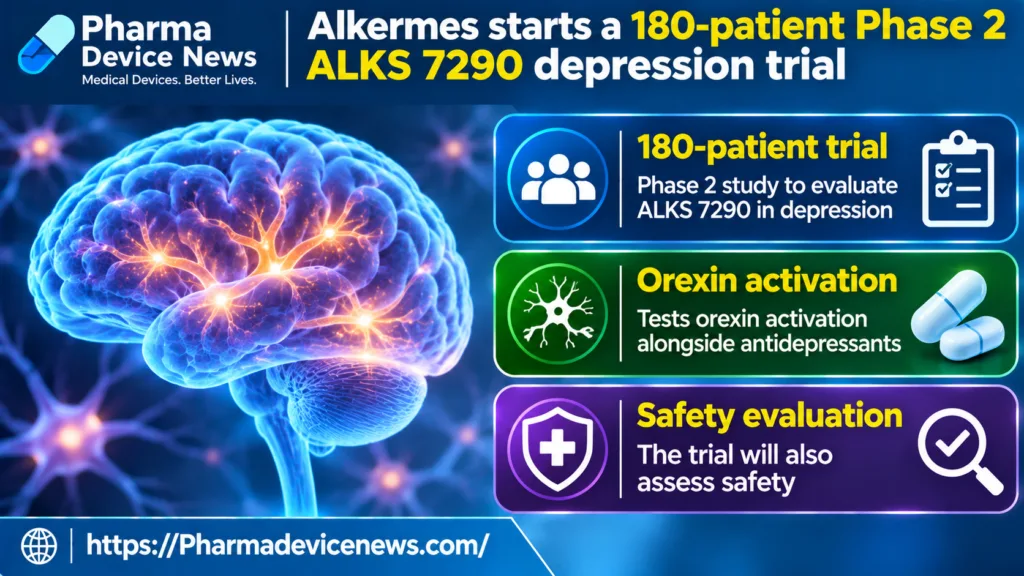
Alkermes plc (NASDAQ: ALKS) has initiated a Phase 2 clinical study evaluating ALKS 7290, an investigational oral orexin 2 receptor agonist, as an adjunctive treatment for adults with major depressive disorder. Announced on October 30, 2026, the randomised, double-blind, placebo-controlled investigation is expected to enrol approximately 180 participants and will assess whether adding ALKS 7290 to existing antidepressant treatment produces an acceptable safety profile and measurable changes in depressive symptoms.
The study represents an expansion of Alkermes’ orexin-focused neuroscience development strategy beyond sleep and attention-related disorders. ALKS 7290 is already being investigated in attention-deficit hyperactivity disorder, where an earlier Phase 1b study produced exploratory improvements in symptom assessments. The new programme will examine whether the drug’s effects on wakefulness and related neural pathways have clinical relevance in depression, including among patients who experience excessive daytime sleepiness.
However, no efficacy results from the depression study are available. Its primary objective is safety and tolerability, while depression severity assessments are secondary endpoints measured after six weeks of treatment. The programme therefore represents a proof-of-concept investigation rather than evidence that ALKS 7290 is an effective antidepressant or superior to existing augmentation strategies.
Why is Alkermes investigating orexin 2 receptor activation as an adjunctive treatment for major depressive disorder?
Major depressive disorder is a heterogeneous psychiatric condition that can involve persistent low mood, loss of interest, cognitive difficulties, disturbed sleep and changes in energy. Although established antidepressants provide meaningful benefits for many patients, some continue to experience significant symptoms despite treatment. This creates interest in approaches that address biological pathways beyond those traditionally targeted by antidepressant medicines.
The orexin system is involved in maintaining wakefulness and regulating several neural circuits associated with attention, motivation and other behavioural processes. Orexin-producing neurons are located mainly in the hypothalamus and interact with broader brain networks. Their activity can influence arousal and aspects of cognitive function, making the system a potential target for neuropsychiatric research.
ALKS 7290 is designed to activate the orexin 2 receptor, known as OX2R. Alkermes is investigating whether pharmacological activation of this pathway can produce beneficial effects in disorders associated with impaired alertness, attention or mood. However, the biological relationship between orexin signalling and depression is complex and cannot be reduced to the assumption that greater wakefulness automatically improves mood.
Craig Hopkinson, chief medical officer and executive vice-president of research and development at Alkermes, has identified the orexin pathway’s connections with attention, cognition and mood as the rationale for the new study. The company aims to investigate whether these connections translate into clinically relevant effects when ALKS 7290 is administered alongside existing antidepressants. That objective remains unproven and will require controlled patient data.
How will the 180-patient Phase 2 ALKS 7290 depression trial be designed?
The Phase 2 study, registered as NCT07901179, is designed as a randomised, double-blind, placebo-controlled investigation in adults with major depressive disorder. Participants will continue receiving standard antidepressant therapy and will be allocated to additional ALKS 7290 or placebo. The treatment period is six weeks, allowing researchers to examine short-term tolerability and preliminary symptom changes under controlled conditions.
The trial is expected to enrol approximately 180 adults, including individuals with excessive daytime sleepiness and those without that symptom. This distinction is important because excessive sleepiness could influence the clinical response to a medicine designed to activate wakefulness-related pathways. Investigators may be able to explore whether symptom patterns differ according to baseline daytime alertness.
The study’s primary objective is evaluating safety and tolerability. According to the clinical trial registry, the primary outcome concerns the incidence of treatment-emergent adverse events, with assessment extending up to eight weeks. This means the trial’s principal success criterion is not a prespecified improvement in depression scores.
Depression symptom severity will be evaluated through secondary outcomes at week six. These include change from baseline on the Montgomery–Åsberg Depression Rating Scale and the Clinical Global Impressions-Severity scale. The trial will compare participants receiving ALKS 7290 plus antidepressant therapy with those receiving placebo plus antidepressant therapy.
The controlled design should provide a stronger basis for assessing treatment-related differences than an uncontrolled study. However, the six-week duration and relatively modest sample size will limit the ability to evaluate uncommon adverse events, longer-term effectiveness and durability. Results will be most useful for deciding whether further development is justified.
What do the MADRS and CGI-S endpoints reveal about the study’s clinical objectives?
The Montgomery–Åsberg Depression Rating Scale, commonly abbreviated as MADRS, is a clinician-rated instrument used to evaluate the severity of depressive symptoms. It covers domains including reported sadness, inner tension, sleep, appetite, concentration and related experiences. The total score provides a structured way to assess changes in symptom burden over time.
The Clinical Global Impressions-Severity scale, or CGI-S, provides a broader clinician assessment of illness severity. Rather than focusing on an individual symptom, it reflects the clinician’s overall judgement of the patient’s condition. Using both instruments can provide complementary information about specific symptoms and general clinical presentation.
In the ALKS 7290 study, investigators will examine whether adding the experimental medicine produces greater improvements than continuing antidepressant therapy with placebo. This distinction is important because participants in both treatment groups may improve during the trial. The clinically relevant question is whether ALKS 7290 provides a measurable incremental benefit beyond the background treatment.
Interpretation will also depend on how much of any observed improvement reflects changes in sleepiness or alertness. A medicine that helps patients feel more awake may influence certain symptom ratings without necessarily affecting the broader emotional and cognitive features of depression. The combination of rating scales, patient characteristics and other clinical information will therefore be important.
A favourable secondary endpoint result could support the biological rationale for further investigation, but it would not automatically establish regulatory-ready efficacy. Larger studies would need to confirm that symptom improvements are reproducible, clinically meaningful and sufficiently durable. The current Phase 2 programme is positioned primarily to generate that initial evidence.
Why is the distinction between depressed patients with and without excessive daytime sleepiness important?
Sleep disturbances are common in major depressive disorder, but they do not follow one consistent pattern. Some patients experience insomnia, while others report prolonged sleep, excessive daytime sleepiness or persistent fatigue. These symptoms can overlap with other medical, behavioural and medication-related factors.
Because orexin signalling is strongly associated with wakefulness, patients who experience excessive daytime sleepiness may respond differently to an orexin receptor agonist from those who remain alert during the day. Evaluating both groups could help clarify whether ALKS 7290’s effects are concentrated in a particular clinical phenotype. However, the trial has not yet established that sleepiness predicts treatment response.
The distinction also has implications for the interpretation of depression scales. Improvements in sleep-related or energy-related symptoms may contribute to an overall reduction in depression severity scores. Researchers will need to determine whether the changes reflect broader clinical improvement or a narrower effect on alertness.
An important safety question is whether stimulating wakefulness could worsen insomnia or other symptoms in some patients. Orexin activity influences normal sleep-wake regulation, and excessive activation may have effects that are undesirable in certain clinical circumstances. The occurrence and severity of sleep-related adverse events will therefore be relevant to the drug’s overall profile.
The study’s inclusion of different sleepiness profiles represents a potentially useful exploratory strategy. However, meaningful conclusions about patient subgroups will require adequate numbers and appropriately defined statistical analyses. A favourable finding in one subgroup should not be treated as a validated treatment-selection rule without further research.
What did Alkermes’ earlier Phase 1b ALKS 7290 study demonstrate in adults with ADHD?
The depression trial follows encouraging but preliminary findings from a Phase 1b programme evaluating ALKS 7290 in adults with attention-deficit hyperactivity disorder. Alkermes disclosed the results on September 21, 2026, after studying healthy volunteers and patients with ADHD. The programme included 88 healthy volunteers and 50 adults with ADHD.
In the ADHD component, participants received total daily doses of 20 mg or 50 mg, administered in divided doses, or placebo for 14 days. The study primarily evaluated safety and tolerability, while symptom changes were assessed through exploratory clinical measures. It was not designed or statistically powered to establish definitive differences between treatment groups.
The company reported median reductions from baseline in Adult ADHD Investigator Symptom Rating Scale scores of 14 points at the 20 mg dose and 19 points at the 50 mg dose by day 14. Improvements were also observed on the Clinical Global Impressions-Severity scale and selected exploratory cognitive assessments. These findings suggested biological activity in domains involving attention and cognition.
However, the reported symptom reductions were changes from baseline within the treated groups, not placebo-adjusted treatment effects demonstrating confirmed superiority. The study’s small size and short duration also limit its ability to establish sustained benefit. Alkermes has appropriately advanced into a larger Phase 2 ADHD study to evaluate efficacy more rigorously.
The ADHD results provide a rationale for investigating orexin biology in additional neuropsychiatric conditions. They do not establish that ALKS 7290 improves major depressive disorder, because the populations, symptoms and clinical endpoints differ. The new depression programme will need to generate its own evidence.
How does ALKS 7290 differ from conventional antidepressants and established depression augmentation treatments?
Many commonly prescribed antidepressants act through pathways involving serotonin, noradrenaline or other neurotransmitter systems. Although these medicines differ in pharmacology, their clinical objective is to reduce depressive symptoms through sustained modulation of neural signalling. Some patients require additional treatment when response to an initial antidepressant is incomplete.
Adjunctive treatment strategies include medicines with mechanisms different from the primary antidepressant. Certain atypical antipsychotics and other agents are authorised for use in selected patients with inadequate antidepressant response. Their benefits must be balanced against adverse effects and individual clinical characteristics.
ALKS 7290 represents a different experimental mechanism because it activates OX2R, a receptor primarily associated with wakefulness and related neural networks. The company is not positioning the drug as a replacement for standard antidepressants within the present study. Instead, it is testing whether the drug can provide additional benefit when patients remain on antidepressant therapy.
This distinction also affects how results should be evaluated. If ALKS 7290 improves certain symptoms, researchers will need to determine whether the added effect is sufficiently large to justify introducing another medicine. The safety and tolerability of the combination will be as important as the observed change in symptom scores.
The compound should not be assumed to have a favourable safety or efficacy advantage over approved augmentation treatments merely because its mechanism is novel. Direct comparative evidence would be necessary to establish such a claim. At this stage, the scientific priority is determining whether OX2R activation has a clinically meaningful role in depression.
What safety considerations could shape the development of an orexin 2 receptor agonist for depression?
The orexin system is involved in arousal and wakefulness, making sleep-related effects an important consideration during clinical development. Excessive activation could potentially alter sleep patterns or contribute to symptoms such as insomnia in susceptible patients. However, the nature and frequency of such effects must be established through actual trial observations.
The earlier ADHD Phase 1b study identified insomnia among the commonly reported treatment-emergent adverse events. Other reported events included dizziness, urinary frequency, urinary urgency and constipation. No serious treatment-emergent adverse events were reported in the ADHD study, and no participants receiving ALKS 7290 discontinued during the 14-day treatment period.
These findings provide initial tolerability information but cannot establish the full risk profile in patients with depression. Individuals with major depressive disorder may differ from ADHD participants in baseline symptoms, concurrent medications and other psychiatric characteristics. Combination treatment could also introduce pharmacological interactions that require evaluation.
Psychiatric safety monitoring will be particularly important. Clinical studies involving depression must evaluate relevant changes in mood, behaviour and suicidal thinking according to their protocols. The existing ALKS 7290 evidence does not establish a particular risk in these domains, but the patient population requires appropriate assessment.
Longer exposure will also be relevant because depression treatment frequently continues beyond six weeks. A medicine that appears tolerable in a short proof-of-concept trial may produce different effects during prolonged administration. Future studies will need to examine sustained safety alongside any demonstrated benefit.
How does the new depression programme fit into Alkermes’ expanding orexin research portfolio?
Alkermes has developed a broader strategy around orexin receptor agonists and related neuroscience medicines. Its pipeline includes alixorexton, an investigational OX2R agonist for narcolepsy and idiopathic hypersomnia, alongside ALKS 7290 for ADHD and major depressive disorder. The company is also evaluating ALKS 4510 for fatigue associated with multiple sclerosis and Parkinson’s disease.
These programmes involve different patient populations and treatment objectives. In narcolepsy and idiopathic hypersomnia, the connection between orexin signalling and impaired wakefulness is comparatively direct. In depression and ADHD, the proposed therapeutic relevance extends into more complex neural circuits associated with attention, cognition and mood.
The expansion creates potential platform advantages because research into receptor activation, drug exposure and central nervous system effects may inform several programmes. However, clinical success in one indication does not establish efficacy in another. Each condition requires its own appropriately controlled studies and benefit-risk evaluation.
ALKS 7290 is already being evaluated in a Phase 2 ADHD study expected to enrol approximately 312 participants, with data anticipated in 2027. The newly initiated depression trial creates another opportunity to test the compound’s therapeutic potential. The results may help Alkermes determine whether a single molecule can support development across multiple neuropsychiatric indications.
The broader strategy could ultimately expand the company’s neuroscience portfolio beyond its existing commercial medicines. Nevertheless, pursuing several programmes increases research expenditure and creates competing development priorities. The value of diversification will depend on whether the clinical data justify continued investment.
What do the latest Alkermes financial results and share performance indicate about investor expectations?
Alkermes is a publicly traded biopharmaceutical company with established commercial medicines, making its financial outlook less dependent on any single early-stage development programme than that of a pre-revenue biotechnology business. Its portfolio includes Vivitrol, Aristada, Lybalvi and Lumryz. The company has also expanded its sleep medicine business through the acquisition of Avadel Pharmaceuticals.
For the second quarter of 2026, Alkermes reported revenue of approximately $496 million, compared with $390.7 million a year earlier. This represented year-on-year growth of about 27%. The company also reported approximately $691.6 million in cash, cash equivalents and investments at June 30, providing financial resources for continued research and development.
Alkermes shares closed at approximately $45.34 on October 30, 2026, down about 0.07% from the preceding session. The small movement does not establish a meaningful negative market reaction to the ALKS 7290 announcement. The shares had gained substantially over the preceding 12 months, with investors also considering commercial execution and the company’s broader orexin pipeline.
The next scheduled financial milestone is the company’s third-quarter 2026 earnings announcement on November 3. That report will provide more current information about revenue, expenditure and management priorities. The depression trial’s financial contribution cannot yet be quantified because ALKS 7290 remains investigational and has no approved commercial indication.
From an investor perspective, the new Phase 2 programme creates additional pipeline optionality rather than an immediate earnings catalyst. The potential value will depend on whether ALKS 7290 demonstrates efficacy in a clinically meaningful population and progresses into larger development studies. The announced study initiation alone cannot support a reliable estimate of future sales.
What results would justify moving ALKS 7290 into larger depression trials?
The first requirement is an acceptable safety and tolerability profile when ALKS 7290 is administered alongside antidepressant treatment. Researchers will need to evaluate adverse events, treatment discontinuations and clinically relevant changes in sleep, alertness and other physiological measures. Dose selection and treatment adherence will also influence whether the regimen is suitable for longer investigation.
The second requirement is a convincing signal on depression severity assessments. A meaningful improvement on MADRS or CGI-S would support further research, particularly if the benefit extends beyond changes in daytime sleepiness alone. The magnitude of the effect and its consistency across participants will be important.
Patient subgroup analyses may provide additional information about whether excessive daytime sleepiness is associated with differential response. However, exploratory findings must be tested prospectively before they can guide treatment selection. A narrow subgroup signal would require a different development strategy from a reproducible effect across a broad depression population.
Longer follow-up would also be needed to assess durability. Six weeks of treatment may be sufficient to identify an initial signal but cannot establish sustained remission, relapse prevention or long-term safety. Larger clinical studies would be required before the medicine could approach regulatory approval for depression.
The initiation of the ALKS 7290 study marks a meaningful expansion of Alkermes’ orexin research strategy. It tests whether a pathway associated strongly with wakefulness can also provide clinically useful effects in major depressive disorder. The decisive evidence will be whether the medicine demonstrates acceptable combination safety and reproducible improvement in depressive symptoms beyond existing antidepressant treatment.