
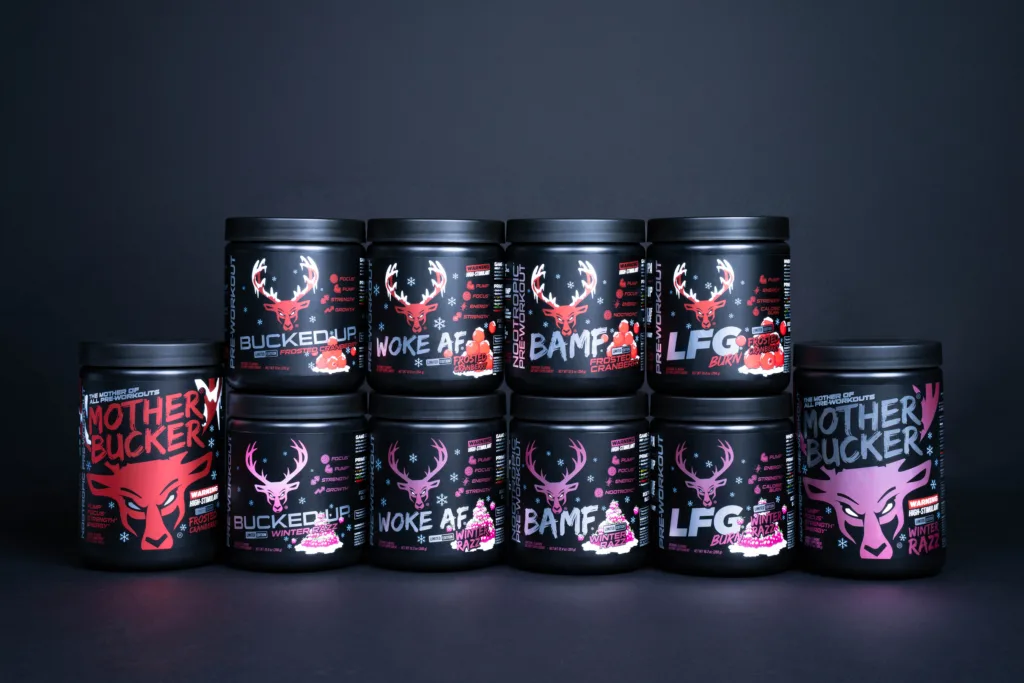
Bucked Up has announced the launch of Winter Razz and Frosted Cranberry, two limited-edition pre-workout flavours being introduced across all five of its established powdered supplement formulations. Announced on 5 November 2026, with availability beginning on 6 November, the rollout creates ten seasonal product variants while retaining the existing formulations, including caffeine concentrations ranging from 200 mg to 400 mg per serving.
The launch covers Bucked Up, Woke AF, BAMF, LFG Burn and Mother Bucker, allowing the brand to extend seasonal flavours across different stimulant strengths rather than restricting them to a single flagship product. The company is targeting direct-to-consumer sales and selected fitness retailers, with availability limited to remaining seasonal inventory.
Unlike a new pharmaceutical or medical device introduction, the announcement does not involve a newly approved therapeutic product, a revised active ingredient formula or clinical trial evidence. Its significance lies principally in the commercial strategy behind seasonal sports nutrition products and the distinction between supplement marketing claims and independently demonstrated physiological benefits.
For the wider consumer wellness industry, the rollout illustrates how brands can refresh established portfolios through flavour, packaging and limited availability. However, the broad range of stimulant concentrations also makes product transparency and responsible marketing relevant to evaluating the launch.
Why is Bucked Up introducing two winter flavours across its entire pre-workout portfolio?
Seasonal product development can help consumer brands generate interest without undertaking the costs and operational risks associated with an entirely new underlying formulation. By changing flavour profiles while retaining established ingredients and doses, manufacturers can introduce product variety while preserving continuity across their existing ranges.
Bucked Up has selected Winter Razz, combining raspberry and grape flavours, and Frosted Cranberry, combining cranberry and lychee. The company has also developed winter-themed packaging featuring seasonal colours and visual elements.
The company is applying both flavours across all five pre-workout formulas. This creates ten individual stock-keeping units from two new flavour concepts, extending the seasonal offering across products with different positioning and stimulant concentrations.
The approach may help maintain continuity for existing customers who already prefer a particular formula. Rather than requiring them to change the underlying product to access a seasonal flavour, the company is offering the new variants across the established range.
However, the strategy also introduces inventory complexity. Ten additional products require manufacturing coordination, packaging, inventory allocation and retailer distribution, even when their core formulations remain unchanged.
The limited-edition model may help manage some of this complexity by restricting availability to a defined selling period. Bucked Up has indicated that products will remain available only while supplies last, with no automatic extension once a particular variant sells out.
The launch also coincides with the approaching US holiday shopping season. The company plans to include the winter variants in its Black Friday promotional activities, with early access for brand ambassadors beginning on 15 November.
Commercially, the strategy is focused on product engagement and purchasing behaviour rather than a new clinical or technical capability.
How do caffeine concentrations differ across the five Bucked Up pre-workout formulas?
The products are positioned along a range of stimulant strengths, with caffeine concentration providing one of the most visible distinctions between them.
The original Bucked Up formula contains 200 mg of caffeine per serving and represents the lowest caffeine level within the announced seasonal range. LFG Burn contains 300 mg per serving and is positioned around exercise-related energy and thermogenic marketing claims.
Woke AF and BAMF each contain 333 mg of caffeine per serving, although their additional ingredient combinations and commercial positioning differ. Woke AF emphasises stimulant intensity, while BAMF includes ingredients marketed in connection with focus and cognitive performance during exercise.
Mother Bucker contains 400 mg of caffeine per serving, making it the highest-caffeine formulation within the winter collection. Its ingredient profile also includes 6,400 mg of beta-alanine and other compounds used in sports nutrition products.
The caffeine differences are relevant because the formulations are not interchangeable from an exposure perspective. A higher-caffeine product delivers a greater amount of the stimulant per serving, regardless of whether the flavour or packaging is similar.
The company has stated that the winter launch does not change ingredient quantities or active formulations. Consequently, the new flavour variants should not be understood as offering improved efficacy, different pharmacological activity or a revised safety profile compared with their respective original products.
The broader clinical question concerns the evidence supporting the ingredients and doses used across the existing range. That question is separate from whether the limited-edition flavours are commercially successful.
Why does the 400 mg caffeine formulation warrant careful interpretation?
Caffeine is a widely consumed stimulant with established effects on alertness and central nervous system activity. It has also been studied in relation to physical performance, although outcomes depend on factors including dose, individual tolerance, exercise type and timing.
The US Food and Drug Administration has cited 400 mg of caffeine per day as an amount not generally associated with negative effects for most healthy adults. That figure should not be interpreted as a universal safety threshold or as an endorsement of consuming 400 mg in a single serving.
Individual responses vary according to factors including body weight, sensitivity, medical conditions, medication use and other caffeine exposure. Coffee, tea, energy drinks and additional supplements can contribute to total consumption.
Excessive caffeine intake may cause symptoms such as increased heart rate, palpitations, nervousness, sleep disturbance, nausea and anxiety. These risks are particularly relevant when products contain substantial caffeine concentrations per serving.
The distinction between a daily reference amount and a single high-caffeine serving is important. Mother Bucker’s stated 400 mg caffeine content equals the FDA’s commonly cited daily amount for most adults, before considering any additional caffeine sources.
This does not establish that the product is inherently unsafe for every consumer. It does mean that the dose requires careful interpretation rather than being presented simply as a stronger or more effective formulation.
The company’s launch announcement does not provide a new clinical safety study evaluating the winter variants. Because the formulations are unchanged, the release should be treated as a commercial product update rather than new evidence concerning stimulant tolerability.
What scientific evidence supports common ingredients used in pre-workout supplements?
Bucked Up markets its pre-workout portfolio around ingredients associated with exercise performance, energy, blood flow and mental focus. The company identifies caffeine, beta-alanine, citrulline and alpha-glycerylphosphorylcholine among the ingredients used across its formulations.
These compounds have different proposed mechanisms and levels of supporting evidence. Caffeine has been investigated extensively for its effects on alertness and selected measures of exercise performance, while beta-alanine is associated with increases in muscle carnosine following repeated supplementation.
Citrulline is commonly marketed in relation to nitric oxide production and blood flow, although evidence for improvements in exercise performance is less consistent across study designs and populations.
Other ingredients are marketed around cognitive performance, thermogenesis or subjective exercise experience. The strength of supporting evidence varies, and results from studies of individual compounds cannot automatically establish the efficacy of a finished multi-ingredient product.
This is particularly relevant because an ingredient may have demonstrated activity at a particular dose or under defined experimental conditions. A commercial formulation may combine several compounds, introducing questions about interactions, tolerability and the relationship between dose and effect.
The company’s assertion that its products support strength, focus or exercise-related performance should therefore be understood as supplement marketing claims unless supported by appropriate evidence specific to the formulation and outcome.
The November announcement does not identify new randomised clinical trials evaluating Winter Razz or Frosted Cranberry. It also does not report independent comparative testing demonstrating that either flavour changes exercise performance.
From a scientific standpoint, the launch does not establish a new efficacy milestone. Its novelty lies in product presentation and commercial availability.
How are Bucked Up’s products regulated compared with pharmaceuticals?
Bucked Up’s pre-workout products are marketed as dietary supplements rather than medicines approved to treat a medical condition. This places them under a different United States regulatory framework from prescription pharmaceuticals.
The FDA generally does not approve dietary supplements for safety and effectiveness before they enter the market. Manufacturers remain responsible for ensuring that products meet applicable legal requirements concerning safety, labelling, composition and manufacturing.
Dietary supplement companies may make certain structure/function claims when they have appropriate substantiation and comply with relevant notification and labelling requirements. Such claims are different from authorised claims that a medicine can diagnose, treat, cure or prevent a disease.
Bucked Up includes the standard statement that its product claims have not been evaluated by the FDA and that the products are not intended to diagnose, treat, cure or prevent disease.
The company also describes its products as manufactured in the United States, with transparent ingredient labelling and good manufacturing practice certification. Those are company-reported quality and manufacturing attributes, not evidence that the FDA has approved the finished supplements.
Transparency about ingredient quantities can help users and healthcare professionals understand what is contained in a product. However, clear labelling does not independently establish clinical efficacy or eliminate the need to consider cumulative ingredient exposure.
The FDA’s regulatory responsibilities include marketplace monitoring, inspection and action where products violate applicable requirements. These obligations differ from the premarket evaluation required for new prescription medicines.
For sports nutrition manufacturers, the commercial value of maintaining regulatory compliance extends beyond avoiding enforcement action. Consumer confidence, retailer relationships and brand reputation can all be affected by concerns about ingredient accuracy or misleading claims.
What does the winter launch reveal about Bucked Up’s retail and brand strategy?
Bucked Up was founded in 2016 and has expanded into categories including pre-workout supplements, energy drinks, protein products and creatine. The company reported distribution through more than 100,000 retail locations, including major retail and specialist fitness chains.
It also described itself as the leading US pre-workout brand, referencing SPINS data for the year ending September 2026. That ranking is company-attributed and should not be interpreted as an independently verified assessment of every sales channel or market segment.
The broad distribution network provides a potential platform for introducing seasonal products. However, the November announcement specifies availability through the company’s direct-to-consumer channel and selected fitness retailers rather than confirming that all ten variants will appear in every distribution location.
Limited-edition products can support several commercial objectives. They may encourage repeat purchases among existing customers, generate promotional interest and provide opportunities to assess flavour preferences before considering future product development.
However, the company has not disclosed expected seasonal sales, production volume, pricing or retailer purchase commitments. The financial contribution of the winter variants therefore cannot be quantified from the announcement.
The launch also does not establish that new customers will enter the category or that existing customers will increase total spending. Some seasonal purchases may simply replace purchases of established flavours.
For manufacturers, the relevant commercial measures include incremental sales, repeat purchasing, inventory turnover and the contribution margin associated with seasonal stock-keeping units.
A successful seasonal range must also avoid creating excessive inventory or discounting pressure after the promotional period. Limited availability may help support urgency, but it does not guarantee that demand will match supply.
Can seasonal flavour innovation generate meaningful growth without new supplement formulations?
Bucked Up’s winter launch illustrates a product development strategy that prioritises variety and commercial engagement while keeping the underlying formulations unchanged. This can reduce some development complexity because the company is not introducing new active ingredient combinations for the seasonal campaign.
The approach may be commercially effective in a category where consumers develop preferences for particular flavours and where product presentation can influence purchasing decisions. Yet the strategy is fundamentally different from pharmaceutical innovation, where new clinical evidence and regulatory decisions are central to establishing treatment value.
For consumer health companies, the challenge is balancing marketing differentiation with clear communication about actual product attributes. A seasonal flavour may offer a new sensory experience without providing a new health or performance benefit.
The caffeine range also makes accurate communication important. Products containing 200 mg and 400 mg of caffeine per serving represent substantially different stimulant exposures, even when marketed under the same seasonal theme.
The next meaningful commercial indicators will be product sell-through, retailer participation and evidence of incremental demand during the holiday period. Bucked Up has not provided those metrics or a financial forecast for the campaign.
The November 2026 introduction of Winter Razz and Frosted Cranberry should therefore be understood as a consumer sports nutrition portfolio expansion rather than a medical or scientific development. Its importance lies in how a growing supplement brand uses seasonal product variety across existing formulations, while maintaining the distinction between marketing claims, ingredient transparency and demonstrated physiological effects.