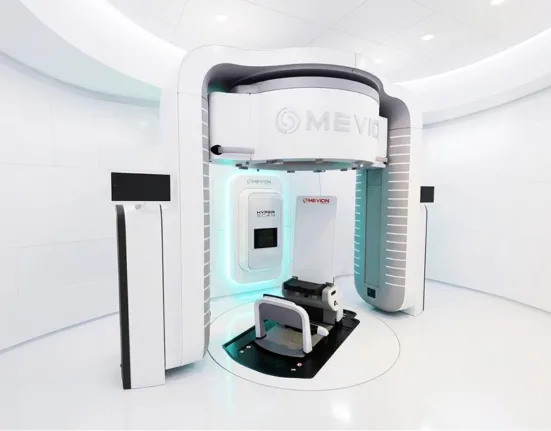
BayCare Health System has treated its first patient using an upright proton therapy system combining Mevion Medical Systems’ S250-FIT accelerator, Leo Cancer Care’s Marie patient positioning and imaging technology, and RaySearch Laboratories’ RayStation treatment planning software. Announced on 5 November 2026, the treatment took place at BayCare Proton Center on the campus of St. Joseph’s Hospital in Tampa, Florida, making it the second clinical site worldwide to use the integrated upright proton therapy configuration.
The milestone demonstrates clinical operation of a compact treatment model designed to fit within a space comparable to a conventional medical linear accelerator vault. Instead of relying on a large rotating proton beam gantry, the installation combines a fixed-beam accelerator with a rotating upright patient positioning system, supported by integrated computed tomography imaging.
For hospitals, the development addresses one of the principal barriers to expanding proton therapy: the cost and complexity of installing and operating specialised radiation treatment infrastructure. Traditional proton centres can require substantial building modifications, shielding, equipment installation and long commissioning periods, creating financial challenges even before patient treatments begin.
However, compact equipment does not automatically establish lower total operating costs or superior clinical outcomes. BayCare’s first treatment confirms that the integrated system has entered clinical use, while the longer-term commercial implications will depend on treatment throughput, operational reliability, appropriate patient selection and reimbursement.
How does BayCare’s upright proton therapy system differ from conventional installations?
Proton therapy uses charged particles to deliver radiation to a specified treatment target. Unlike conventional photon radiation, which deposits energy along its path and continues beyond the target, protons can be planned to release a substantial proportion of their energy near a defined depth.
This physical characteristic provides opportunities to reduce radiation exposure to certain surrounding tissues. However, the clinical benefit depends on tumour location, treatment planning, anatomical characteristics and the comparison with other available radiation techniques.
Traditional proton installations frequently use a rotating gantry that directs the beam towards a patient positioned on a treatment table. The gantry structure can be large and mechanically complex, contributing to the facility footprint and installation requirements.
BayCare’s system changes that arrangement by using a compact fixed-beam accelerator and moving the patient relative to the treatment beam. The Marie platform positions patients upright, either seated or perched, and can rotate them through the required treatment geometry.
The objective is to achieve appropriate beam access while reducing the need for a large rotating gantry. This does not remove the technical requirements associated with delivering highly controlled radiation, but it changes how the necessary geometry is achieved.
The combined system is designed to fit within a conventional linear accelerator-sized vault. That could be attractive to hospitals seeking to add proton therapy without constructing a large standalone facility.
The actual suitability of an existing vault will nevertheless depend on building dimensions, shielding calculations, structural requirements and installation-specific engineering assessments. The system’s compact design does not mean that every conventional radiotherapy room can accommodate proton treatment without modification.
For BayCare, the November announcement represents completion of a substantial practical milestone. Its significance lies in demonstrating that this configuration can be commissioned and used for patient treatment within an operating hospital environment.
What role does Mevion S250-FIT play in delivering proton radiation?
Mevion Medical Systems developed the S250-FIT as a compact proton therapy device incorporating pencil beam scanning technology. The system is designed to produce and direct proton radiation towards a prescribed treatment volume while allowing treatment planners to control the spatial distribution of the delivered dose.
Pencil beam scanning involves directing a relatively narrow proton beam to multiple positions within the target. By varying beam position and energy, the system can build up a planned dose distribution across a three-dimensional volume.
The technique requires coordination between treatment planning, beam delivery and patient positioning. Accurate delivery depends on the accelerator producing the prescribed beam characteristics and the treatment system maintaining appropriate alignment with the planned target.
The US Food and Drug Administration granted 510(k) clearance for the S250-FIT Proton Beam Radiation Therapy Device under submission K253406 on 25 March 2026. The decision classified the device as substantially equivalent under the applicable medical radiation equipment framework.
An earlier S250-FIT clearance also appears in the FDA’s device records, reflecting the system’s regulatory development before the latest configuration was introduced into clinical operation. These authorisations concern device marketing and specified use, not proof that treatment with the system produces superior cancer outcomes.
The clearance also should not be confused with approval of a new cancer drug or therapeutic regimen. Proton therapy equipment is regulated as a medical device, while its clinical application depends on radiation oncology assessment and the relevant treatment protocol.
Mevion’s commercial proposition is based on providing proton therapy within a more compact physical arrangement. The company has previously supplied single-room proton treatment systems, giving it experience with installations designed to reduce the scale of conventional proton facilities.
The S250-FIT and upright patient configuration extend that approach by addressing both accelerator size and the physical arrangement of the treatment room.
Why is Leo Cancer Care’s Marie positioning and CT imaging system essential?
Leo Cancer Care’s Marie system provides upright patient positioning together with computed tomography imaging. Its role is central because a fixed-beam proton system requires precise alignment between the patient and the radiation beam.
Rather than positioning patients horizontally on a conventional table, Marie supports upright treatment geometries and provides rotational movement around the treatment position. The system also incorporates fan-beam CT imaging intended to support treatment planning and patient registration.
The FDA granted 510(k) clearance for the Marie system under K250970 on 25 July 2025. The device was classified as a computed tomography imaging and positioning system, distinct from the proton beam delivery system itself.
Separating these regulatory functions is important. Marie provides imaging and positioning capabilities, while Mevion’s equipment generates and delivers the therapeutic proton beam. The integrated treatment process depends on both systems performing their respective functions accurately.
Upright positioning could offer practical advantages for selected patients who find prolonged horizontal positioning difficult. It may also allow radiation therapists to interact with patients face-to-face during setup, potentially changing the treatment experience.
However, a more comfortable or natural position does not automatically mean better treatment accuracy. Patient stability, reproducibility of posture and movement during treatment remain central considerations.
An upright patient may also exhibit different anatomical relationships from those observed in a conventional supine position. Internal organs, soft tissues and tumour location can shift with posture, which is why imaging and treatment planning must reflect the actual treatment position.
The availability of upright CT imaging is therefore more than a convenience feature. It supports the need to assess anatomy in the configuration used during radiation delivery.
Clinical teams must still verify that the planned dose distribution remains appropriate and that treatment can be delivered reproducibly across multiple sessions.
How does RaySearch Laboratories’ RayStation software integrate the treatment workflow?
RaySearch Laboratories supplies the RayStation treatment planning system used within the BayCare installation. The software supports the creation of radiation plans by allowing clinical teams to define target volumes, relevant organs and the intended distribution of radiation dose.
For proton therapy, treatment planning must account for the physical behaviour of proton beams as they pass through tissue. The location and shape of the target, differences in tissue density and uncertainties in patient positioning can influence the delivered dose.
Integrating the accelerator with RayStation and Marie creates a workflow involving imaging, planning, positioning verification and beam delivery. The effectiveness of the system depends on the coordination of these elements rather than the performance of any one component in isolation.
This integration introduces important software and operational requirements. Clinical teams need reliable transfer of treatment plans, consistent patient identification and appropriate verification that the delivered configuration matches the approved treatment prescription.
Quality assurance procedures are particularly important when combining technologies supplied by different manufacturers. Hospitals must establish appropriate acceptance testing, commissioning and ongoing checks across the complete system.
RaySearch is publicly traded on Nasdaq Stockholm under the RAY B ticker. The BayCare milestone provides another example of its software being used in a specialised proton therapy environment, although the announcement does not disclose the value of the software contract or incremental revenue attributable to the installation.
The commercial significance for RaySearch is therefore principally related to the use of its treatment planning software within another clinical configuration. The news does not independently establish a material change in the company’s earnings outlook.
For all three technology providers, the hospital’s operational experience may provide valuable information about integration requirements, clinical support and the practical demands of deploying upright proton therapy.
Can compact proton therapy improve hospital economics and expand patient access?
The economic proposition behind compact proton therapy is that smaller infrastructure requirements may lower some of the barriers associated with building a treatment facility. Large proton centres can require extensive construction, substantial capital expenditure and specialised maintenance arrangements.
A system designed for a conventional linear accelerator-sized vault could potentially reduce the amount of new construction required. This may be particularly relevant to hospitals that already operate radiation oncology departments but do not have room for a large proton installation.
However, total project economics extend far beyond the physical footprint. Hospitals must consider the cost of the accelerator, shielding, treatment planning software, installation, maintenance, staffing, commissioning and ongoing quality assurance.
Proton therapy also requires specialist clinical expertise. Radiation oncologists, medical physicists, radiation therapists and technical personnel must be trained to plan, verify and deliver treatments using the installed system.
The equipment’s operating capacity will influence financial performance. A centre that treats too few patients may struggle to recover fixed costs, while high patient throughput requires reliable scheduling, efficient setup and minimal equipment downtime.
BayCare’s announcement does not disclose project capital expenditure, installation savings, expected annual patient volume or treatment revenue. Therefore, the compact design should be treated as a potential economic advantage rather than proof that the centre will operate at lower cost than a conventional proton facility.
Reimbursement is another significant factor. Coverage for proton therapy can depend on the cancer indication, clinical setting, insurer policy and supporting evidence. Regulatory clearance of the equipment does not guarantee that every treatment delivered using it will be reimbursed.
For patients in West Central Florida, local availability may reduce the need to travel to more distant proton centres when this form of radiation therapy is clinically appropriate. That is a meaningful potential access benefit, but the actual effect will depend on patient eligibility and the centre’s operating capacity.
Does upright proton therapy provide better outcomes than conventional radiotherapy?
The use of proton radiation is supported by clinical evidence in several oncology settings, particularly where reducing radiation exposure to surrounding tissues is important. However, the magnitude of benefit varies across disease sites and patient populations.
Upright positioning introduces a separate question from the underlying choice between proton and photon radiation. The clinical value of changing patient orientation must be evaluated through its effects on treatment accuracy, reproducibility, comfort and relevant patient outcomes.
The BayCare announcement confirms successful treatment of the first patient but does not provide comparative data showing better tumour control, reduced toxicity or improved survival because of the upright configuration.
Nor does the announcement demonstrate that every patient would be better treated in a seated or perched position. Some clinical situations may require alternative positioning, and the manufacturer’s cleared indications govern the permitted treatment configurations.
Clinical evidence would be strengthened by prospective studies examining setup accuracy, intrafraction movement, treatment time and the reproducibility of anatomical alignment over multiple fractions.
Patient-reported outcomes could also help determine whether upright positioning improves comfort or reduces treatment burden compared with conventional arrangements.
For hospitals evaluating the technology, such evidence would complement mechanical and dosimetric testing. Technical feasibility is necessary for adoption, but measurable clinical or operational benefits are needed to justify broader investment.
The second-site milestone indicates that the system has progressed beyond a single initial installation. However, two operational sites do not yet provide enough evidence to determine how consistently the model can be deployed across different hospital environments.
What does BayCare’s first-patient treatment mean for future proton centre installations?
BayCare’s installation provides a clinical reference for the combined technologies of Mevion, Leo Cancer Care and RaySearch Laboratories. The ability to demonstrate an operational system within a conventional radiation oncology environment could support discussions with hospitals considering more compact proton therapy facilities.
International interest is also emerging. In September 2026, Fortis Healthcare announced plans to install a Mevion S250-FIT system incorporating Marie upright positioning and RayStation software at Fortis Memorial Research Institute in Gurugram, India.
That announcement concerned a planned installation, not a centre that had already begun treating patients. It nevertheless illustrates how the compact upright model is being considered beyond the United States.
For the manufacturers, commercial development will depend on turning individual installations into a repeatable delivery model. Hospitals will examine project timelines, regulatory requirements, service support and the experience of institutions already operating the technology.
The first-patient treatment at BayCare is a genuine operational achievement, particularly because it brings multiple technologies into a coordinated clinical workflow. It does not establish the system’s long-term reliability, financial return or comparative effectiveness.
The next meaningful indicators will be sustained clinical utilisation, treatment throughput, equipment availability and the publication of relevant workflow and patient outcome data.
For BayCare, the immediate result is the availability of an additional cancer treatment capability within its regional healthcare system. For Mevion, Leo Cancer Care and RaySearch, the longer-term opportunity depends on demonstrating that compact upright proton therapy can be deployed reliably and economically while maintaining the treatment quality expected of a modern radiation oncology service.