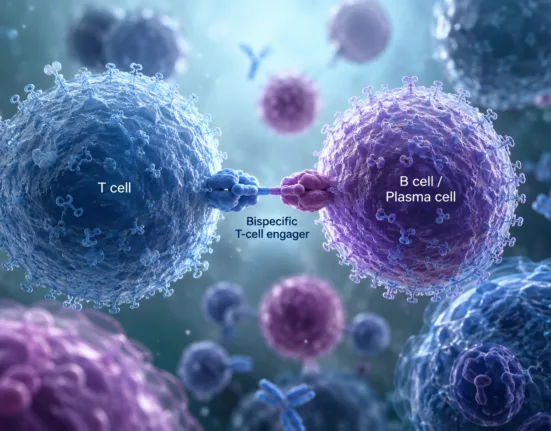
Voro Therapeutics and Alloy Therapeutics have entered a strategic research collaboration to discover and develop next-generation masked T-cell engager therapeutics for cancer. The collaboration combines Voro Therapeutics’ tumor-activated biologics platform and T-cell engager expertise with Alloy Therapeutics’ antibody discovery, optimized CD3 antibodies and multispecific engineering capabilities in an effort to improve tumor-selective immune activation.
Why the Voro Therapeutics and Alloy Therapeutics collaboration matters for the next phase of T-cell engager development
The strategic importance of the collaboration lies less in the fact that two biotechnology firms are working together and more in the specific problem they are trying to solve. T-cell engagers have become one of the most closely watched areas in cancer immunotherapy because they can redirect a patient’s immune cells toward malignant cells without requiring the same individualized manufacturing model associated with autologous cell therapies. However, the field has also been constrained by a familiar trade-off: stronger immune activation can improve tumor killing, but it can also increase systemic toxicity.
That is where masked T-cell engager therapeutics are drawing industry attention. The core idea is to keep the drug functionally restrained until it reaches the tumor microenvironment, where disease-associated biological conditions can activate the therapeutic. If this works, it could allow drug developers to pursue targets and potency levels that might be too risky with conventional immune-engaging formats. The risk is that tumor-selective activation is difficult to prove before clinical testing, and a promising preclinical masking strategy can still fail if activation is incomplete, inconsistent across tumor types, or insufficiently separated from healthy tissue biology.
For Voro Therapeutics, the collaboration gives its PrimeBody platform a broader validation pathway beyond its lead conditionally activated CD47 inhibitor. For Alloy Therapeutics, the deal reinforces its role as an infrastructure partner for biologics discovery rather than a single-asset developer. The unresolved question is whether the collaboration can generate candidates with enough differentiation to matter in an increasingly crowded immuno-oncology landscape where investors, clinicians and regulators are asking for more than clever engineering.
What masked T-cell engager therapeutics could change in cancer immunotherapy safety
The biggest clinical ambition behind masked T-cell engager therapeutics is an improved therapeutic index. In practical terms, that means widening the gap between antitumor activity and unacceptable toxicity. This matters because T-cell engagers are designed to bring immune effector cells into close contact with cancer cells, a mechanism that can be powerful but biologically unforgiving when immune activation spills beyond the intended site.
Clinicians tracking the field remain focused on cytokine release syndrome, immune effector cell-associated neurotoxicity, on-target off-tumor toxicity and dosing complexity. These safety challenges are not theoretical. They influence hospital monitoring, step-up dosing, premedication strategies, treatment setting and patient selection. A tumor-activated approach could potentially reduce some of those burdens if it limits immune activation in normal tissues, but the clinical bar will be high because regulators will need evidence that masking does not simply delay toxicity or shift it into a less predictable pattern.

The commercial upside is also meaningful. A safer T-cell engager format could expand development into solid tumors, broader patient populations and targets previously viewed as too hazardous. However, the field has already learned that better engineering does not automatically translate into simpler clinical development. Developers still need durable responses, manageable dosing schedules, scalable manufacturing, clear biomarkers and a regulatory package that demonstrates why the masking mechanism changes real patient outcomes.
How Voro Therapeutics’ PrimeBody platform could fit into a broader precision biologics strategy
Voro Therapeutics’ PrimeBody platform is positioned around conditionally activated biologics that deliver potent activity where disease is present. In this collaboration, that concept is being applied to masked T-cell engagers, but the platform’s broader relevance comes from its potential use across multiple immune and oncology modalities. The confirmed development suggests Voro Therapeutics wants to show that its masking and linker technologies can support a platform strategy rather than remain tied to one therapeutic concept.
That platform logic is important because the biotechnology market has become less forgiving of single-mechanism stories. Investors and strategic partners increasingly want to see whether a company’s technology can generate repeatable drug design advantages across targets, tumor types and modalities. If PrimeBody can support T-cell engagers, antibody-drug conjugates, cytokines and CD47-targeted therapies, Voro Therapeutics may be able to build a pipeline around a common tumor-activation principle.
The limitation is that platform breadth can become a liability if it outpaces clinical proof. A tumor-activated biologics platform must eventually show that its activation rules are reproducible, measurable and clinically meaningful. Without human data, the most important questions remain open: which tumor protease or microenvironmental signals are reliable enough, how heterogeneous activation will be across patients, and whether masking reduces potency too much in tumors with lower activation capacity.
Why Alloy Therapeutics’ antibody discovery and multispecific engineering capabilities are central to the deal
Alloy Therapeutics brings a different type of leverage to the collaboration. Its role is not just to supply antibodies, but to contribute discovery infrastructure, optimized CD3 binders and multispecific engineering capabilities that can shape how next-generation T-cell engagers are designed. In T-cell engager development, the CD3 arm is especially important because it influences the strength, timing and quality of T-cell activation.
This is commercially relevant because many developers are trying to fine-tune CD3 engagement rather than simply maximize it. Too much activation can worsen toxicity, while too little can undermine efficacy. Alloy Therapeutics’ engineering capabilities could help the collaboration explore formats that balance binding affinity, valency, geometry, half-life and activation control. That kind of optimization may be essential if masked T-cell engagers are to compete with conventional bispecific antibodies, antibody-drug conjugates and cell therapies.
However, the engineering challenge is complex. A successful candidate must integrate masking chemistry, target selection, CD3 binding behavior and manufacturability without creating instability, aggregation, poor pharmacokinetics or unpredictable activation. The collaboration’s early research nature means there is no disclosed lead asset, target, indication, clinical timeline or economic structure. That leaves substantial uncertainty around how quickly the partnership can move from platform integration to a development candidate.
What clinicians, regulators and industry observers are likely to watch next
The next meaningful milestones will not be press-release milestones, but evidence milestones. Industry observers will look for target disclosure, preclinical efficacy data, selectivity data, cytokine release comparisons, tumor activation assays, safety margins and early manufacturability signals. For clinicians, the key question will be whether masked T-cell engagers can preserve tumor killing while reducing the monitoring burden that has limited some immune-engaging therapies.
Regulatory watchers are likely to focus on mechanism clarity. A masked T-cell engager must be evaluated not only as an immunotherapy but as a conditional activation system. That means regulators may scrutinize the assays used to prove masking, the tumor biology used to justify activation, the potential for activation in inflamed normal tissues and the reversibility or persistence of immune activation once the therapeutic is unmasked.
The commercial risk is that the field moves quickly. Established oncology companies, bispecific antibody developers, antibody-drug conjugate specialists and cell therapy firms are all pursuing better ways to intensify antitumor immunity while managing toxicity. Voro Therapeutics and Alloy Therapeutics are entering a scientifically attractive area, but differentiation will depend on whether the collaboration can produce a candidate that is not only elegant in design but also practical in the clinic.
Why this is promising but still early
This collaboration is strategically sensible because it attacks a real bottleneck in T-cell engager development rather than chasing a cosmetic platform extension. The combination of tumor-activated masking, CD3 optimization and multispecific engineering is exactly the kind of integrated design logic the field needs if T-cell engagers are to move deeper into solid tumors and higher-risk targets.
The caution is that this remains an early research collaboration. There is no clinical asset, no disclosed indication and no human proof that the proposed masking approach will deliver a better safety-efficacy balance. The opportunity is credible, but the burden of proof is substantial. For PharmaDeviceNews.com readers, the story is best understood as a platform-enabling partnership with meaningful scientific logic, not yet as a clinical inflection point.