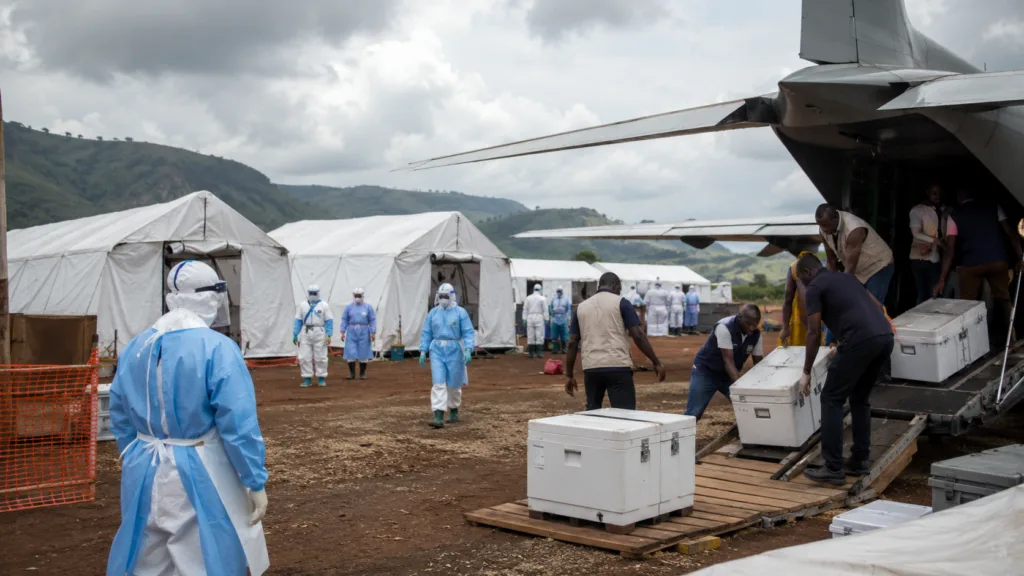
Samaritan’s Purse is airlifting an Ebola Treatment Center and personal protective equipment to the Democratic Republic of the Congo, placing emergency field infrastructure at the center of a fast-moving outbreak response where medical supplies, trained personnel and infection-control capacity can determine whether a local health crisis becomes a wider regional threat.
The Boone, North Carolina-based international relief organisation said its 767 cargo plane would carry more than 34 tons of essential medical supplies to support the response to the Ebola outbreak. The aircraft was expected to land in Uganda, with supplies then transported into the Democratic Republic of the Congo. The deployment includes an Ebola Treatment Center, personal protective equipment and specialists focused on outbreak response, infection prevention and control, and medical operations.
The important angle is not only the humanitarian deployment. It is what the deployment reveals about the continuing fragility of outbreak-response systems in high-risk regions. Ebola is not a disease that gives health systems the luxury of slow mobilisation. When surveillance is delayed, protective equipment is scarce, contact tracing is under-resourced and treatment sites are not rapidly established, the virus can exploit every weak link in the public health chain.
That is why emergency field hospitals remain central to Ebola containment. Vaccines, diagnostics, therapeutics and surveillance tools have improved since the West Africa crisis of 2014, but the operational challenge remains brutally physical. Patients need safe isolation. Healthcare workers need protection. Communities need trusted communication. Specimens need secure handling. Suspected cases need triage. Treatment sites need to function under pressure, often in remote regions with limited infrastructure.
Why does the Samaritan’s Purse Ebola deployment matter now?
The Samaritan’s Purse deployment matters because it comes as the Democratic Republic of the Congo faces renewed pressure from Ebola in a setting where health responders have already warned of resource shortages. Reuters reported that the outbreak in northeastern Ituri province had strained local response capacity, with shortages affecting essential items such as medicines, face masks and transport needed for contact tracing. Reuters also reported that the outbreak involved the Bundibugyo strain and that responders were dealing with hundreds of suspected cases and more than 100 suspected deaths.
That context makes the airlift more than a logistics story. It is a reminder that outbreak control depends on speed, coordination and infrastructure. An Ebola Treatment Center is not simply a tent with beds. It is a specialised clinical and infection-control environment designed to separate risk zones, protect staff, monitor patients, manage contaminated materials and reduce transmission inside healthcare settings.
Samaritan’s Purse said its initial team would help establish infection prevention and control protocols for local mission hospitals and communities, while coordinating with the Democratic Republic of the Congo’s Ministry of Health to establish the treatment center. That operational detail is important because hospitals can become amplification points during Ebola outbreaks if triage, isolation and protective protocols are weak.
The organisation has also framed the response through its previous Ebola experience. Samaritan’s Purse said it responded to the 2014 Ebola outbreak in Liberia by opening a treatment center and supporting hygiene training and prevention education for more than 1.6 million people. It also said it established an Ebola Treatment Center in the Democratic Republic of the Congo in 2018, treating more than 600 patients.
How do Ebola treatment centers change outbreak response on the ground?
Ebola treatment centers are the clinical backbone of outbreak response because they create a controlled environment for diagnosis, isolation and supportive care. Without them, suspected patients may remain in general wards, homes or informal care settings, increasing the risk of transmission to relatives, nurses, doctors and community caregivers.
The field hospital model is especially important in regions where permanent infectious disease infrastructure is limited. A deployable Ebola Treatment Center can create temporary capacity while national authorities and partners expand surveillance, laboratory testing and community engagement. The goal is not merely to treat patients after infection. The goal is to break the chain of transmission.
That is where personal protective equipment becomes as important as beds. Ebola response is intensely dependent on protective clothing, gloves, masks, face shields, disinfection protocols and staff training. If healthcare workers do not feel safe, response capacity collapses quickly. If healthcare workers become infected, public trust can collapse even faster.
The World Health Organization has also been increasing supplies to the Democratic Republic of the Congo. Reuters reported that the World Health Organization expected an additional six tons of Ebola-related supplies, including personal protective equipment and sample collection materials, to arrive after an earlier delivery of 12 tons. That points to a broader multi-partner response in which humanitarian organisations, national authorities and global health agencies are trying to close urgent supply gaps.
Why is infection prevention and control the real frontline?
Infection prevention and control often sounds like a technical phrase, but in an Ebola outbreak it is the frontline. The disease spreads through direct contact with bodily fluids from infected people or contaminated materials. That means unsafe clinical practice, inadequate protective equipment and poorly managed patient flow can turn clinics into transmission hubs.
The Samaritan’s Purse release specifically mentions outbreak specialists, infection prevention and control specialists, and medical personnel. That mix matters. Ebola treatment requires more than doctors and nurses. It requires operational design, safe movement of people, controlled waste handling, rapid triage, environmental cleaning, training, security, community liaison and psychological support.
This is why emergency deployments often focus first on protocols before patient volume. A treatment center that opens without disciplined workflows can create new risks. Staff need to understand donning and doffing procedures, safe patient interaction, contamination zones and escalation pathways. Communities need to know when and how to seek care. Ambulance and transport systems need clear rules. Laboratories need safe sample flow.
For the medical device and diagnostics sectors, this is also where opportunity and responsibility intersect. Outbreak response needs durable protective equipment, rapid diagnostics, cold chain where applicable, specimen transport systems, monitoring tools, waste management technologies and field-deployable clinical equipment. The harder question is whether these tools can be made affordable, available and usable in remote settings before outbreaks accelerate.
What does this say about the post-COVID outbreak preparedness problem?
The Democratic Republic of the Congo Ebola response is unfolding in a world that should, in theory, be better prepared after COVID-19. Governments, donors and global health institutions have spent years talking about pandemic readiness, surveillance, local manufacturing, health security and emergency medical stockpiles. Yet Ebola continues to show that preparedness is uneven, especially in regions already dealing with fragile health systems, insecurity and limited transport infrastructure.
The core problem is not that the world lacks scientific knowledge about Ebola. It is that response systems remain dependent on rapid mobilisation after danger becomes visible. That is an uncomfortable model. By the time a cargo plane is being loaded, an outbreak has already exposed weaknesses in detection, supply chains and frontline capacity.
The stronger long-term model would place more resources upstream. That means sustained disease surveillance, routine training for health workers, permanent infection-control capacity, regional stockpiles, community trust networks, emergency transport and faster diagnostic access. Emergency airlifts will still be needed, but they should be part of a prepared system rather than a substitute for one.
This is where international relief organisations such as Samaritan’s Purse can play a practical role, but they cannot replace durable public health infrastructure. Humanitarian response can surge capacity. It can help protect healthcare workers. It can stand up treatment sites. It can support communities under pressure. But the lasting test is whether national and regional systems become stronger after each outbreak.
How should pharma and diagnostics companies read this signal?
For pharma, diagnostics and medtech companies, the current Ebola response reinforces a familiar but underappreciated lesson: outbreak medicine is not only about having products. It is about deployment readiness. A vaccine, test, therapeutic or protective system has limited impact if it cannot reach the right place at the right time, be used safely by trained personnel, and fit into field workflows.
Ebola has seen major scientific progress over the past decade, including vaccine development and therapeutic advances. But field response still depends on basic operational layers: protective equipment, triage spaces, trained staff, logistics, diagnostics, community education and data reporting. Companies operating in infectious disease should see this as a reminder that adoption in outbreak settings depends on simplicity, ruggedness, training and affordability.
There is also a reputational dimension. Global health emergencies increase scrutiny of whether industry can support equitable access. In an outbreak, delays are not abstract. They affect healthcare worker safety, mortality risk and community confidence. Companies that can work with governments, non-governmental organisations and global health agencies to support practical deployment may be better positioned than those that focus only on high-income market models.
What risks could undermine the response?
The most immediate risk is delayed containment. Ebola can be controlled, but delays in diagnosis, isolation and contact tracing can sharply increase response complexity. If suspected cases are dispersed across communities or if contacts are not rapidly identified, even well-equipped treatment centers can struggle to keep pace.
The second risk is healthcare worker exposure. Protective equipment and training are not optional in Ebola response. They are the foundation of response continuity. If healthcare workers are infected or fear infection, staffing becomes harder, hospitals become less trusted and communities may avoid care.
The third risk is community mistrust. Ebola response often intersects with fear, misinformation, burial practices, mobility and local politics. Treatment centers must therefore be paired with trusted community engagement. A technically strong field hospital can still fail if patients are hidden, families reject isolation, or rumours undermine public health messaging.
The fourth risk is donor fatigue. Outbreak response requires immediate money, but preparedness requires boring, steady investment between crises. That is often harder to fund. The Democratic Republic of the Congo has experienced repeated Ebola outbreaks, yet repeated outbreaks do not automatically create permanent readiness.
Can emergency field infrastructure stop Ebola from becoming a wider crisis?
The Samaritan’s Purse airlift shows how quickly specialised humanitarian infrastructure can be mobilised when an Ebola outbreak escalates. The deployment of an Ebola Treatment Center, personal protective equipment and field specialists could help protect healthcare workers, support local hospitals and create safer treatment capacity in affected areas.
But the bigger lesson is sharper. Emergency treatment centers are vital, but they are also evidence of the gap they are trying to close. If outbreak-prone regions had stronger routine surveillance, better infection-control readiness, deeper supply reserves and more permanent isolation capacity, emergency deployments would still matter, but they would not have to carry so much of the burden.
For the Democratic Republic of the Congo, the immediate priority is containment. For global health systems, the priority should be learning the same lesson before the next outbreak starts. Ebola response is not won only in laboratories or policy meetings. It is won in treatment tents, rural clinics, contact tracing teams, supply chains and communities where trust can spread faster than fear.