Cellares and Sonoma Biotherapeutics said on July 13, 2026, that they will collaborate to automate manufacturing of SBT-77-7101, an investigational autologous engineered regulatory T-cell therapy being studied in Phase 1 development for refractory rheumatoid arthritis. The process will be transferred to Cellares’ Cell Shuttle platform, while the associated in-process and release testing is expected to be automated through the Cell Q quality-control system.
The agreement makes SBT-77-7101 the first regulatory T-cell program to be onboarded to Cell Shuttle. That distinction matters because regulatory T cells, commonly called Tregs, can be unusually sensitive to manufacturing conditions, and the identity, purity, stability and suppressive function of the resulting cells may all be affected by how the production process is executed.
The collaboration is therefore not simply a capacity reservation. It is a technology-transfer and comparability exercise that will test whether Sonoma Biotherapeutics’ proprietary process can be reproduced within a more automated manufacturing environment without changing the critical characteristics of the investigational therapy.
Financial terms, the expected duration of the technology transfer and the timing of the first clinical batch manufactured through Cell Shuttle were not disclosed. The companies also did not specify whether Cell Shuttle-produced SBT-77-7101 will enter the ongoing Phase 1 program, a future expansion cohort or a later clinical study.
Why is SBT-77-7101 manufacturing more technically sensitive than conventional CAR-T production?
SBT-77-7101 is manufactured from a patient’s own regulatory T cells and genetically modified with a chimeric antigen receptor designed to recognise citrullinated proteins. These proteins are associated with inflamed tissues in rheumatoid arthritis and other inflammatory conditions.
Sonoma Biotherapeutics is attempting to use the natural immunoregulatory properties of Tregs to reduce inflammation and restore immune tolerance. This is different from the cytotoxic strategy used by many conventional CAR-T products, which are engineered to eliminate target cells.
That biological difference creates a distinct manufacturing problem. The production process must generate sufficient numbers of cells while preserving the regulatory phenotype and suppressive function that define a Treg. Excessive stimulation, inconsistent culture conditions or changes in cell composition could potentially produce a batch that meets basic cell-count requirements but does not behave as intended.
A successful transfer will consequently require more than showing that Cell Shuttle can execute the same sequence of manufacturing steps. Sonoma Biotherapeutics and Cellares will need to demonstrate analytical comparability between material produced through the existing process and material generated on the automated platform.
Relevant measurements could include cellular identity, viability, purity, CAR expression, potency, stability and the molecular characteristics associated with regulatory function. The exact comparability package and release specifications have not been disclosed.
Automation may reduce human variability and create more consistent control over timing, temperature, reagent handling and process parameters. It cannot, however, remove the need to understand which attributes are essential to SBT-77-7101 and which changes might affect its clinical performance.
What does the collaboration reveal about Sonoma Biotherapeutics’ development priorities?
The decision to begin process automation while SBT-77-7101 remains in Phase 1 suggests that Sonoma Biotherapeutics is trying to address a potential scale-up constraint before it becomes a late-stage development bottleneck.
This is a strategically sensible point in the program to consider manufacturing evolution. Moving to a substantially different production system after pivotal trials can create additional comparability work because regulators may need evidence that the post-change product remains sufficiently similar to the material used to generate the supporting clinical data.
Beginning the transfer earlier could allow Sonoma Biotherapeutics to incorporate automated manufacturing into future development cohorts and build a more consistent chemistry, manufacturing and controls package over time. Whether that advantage is realised will depend on the speed of the transfer and the quality of the comparability results.
The agreement does not mean SBT-77-7101 is approaching regulatory approval. It remains an investigational product supported by a small, early-stage clinical dataset, and further dose-escalation, expansion and controlled clinical evidence will be needed before its benefit-risk profile can be determined.
The manufacturing move is better understood as preparation for possible success. Sonoma Biotherapeutics is investing in an infrastructure pathway that could support larger studies if the clinical program continues to advance.
How mature is the clinical evidence supporting SBT-77-7101 in rheumatoid arthritis?
SBT-77-7101 is being evaluated in REGULATE-RA, a first-in-human Phase 1 dose-escalation study involving adults with active rheumatoid arthritis who have had inadequate responses to multiple biologic or targeted synthetic disease-modifying therapies. The study is primarily designed to evaluate safety and tolerability, with pharmacokinetic, pharmacodynamic, mechanistic and preliminary activity measures included as exploratory endpoints.

Sonoma Biotherapeutics reported interim results in October 2025 from six participants across the first two dose cohorts. According to the company, there were no dose-limiting toxicities, cases of cytokine release syndrome or immune effector cell-associated neurotoxicity syndrome in that early dataset.
The company also reported reductions in joint counts and disease-activity measures among several participants, along with detection of engineered Tregs in blood and synovial tissue. One participant was reported to have maintained a response through 24 weeks, while follow-up for other participants was continuing.
These findings offered an early clinical and mechanistic signal, but they should not be treated as evidence of established efficacy. Six participants are insufficient to characterise response variability, durability, uncommon safety events or the extent to which observed changes differ from fluctuations in disease activity.
REGULATE-RA is not a randomised controlled trial, and the initial analysis was based on company-reported interim data. The program must progress through higher-dose assessment, additional participants and longer follow-up before stronger conclusions can be drawn.
SBT-77-7101 is also being evaluated in Phase 1 development for hidradenitis suppurativa through the REGULATE-HS study. The broader development strategy reflects Sonoma Biotherapeutics’ belief that targeting citrullinated proteins with engineered Tregs may have applications across more than one inflammatory disease, although each indication will require its own evidence.
Can Cell Shuttle reduce the operational burden of autologous Treg manufacturing?
Autologous therapies require an individual manufacturing journey for each patient. Cells must be collected, transported, processed, genetically modified, expanded, tested, released and returned to the correct treatment centre without losing chain-of-identity or chain-of-custody control.
That patient-specific model creates multiple opportunities for delay or failure. Manual interventions can add variability, labour requirements and contamination risks, while fragmented equipment can complicate technology transfer and digital recordkeeping.
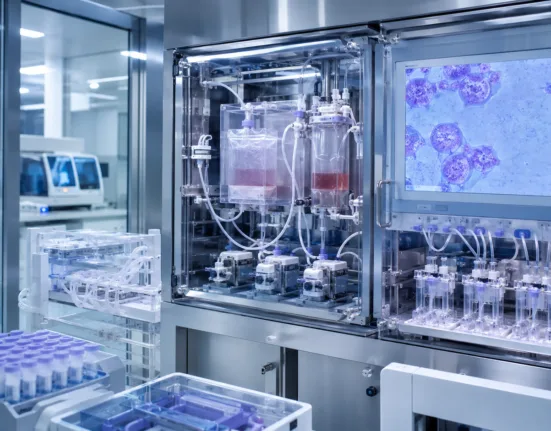
Cell Shuttle is designed to integrate a series of cell-processing operations within an automated manufacturing platform. Cell Q is intended to automate parts of in-process and release testing that are often conducted through separate, labour-intensive quality-control workflows.
For SBT-77-7101, the operational attraction is clear. A closed and more standardised process could reduce manual handling and make it easier to reproduce the same manufacturing conditions across patients and manufacturing sites.
The economic benefit remains unproven for this specific program. Cellares has made broader claims about higher throughput and improved manufacturing economics across its platform, but the collaboration announcement did not provide SBT-77-7101-specific estimates for batch duration, manufacturing success rates, labour savings, cost per dose or release-testing timelines.
Those measures will become important if Sonoma Biotherapeutics progresses beyond a relatively small Phase 1 population. A platform can be technically capable of producing a therapy while still facing commercial challenges related to scheduling, logistics, testing costs, batch failures and the time between cell collection and infusion.
Does the FDA designation for Cell Shuttle reduce regulatory risk for Sonoma Biotherapeutics?
The Cell Shuttle platform received an Advanced Manufacturing Technology designation from the U.S. Food and Drug Administration in 2025. The designation can support earlier and more frequent interactions with the agency regarding use of the manufacturing technology.
It should not be confused with approval of Cell Shuttle-produced SBT-77-7101 or validation of Sonoma Biotherapeutics’ eventual manufacturing process. The investigational therapy will still require a product-specific comparability package, validated analytical methods, appropriate process controls and regulatory submissions supporting any manufacturing change.
The designation may nevertheless be useful because advanced cell-therapy manufacturing questions are easier to address before a process is locked into later-stage development. Early regulatory dialogue could help the companies align on what evidence is needed to demonstrate that automated production preserves the product’s critical quality attributes.
Cellares has already reported that another partner program progressed through an investigational new drug amendment permitting clinical manufacturing on Cell Shuttle and that patients subsequently received platform-manufactured therapy. That experience provides a degree of platform-level clinical validation, but it does not automatically transfer to SBT-77-7101.
Regulatory T cells represent a new modality for Cell Shuttle, and their functional requirements differ from those of cytotoxic CAR-T products. The Sonoma Biotherapeutics program will therefore test the platform’s adaptability rather than simply repeat an established manufacturing template.
Why could automated quality control prove as important as the manufacturing transfer?
Release testing is one of the less visible constraints in personalised cell therapy. Even after a batch has been manufactured, it cannot be administered until required quality tests have been completed and reviewed.
Automating appropriate analytical methods through Cell Q could reduce fragmented workflows, improve data traceability and create a more consistent quality-control process. It may also help Cellares integrate manufacturing and testing records across its planned international network.
The difficulty is that sophisticated cell therapies often depend on assays that are not easily reduced to a single automated measurement. Potency testing is particularly important for engineered Tregs because the relevant question is not merely whether the cells are present, but whether they retain the intended regulatory function.
Method transfer, qualification and eventual validation can take substantial time. Sonoma Biotherapeutics and Cellares will have to determine which existing assays can be automated without affecting performance and whether new analytical methods are needed for the Cell Shuttle process.
No testing turnaround times or assay-development milestones were disclosed. Until those data emerge, Cell Q should be viewed as a proposed part of the manufacturing solution rather than proof that SBT-77-7101 release testing has already been streamlined.
What milestones will show whether the Cellares and Sonoma collaboration is working?
The first meaningful milestone will be successful completion of process translation, followed by evidence that engineering and clinical-grade batches meet predefined specifications. Comparability data will be more informative than the simple announcement that onboarding has been completed.
The next test will be regulatory acceptance of the transferred process for clinical use. That could involve an amendment to the existing investigational new drug application, depending on how and when Sonoma Biotherapeutics plans to introduce Cell Shuttle-manufactured material.
Clinical deployment will provide another level of evidence. Manufacturing success rates, product consistency, vein-to-vein time and patient dosing with automated batches will reveal whether laboratory comparability translates into operational performance.
Cellares enters the collaboration with substantial financial backing, having expanded its Series D financing to $327 million in June 2026. The company is using that capital to support commercial-scale operations and its manufacturing expansion in the United States, Europe and Japan. Sonoma Biotherapeutics could therefore gain access to a broader infrastructure without building an equivalent network internally.
The immediate value of the agreement, however, will be determined inside the comparability package rather than by the size of Cellares’ factory network. If the companies can preserve Treg identity and function while reducing process variability and quality-control friction, the collaboration could remove an important constraint on SBT-77-7101’s development.
If comparability proves difficult, the transfer could require further process optimisation and delay introduction of automated batches. The defining question is now whether a manufacturing platform developed to industrialise cell therapy can accommodate the biological sensitivity of engineered regulatory T cells without changing the product that Sonoma Biotherapeutics is attempting to advance.