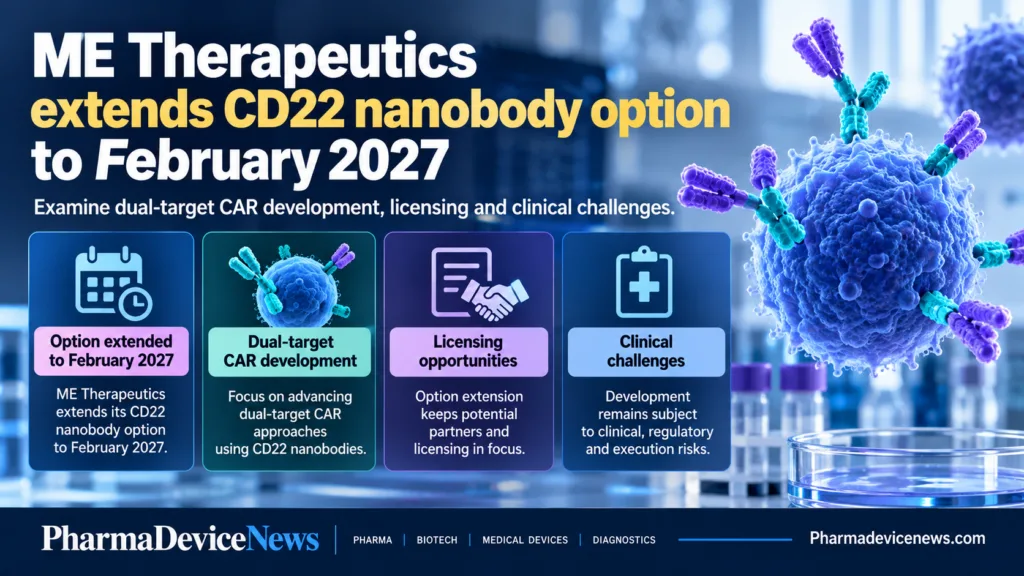
ME Therapeutics Holdings Inc. (CSE: METX; FSE: Q9T), a Vancouver-based biotechnology company developing experimental cancer immunotherapies, has extended its option agreement covering a proprietary CD22-binding nanobody developed by the National Research Council of Canada. Announced on October 9, 2026, the extension moves the option exercise deadline to February 10, 2027, allowing the company to continue incorporating the technology into its preclinical in vivo chimeric antigen receptor programme while evaluating competing CD19/CD22-targeted therapeutic designs.
The extension follows a September pipeline update in which ME Therapeutics disclosed two engineered CAR configurations intended to recognise both CD19 and CD22, proteins expressed on B-lineage cells. The company expects to select a lead construct and advance toward lipid nanoparticle formulation during the fourth quarter of 2026, although the October announcement did not provide additional efficacy, safety or delivery data. The latest transaction therefore concerns continued access to a technology component during preclinical development rather than a regulatory milestone or clinical demonstration of treatment effectiveness.
The agreement also gives ME Therapeutics additional time to evaluate a strategy intended to simplify the manufacture of engineered immune-cell therapies by modifying immune cells inside the body. Conventional autologous CAR-T treatments require patient cells to be collected, engineered outside the body and reinfused after manufacturing. In vivo engineering seeks to avoid several of those steps, but its potential operational advantages remain dependent on achieving selective delivery, effective immune-cell modification and clinically acceptable safety.
Why is ME Therapeutics extending access to the NRC’s CD22 nanobody technology?
The October agreement preserves a contractual window for ME Therapeutics to exercise an option associated with the National Research Council of Canada’s proprietary CD22-binding technology. The company stated that all other terms remain unchanged, without disclosing a new payment amount, revised royalty structure or additional development obligations. The announcement consequently establishes a deadline extension, not a newly completed acquisition or a fresh licensing payment.
The contractual history requires careful distinction because ME Therapeutics previously announced a technology licence agreement with the National Research Council of Canada in October 2025. That earlier disclosure described commercial rights involving the CD22 binder for CAR applications across several international markets, including in vivo CAR-T approaches. The October 2026 announcement refers specifically to an option to license the asset, but does not explain how that terminology relates to the previously disclosed licence arrangement.
The newer announcement should therefore not be interpreted as evidence that the company has newly obtained unrestricted rights to the underlying technology. Nor does it establish that the option has been exercised or that every commercial right mentioned in earlier disclosures has changed. The financial and legal implications depend on the operative agreements, including any conditions attached to the rights relevant to particular CAR applications.
The nanobody itself is an attractive research component because it can function as an antigen-recognition element within a larger engineered immune receptor. Nanobodies are compact antibody-derived binding domains that may provide useful flexibility when constructing complex molecular designs. Their potential engineering advantages do not independently establish improved treatment efficacy, stability in patients or manufacturing performance for a completed therapeutic product.
How could CD19 and CD22 dual targeting address relapse after conventional CAR-T treatment?
CD19-directed CAR-T therapies have established an important role in treating selected B-cell malignancies, including certain forms of acute lymphoblastic leukaemia and lymphoma. However, some patients experience relapse after treatment, including cases where malignant cells lose or reduce expression of the CD19 antigen targeted by the original therapy. This form of antigen escape provides a biological rationale for investigating treatments capable of recognising an additional target.
CD22 is another B-cell-associated surface protein that can remain expressed in some cancers following CD19-directed treatment. Researchers have therefore investigated CD22-targeted CAR-T therapies and dual-target combinations intended to reduce the ability of malignant cells to evade immune recognition through loss of a single antigen. The approach is relevant to diseases in which both targets may be present, although expression levels and patterns vary between patients and across different malignancies.
Clinical research involving dual-antigen CAR-T strategies has produced encouraging responses in selected populations, but the evidence does not establish that combining CD19 and CD22 consistently improves long-term outcomes over established single-target treatments. Relapse can occur even when two antigens are targeted, including through changes in antigen density, insufficient engineered T-cell persistence or other biological resistance mechanisms. A 2025 review published in Blood Advances highlighted that dual targeting has not eliminated antigen-negative relapse or demonstrated uniformly superior durability.
For ME Therapeutics, incorporating a CD22-binding nanobody may broaden the recognition capabilities of its investigational CAR constructs. However, clinical outcomes generated by other companies’ CD19/CD22 therapies cannot be attributed to ME Therapeutics’ programme. Its own designs must demonstrate adequate antigen recognition, functional immune-cell activity and appropriate selectivity before their potential clinical advantages can be assessed.
What are the two CD19 CD22 CAR designs currently being evaluated by ME Therapeutics?
ME Therapeutics disclosed in September that it had developed two differentiated CAR configurations and was conducting comparative preclinical testing to guide candidate selection. The first uses a co-expression strategy involving separate CAR constructs incorporating CD19 and CD22 recognition components. The second uses a tandem CAR architecture that combines a CD19-targeting single-chain variable fragment with a CD22-targeting single-domain antibody within one receptor construct.
These configurations reflect different engineering approaches to the same broad objective of targeting B-lineage cells through more than one antigen. Separate CAR constructs may provide flexibility in receptor design and expression, while a tandem receptor places two recognition elements within a single molecular architecture. Neither configuration can be considered superior without comparative data showing how effectively it is expressed, how selectively it recognises target cells and how consistently it triggers the intended immune response.
The company stated that its head-to-head preclinical programme is evaluating expression and functional characteristics before the selection of a final candidate. The September update identified the fourth quarter of 2026 as the expected period for candidate selection and progression toward lipid nanoparticle formulation. The October option extension provides additional contractual time beyond that planned research milestone, although it does not confirm that the selection process will be completed on schedule.
Importantly, the latest disclosure did not identify a selected lead product, provide quantitative comparisons between the designs or announce successful in vivo delivery. The engineered constructs remain investigational research assets rather than therapies that have demonstrated clinical effectiveness. Their next meaningful milestone will involve identifying which design has the most suitable combination of target recognition, expression characteristics and functional activity for further development.
Why is lipid nanoparticle delivery the bigger challenge for in vivo CAR-T development?
A central ambition of ME Therapeutics’ programme is to generate engineered immune cells directly inside the patient’s body rather than through conventional laboratory-based cell manufacturing. The proposed approach involves delivering messenger RNA encoding a CAR construct using lipid nanoparticles designed to reach T cells. Once delivered into the appropriate cells, the RNA would direct temporary production of the engineered receptor, potentially enabling those immune cells to recognise the intended cancer-associated targets.
This approach could eventually simplify aspects of CAR-T manufacturing and distribution because conventional autologous products require specialised facilities, individual patient manufacturing and complex logistics. Nevertheless, eliminating external cell engineering introduces a demanding drug-delivery challenge. The nanoparticles must reach suitable immune cells, enter those cells efficiently and release functional RNA while limiting uptake by unintended tissues.
T-cell-specific delivery is particularly difficult because lipid nanoparticles frequently distribute to tissues such as the liver. Even formulations designed to target selected immune populations can be taken up by other cell types, creating potential differences between intended and actual receptor expression. Researchers developing this field must therefore establish not only that the RNA can generate a functional CAR, but also that its delivery and expression occur in the appropriate cellular population.
Messenger RNA expression is generally transient, which may offer advantages in controlling the duration of receptor activity but also introduces questions about treatment persistence. An engineered immune response that fades too quickly may not provide sustained disease control, while repeated dosing could create additional tolerability, immune activation or formulation challenges. The appropriate balance between duration, activity and safety remains an important question for in vivo CAR platforms.
For ME Therapeutics, moving its chosen CD19/CD22 construct into a T-cell-targeting lipid nanoparticle system will be a significant development step. The company has not yet reported sufficient programme-specific evidence to establish efficient targeted delivery, durable antitumor activity or acceptable systemic safety. Its proposed candidate selection should therefore be viewed as a step toward formulation and additional preclinical testing, not as evidence that a clinically viable product has already been demonstrated.
Does the National Research Council’s CD22 clinical research validate ME Therapeutics’ programme?
The National Research Council’s CD22 nanobody has also been associated with an investigator-driven clinical research programme evaluating a CD22-directed CAR-T product. The relevant Phase 1 study, registered as NCT06208735, concerns CLIC-2201, an autologous CAR-T therapy under investigation for selected relapsed or refractory B-cell malignancies. The study is sponsored by the British Columbia Cancer Agency and is separate from ME Therapeutics’ proposed in vivo CAR development programme.
That distinction matters because CLIC-2201 involves collecting patient T cells and engineering them outside the body before reinfusion. ME Therapeutics intends to investigate a different delivery approach involving direct immune-cell engineering through messenger RNA and lipid nanoparticles. Even when programmes involve a related CD22-binding component, they can differ substantially in manufacturing, dosing, cellular expression, safety and therapeutic persistence.
The Phase 1 study is designed primarily to evaluate safety, tolerability and dose selection in patients with relapsed or refractory B-cell malignancies. Its development status does not establish that the National Research Council’s binder has demonstrated clinical efficacy, nor does it provide evidence that ME Therapeutics’ dual-target constructs will perform similarly. The October option-extension announcement did not present new clinical results from CLIC-2201.
Evidence generated in one CAR-T configuration may nevertheless help researchers understand aspects of target recognition and antigen-related biology. Such information could support future development decisions, provided that the differences between therapeutic constructs and delivery systems are recognised. It cannot replace the functional, toxicology and clinical evidence needed for an independently developed in vivo CAR candidate.
How could the licensing extension affect ME Therapeutics’ financing and development strategy?
The extension preserves flexibility during a period when ME Therapeutics is pursuing several research and corporate objectives simultaneously. In addition to its CD19/CD22 programme, the company is developing messenger RNA-based immunotherapies intended to influence the tumor microenvironment. It is also pursuing a potential United States stock exchange listing, making capital availability and programme prioritisation important commercial considerations.
In September, ME Therapeutics reported progress with a liver-detargeted messenger RNA construct targeting the STING immune signalling pathway. The company described laboratory experiments showing reduced STING protein expression in a human hepatocyte cell line while maintaining expression in tested non-hepatocyte cells. These findings provide early evidence relevant to the intended tissue-selective design, but they do not establish tumor-specific delivery, improved antitumor efficacy or a favourable safety profile in animals or humans.
The combination of an in vivo CAR programme and a separate STING-related messenger RNA programme creates competing demands on research expenditure. Both require further formulation development, laboratory validation and potentially substantial preclinical safety work before clinical testing can be considered. The CD22 option extension does not itself provide financing or resolve the cost of these development activities.
ME Therapeutics completed a non-brokered private placement in July 2026 generating approximately C$576,501 in gross proceeds. The transaction involved 339,118 units priced at C$1.70 each, with every unit comprising one common share and one purchase warrant. The company indicated that the proceeds would support research, possible strategic transactions, United States listing activities, working capital and other corporate requirements.
Its February 28, 2026 interim financial statements reported approximately C$799,170 in cash, compared with C$1.35 million at the end of August 2025. These figures predate the July financing and do not represent the company’s cash position at the time of the October agreement. Without an updated cash balance and current expenditure forecast, it is not possible to determine how much development runway the company has available or how much additional capital its programmes will require.
What does the CD22 option extension mean for ME Therapeutics stock and investor sentiment?
ME Therapeutics shares trade on the Canadian Securities Exchange under METX and on the Frankfurt Stock Exchange under Q9T. Its Canadian shares were quoted at C$2.80 on October 9, 2026, unchanged from the previous reported closing price. Trading activity was extremely limited, reducing the usefulness of short-term share-price movements as an indicator of institutional or broader investor sentiment.
The option extension was announced after the regular Canadian trading session on October 9, meaning the reported closing price cannot be treated as a market reaction to the disclosure. Thinly traded biotechnology securities can experience considerable price changes on relatively small transaction volumes. As a result, isolated price movements provide limited evidence about how investors value the underlying scientific programme.
The company’s clinical development exposure is also materially different from that of biotechnology businesses with established human efficacy data. ME Therapeutics has not announced clinical results for its in vivo CD19/CD22 CAR constructs, and its expected next step concerns preclinical candidate selection and formulation development. The investment implications are therefore linked more closely to future scientific validation, access to capital and intellectual property arrangements than to near-term commercial sales.
Management has separately disclosed that it is pursuing a possible Nasdaq listing and was responding to an initial round of comments concerning a draft registration statement in September. A proposed listing is not equivalent to securing exchange approval, completing a public offering or obtaining fresh financing. The October nanobody option extension should likewise be assessed independently from assumptions about future exchange access or improved funding capacity.
What must happen before ME Therapeutics can advance its CD22 CAR programme toward patients?
The first measurable scientific milestone is the selection of a preferred CD19/CD22 CAR design following the company’s comparative preclinical work. That decision will need to be supported by data showing appropriate receptor expression, antigen recognition and functional performance. The selected construct would then need to undergo formulation and testing within the intended T-cell-targeting lipid nanoparticle platform.
Subsequent studies would need to determine whether the formulated candidate can reach appropriate immune cells in vivo, produce sufficient receptor expression and generate useful biological activity without unacceptable effects on other tissues. Safety research would also need to address unintended cell targeting, excessive immune activation and the consequences of temporary or repeated receptor expression. The relevant requirements would depend on the final molecular design, formulation and proposed clinical indication.
The option deadline of February 10, 2027 creates a separate commercial milestone. ME Therapeutics must determine how the extended contractual rights fit its selected development candidate and broader intellectual property strategy. The company has not disclosed a new licensing payment, confirmed exercise of the option or a revised commercialisation timetable in the October announcement.
For a small biotechnology developer, these scientific and contractual decisions are closely connected. Choosing a lead CAR architecture before completing relevant licensing decisions could help concentrate development resources, but the company will still need to establish rights sufficient for its intended research and commercial activities. Additional funding may also be necessary as the programme moves from molecular engineering into more extensive preclinical testing.
The extended CD22 option gives ME Therapeutics additional time to align access to the National Research Council’s technology with its evolving dual-target CAR strategy. It does not eliminate the uncertainty surrounding selective immune-cell delivery, therapeutic persistence or the effectiveness of the selected construct against B-cell malignancies. The most consequential next development will be evidence that the company’s preferred CAR design can be formulated and delivered with the functional characteristics necessary to justify continued progression toward clinical research.