Veradermics, Incorporated (NYSE: MANE) will hold an investor call and webcast on July 15, 2026, at 8:00 a.m. Eastern Time to present results from the female treatment arms of Study 207, an open-label Phase 2 trial of its investigational extended-release oral minoxidil tablet VDPHL01. The company’s July 14 announcement did not disclose numerical efficacy or safety findings, making the scheduled presentation the first substantive opportunity to assess the candidate’s performance in women with mild-to-moderate pattern hair loss.
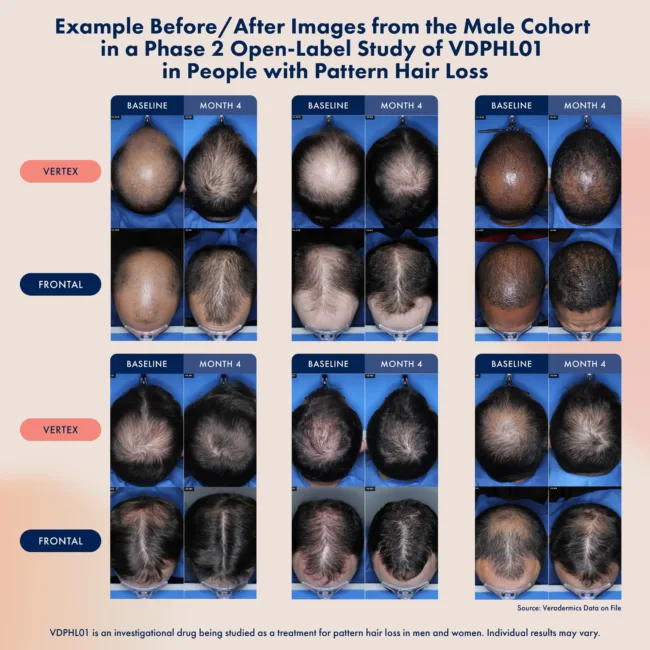
Study 207 enrolled 21 adult men and 22 adult women and was designed as a 12-month proof-of-concept trial. Female participants received VDPHL01 at 4.5 mg either once or twice daily, while the trial measured changes in non-vellus target-area hair count alongside patient-reported assessments at multiple time points.
The small study is exploratory, open-label and not formally powered to demonstrate statistical efficacy. Its results therefore cannot establish the same level of evidence expected from Veradermics’ randomized, double-blind and placebo-controlled registration programme. However, the findings could provide an important early view of dose response, onset of activity, durability and tolerability in women before results emerge from the much larger Study 306.
Why will Study 207 matter more for dose selection than definitive proof of efficacy?
The most important limitation of Study 207 is also central to interpreting whatever Veradermics presents. With only 22 female participants divided between two dosing schedules and no placebo group, apparently large changes in hair counts or patient assessments will need to be treated as exploratory signals rather than confirmatory evidence.
Open-label studies are useful when developers need an early understanding of biological activity and tolerability. They are less reliable for estimating the treatment effect that might appear in a controlled study because participants and investigators know that an active drug is being administered. That awareness can influence subjective assessments, expectations and treatment persistence.
Objective target-area hair counts should carry more weight than isolated testimonials or selected photographs. Even those measurements will require context, including baseline hair density, the number of evaluable participants, missing observations, treatment discontinuations and variability between patients.
The dosing comparison could prove particularly informative. The once-daily regimen delivers 4.5 mg per day, while the twice-daily schedule delivers a total of 9 mg per day. Veradermics will need to show whether the higher daily exposure produces a visibly stronger or faster hair-growth signal and whether any incremental activity is accompanied by greater adverse-event frequency.
A clear dose response would support the biological case for VDPHL01, but it would not automatically identify the best commercial dose. For a chronic treatment intended for a broad population, the most effective regimen is not necessarily the one with the highest numerical hair count. Convenience, tolerability, discontinuation rates and the ability to use the therapy consistently could be equally important.

What efficacy details would make the female VDPHL01 findings clinically persuasive?
The headline percentage of participants showing improvement will reveal only part of the story. The presentation should disclose the absolute and percentage changes in non-vellus hair counts, the distribution of individual responses and the proportion of women achieving predefined levels of improvement.
Time to response will also matter. Hair-growth trials operate within the slow biology of the hair cycle, so an early change may attract attention, but durability at later visits will be more important for establishing whether the response is sustained. Study 207 scheduled assessments at months one, two, four, six, eight, ten and twelve, creating an opportunity to show the trajectory rather than one favourable snapshot.
Patient-reported outcomes could add useful evidence if they move in the same direction as objective hair counts. A statistically measurable increase that patients cannot see or value may have limited commercial relevance. Conversely, a strong subjective response without corresponding objective evidence would be difficult to interpret in an unblinded study.
The company should also disclose how many participants completed the relevant assessment periods and whether missing data were concentrated in either dosing arm. Results calculated only from participants who remained on treatment can look more favourable than results based on everyone who began the trial.
Female pattern hair loss is clinically heterogeneous, and treatment responses can be influenced by age, menopausal status, baseline severity and other underlying factors. Study 207 is too small for dependable subgroup conclusions, but disclosure of baseline characteristics would help determine whether the two dose groups were reasonably comparable.
Why will edema, blood pressure and hypertrichosis be as important as hair counts?
VDPHL01 is an extended-release formulation of minoxidil, a vasodilator originally developed for severe hypertension. Immediate-release oral minoxidil is used off-label by some dermatologists for hair loss, but it is not approved by the United States Food and Drug Administration for that indication.
Veradermics designed VDPHL01 to release minoxidil more gradually, extending exposure while avoiding the high concentration peaks associated with immediate-release administration. That pharmacokinetic rationale is commercially important, but clinical safety results must ultimately demonstrate whether the formulation produces an acceptable benefit-risk profile.
The Study 207 presentation should therefore provide detailed information on blood pressure, heart rate, electrocardiogram findings, peripheral edema, dizziness, headache, palpitations, hypertrichosis and treatment discontinuations. Any serious adverse events should be described with the investigator’s assessment of causality, without assuming that an event was or was not treatment-related merely because it occurred during the study.
The twice-daily female regimen deserves particular attention because it produces total daily exposure of 9 mg. Even if extended release reduces peak concentrations, the company still needs to demonstrate that repeated systemic exposure remains tolerable for chronic use.
A 22-participant female cohort cannot reliably identify rare adverse events or establish long-term safety across a broad population. Clean Study 207 findings would be reassuring, but the randomized Study 306 safety database and the combined clinical programme will be more relevant to a future regulatory review.
How does Study 207 connect to Veradermics’ larger Study 306 programme in women?
Study 207 is best viewed as a bridge between Veradermics’ formulation hypothesis and its registration-directed female programme. Study 306 is a randomized, double-blind, placebo-controlled Phase 2/3 trial expected to enrol more than 500 women with pattern hair loss in the United States.
The larger study is designed to provide a more dependable estimate of efficacy and safety under controlled conditions. It should reduce the influence of patient expectations, investigator bias and natural variation in hair measurements that complicate interpretation of a small open-label study.
Strong Study 207 results could reinforce confidence that VDPHL01 is active in women and that the chosen dosing strategy is reasonable. They could also support recruitment by increasing awareness of the programme. However, they would not de-risk Study 306 completely, especially if the results depend heavily on one dose, one time point or a small number of unusually strong responders.
Veradermics has already reported positive topline results from Study 302, a randomized Phase 2/3 trial involving 519 men with mild-to-moderate pattern hair loss. According to the company, that study met its primary and key secondary endpoints, while overall treatment-emergent adverse-event rates were similar across VDPHL01 and placebo groups.
Those male results provide encouraging context, but they cannot be assumed to predict the female programme. Differences in dosing, patient characteristics and treatment response mean the female evidence must stand independently. Study 304, the confirmatory Phase 3 trial in men, is expected to report during the second half of 2026, while Study 306 remains the decisive trial for women.
Has the market already priced substantial VDPHL01 success into Veradermics shares?
Veradermics shares closed the July 14 regular session at approximately $110.17, almost unchanged from the previous close. Because the Study 207 call was announced after the trading session, the July 14 movement should not be interpreted as a market reaction to the forthcoming female results.
The stock had declined approximately 6.8% over five trading days but remained up nearly 20% over one month. Its 52-week range stood at roughly $32.00 to $131.24, while the company’s market capitalisation was approximately $4.6 billion.
That performance indicates that investors have already assigned considerable value to the VDPHL01 programme following the positive Study 302 disclosure and Veradermics’ rapid transition into a well-financed public biotechnology company. The recent pullback also shows how sensitive the valuation may be to data expectations and changes in clinical confidence.
Veradermics strengthened its balance sheet through its February 2026 initial public offering and a subsequent follow-on offering and private placement. The company generated approximately $766.8 million in aggregate gross proceeds through those transactions and has said its pro forma resources should support operations into 2030, including several Phase 3 readouts and a potential VDPHL01 launch if the product is approved.
This funding substantially reduces near-term financing pressure, but it does not remove clinical concentration risk. VDPHL01 is the company’s principal value driver, and the investment case depends heavily on successful development across both male and female pattern hair loss.
Positive Study 207 results could strengthen the broader narrative, particularly if the data demonstrate consistent improvement in both female dosing groups. Ambiguous efficacy, a weak dose response or a tolerability imbalance would carry greater significance because the market is valuing more than a preliminary proof-of-concept programme.
Could an approved extended-release minoxidil tablet overcome entrenched treatment habits?
The commercial opportunity for VDPHL01 rests partly on the limitations of existing choices. Topical minoxidil is widely available, but daily application can be inconvenient, while scalp irritation, residue and inconsistent adherence can limit its usefulness for some patients. Immediate-release oral minoxidil offers convenience and is already used off-label, but it lacks an approved hair-loss indication and was not originally formulated for hair restoration.
VDPHL01 could offer a differentiated proposition if Veradermics demonstrates that its extended-release design provides meaningful hair growth, predictable exposure and an acceptable safety profile. A formal approval supported by large controlled trials could also give physicians a standardized dose and a defined prescribing framework.
The complication is that generic immediate-release minoxidil is inexpensive. Veradermics will need to persuade clinicians and patients that formulation engineering, registration-quality evidence and the approved label justify any premium attached to VDPHL01.
Reimbursement cannot be assumed because pattern hair loss is frequently treated within an aesthetics-oriented, cash-pay environment. Commercial adoption may therefore depend on visible benefit, ease of use, treatment persistence and whether patients perceive the results as worth the recurring cost of chronic therapy.
What must the July 15 presentation disclose to strengthen the female development case?
The most informative presentation would show complete results for both female dosing groups, including participant numbers, baseline characteristics, objective hair-count changes, patient-reported outcomes, response distribution, discontinuations and adverse events at each relevant time point.
Investors and clinical observers should be cautious if the presentation focuses mainly on selected photographs, average changes without dispersion, or pooled results that obscure differences between once-daily and twice-daily treatment. A small trial can produce an encouraging mean result even when responses vary substantially between participants.
Study 207 does not need to deliver registration-level certainty to be useful. Its real test is whether the female findings are internally consistent, biologically credible and sufficiently tolerable to support confidence in Study 306.
For Veradermics, the July 15 call is therefore more than a routine clinical update. It is the first focused examination of whether VDPHL01’s emerging profile can extend beyond the male programme and support the company’s ambition to develop an approved oral, non-hormonal treatment for women with pattern hair loss.