
EvoEndo, Inc. said on July 28, 2026 that it is expanding access to sedation-free endoscopy across gastroenterology programs of different sizes, extending the commercial reach of its single-use EvoEndo Endoscopy System. The initiative comes shortly after the company reported that more than 3,000 sedation-free transnasal endoscopy procedures had been performed using its platform at more than 70 locations across the United States.
The announcement is best understood as a commercial implementation push rather than a new regulatory event. EvoEndo already has United States Food and Drug Administration clearance for its ultra-slim Model LE Gastroscope and associated controller, with the system intended for upper gastrointestinal visualization, diagnosis and endoscopic treatment in adult and pediatric patients. The device can be introduced orally or transnasally, depending on the patient, clinical objective and procedure plan.
What has changed is the scale of EvoEndo’s ambition. The company is no longer presenting sedation-free transnasal endoscopy mainly as a specialist technique for selected pediatric academic centers. It is increasingly positioning the platform as an endoscopy service that smaller hospitals, community gastroenterology practices and satellite programs may be able to introduce without acquiring a conventional reusable endoscopy tower or building a procedure model around routine anesthesia.
That proposition is commercially attractive, but it is not automatic. A portable controller and disposable gastroscope may reduce some infrastructure and reprocessing requirements, yet successful adoption still depends on patient selection, clinician training, reimbursement, procedure volume, consumable economics and the ability of each site to integrate unsedated procedures into existing clinical workflows.
Why is EvoEndo’s latest expansion more about implementation than another regulatory milestone?
The EvoEndo system’s regulatory history stretches back to February 2022, when the original device received 510(k) clearance after the United States Food and Drug Administration found it substantially equivalent to a legally marketed predicate device. Subsequent clearances have updated and expanded the platform, including a 2025 decision covering the current Model LE configuration. These are clearances, not approvals, and they establish the device’s permitted marketing status rather than proving that sedation-free endoscopy will be appropriate or preferable for every patient.
EvoEndo announced an expanded all-ages indication in July 2025, allowing the gastroscope to be used from neonatal patients through adulthood. That expansion requires careful interpretation. The company particularly highlighted transoral use in infants and younger children, while sedation-free transnasal endoscopy has historically been used more extensively in older children, adolescents and adults who can cooperate with an awake procedure. The all-ages clearance should therefore not be read as evidence that every neonatal or young pediatric examination can be performed transnasally without sedation.
The July 2026 initiative shifts attention from what the device is permitted to do toward whether gastroenterology programs can repeatedly deliver the procedure in routine care. This distinction matters because medical device adoption frequently slows after regulatory clearance. Hospitals must still establish protocols, identify suitable patients, train clinicians and nurses, negotiate purchasing arrangements, confirm reimbursement pathways and demonstrate that the service improves capacity or reduces costs.
EvoEndo’s access strategy appears designed to address that implementation gap. Its current commercial materials emphasize clinical education, business planning and assistance with program launch and expansion, suggesting that management recognises the device alone is not a complete solution. For many potential customers, the decisive product may effectively be the combination of the gastroscope, controller, training model and operational support.
Can a portable single-use endoscopy system lower barriers for smaller GI programs?
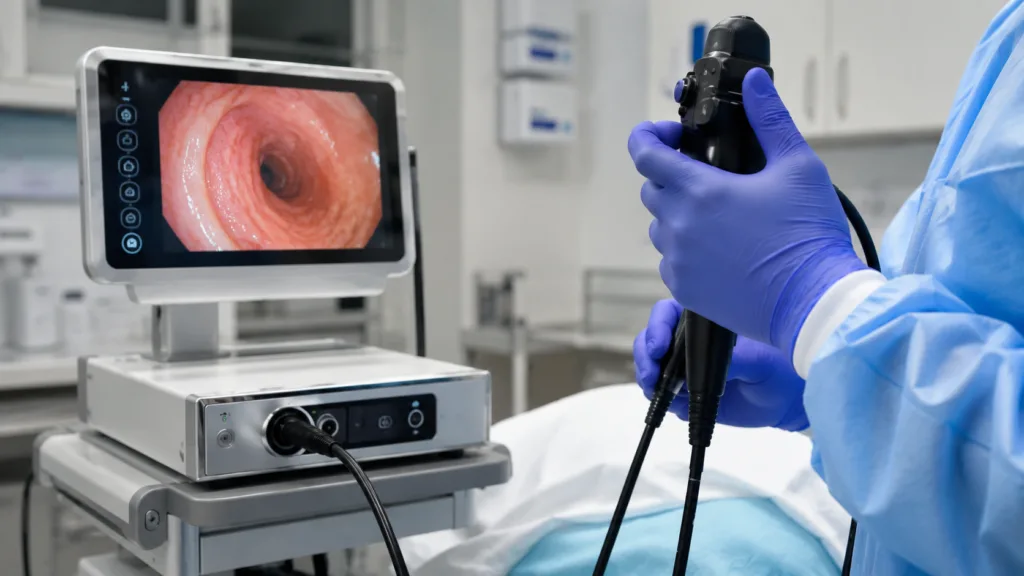
The technical design offers several features that could appeal to programs with limited endoscopy infrastructure. EvoEndo describes the Model LE Gastroscope as an ultra-slim device with an approximately 3.5 millimetre insertion tube and a 2 millimetre working channel. The company offers 85 centimetre and 110 centimetre versions, while the controller is portable and weighs approximately two pounds.
The single-use scope eliminates the need to clean, disinfect, store and repair that component between procedures. This may be particularly relevant for low-volume programs where maintaining a reusable fleet and reprocessing operation can be difficult to justify. Portability could also allow procedures to be conducted in clinic rooms or other appropriate settings rather than limiting them to a conventional operating room or endoscopy suite.
Those advantages do not mean the platform is infrastructure-free. A program still needs appropriate clinical space, infection-control procedures, trained personnel, monitoring protocols, emergency preparedness, documentation systems and access to follow-up care. Sites must also determine how the procedure will be scheduled, who will administer topical anaesthesia where required, how patients will be prepared and what happens when an examination cannot be completed without sedation.
Single-use technology also changes rather than eliminates the economic calculation. Hospitals may avoid reprocessing labour, maintenance contracts and scope-repair expenses, but they incur a new consumable cost for every procedure. Waste management and supply continuity become additional considerations. A site performing only a small number of cases may value predictable per-procedure costs, while a high-volume center may compare those costs closely with the utilisation economics of its reusable equipment.
EvoEndo’s opportunity is strongest where sedation-free procedures create capacity that would otherwise be unavailable or expensive. A program that can move selected diagnostic examinations out of anesthesia-supported rooms may free those resources for more complex procedures. Smaller facilities may also gain the ability to evaluate patients locally rather than referring every suitable case to a distant tertiary center.
The business case will vary considerably between institutions. It will depend on procedure mix, local labour costs, anesthesia availability, payer contracts, expected case volume and whether clinicians can complete examinations reliably while obtaining adequate biopsies.
What does the 3,000-procedure milestone reveal about EvoEndo’s commercial traction?
EvoEndo’s reported footprint has expanded steadily. The company said its system was being used in 25 hospitals in April 2024. By July 2025, it reported availability at more than 40 facilities. Its July 2026 update placed the platform at more than 70 locations, with over 3,000 sedation-free transnasal procedures completed.
That trajectory indicates meaningful early adoption for a specialised endoscopy model. It also suggests that some hospitals have moved beyond occasional evaluation. EvoEndo reported that programs at Children’s Mercy Kansas City and Phoenix Children’s Hospital had each completed more than 300 procedures, providing evidence that sustained utilisation is possible at experienced sites.
The figures remain company-reported operational metrics rather than independently audited measures of national market share. They do not reveal how many procedures are performed each month, how utilisation varies across the installed base or how many sites have established financially sustainable programs. Seventy locations could include a mixture of high-volume centers, newer adopters and sites performing relatively few cases.
Procedure count also does not answer every clinical question. Future evidence will need to provide detailed completion rates, biopsy adequacy, patient tolerance, conversion to sedated endoscopy, adverse events and outcomes across different ages and clinical indications. Results from experienced academic centers may not transfer directly to community settings where staff encounter fewer cases and have less opportunity to progress along the learning curve.
Nevertheless, the milestone strengthens EvoEndo’s commercial story. The company can now point to implementation across multiple geographies and clinical environments rather than relying only on the promise of an FDA-cleared platform. The next stage will test whether this experience can be converted into a repeatable deployment model for programs with fewer specialist resources.
How will patient selection and clinician training shape sedation-free endoscopy adoption?
Sedation-free transnasal endoscopy offers a different patient experience from conventional sedated upper endoscopy. An ultra-slim scope is passed through the nasal passage and into the upper gastrointestinal tract while the patient remains awake. The approach may avoid anesthesia-related preparation and recovery, but it requires cooperation and may involve pressure, gagging, nasal discomfort or anxiety.
Not every patient will be an appropriate candidate. Anatomical limitations, previous nasal surgery, bleeding risk, severe anxiety, developmental considerations, complex therapeutic requirements and the expected duration of the procedure can influence the decision. Some examinations may still require conventional sedation because of patient tolerance, procedural complexity or the need for interventions that cannot be performed through the smaller working channel.
Implementation literature on pediatric transnasal endoscopy emphasises that programs need more than device instruction. Published guidance addresses room design, staffing, topical analgesia, patient preparation, distraction techniques, procedural workflow, financing and training. Virtual reality and other distraction tools may improve the experience for some pediatric patients, but they do not replace clinical judgment or the need for an escalation plan when an awake procedure cannot be completed.
Training will become more important as EvoEndo reaches programs with less prior experience. A clinician who performs the procedure only occasionally may face a different learning curve from a specialist at a high-volume children’s hospital. The company will therefore need to demonstrate that its training system produces consistent performance across different practice types, not merely that expert early adopters can use the device effectively.
Hospitals will also need clear consent and communication processes. Patients and caregivers should understand the possibility that the examination may be incomplete or that a separate sedated procedure could still be required. Sedation-free endoscopy should be presented as an additional clinical pathway for selected cases, not as a universal replacement for conventional upper endoscopy.
Why will reimbursement and procedure economics determine whether access genuinely expands?
Regulatory clearance allows EvoEndo to market its system for the cleared indications, but reimbursement determines whether providers can establish a durable service. Coding, coverage and payment are separate issues. The existence of a procedure code or hospital payment classification does not guarantee that every payer will cover the examination, pay at the same rate or accept the same documentation.
Programs must compare expected reimbursement with the cost of the disposable scope, staff time, topical medications, equipment, room utilisation and any follow-up procedure required after an incomplete examination. They must also calculate the potential savings from avoiding anesthesia, recovery-room occupancy, reusable-scope reprocessing and delays caused by limited operating-room capacity.
The economic argument may be strongest where anesthesia access is constrained or where conventional scheduling creates long waits for relatively straightforward diagnostic procedures. Sedation-free examinations could also reduce the time patients and caregivers spend at a facility, although the scale of that benefit will depend on local protocols and patient circumstances.
For smaller sites, the critical question is whether enough suitable patients can be identified to maintain clinician proficiency and justify program support. A portable controller may lower the initial capital barrier, but low utilisation can still make the per-procedure model unattractive. Conversely, a regional health system may find value in sharing implementation expertise across several hospitals or outpatient locations.
EvoEndo’s claim that it can serve programs of all sizes will therefore be judged site by site. Broad access is not simply a matter of selling more scopes. It requires a commercially workable pathway that links patient identification, procedure scheduling, clinician training, payer reimbursement and reliable product supply.
What evidence will determine the next phase of EvoEndo’s expansion?
The most important next step would be broader prospective evidence generated across multiple institutions and practice settings. Decision-makers will want to see procedure-completion rates, biopsy quality, patient-reported experience, complications, conversion to sedated endoscopy and cost outcomes reported with enough detail to identify which populations benefit most.
Comparative studies could also clarify where sedation-free transnasal endoscopy adds the greatest value. The relevant comparison may vary between patients. For some, it may be conventional sedated esophagogastroduodenoscopy. For others, it may be delayed evaluation, referral to a tertiary center or repeated monitoring that is difficult to schedule under anesthesia.
Real-world reports have already described use in settings including rural care, inpatient evaluation and higher-risk outpatient populations, but case experiences do not establish that the same performance will be achieved everywhere. They are useful signals of operational flexibility, not substitutes for controlled or systematically collected multicenter evidence.
Commercially, observers should watch whether EvoEndo continues to add locations while increasing average procedure volumes at existing customers. Repeat purchasing, expansion from pediatric into adult programs, adoption by community gastroenterology groups and use across multiple facilities within the same health system would provide stronger evidence that the model is becoming embedded in routine care.
EvoEndo’s July 28 announcement marks a credible shift from early specialist adoption toward broader commercial scaling. The company has an FDA-cleared platform, a growing location count and several thousand reported procedures behind its expansion strategy. The harder test now is whether it can help programs of different sizes turn sedation-free endoscopy into a consistent, reimbursable and clinically appropriate service rather than an occasionally used alternative.
That outcome will depend less on how small the scope is than on how well the entire pathway works around it.