Epitel, Inc. has closed a $26 million Series B financing to expand commercial adoption of its REMI Remote EEG Monitoring System, a wearable platform designed to support wireless electroencephalography in healthcare facilities and ambulatory settings. The round was co-led by Catalyst Health Ventures and Genoa Ventures, with participation from unidentified new and existing investors, and will fund sales, marketing, customer experience, provider deployment and broader ambulatory market access.
The financing shifts the central question around Epitel from whether it can assemble a cleared wireless EEG portfolio to whether it can build a repeatable commercial model around that technology. REMI has accumulated five United States Food and Drug Administration 510(k) clearances across the monitoring system and related artificial intelligence tools, but regulatory clearance alone does not determine whether neurologists, hospitals, ambulatory EEG providers and payers will adopt the platform at scale.
Epitel said the capital will support a larger dedicated field team and help clinical organisations incorporate REMI into existing workflows. That makes the Series B primarily a commercial execution round, with the next phase likely to be judged through customer utilisation, repeat sensor demand, payer access and evidence that the platform can reduce practical barriers to obtaining and reviewing EEG recordings.
Why does Epitel’s $26 million Series B mark a different stage from its earlier financing?
Epitel’s previous disclosed institutional round was a $12.5 million Series A announced in February 2022, also co-led by Catalyst Health Ventures and Genoa Ventures. That financing was directed toward initial hospital commercialisation and platform development, while the company said it had previously received more than $7.5 million in grant-backed support from the National Institutes of Health and the Epilepsy Foundation.
The latest transaction brings Epitel’s publicly announced venture financing from the Series A and Series B rounds to at least $38.5 million. The new round is more than twice the size of the 2022 raise, reflecting a larger commercial mandate after the company expanded REMI’s indications, added artificial intelligence modules and moved from initial hospital deployment toward longer-duration ambulatory monitoring.
The continuity of the two co-lead investors suggests that existing backers remain prepared to finance the next phase. Epitel, however, did not disclose its valuation, revenue, number of commercial sites, utilisation levels, pricing, cash burn, expected runway or the identities of the other participating investors. Those omissions are common in private financings, but they limit any external assessment of how much commercial traction has already been achieved.
The leadership structure also points toward commercialisation. Steve Pacelli became chief executive officer in February 2025 after a long operating career at Dexcom, while founder Mark Lehmkuhle moved into the chief technology officer role. The combination of a commercially experienced chief executive, an expanded regulatory portfolio and a materially larger financing creates a clearer growth platform, but also raises expectations for measurable execution.
How could wireless EEG address access and monitoring-duration gaps without replacing full-montage systems?
EEG access remains uneven across the United States. A published analysis of 4,550 hospitals found that only 27.3 percent were classified as EEG capable in 2018, with most of those facilities located in urban areas. The dataset is not current and its definition of capability was broad, but it illustrates the structural problem Epitel is targeting: neurological monitoring expertise and equipment remain concentrated in a limited share of hospitals.
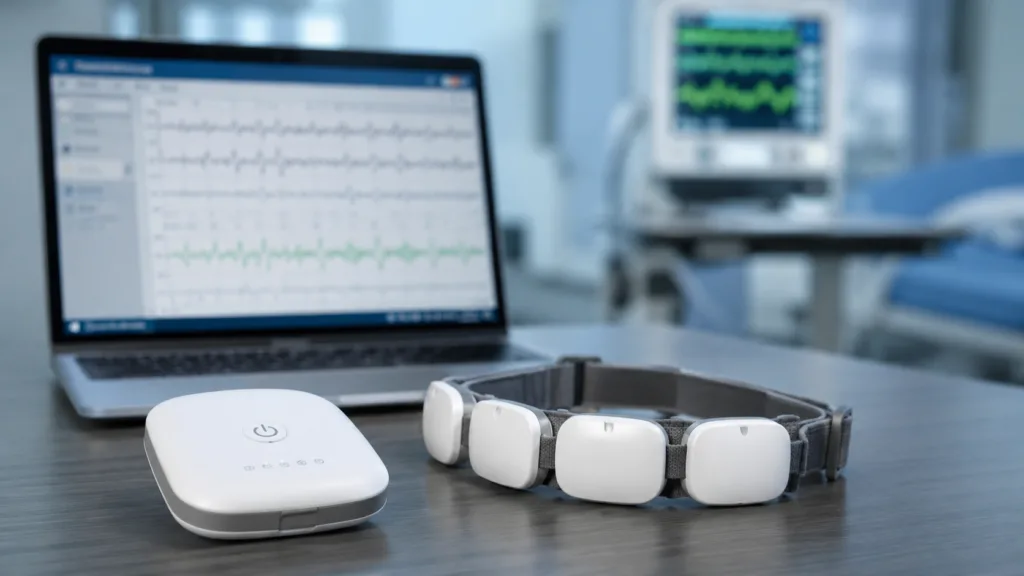
REMI uses four small wireless sensors positioned below the hairline to record electrical brain activity. Data are transmitted through the REMI Mobile application to the REMI Cloud and prepared for review using qualified EEG viewing software. The cleared system can be used in healthcare and ambulatory settings for recording periods of up to 30 days, creating the possibility of observing intermittent events that may not occur during a brief routine test or limited inpatient stay.
That extended duration is commercially important because suspected seizures can be unpredictable and may not be captured within the first hours or days of monitoring. A system that is less restrictive than tethered equipment could support monitoring during normal activity and reduce the practical burden associated with prolonged recording.
The trade-off is that REMI is a reduced-montage system rather than a conventional high-channel-count video EEG platform. Reduced-channel monitoring can be useful for identifying electrographic events, expanding access and supporting triage, but it may not provide the same spatial information or clinical context required for every diagnostic question.
Epitel’s opportunity therefore depends on positioning REMI as an additional monitoring pathway for suitable patients and settings, rather than as a universal substitute for comprehensive EEG evaluation.
What does the clinical evidence show about REMI and its seizure-detection algorithm?
The evidence base has advanced beyond early feasibility, although it remains narrower than the commercial ambition implied by a broad United States expansion strategy. A 2021 peer-reviewed study evaluated recordings from 20 adults who wore four Epitel sensors alongside standard video EEG during epilepsy monitoring unit stays. Ten participants experienced 24 focal-onset electrographic seizures.
Blinded consensus review of the reduced-channel REMI montage identified patients experiencing electrographic seizure activity with 90 percent sensitivity and 90 percent specificity. Detection of individual focal-onset seizures was more difficult, with consensus sensitivity of 61 percent without algorithm annotations and 68 percent with decision-support annotations.
The automated algorithm reported 90 percent mean sensitivity for individual seizures, accompanied by a higher false-detection rate than the expert consensus review. Those findings supported the clinical potential of the system but came from a small dataset and an early stage of algorithm development. Several authors were affiliated with or had financial interests in Epitel, reinforcing the importance of broader independent and real-world evaluation.
A larger validation study published in Epilepsia in 2025 evaluated 50 participants, including 31 with seizures. The algorithm achieved event-level sensitivity of 86.2 percent and a false-detection rate of 0.162 per hour. Performance varied by seizure type, with sensitivity of 77.3 percent for focal seizures, 86.7 percent for generalised seizures and 91.4 percent for focal seizures evolving to generalised events.
The study also reported 80 percent sensitivity in ambulatory monitoring and 87.5 percent in epilepsy monitoring units. The ambulatory false-detection rate was higher at 0.290 per hour, with those ambulatory recordings involving pediatric participants. This matters because the commercial case for weeks-long home monitoring depends not only on finding events but also on keeping false detections and review burden at manageable levels.
The results provide a meaningful validation layer for REMI Vigilenz, but they do not independently establish that the platform shortens time to diagnosis, reduces hospital transfers, improves treatment decisions, lowers total care costs or produces better patient outcomes. Those questions require prospective implementation studies across different provider types, populations and monitoring durations.
Can artificial intelligence make extended EEG review scalable without overstating automation?
Longer monitoring creates a data-volume problem. Recording for days or weeks may increase the chance of capturing an infrequent seizure, but it also produces substantially more EEG for qualified clinicians to examine. Epitel’s artificial intelligence tools are intended to narrow that review burden by identifying sections that may contain electrographic events and presenting confidence information to clinicians.
REMI Vigilenz AI for Event Detection is cleared to analyse previously acquired REMI recordings and mark sections that may correspond to potential electrographic seizures lasting at least 10 seconds. It is intended as an aid for physicians qualified to interpret EEG and is cleared for patients aged six years and older.
The software does not make a diagnostic conclusion and does not remove the requirement for professional review. This distinction will be important as Epitel expands its commercial team because phrases such as AI-driven seizure detection can create an impression of autonomous diagnosis that the authorised indication does not support.
Epitel also holds clearance for REMI Vigilenz AI for Bedside Notifications, which conducts automated analysis in near real time and can generate notifications when specified seizure characteristics are detected. Its authorised use is narrower than a general description of real-time seizure monitoring might imply.
The module is indicated for non-intensive-care healthcare settings, has not been validated for electrographic status epilepticus, can involve delays of several minutes and is not a substitute for real-time monitoring. Its value proposition is therefore clinician-directed prioritisation and workflow support, not independent diagnosis or an automatic treatment trigger.
Why does the pediatric expansion increase REMI’s opportunity while preserving an AI age boundary?
The March 2025 clearance expanded use of the REMI Remote EEG Monitoring System to adult and pediatric patients aged one year and older. That broadened the addressable population for the underlying monitoring platform and created a potential route into pediatric ambulatory care, where wired systems may be difficult to maintain during normal movement and daily routines.
The expansion should not be interpreted as extending every REMI capability to children of the same age. The REMI monitoring system is cleared from age one, while REMI Vigilenz AI for Event Detection remains indicated for patients aged six years and older. Commercial materials, training and clinical protocols will need to preserve that distinction.
For younger patients, practical adoption will also depend on sensor adhesion, skin tolerance, caregiver training, motion-related artefacts, data completeness and the ability to maintain recordings over the prescribed duration. FDA clearance establishes that the device met the requirements of the 510(k) pathway for its stated use, but it does not prove identical adherence, data quality or clinical utility across every pediatric age group.
Real-world studies in younger children could help determine monitoring completion rates, sensor replacement needs, event capture, caregiver burden and how frequently the resulting recordings alter clinical decision-making. Such evidence may become increasingly important as Epitel seeks broader provider and payer adoption.
Will reimbursement, workflow integration and disposable-sensor economics determine adoption?
Epitel describes REMI as reimbursable through existing codes, which may reduce one barrier to adoption. The existence of billing codes, however, does not guarantee coverage or payment. Reimbursement can depend on the patient’s indication, monitoring duration, provider qualifications, place of service, payer policy, documentation and the way technical and professional components are delivered.
Hospitals and ambulatory providers will also evaluate how quickly staff can be trained, how REMI integrates with existing EEG viewing systems, how data move through the cloud environment and how technical support is provided when recordings fail or sensors detach.
Cybersecurity, patient privacy, interoperability, service reliability and supply continuity are likely to be part of procurement reviews because REMI combines disposable hardware, mobile software, cloud storage and clinician-facing analysis.
The disposable-sensor model could support recurring revenue if customers use REMI consistently, but the commercial economics have not been disclosed. Investors will eventually need evidence that expanded placement translates into sustained monitoring volume rather than isolated trials or low-utilisation installations.
Repeat orders, monitoring days per site, patient completion rates, customer retention and gross margin will therefore be more informative than the number of initial accounts alone. Epitel’s plan to expand its customer experience and field teams recognises that medical device adoption is often operational rather than purely technological.
What should clinicians, investors and digital-health observers watch after the Series B?
The Series B gives Epitel more capacity to turn regulatory progress into commercial infrastructure. The company now has a broader age indication for REMI, artificial intelligence modules for event review and bedside notifications, a chief executive with medical technology scaling experience and returning lead investors willing to fund expansion.
The next proof points should be concrete. Epitel will need to demonstrate growth in active clinical sites, repeat use of disposable sensors, reliable ambulatory completion, manageable false-detection burden, clearer reimbursement pathways and evidence that REMI fits the work of neurologists and EEG readers without transferring complexity elsewhere in the system.
Additional prospective studies could strengthen the commercial and clinical case by measuring time to diagnosis, treatment changes, avoided transfers, patient experience and total cost of care. Wider adoption will also require manufacturing and supply capacity that can support recurring sensor demand without compromising service quality.
The $26 million financing reduces near-term capital pressure and gives Epitel a credible opportunity to build a larger commercial presence. It does not settle the adoption question. The company’s next phase will be defined by whether REMI becomes a routinely used neurological monitoring pathway rather than merely a well-cleared and clinically promising wireless platform.