Intellia Therapeutics Inc. (Nasdaq: NTLA) has moved its one-time CRISPR therapy lonvoguran ziclumeran into Priority Review at the United States Food and Drug Administration, with regulators setting a March 10, 2027 target action date for the treatment of hereditary angioedema. If approved, lonvo-z could become the first commercially authorized in-vivo CRISPR gene-editing treatment and the first HAE therapy designed to provide durable disease control from a single administration.
The Biologics License Application is supported by the 80-patient Phase 3 HAELO study, in which one 50 mg infusion of lonvo-z reduced mean monthly hereditary angioedema attacks by 87% compared with placebo between weeks five and 28. Sixty-two percent of treated patients were completely attack free and free from HAE therapy during the six-month efficacy period compared with 11% receiving placebo.
Despite the potential historical significance, NTLA shares have responded cautiously. The stock closed September 14 around $11.87, up 1.1% for the session but below its September 8 level and far beneath its 52-week high of $28.25.
That divergence makes NTLA particularly interesting for retail biotech communities. The clinical efficacy signal is unusually strong, but investors are also pricing permanent gene-editing safety, regulatory risk, competition from highly effective existing HAE medicines and uncertainty around how quickly patients will adopt an irreversible one-time therapy.
How does a single lonvo-z infusion reduce hereditary angioedema attacks?
Hereditary angioedema is commonly caused by deficiency or dysfunction of C1 inhibitor, leading to uncontrolled activity in the kallikrein-kinin pathway and excessive production of bradykinin. Elevated bradykinin increases vascular permeability and causes unpredictable episodes of severe swelling.
Attacks can affect the hands, feet, gastrointestinal tract, face and airway. Laryngeal swelling can become life threatening, making reliable prevention an important objective even for patients whose attacks are relatively infrequent.
Several approved therapies already reduce kallikrein activity or replace C1 inhibitor, but they generally require repeated administration. Patients can use injections every few days or weeks, daily oral prophylaxis or on-demand medicines during individual attacks.
Lonvo-z attempts to change the biological source of kallikrein production permanently. The therapy uses lipid nanoparticles to deliver CRISPR gene-editing machinery to liver cells, where it is designed to disable the KLKB1 gene responsible for producing plasma prekallikrein.
Once the gene is disrupted, hepatocytes should produce substantially less kallikrein over the long term, reducing downstream bradykinin generation and therefore the biological trigger for swelling attacks.
The treatment does not insert a new gene and is not intended to correct the underlying SERPING1 mutation responsible for many HAE cases. Instead, it permanently modifies another gene within the disease pathway to suppress a major mediator of attacks.
How strong are the Phase 3 HAELO efficacy results?
HAELO randomized 80 adults and adolescents aged 16 or older with Type 1 or Type 2 hereditary angioedema. Fifty-two received a single 50 mg lonvo-z infusion and 28 received placebo.
Between weeks five and 28, the mean monthly attack rate was 0.26 with lonvo-z compared with 2.10 for placebo, corresponding to an 87% reduction. The result was statistically significant with a p-value below 0.0001.
All key secondary endpoints were also met. Sixty-two percent of lonvo-z recipients had no attacks and used no additional HAE therapy during the six-month efficacy period compared with 11% receiving placebo.
Attacks requiring on-demand treatment were reduced by 89%, while moderate or severe attacks were reduced by 91% relative to placebo.
Quality of life also improved substantially. The mean Angioedema Quality of Life score decreased by 23.51 points with lonvo-z compared with 6.47 points for placebo at week 28, a 17.04-point difference.
These results establish a strong clinical effect within the trial period. The most important longer-term question is durability because the value proposition depends on editing liver cells once and obtaining years of benefit.
Earlier-phase patients have provided follow-up extending several years, offering evidence that kallikrein suppression and attack reduction can persist. Continued long-term observation will remain essential because permanent editing creates both the attraction and the unique risk of the therapy.
What makes lonvo-z different from existing HAE prevention medicines?
The HAE treatment market is already clinically successful. Takeda Pharmaceutical’s Takhzyro blocks plasma kallikrein through periodic subcutaneous injections. BioCryst Pharmaceuticals’ Orladeyo provides oral prophylaxis, while CSL Behring’s Haegarda replaces C1 inhibitor through subcutaneous treatment.
Patients also have on-demand therapies for breakthrough attacks, including KalVista Pharmaceuticals’ oral Ekterly, approved in 2025.
This means Intellia is not entering an untreated disease. To succeed commercially, lonvo-z must persuade patients and physicians that one-time administration offers enough convenience and durable efficacy to justify permanent genomic modification.
The trade-off is conceptually powerful. A patient who currently plans life around injections, daily tablets and rescue medicines could potentially receive one infusion and experience sustained attack control without ongoing prophylaxis.
The psychological threshold is equally significant. Taking a drug repeatedly allows treatment to be stopped if circumstances change. CRISPR editing is designed to be permanent.
That makes counseling, informed consent and long-term safety confidence unusually important. Patients may differ substantially in how they value the convenience of a one-time intervention against the uncertainty inherent in permanent gene editing.
What does the safety database show so far?
In HAELO, Intellia reported favorable safety and tolerability through the primary observation period. The most common treatment-emergent adverse events occurring more frequently with lonvo-z included infusion-related reactions, headache, fatigue, back pain and upper respiratory tract infection.
The company reported no serious adverse events in the lonvo-z arm during the primary observation period, while adverse events were generally mild or moderate.
That profile supports regulatory review, but conventional adverse-event tables are only one part of gene-editing safety.
Regulators will examine whether CRISPR activity produces unintended genomic changes, whether editing occurs in tissues outside the intended liver target and whether altered KLKB1 biology creates long-term consequences not visible during a six-month controlled trial.
Intellia has designed its lipid nanoparticles to deliver editing machinery transiently. The CRISPR components are present for a limited period, while the genomic change they create is intended to persist.
This differs from gene therapies in which a vector may continue carrying genetic material over long periods, but permanent DNA modification still requires long-term patient monitoring.
The FDA’s decision not to currently plan an advisory committee meeting may suggest the agency believes the application can be reviewed without external panel discussion, though that position could still change during the review.
Why could FDA approval be a landmark for the entire CRISPR field?
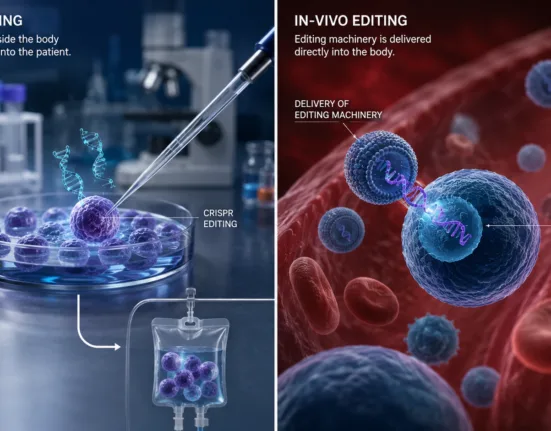
CRISPR medicines have already reached commercial medicine, but approved products to date have relied on ex-vivo editing. In that approach, cells are removed from the patient, edited outside the body, quality tested and reinfused.
Lonvo-z performs editing directly inside the patient.
That distinction matters because in-vivo delivery could dramatically broaden the diseases accessible to gene editing. It eliminates the need to remove and manufacture a personalized cellular product and could eventually allow relatively conventional infusion-center administration.
The liver is an attractive first organ because lipid nanoparticles naturally accumulate there and hepatocytes produce numerous circulating proteins involved in genetic and metabolic disorders.
Successful approval of lonvo-z would therefore validate more than one HAE product. It would show that regulators are willing to approve a systemically delivered CRISPR therapy that makes permanent edits inside human organs when the clinical and safety package is sufficiently compelling.
Investors consequently view NTLA partly as an HAE company and partly as a platform company. The valuation implications of the first approval could extend to Intellia’s other in-vivo editing programs.
Platform enthusiasm should remain disciplined. Success editing KLKB1 in the liver does not prove that every future gene, organ or disease can be targeted safely. Delivery remains one of the largest constraints in gene editing outside the liver.
Why hasn’t Priority Review produced a larger NTLA stock rally?
NTLA closed September 14 at $11.87, compared with $12.74 on September 8 when the Priority Review development entered the market. The shares remain down substantially from a 52-week high of $28.25.
That subdued reaction does not mean investors doubt the HAELO efficacy data. Instead, Intellia carries several simultaneous considerations that complicate the stock story.
The company is investing heavily ahead of commercialization while continuing other expensive clinical programs. Second-quarter cash, cash equivalents and marketable securities totaled approximately $628 million, and Intellia recorded a quarterly net loss above $100 million.
It has strengthened liquidity through a term-loan facility of up to $400 million from OrbiMed, with $75 million funded initially and additional tranches tied to milestones.
The company says existing resources should support operations into at least 2028 and beyond the anticipated lonvo-z launch.
Investors are also assessing Intellia’s transthyretin amyloidosis program after prior regulatory and clinical complications, making NTLA valuation broader than the success of one HAE application.
Retail sentiment has nevertheless remained active, particularly because prominent investors have accumulated shares and because approval could create the first commercial example of in-vivo CRISPR editing.
Can a one-time therapy disrupt an established recurring-revenue HAE market?
The commercial tension is unusual. Chronic HAE prophylaxis creates recurring pharmaceutical revenue for incumbent manufacturers because patients remain on treatment for years.
Lonvo-z potentially converts that model into one major treatment event.
Pricing will therefore be critical. Intellia has not yet disclosed a commercial price, but one-time genetic treatments are typically evaluated through the value of many years of avoided chronic therapy rather than through the manufacturing cost of one infusion.
Payers may view that logic favorably if durability is convincing, but they may also worry about paying a high upfront price for a patient who could later switch insurance plans.
Outcomes-based agreements or other payment structures could become relevant, particularly during the early commercial years when long-term real-world durability remains incomplete.
Intellia also needs a different commercial infrastructure from companies selling daily tablets. Treatment centers must be capable of delivering the infusion and managing associated monitoring, while physicians need confidence identifying suitable patients.
The HAE specialist community is relatively concentrated, which may make targeted launch execution more manageable than a mass-market gene-editing rollout.
What are the key NTLA catalysts through March 2027?
The March 10 FDA action date is the obvious binary event. Approval would move Intellia immediately into launch execution, while a Complete Response Letter would likely have a substantial stock impact given lonvo-z’s importance to the company.
Investors should watch whether FDA requests an advisory committee later in the review, though none is currently planned.
Final labeling matters nearly as much as approval. Age restrictions, monitoring requirements, contraindications and any long-term follow-up obligations could materially influence the commercial population.
Manufacturing inspection outcomes are another factor. Complex genetic medicines depend on reproducible lipid nanoparticle and CRISPR component manufacturing, meaning strong clinical data alone cannot overcome unresolved quality issues.
The commercial launch is targeted for the first half of 2027 if approval occurs.
For NTLA, the stakes extend well beyond the first few hundred HAE patients. A positive FDA decision would convert in-vivo CRISPR editing from an experimental clinical concept into a regulated commercial modality.
That is precisely why the stock is likely to remain highly sensitive to every regulatory update through March. Lonvo-z is not merely another rare-disease filing. It is a test of whether permanent gene editing delivered directly inside the body is ready to move from biotechnology’s promise into routine medicine.