Johnson & Johnson has reported positive pivotal clinical study results for the investigational OTTAVA Robotic Surgical System in Roux-en-Y gastric bypass procedures, with the soft tissue surgical robot meeting its primary safety and performance endpoints through 30 days. The study, presented at the 2026 American Society for Metabolic and Bariatric Surgery Annual Meeting, supports the medical device giant’s U.S. Food and Drug Administration De Novo submission for upper abdominal general surgery procedures.
Why Johnson & Johnson’s OTTAVA robot matters beyond one gastric bypass study
The bigger story is not simply that Johnson & Johnson has generated supportive clinical data in bariatric surgery. The more important signal is that the healthcare group is moving closer to a U.S. soft tissue robotic surgery market that has long been shaped by Intuitive Surgical’s da Vinci ecosystem and is now becoming more contestable as large medtech companies try to convert procedure expertise, instruments, software, and hospital relationships into platform advantage.
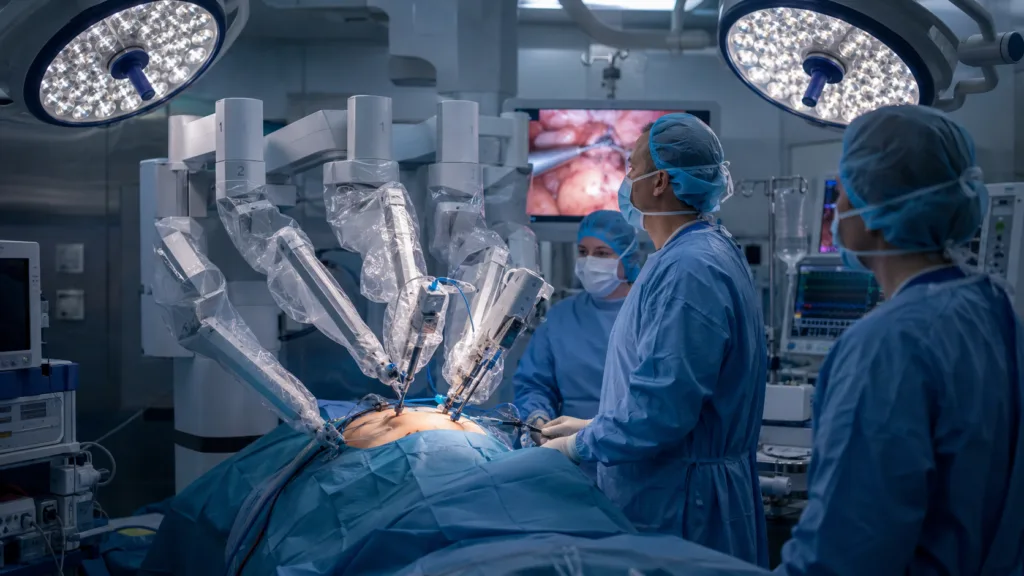
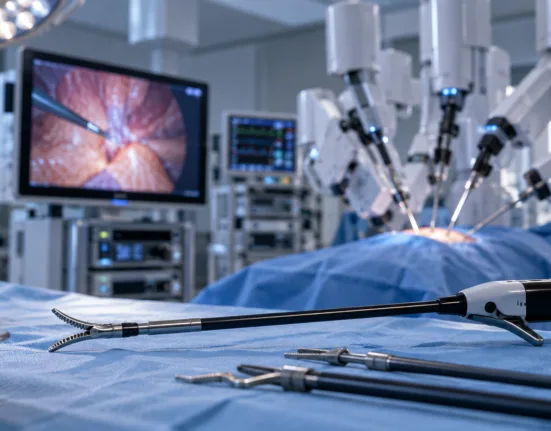
The FORTE study was modest in size, with 30 patients undergoing Roux-en-Y gastric bypass across six U.S. sites, but it still gives Johnson & Johnson a clinically relevant entry point. Roux-en-Y gastric bypass is not a trivial test case. It requires controlled soft tissue manipulation, stapling, suturing, anatomical navigation, and procedural coordination across the upper abdomen. Completing all cases robotically without conversion to a non-robotic approach helps address one of the first questions regulators and hospital robotics committees ask: whether a new platform can perform consistently in real operating room conditions.
The limitation is equally clear. A 30-day follow-up window can support early safety and performance evaluation, but it cannot settle long-term questions about comparative outcomes, learning curves, operating room throughput, cost-effectiveness, complication durability, or how the system performs across broader patient types. For clinicians and hospital executives, this is an enabling data point, not yet a definitive market conversion moment.
How the table-integrated design could reshape hospital adoption of soft tissue robotics
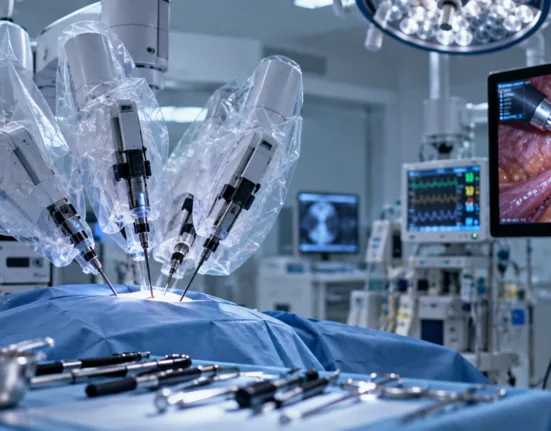
OTTAVA’s table-integrated architecture is likely to be the most strategically important feature for hospital buyers. Johnson & Johnson has positioned the platform around four robotic arms integrated into a standard-size surgical table, with the arms designed to be stowed when not in use. That design targets a practical pain point that can matter as much as clinical capability: operating room space.
Many hospitals, especially community facilities and older surgical centers, do not have unlimited room capacity for large robotic systems, towers, carts, instrument storage, and workflow redesign. A system that can reduce floor-space friction could expand the addressable market for robotic-assisted surgery, particularly if it allows facilities to adopt robotics without major construction or dedicated room conversion. That is where OTTAVA may try to differentiate itself from legacy robotic surgery models.
However, architecture alone does not guarantee adoption. Hospitals will still assess instrument costs, service contracts, surgeon training, sterile processing impact, case scheduling, and integration with existing laparoscopic and robotic workflows. A compact design may solve one constraint, but robotic surgery purchasing decisions are multi-year capital commitments. The platform will need to prove not only that it fits into the room, but that it fits into hospital economics.
Why the FDA pathway still leaves major commercial questions unresolved
Johnson & Johnson’s De Novo submission is central to the story because it seeks a pathway for multiple upper abdominal general surgery procedures, including gastric bypass, gastric sleeve, small bowel resection, and hiatal hernia repair. That broader procedural ambition matters because robotic platforms require utilization density. A robot used for only a narrow set of cases may struggle to justify purchase costs, while a system used across bariatric, gastrointestinal, and hernia workflows can build a stronger capital equipment case.
The regulatory risk is that De Novo classification does not automatically translate into broad clinical enthusiasm. Even if clearance is granted, hospitals may adopt cautiously until surgeons have more comparative data, training pathways are mature, and early users report practical workflow benefits. Regulators may focus on safety and performance for the requested indication, but commercial committees will focus on whether the platform improves productivity, expands access, reduces conversions, or supports predictable outcomes.
This is where Johnson & Johnson’s broader surgery business becomes relevant. The healthcare group already has deep relationships through Ethicon instruments, stapling, energy devices, and surgical procedure support. If OTTAVA can eventually connect robotics with that installed procedural footprint, Johnson & Johnson could approach robotics not as a standalone device sale but as part of a broader surgical ecosystem. The unresolved question is whether that ecosystem can overcome the switching costs and loyalty already embedded around incumbent robotic platforms.
How OTTAVA compares with Intuitive Surgical and Medtronic Hugo in the robotics race
OTTAVA enters a market where Intuitive Surgical remains the benchmark. Intuitive Surgical reported a da Vinci surgical system installed base of 11,395 systems as of March 31, 2026, up 12% from the prior year, and first-quarter 2026 revenue growth of 23%. That scale gives Intuitive Surgical a major advantage in surgeon familiarity, training, procedure libraries, hospital procurement experience, and ecosystem confidence.
Medtronic has also changed the competitive backdrop. The Hugo robotic-assisted surgery system received U.S. Food and Drug Administration clearance for urologic procedures in December 2025, giving another global medtech group a formal U.S. entry point. While Hugo’s initial U.S. clearance is in urology rather than broad upper abdominal surgery, its arrival reinforces the idea that robotic surgery is shifting from a single-dominant-platform market toward a more contested capital equipment category.
Johnson & Johnson’s differentiator may be neither first-mover scale nor first U.S. entry among major challengers. Instead, OTTAVA’s case rests on whether a table-integrated soft tissue platform can reduce physical adoption barriers while giving surgeons the reliability needed for complex upper abdominal procedures. That is a different bet from simply matching an incumbent robot feature by feature. It is a bet that operating room design, workflow efficiency, and procedural ecosystem integration can become competitive weapons.
What clinicians will watch after the FORTE study
Clinicians tracking robotic bariatric surgery are likely to look beyond endpoint success and focus on what the data do not yet answer. The 30-day weight loss figure is expected in the context of gastric bypass and is less important than surgical performance, conversion avoidance, adverse event patterns, operative time, docking efficiency, ergonomics, and reproducibility across sites.
The six-site structure improves the study’s relevance because it suggests the system was not evaluated in a single highly controlled center. Still, a 30-patient cohort is too small to capture uncommon complications or facility-level variation at scale. Bariatric programs may want evidence across larger cohorts, different body mass index categories, more diverse patient anatomy, and additional upper abdominal procedures before changing robotic capital planning.
The next layer of evidence will need to show whether OTTAVA can deliver a practical advantage over high-quality laparoscopy and established robotic systems. If the platform only demonstrates that it can perform procedures safely, it may meet a regulatory bar but not necessarily a hospital investment bar. If it can shorten setup time, support efficient room turnover, reduce space constraints, and integrate smoothly with existing surgical teams, the commercial case becomes much stronger.
Why Johnson & Johnson’s stock sentiment may stay cautious despite the robotics milestone
Johnson & Johnson shares recently traded around $221.32, giving the healthcare group a market capitalization of about $541 billion. For a company of that size, a robotics milestone is strategically meaningful but unlikely to move investor sentiment on its own unless it begins to reshape expectations for the MedTech segment’s long-term growth profile.
The investor lens is therefore measured rather than euphoric. OTTAVA could become an important platform if cleared and adopted, but the revenue ramp for surgical robots can be slow because hospitals require capital budgets, surgeon training, service infrastructure, and procedural proof before broad deployment. Robotics could improve Johnson & Johnson’s strategic positioning in surgery, but near-term sentiment will still be influenced by broader pharmaceutical, medtech, litigation, and capital allocation factors.
That said, the strategic upside is not trivial. If Johnson & Johnson can build a credible soft tissue robotics platform around existing surgical instruments and digital surgery assets, it could defend and expand its position in procedure-driven medtech. The prize is not one bariatric indication. It is a larger role in the connected operating room, where robotics, instrumentation, data, imaging, and digital workflow may increasingly determine vendor preference.
What happens next for OTTAVA and the soft tissue surgical robotics market
The next major milestone is the U.S. Food and Drug Administration’s review of the De Novo application. A favorable decision would give Johnson & Johnson a regulatory foundation for commercial planning in upper abdominal general surgery. It would also allow hospitals and surgeons to evaluate OTTAVA not as an experimental concept but as a potential entrant in a market that is becoming more competitive.
The risk is that regulatory clearance, if achieved, could create expectations faster than adoption can realistically follow. Robotic surgery markets are not won only by technical clearance. They are won by procedural evidence, surgeon confidence, training scale, service reliability, instrument availability, and hospital economics. Johnson & Johnson has many of the ingredients needed to compete, but it still has to prove that OTTAVA can translate clinical feasibility into routine surgical value.
For the medical device industry, the FORTE study marks a credible step in the gradual opening of soft tissue robotics competition. For clinicians, it raises practical questions about whether new architectures can expand robotic access without adding workflow burden. For hospital executives, it adds another platform to watch as capital planning becomes more complex. And for Johnson & Johnson, it turns OTTAVA from a long-running development story into a regulatory and commercial test of whether the operating room is ready for a new kind of surgical robot.