PanopticAI Technologies Limited has announced United States Food and Drug Administration clearance for respiratory-rate measurement through its PanopticAI Vital Signs software, expanding a platform previously cleared for contactless pulse-rate assessment. The privately held Hong Kong health-technology company can now use compatible smartphone and tablet cameras to produce non-invasive spot measurements of pulse and respiratory rates for healthcare professionals monitoring eligible adults.
Why respiratory-rate clearance matters more than simply adding another number to the app
Respiratory rate is one of the most fundamental vital signs, yet it is frequently recorded less consistently than temperature, blood pressure or heart rate. Conventional measurement often requires a clinician to observe chest movement manually, use a contact sensor or rely on specialised monitoring equipment.
Embedding respiratory-rate measurement inside an ordinary smartphone or tablet could reduce the equipment and labour needed for routine spot checks. A healthcare professional could open the software, position the patient within the camera frame and collect pulse and respiratory information without attaching electrodes, wearing a chest strap or using a dedicated respiratory sensor.
The regulatory expansion also strengthens the platform concept. PanopticAI is no longer presenting a single-purpose pulse-counting application. It is building a software layer intended to extract several physiological measurements through cameras already present in consumer devices.
That distinction matters commercially because hospitals, telemedicine providers and insurers are unlikely to integrate separate applications for every vital sign. A broader validated panel can make software integration, workflow training and enterprise purchasing more attractive.
The clearance remains narrow. The device is designed for spot checks rather than continuous monitoring, and it cannot independently direct treatment. It is not cleared to detect apnea, monitor critically ill patients or replace the wider clinical assessment required when respiratory deterioration is suspected.
How PanopticAI measures breathing without a wearable sensor touching the patient
The respiratory-rate function does not depend on visible facial colour changes alone. The software analyses small periodic movements in the upper torso associated with breathing while the subject remains still in front of the camera.
Pulse rate is calculated through remote photoplethysmography, which analyses subtle changes in reflected light caused by blood flow beneath the skin. Respiratory rate uses motion analysis to identify repeated chest-wall movement and estimate the number of breaths per minute.
The captured signals are sent to PanopticAI’s cloud-based Vital Sign Engine Service for processing. The calculated results are then returned to the application for display to the healthcare professional.
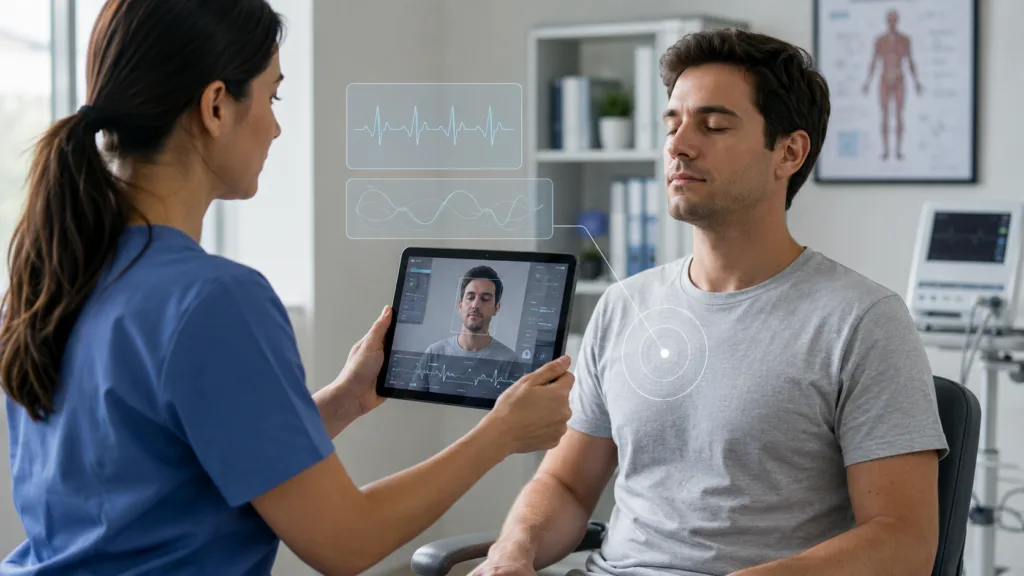
This architecture creates an important advantage. The device does not require specialised optical hardware because it uses compatible cameras and ambient light. Software updates and algorithm improvements could also be distributed centrally rather than requiring hospitals to replace physical monitoring equipment.
The same architecture introduces dependencies. The measurement requires an appropriate camera, supported operating system, adequate lighting, correct positioning and sufficient connectivity for cloud processing. A software-only product can remove hardware costs while becoming more sensitive to device configuration and network reliability.
PanopticAI must therefore prove that the experience remains consistent outside controlled validation environments. A feature that performs well in a well-lit clinic may face additional difficulty in patients’ homes, rural facilities or telemedicine settings with older devices and unstable internet connections.
What the 73-participant clinical validation establishes and what remains unanswered
The regulatory submission included a clinical validation study involving 73 adults aged 18 to 60. The study population included men and women, several racial and ethnic groups, different body-mass categories, participants with chronic illness and representation across all six Fitzpatrick skin types.
The software’s respiratory-rate estimates were compared with blinded manual counting of end-tidal carbon dioxide waveforms produced by an FDA-cleared reference device. The company also used metronome-guided breathing to test rates unlikely to occur naturally during ordinary study visits.
The combined evidence supported performance across a claimed range of six to 34 breaths per minute, with an accuracy target of within approximately three breaths per minute. Testing also examined distance, lighting, clothing, appearance conditions, cloud processing and software transmission.
This evidence is sufficient for substantial equivalence under the 510(k) pathway. It is not evidence that camera-derived respiratory rate improves clinical outcomes, predicts deterioration or reduces hospital admissions.
The sample is also too small to characterise every difficult-use population. Facial appearance, torso visibility, involuntary movement, tremor, obesity, loose clothing, poor lighting and respiratory distress could all affect signal quality.
The clearance excludes adults older than 60, even though older patients account for a large proportion of respiratory and cardiovascular monitoring. It also excludes children and people requiring critical care, continuous monitoring or apnea detection.
Future studies will need to expand the eligible population and show performance among patients whose movement, breathing pattern or clinical condition makes camera-based measurement more difficult.
Can contactless vital signs improve telemedicine rather than merely decorate virtual visits?
Telemedicine expanded access to healthcare but often removed objective physiological measurements from the consultation. A clinician may be able to speak with a patient through video while lacking reliable heart rate, respiratory rate, oxygen saturation or blood pressure information.
PanopticAI’s technology could help close part of that gap. A remote provider could ask an eligible patient to remain still while a compatible smartphone or tablet captures a spot measurement before or during the appointment.
This could be useful in virtual primary care, chronic-disease follow-up, insurance health assessments and post-discharge monitoring. Respiratory rate may add context when evaluating fever, cough, shortness of breath or recovery from an infection.
The regulatory label currently assigns use to healthcare professionals. It should not be interpreted as an unrestricted consumer-wellness feature that patients can use independently to diagnose illness.
Workflow integration will determine practical value. The result must enter the telehealth platform, become associated with the correct patient and appear inside the medical record without requiring repetitive manual transcription.
A stand-alone reading displayed on a separate screen may add friction rather than remove it. PanopticAI’s strongest commercial model may therefore involve licensing its software-development kit or application interface to hospitals, insurers and digital-health platforms rather than relying on direct consumer downloads.
Why the technology could reduce monitoring costs without replacing medical equipment
A software-based measurement can avoid some of the purchasing, maintenance and distribution costs associated with dedicated devices. Organisations may already own compatible phones and tablets, allowing PanopticAI to convert existing hardware into regulated spot-measurement tools.
This could be valuable for home-health providers, community clinics and insurance programmes operating across many locations. Shipping and retrieving physical monitors creates logistical expense, while software can be deployed remotely to approved devices.
Contactless measurement can also reduce cleaning requirements and cross-contamination concerns because the camera does not need to touch the patient. This may be helpful in pharmacies, health-screening kiosks and environments processing many people each day.
The product will not eliminate conventional monitors. Contact devices remain necessary when continuous surveillance, high-frequency measurements, emergency decision-making or detailed physiological waveforms are required.
A hospital cannot replace bedside critical-care monitors with an application cleared only for still, non-critical adults. A clinician evaluating unstable respiratory distress cannot rely on one camera-derived spot result to decide treatment.
PanopticAI’s commercial opportunity is therefore complementary. It can expand measurement into workflows where conventional monitoring is inconvenient or too expensive, rather than displacing every established vital-sign device.
How cybersecurity and cloud processing could influence hospital purchasing decisions
The platform transmits captured signals to a cloud service for calculation, making cybersecurity and data governance central to adoption. Hospitals will assess where information is processed, how it is encrypted, how long data are retained and whether the system can be integrated without exposing protected health information.
The regulatory documentation states that neither the application nor the cloud server stores personally identifiable information as part of the measurement process. That design could reduce privacy exposure, although healthcare customers will still need to evaluate how results are connected with patient records.
Cloud dependence may also create uptime concerns. A camera may remain functional during a network interruption, but the measurement cannot deliver value when the processing service is unavailable or inaccessible.
Enterprise customers will expect documented service levels, incident-response procedures, software-update controls and monitoring for newly discovered vulnerabilities. Hospitals increasingly evaluate medical software through the same procurement scrutiny applied to other connected clinical systems.
PanopticAI must balance rapid software improvement with regulated change control. Algorithm updates that materially affect performance or intended use may require additional verification and potentially another regulatory submission.
This can slow the experimentation common in ordinary consumer applications. Once software becomes a medical device, every product change must be evaluated through safety, quality and regulatory requirements.
Why PanopticAI faces growing competition in camera-based physiological monitoring
PanopticAI is entering an emerging but increasingly competitive remote-monitoring category. Other companies have developed optical-camera software for pulse rate, respiratory rate, stress indicators and estimated cardiovascular measurements.
Competitors include firms offering smartphone-based remote photoplethysmography, fixed-camera hospital monitoring and software-development kits for digital-health companies. Some have already secured regulatory clearance for selected measurements or environments.
The competitive question is therefore not whether a camera can detect physiological signals. The market must decide which company delivers the strongest combination of accuracy, regulatory breadth, hardware compatibility, integration flexibility and enterprise reliability.
PanopticAI’s initial advantage comes from holding clearances for both pulse and respiratory rate through a mobile-device workflow. Its relationships with healthcare providers, pharmacy groups and insurance companies also provide early commercial reference points.
The platform remains limited to specific Apple devices listed in its regulatory submission. Wider compatibility across Android phones, laptops and additional tablet models could increase market reach, but every hardware expansion requires validation because camera quality and image processing differ between devices.
The company is also pursuing additional measurements, including blood pressure and other cardiovascular indicators. Those functions may be commercially valuable, but they should not be treated as medically cleared until the relevant regulatory and clinical work is completed.
Can a private Hong Kong startup build a defensible global software business from the clearance?
PanopticAI was founded by engineers connected with the Hong Kong University of Science and Technology and previously raised seed funding from Alibaba Hong Kong Entrepreneurs Fund, Gobi Partners and the university’s entrepreneurship fund.
The company has pursued partnerships with healthcare and consumer-health organisations rather than building its own network of clinics. Early users and collaborators have included Gleneagles Hospital Hong Kong, health-and-beauty retailer Mannings and insurance provider Bupa.
This partnership-led model could scale efficiently. PanopticAI can embed the technology inside third-party applications, allowing partners to retain their existing patient relationships while the startup supplies the measurement engine.
The business may generate revenue through enterprise licences, software subscriptions, usage-based fees or integration agreements. The company has not publicly disclosed enough commercial data to determine which structure will dominate or how much recurring revenue existing deployments produce.
Regulatory clearance can improve negotiating power because partners are more likely to deploy software that has passed formal medical-device review. It may also increase interest from larger remote-monitoring, telehealth or insurance-technology companies seeking regulated capabilities without developing their own algorithms.
The risk is that software features become commoditised as more competitors receive clearance. PanopticAI will need patents, clinical datasets, integration depth and customer relationships strong enough to prevent partners from switching to another provider.
Why respiratory rate could become a gateway rather than the final commercial destination
Adding respiratory rate creates a more useful vital-sign panel, but the larger ambition is likely to involve multiple camera-derived measurements from one short scan.
A platform combining pulse rate, respiratory rate, blood pressure, oxygen-related indicators and selected autonomic measures could support broader screening and risk assessment. Each additional regulated parameter increases the clinical information available without adding hardware.
The regulatory burden also rises with every metric. Blood pressure and oxygen saturation can influence treatment decisions more directly and may require larger or more complex validation across different patient groups and disease states.
Combining several individually accurate measurements does not automatically create an accurate diagnostic conclusion. PanopticAI must avoid moving from measurement software into disease prediction without the evidence required for that intended use.
The company’s best near-term opportunity may involve making simple vital-sign capture easier and more scalable. This is less dramatic than automated diagnosis, but it addresses a clear operational problem across telemedicine and decentralised care.
Successful adoption could then provide the data, customer base and regulatory experience required to support additional functionality.
What healthcare customers and potential investors should watch after the clearance
The first commercial indicator will be the number and quality of United States partnerships. A hospital, national telehealth provider or insurer integrating the cleared software would provide stronger validation than pilot programmes without disclosed utilisation.
The second issue will be measurement completion rates in real-world use. Accuracy among successful scans is important, but a product can still disappoint when too many users fail because of movement, clothing, lighting or positioning.
The third issue will involve workflow integration. Healthcare organisations need results to enter electronic records and remote-monitoring dashboards with limited manual effort.
The fourth question is reimbursement. PanopticAI may generate value as part of a reimbursed telehealth or remote-monitoring service, but the software itself does not automatically receive separate payment simply because it is FDA cleared.
The fifth issue will be expansion beyond adults aged 18 to 60. Validation in older patients could materially increase relevance for chronic-disease and post-discharge monitoring, while paediatric evidence could open additional use cases.
PanopticAI has achieved a meaningful regulatory milestone by turning ordinary mobile-device cameras into cleared spot-measurement tools for two fundamental vital signs. The clearance strengthens the argument that contactless monitoring can move beyond consumer wellness into regulated clinical workflows.
The technology’s commercial success will depend on less glamorous factors, including scan reliability, enterprise integration, cybersecurity, reimbursement and the ability to operate across more devices and patient groups.
The smartphone camera has become a regulated sensor. PanopticAI must now prove that healthcare systems need its measurements frequently enough to build a scalable business around them.