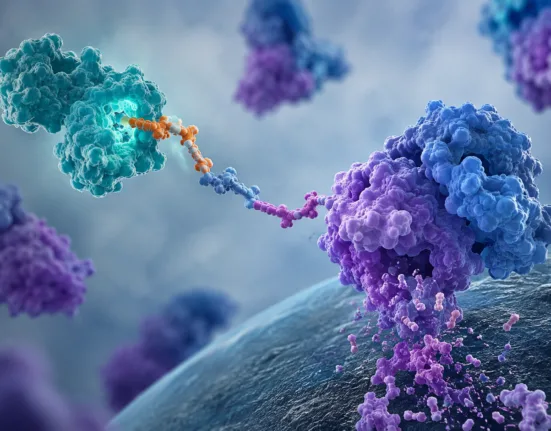
Triana Biomedicines, Inc. has dosed the first patient in a Phase 1/2 clinical trial evaluating TRI-611, an oral molecular glue degrader targeting ALK fusion proteins, in patients with ALK-positive non-small cell lung cancer. The first-in-human, open-label study is assessing safety, pharmacokinetics, and preliminary anti-tumor activity in patients previously treated with ALK tyrosine kinase inhibitors, placing the program squarely within a resistance-driven treatment setting.
Why targeting protein degradation instead of kinase inhibition could reshape resistance management in ALK positive lung cancer
The clinical entry of TRI-611 reflects a deliberate shift away from inhibiting oncogenic signaling toward eliminating the oncogenic driver itself. In ALK positive non small cell lung cancer, successive generations of tyrosine kinase inhibitors have extended survival but have not eliminated the core problem of acquired resistance. Tumors evolve through secondary mutations, pathway bypass mechanisms, and central nervous system escape, creating a cycle of sequential inhibitor use that ultimately reaches diminishing returns.
Industry observers note that a degradation-based approach attempts to break this cycle by removing the ALK fusion protein entirely rather than competing for its active site. This distinction is not simply mechanistic but strategic, as it opens the possibility of overcoming a broader range of resistance mutations that reduce binding affinity for existing inhibitors. If TRI-611 can consistently degrade ALK across mutation variants, it could redefine how resistance is approached in this disease setting rather than extending the current sequencing paradigm.
At the same time, this approach remains largely unproven in solid tumors. While targeted protein degradation has generated momentum in drug discovery, its clinical validation has been limited compared to kinase inhibitors, which benefit from decades of development experience. The transition from concept to durable clinical benefit remains the central question.
How TRI-611 positions itself against established ALK inhibitors and why central nervous system activity will be critical
The current treatment landscape for ALK positive non small cell lung cancer is dominated by highly potent, brain-penetrant inhibitors such as alectinib, brigatinib, and lorlatinib. These agents have set a high efficacy benchmark, particularly in delaying intracranial progression, which is a major driver of morbidity in this patient population.
TRI-611’s design as a brain-penetrant degrader directly addresses this clinical requirement. Central nervous system metastases are not a niche complication but a near-inevitable progression point in many patients, and any new therapy must demonstrate meaningful intracranial activity to remain competitive. Clinicians tracking the field believe that even strong systemic activity may not be sufficient if central nervous system control is inadequate.
However, the competitive challenge extends beyond matching existing therapies. To justify its development pathway, TRI-611 will need to demonstrate clear differentiation, either by overcoming resistance mutations that limit current inhibitors or by providing more durable responses. Without such differentiation, it risks being positioned as an incremental addition rather than a paradigm shift, which would complicate both regulatory approval and clinical adoption.
What the Phase 1/2 trial design reveals about regulatory strategy and early development risks
The structure of the Phase 1/2 trial offers insight into how Triana Biomedicines is positioning TRI-611 within the development pathway. By enrolling patients who have already received standard-of-care ALK inhibitors, the U.S.-based biotech firm is targeting a population with high unmet need and fewer therapeutic options. This approach aligns with typical oncology development strategies, where early efficacy signals in refractory populations can support accelerated development.
Regulatory watchers suggest that demonstrating activity in heavily pretreated patients could provide a basis for expedited pathways if response rates are compelling. However, this strategy also introduces complexity. Tumors in this setting often exhibit heterogeneous resistance mechanisms, meaning that targeting ALK alone may not fully restore treatment sensitivity. The presence of co-occurring mutations or pathway adaptations could limit the effectiveness of even a potent degrader.
The open-label, dose-escalation design is appropriate for first-in-human studies, but it also means that early efficacy data will be exploratory rather than definitive. Small patient numbers and lack of control arms make it difficult to draw firm conclusions, increasing the importance of biomarker-driven analyses to interpret results.
What is genuinely new about molecular glue degraders in this context and what remains incremental
The novelty of TRI-611 lies in its use of molecular glue technology to induce proximity between ALK fusion proteins and the E3 ligase cereblon, triggering targeted degradation. This mechanism operates independently of the kinase active site, which is the focal point of traditional inhibitors. In theory, this expands the range of druggable conformations and resistance profiles.
Industry observers note that this represents a conceptual advance over traditional small molecule approaches, particularly for targets where binding site mutations undermine inhibitor efficacy. The ability to harness the cell’s own protein degradation machinery introduces a new dimension to drug design that could extend beyond ALK to other difficult-to-target oncogenic drivers.
However, much of the surrounding infrastructure remains incremental. The clinical development framework, regulatory expectations, and endpoint selection still follow established oncology paradigms. Safety, tolerability, response rate, and progression-free survival will remain the core metrics, meaning that the success of TRI-611 ultimately depends on delivering outcomes that exceed existing standards rather than relying on novelty alone.
What clinicians and regulators will watch as early data emerge from the TRI-611 study
The initial data readouts from the TRI-611 trial will be scrutinized across several dimensions. Safety will be the first gating factor, particularly given the potential for off-target protein degradation. Unlike kinase inhibitors, which typically exhibit predictable class-related toxicities, degraders may introduce broader proteomic effects that are less well characterized.
Clinicians will also focus on early signs of anti-tumor activity, especially in patients with known resistance mutations. Evidence that TRI-611 can induce responses in tumors that have progressed on multiple lines of ALK inhibitors would provide a strong signal of clinical relevance. Conversely, limited activity in this setting would raise questions about the breadth of its mechanism.
Pharmacokinetics and target engagement will play a critical role in interpreting outcomes. Demonstrating that the drug achieves sufficient exposure in both systemic and central nervous system compartments will be essential, particularly given the importance of brain metastases in this disease.
What could limit adoption even if TRI-611 shows clinical activity in resistant ALK positive non small cell lung cancer
Even in a positive scenario where TRI-611 demonstrates meaningful activity, several barriers to adoption remain. The existing treatment landscape is well established, with clinicians familiar with the sequencing and management of ALK inhibitors. Introducing a new modality requires not only efficacy but also clear guidance on where it fits within treatment algorithms.
Reimbursement considerations may also influence uptake. Payers increasingly demand evidence of superiority or clear differentiation, particularly in indications with multiple effective therapies. If TRI-611 is positioned as a later-line option, its commercial impact may be limited unless it shows transformative benefits.
Manufacturing and scalability represent additional challenges. Molecular glue degraders rely on precise chemical design and may face complexities in large-scale production. Ensuring consistent quality and supply will be essential as the program advances.
Finally, the broader risk lies in the inherent uncertainty of early-stage oncology development. Many first-in-human programs fail to translate promising preclinical data into clinical success. For TRI-611, the combination of a novel modality and a competitive indication amplifies both the potential upside and the execution risk.