Renew Biotechnologies has moved its NeuroLens blood biomarker platform onto firmer scientific ground after researchers reported that cell-free DNA methylation signatures in plasma could be associated with neuronal populations selectively affected in major neurodegenerative diseases. The peer-reviewed study, published in Frontiers in Neurology on August 6, 2026, evaluated Alzheimer’s disease, Parkinson’s disease, amyotrophic lateral sclerosis and mild cognitive impairment using native nanopore sequencing.
The important distinction is that NeuroLens is not being presented as an established clinical diagnostic for these diseases. The study is explicitly framed as proof-of-concept work, while Renew said on August 7 that NeuroLens remains available as a Research Use Only assay for biomarker and translational research. The company said it is continuing validation work as it prepares to offer the assay as a laboratory-developed test.
What makes the work scientifically interesting is not simply another attempt to detect neurodegeneration from blood. Renew is trying to infer which neuronal populations may be contributing to circulating cell-free DNA, potentially adding a cell-of-origin layer to a biomarker landscape increasingly dominated by proteins linked to pathology or neuronal injury. That biological context could eventually prove useful for disease differentiation, longitudinal research and therapeutic-development programmes, although the current evidence does not yet establish those clinical applications.
How does NeuroLens use DNA methylation to identify neuron-associated signals in blood?
Cell-free DNA consists of fragments of DNA released into circulation as cells turn over or die. Because DNA methylation patterns vary between tissues and cell types, those patterns can potentially act as molecular fingerprints indicating where circulating DNA originated.
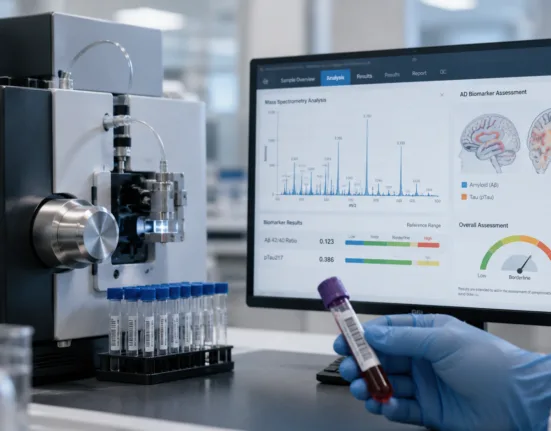
Renew’s approach builds a methylation reference atlas and then compares cfDNA recovered from plasma with the reference profiles. The researchers generated native whole-genome nanopore methylation profiles from six primary human neural populations: cortical neurons, dopaminergic neurons, spinal motor neurons, astrocytes, Schwann cells and microglia. Classifiers derived from those profiles were subsequently applied to patient plasma.
Native nanopore sequencing is central to the strategy. Conventional methylation analysis frequently involves bisulfite conversion, which can damage already scarce DNA, followed by amplification that can introduce additional bias. Nanopore sequencing can interrogate methylation on native DNA molecules without those processing steps while covering a substantially broader portion of the genome than fixed methylation arrays.
That matters because brain-derived cfDNA is expected to represent only a small part of the total circulating DNA pool. The paper notes previous estimates suggesting neuron-derived cfDNA could account for roughly 2% of circulating DNA, meaning the signal Renew wants to measure is buried inside a predominantly non-neuronal background.
The proposition, therefore, is less like finding a loud diagnostic signal and more like identifying a particular instrument inside a very crowded orchestra. The technology has to distinguish both the brain-derived DNA from the rest of the bloodstream and one neuronal population from another.
What did the 137-sample study actually show across Alzheimer’s, Parkinson’s and ALS?
The researchers initially obtained 219 plasma samples spanning Alzheimer’s disease, mild cognitive impairment, Parkinson’s disease, sporadic and familial amyotrophic lateral sclerosis and healthy controls. After quality filtering, removal of repeated donor samples and other exclusions, 137 samples remained in the final clinical analysis. These comprised 35 Alzheimer’s disease samples, five mild cognitive impairment samples, 37 Parkinson’s disease samples, 39 amyotrophic lateral sclerosis samples and 21 healthy controls.
The resulting patterns broadly followed the expected biology of the diseases. Cortical neuron-associated cfDNA was elevated in the combined Alzheimer’s disease and mild cognitive impairment group. Dopaminergic neuron-associated cfDNA was elevated in Parkinson’s disease, while spinal motor neuron-associated cfDNA was elevated in amyotrophic lateral sclerosis.
For the Alzheimer’s disease analysis against healthy controls, the individual cortical neuron classifier generated an area under the receiver operating characteristic curve of 0.9511. Combining signals from cortical, dopaminergic and spinal motor neurons produced an AUC of 0.9992 in the binary Alzheimer’s-versus-control analysis.
The more relevant challenge, however, is not simply separating known disease cases from healthy individuals. In clinical practice, a biomarker may need to distinguish patients whose symptoms could arise from different neurological conditions. The multivariate Parkinson’s disease model retained an AUC of 0.9644 when broader neurodegenerative comparators were incorporated, while the combined amyotrophic lateral sclerosis model produced an AUC of 0.8598 in its multi-disease setting.
Those results explain why the platform merits further study. They suggest that combining several neuronal methylation signatures may provide more disease-specific information than relying on one presumed cell type in isolation.
They should not, however, be interpreted as externally validated diagnostic sensitivity or specificity. The analysis used repeated cross-validation within the available dataset, with models trained on 90% of the data and evaluated against held-out observations. That is more rigorous than simply reporting performance on the training data, but it remains different from taking a locked classifier into a separate clinical population collected independently at multiple sites. The authors explicitly identify external-cohort evaluation as a necessary next step.

Why could cell-of-origin information complement today’s neurodegeneration blood biomarkers?
The timing of Renew’s work is important because blood-based neurological biomarkers have already moved beyond an academic concept.
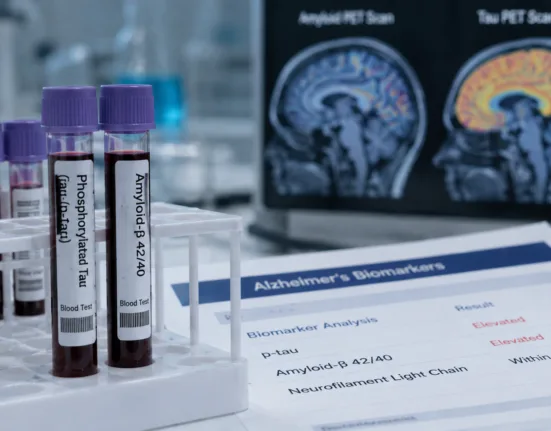
In Alzheimer’s disease, for example, the United States Food and Drug Administration cleared the Fujirebio Diagnostics Lumipulse G pTau217/β-Amyloid 1-42 Plasma Ratio in May 2025 to aid identification of amyloid pathology in patients with cognitive decline. The test measures protein biomarkers and is intended to be interpreted alongside other clinical information rather than used as a standalone diagnosis or population-screening test.
NeuroLens is pursuing a different layer of biological information. Instead of primarily asking whether a disease-associated protein pathology or generalized injury marker is present, methylation-based cfDNA analysis could potentially indicate which cellular populations are contributing DNA to circulation.
That distinction could become valuable in research settings where several neurodegenerative disorders share symptoms or where investigators want to measure the biological effects of an experimental therapy over time. A platform capable of detecting changing cortical, dopaminergic or motor-neuron-associated signals could theoretically provide information that conventional aggregate biomarkers do not.
The word “theoretically” remains essential. The present study does not demonstrate that NeuroLens improves diagnosis when added to established biomarkers, predicts treatment response, alters patient management or improves clinical outcomes. Nor does it establish that longitudinal changes in the reported cfDNA fractions reliably measure the rate of neuronal loss.
Those are precisely the kinds of questions that would turn an intriguing biomarker architecture into a clinically useful platform.
Why does the limited brain methylation atlas remain the biggest scientific caveat?
Perhaps the most consequential limitation comes directly from the study’s own discussion.
The current atlas represents only a fraction of the extraordinary cellular diversity of the human brain and peripheral tissues. The researchers also used pooled plasma as a practical representation of major blood-derived cfDNA contributors rather than building a comprehensive reference atlas covering every plausible non-neuronal source.
That limitation appears to matter quantitatively. The study reported neuron-associated cfDNA fractions considerably higher than previous estimates of the actual neuronal contribution to circulating DNA. The authors said residual overlap among methylation signatures, incomplete exclusion of non-neuronal sources and broader cell-death patterns could be contributing to those elevated estimates. Excluding reads with indeterminate methylation profiles may also have increased the apparent neuronal fraction.
In other words, the classifiers may currently be very useful at recognizing disease-associated molecular patterns without yet being able to claim that every fragment assigned to a particular neuron category definitively originated from that exact neuronal population.
That distinction is critical for NeuroLens. If the longer-term commercial proposition involves genuine cell-of-origin resolution, atlas expansion is not merely an incremental technical upgrade. It is part of proving what the measurement actually represents.
Renew and its collaborators will therefore need broader primary-human reference datasets incorporating additional neuronal subtypes, brain regions, glial populations and peripheral tissues. Demographic diversity will also matter because methylation patterns can be influenced by biological variables that need to be separated from disease-associated signals.
Can the high AUC values hold up when NeuroLens moves into independent clinical cohorts?
The final analytic cohort was relatively small, particularly for mild cognitive impairment, where only five samples remained. Cases and controls also differed significantly in age, with pooled disease cases averaging 65.9 years compared with 58.2 years among controls. The investigators reported that principal component analysis did not identify age as a dominant driver of global methylation variation, but acknowledged that age-related confounding could not be completely excluded.
The study was also cross-sectional, limiting conclusions about whether NeuroLens can track disease progression or treatment response over time. Collection-site information for disease samples obtained through the commercial biobank supplier was unavailable, leaving potential preanalytical variation from collection history and sample handling among the factors requiring further investigation.
There is another context readers should understand when interpreting the findings. All listed authors were employees of Renew Biotechnologies or its subsidiary Resonant, and the journal disclosure states that Renew provided funding and was involved in study design, data collection, analysis, interpretation and preparation of the publication. The research also received support through the Alzheimer’s Disease and Dementia Research Center at Utah State University.
Industry involvement does not invalidate peer-reviewed research, particularly for technology being developed commercially, but it makes replication by independent investigators and performance in externally collected cohorts especially valuable. For NeuroLens, that external-validation stage is likely to matter more than squeezing another decimal point from internal classifier performance.
What must Renew Biotechnologies prove before NeuroLens can move from research tool to clinical platform?
Renew said it has processed more than 2,000 patient-derived samples since completion of the published study as it continues developing and validating NeuroLens. That is potentially meaningful because scaling from a 137-sample proof-of-concept dataset into substantially larger cohorts should provide an opportunity to refine the atlas, test classifier robustness and better understand biological variability. The company has not disclosed the results of those additional samples in the peer-reviewed paper discussed here.
The regulatory and commercial position also remains deliberately early. Renew currently describes NeuroLens as a research-use assay. Its product information has referenced laboratory-developed-test validation, while the latest August announcement says the company continues validation work as it prepares for an LDT offering. The practical implication is that publication strengthens the platform’s evidence base but does not itself convert NeuroLens into an established clinical diagnostic.
The next meaningful evidence package would ideally include a locked assay and classifier evaluated prospectively or retrospectively in genuinely independent cohorts, broader demographic representation, stronger control of preanalytical variables, comparison with established biomarkers and clinical diagnoses, and longitudinal data showing whether cfDNA signals reliably change with disease evolution.
Renew has nevertheless moved the discussion forward. Its 2026 paper goes beyond the company’s earlier targeted cfDNA work by creating a native-sequenced primary neural methylation atlas and testing several neuron-associated signatures across three major neurodegenerative diseases. The strongest aspect of the concept is its attempt to add biological location to blood-based neurodegeneration measurement rather than competing solely on another disease-associated concentration value.
The decisive question now is whether that cell-type information survives the transition from a carefully analysed proof-of-concept cohort into independent, heterogeneous clinical populations. If it does, NeuroLens could become a useful complement to protein-based biomarkers and imaging in neurological research. If the apparent cell specificity narrows as the reference atlas expands and confounding sources are better represented, the platform may need substantial refinement. Either outcome will be scientifically informative.
For Renew Biotechnologies, the August publication therefore represents an important validation milestone, but not the finish line. The next phase is harder and considerably more consequential: demonstrating that the neuron-associated cfDNA patterns are reproducible, biologically specific and clinically informative outside the dataset that produced them.