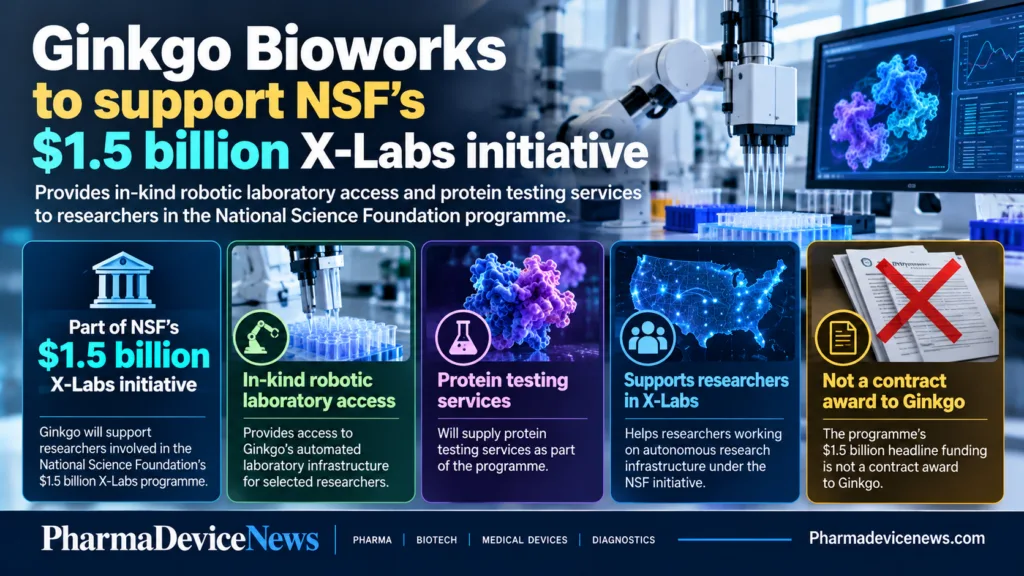
Ginkgo Bioworks Holdings, Inc. (NYSE: DNA), the Boston-based biotechnology and laboratory automation company, announced on October 8, 2026, that it will provide in-kind access to its autonomous laboratory and protein testing services for researchers participating in the United States National Science Foundation’s $1.5 billion X-Labs initiative. The contribution will allow eligible research teams to remotely design, execute and analyze experiments using Ginkgo’s automated laboratory infrastructure, extending the company’s involvement in federally supported research programmes without establishing a new $1.5 billion revenue contract.
The announcement was made during the Science: A New Golden Age Summit in Washington, D.C., where Michael Kratsios, director of the White House Office of Science and Technology Policy, highlighted Ginkgo’s contribution. The National Science Foundation launched X-Labs in May 2026 as a decade-long initiative to support independent research organizations working on complex scientific and technological problems through milestone-based funding. Ginkgo’s participation adds physical experimental infrastructure to that programme, potentially allowing research teams to conduct laboratory work without constructing or operating their own specialized facilities.
The financial distinction is central to understanding the agreement. The $1.5 billion represents the National Science Foundation’s planned investment in the broader X-Labs initiative over approximately ten years, not a payment to Ginkgo Bioworks or a guaranteed allocation for its facilities. Ginkgo described its participation as an in-kind contribution and did not disclose the monetary value of the laboratory time, number of research teams supported, available experimental capacity or potential future revenue arrangements.
The announcement nevertheless strengthens Ginkgo’s positioning within an emerging market for remotely operated scientific infrastructure. The company is developing a business around autonomous laboratories, robotic experimental workflows and biological data generation, seeking to make physical laboratory experimentation more accessible to researchers using computational and artificial intelligence tools. The fundamental commercial question is whether growing adoption of this infrastructure will ultimately produce enough contracted revenue and laboratory utilization to improve a business that continues to report significant operating losses.
What exactly will Ginkgo Bioworks provide to NSF X-Labs researchers?
Ginkgo’s contribution centers on its Boston autonomous laboratory, a physical research facility equipped with robotic systems that can be operated through remote software interfaces. Researchers participating in NSF X-Labs will be able to access laboratory time and submit experimental protocols without establishing equivalent wet laboratory infrastructure at their own institutions. The offering also includes protein expression and characterization services, enabling teams to test whether designs generated through computational methods exhibit the biological properties researchers are seeking.
The system operates through Ginkgo’s Reconfigurable Automation Carts, or RACs, which integrate robotic arms, magnetic levitation sample transportation and the company’s Catalyst laboratory automation software. These components coordinate experimental processes including sample preparation, liquid handling, incubation, storage and analytical measurements. The architecture is intended to support different experimental workflows within a shared robotic environment rather than requiring every research group to purchase dedicated instruments.
According to Ginkgo, its cloud laboratory infrastructure provides remote access to more than 70 scientific instruments. The broader Nebula facility has more than 100 robots capable of performing laboratory tasks around the clock, although the company has not specified how many instruments or hours will be reserved for NSF X-Labs. Availability and allocation policies will influence how much practical research capacity participating teams receive.
The term cloud laboratory is important because it describes remote access to physical experimentation rather than merely providing computational services. A researcher can develop a hypothesis or experimental design through software, submit instructions to a robotic facility and receive measurements produced by laboratory instruments. This approach potentially expands access to specialized scientific equipment while retaining the physical testing needed to validate biological and chemical hypotheses.
Ginkgo has not disclosed whether NSF X-Labs participants will receive unlimited access, fixed allocations of instrument time or services subject to specific eligibility criteria. The value of the contribution will depend partly on how much laboratory capacity is made available and how effectively research groups use it. Without those details, the contribution cannot be assigned a defensible monetary value based solely on the programme’s overall funding.
Why is the NSF X-Labs $1.5 billion funding figure different from a contract awarded to Ginkgo Bioworks?
The National Science Foundation announced NSF X-Labs on May 14, 2026, with a planned investment of up to $1.5 billion over the following decade. The initiative supports independent teams of researchers, engineers and entrepreneurs pursuing difficult scientific challenges through milestone-based awards. Its structure seeks to develop research capabilities and technologies that traditional institutional arrangements may struggle to advance efficiently.
The funding framework is materially different from a conventional procurement agreement for laboratory services. The National Science Foundation intends to support selected organizations working on defined scientific challenges, while Ginkgo is contributing access to infrastructure that those researchers may use. Neither the agency nor Ginkgo has disclosed an award of $1.5 billion, or any specified portion of that amount, to the company under the October arrangement.
This distinction is particularly relevant for shareholders evaluating the announcement’s potential effect on revenue. An in-kind contribution may provide access to new customers, greater visibility for a technology platform and opportunities for follow-on commercial relationships. However, none of those possibilities establishes contracted future revenue, deferred revenue or a guaranteed payment stream.
Ginkgo has not disclosed an obligation requiring X-Labs researchers to purchase additional services once their contributed laboratory access has been used. Nor has it announced a conversion mechanism through which participating teams would automatically become paying cloud laboratory customers. Any future commercial transactions would need to be evaluated separately from the current contribution.
For financial analysis, the announcement is best understood as an expansion of Ginkgo’s position within publicly supported scientific infrastructure. Its economic value may emerge through future paid work, improved equipment utilization or additional infrastructure projects, but those outcomes have not been quantified. Treating the full federal programme budget as a commercial opportunity directly attributable to Ginkgo would substantially overstate the disclosed arrangement.
How could Ginkgo’s protein testing services help researchers validate AI-generated biological designs?
One of the most commercially relevant features of the announcement is the inclusion of protein expression and characterization services. Advances in artificial intelligence have improved researchers’ ability to generate candidate protein structures and sequences, but computational designs must still undergo experimental testing to establish their physical and biological properties. This creates demand for systems capable of producing consistent laboratory measurements at sufficient scale.
Protein characterization may involve examining properties such as expression, stability, activity, binding and other experimentally measurable attributes, depending on the research objective. These measurements help determine whether a designed protein behaves as expected under relevant test conditions. Ginkgo’s automated infrastructure can support parts of that experimental process, although the precise assays available to individual NSF X-Labs teams will depend on the services and protocols offered.
The potential value lies in connecting computational design with repeatable physical experimentation. Researchers can generate candidate designs using AI models, produce or test selected proteins and use the resulting laboratory data to refine subsequent predictions. This creates the possibility of an iterative design-build-test cycle in which experimental results continuously inform future computational work.
Such workflows can be valuable because even sophisticated protein prediction systems may struggle to capture every aspect of biological function. A protein with a plausible predicted structure may fail to express efficiently, remain unstable or exhibit activity different from what a model anticipates. Laboratory testing provides evidence that computational analysis alone cannot establish.
However, access to robotics does not automatically improve the predictive performance of an artificial intelligence model. The quality of the resulting data depends on experimental design, assay validation, measurement accuracy and the relevance of those measurements to the underlying scientific question. Researchers must also consider whether the laboratory conditions adequately represent the biological environment in which a candidate protein is intended to function.
For Ginkgo, protein testing represents a potential area for recurring service demand because AI research programmes can generate large numbers of candidate designs requiring physical validation. The business opportunity would become more concrete if the company demonstrated increasing paid testing volumes, repeat customers and improving economics per experiment. The NSF X-Labs contribution creates additional exposure to that demand without establishing those commercial outcomes.
How does the new X-Labs contribution fit Ginkgo’s existing $400 million NSF cloud laboratory network?
The October announcement builds on an existing relationship between Ginkgo and the National Science Foundation, but two separate federal initiatives must be distinguished. The NSF X-Labs programme involves a planned $1.5 billion investment over ten years to support independent scientific research teams. Separately, the agency announced approximately $400 million in July 2026 for a nationwide network of programmable cloud laboratory test beds.
The programmable cloud laboratory initiative includes an initial $380 million in NSF funding for 20 selected teams, supplemented by more than $20 million in philanthropic contributions. Its purpose is to establish remotely accessible, AI-enabled laboratory infrastructure supporting different areas of scientific research. Ginkgo has been selected to provide automation technology for several participating institutions, creating a more direct infrastructure deployment opportunity than the in-kind X-Labs contribution.
Among the projects involving Ginkgo are autonomous laboratories at the California Institute of Technology, Northwestern University and the University of Maryland. The company has also been selected to support a cloud laboratory project at the Massachusetts Institute of Technology through an initiative backed by the Massachusetts Life Sciences Center. These arrangements extend Ginkgo’s RAC hardware and associated software into university research environments.
The University of Maryland received a four-year NSF award of $17.3 million for its Collaborative for the Realization of Autonomous Biomanufacturing laboratory. The facility is intended to support AI-enabled biomanufacturing research, including experimentation involving biological production processes. Northwestern University separately received $20 million over four years for an AI-directed protein engineering cloud laboratory intended to support remotely accessible research infrastructure.
Those award amounts belong to the respective institutional projects and should not be described as revenues awarded directly to Ginkgo. The company may receive payments for its contracted role in building or supplying automation infrastructure, but the disclosed federal funding totals do not establish the value of its individual contracts. The distinction is essential when estimating the actual commercial contribution from the broader national laboratory network.
The October X-Labs participation adds a different dimension to this relationship. Rather than exclusively supplying equipment to facilities operated by other institutions, Ginkgo will make its existing Boston laboratory available directly to eligible research teams. That combination of infrastructure sales and remotely delivered laboratory services provides a basis for developing multiple business models, although their long-term financial contributions remain uncertain.
Could the Nebula autonomous laboratory become a recurring revenue platform for Ginkgo Bioworks?
Ginkgo’s Nebula facility represents the physical foundation of its strategy to deliver laboratory experimentation as a remotely accessible service. The company’s objective is to automate common scientific workflows and make them available to customers through a shared infrastructure model. This differs from traditional contract research arrangements in which experiments may depend heavily on customized manual laboratory processes.
A cloud laboratory can theoretically support multiple customers using the same equipment, creating opportunities to distribute fixed infrastructure costs across a larger volume of experimental work. That model becomes attractive when instruments are sufficiently utilized and standardized workflows can be repeated without substantial manual intervention. However, high utilization is not guaranteed, particularly when incoming research protocols require adaptation or specialized experimental development.
Ginkgo reported in August that Nebula was continuing to scale, with additional protocols being introduced regularly and further equipment deployment planned. The company also described its autonomous laboratory operations as supporting several commercial offerings, including Ginkgo Cloud Lab, Ginkgo Datapoints and Ginkgo Solutions. These businesses may generate revenue through different combinations of laboratory access, data generation and contract research services.
An important challenge is converting technical capacity into economically productive utilization. Instruments may be available around the clock, but customer demand, maintenance, sample preparation and experimental complexity can influence actual operating throughput. A facility containing more robots does not necessarily generate proportionately more revenue unless those systems are used for work customers are willing to purchase.
The NSF contribution may help introduce new researchers to Ginkgo’s operating environment. Participating teams could become familiar with its experimental interfaces, available assays and ability to execute repeated workflows remotely. Whether that familiarity translates into future commercial demand will depend on the quality of the experience, service pricing and researchers’ access to funding after the contributed laboratory capacity is exhausted.
The company has not disclosed a direct revenue forecast, utilization target or operating margin associated with its X-Labs participation. Consequently, the contribution should not be treated as evidence that Nebula has reached breakeven or that government-supported demand will eliminate the costs associated with operating the facility.
Why are Ginkgo’s recent Novo and Eli Lilly agreements important to its autonomous laboratory strategy?
Ginkgo’s federal laboratory involvement forms part of a broader effort to commercialize automation technology across pharmaceutical research and biotechnology. In September 2026, the company announced that Novo had selected its Reconfigurable Automation Cart architecture for a new research and development facility in Waltham, Massachusetts. The arrangement expanded an existing relationship and introduced Ginkgo’s robotic hardware and software into Novo’s internal laboratory operations.
The Novo agreement is commercially distinct from providing experimental services through a centrally operated cloud laboratory. When a customer purchases automated laboratory infrastructure for its own facility, Ginkgo can participate as a technology and software provider rather than solely as an outsourced research contractor. This potentially creates opportunities involving equipment deployment, software integration and continuing technical support, although the company did not disclose the transaction’s financial value.
On September 16, Ginkgo announced a separate agreement involving Lilly TuneLab, the collaborative AI-driven drug discovery platform created by Eli Lilly and Company. Through its Ginkgo Datapoints offering, the company will provide experimental data generation services relating to small-molecule developability and antibody developability. Those services address an important issue in AI-assisted pharmaceutical discovery: models require experimentally measured data to evaluate and improve predictions.
The Lilly TuneLab arrangement complements the NSF X-Labs contribution because both rely on Ginkgo’s capacity to connect computational research with physical experiments. Pharmaceutical customers may need repeated laboratory testing to assess molecular properties, while NSF-funded researchers may require experimental validation for a wider range of scientific questions. The underlying infrastructure can potentially support both activities, although the workflows and commercial terms may differ substantially.
Ginkgo has also disclosed work on a $47 million, 97-instrument autonomous laboratory project for the Environmental Molecular Sciences Laboratory at Pacific Northwest National Laboratory. The figure describes the laboratory project and should not automatically be treated as the full amount of revenue payable to Ginkgo. Together with university deployments and private-sector relationships, the project suggests increasing interest in the company’s automation architecture across different research settings.
These developments support the argument that Ginkgo is moving toward a broader laboratory infrastructure business. However, growing the number of partnerships is not equivalent to demonstrating profitability. The decisive financial measures will include recognized revenue, repeat customer demand, cost per experiment and the contribution of individual contracts to operating cash flow.
What do Ginkgo Bioworks’ latest financial results reveal about its ability to fund expansion?
Ginkgo’s financial position provides an important counterbalance to the strategic optimism surrounding its laboratory partnerships. In its second-quarter 2026 results, announced on August 5, the company reported revenue of approximately $20 million, down from $39 million in the corresponding period of 2025. The decline of approximately 48% reflected continued programme rationalization associated with its restructuring activities.
The company recorded a GAAP net loss from continuing operations of approximately $57 million, compared with $53 million a year earlier. Adjusted EBITDA was negative $36 million, compared with negative $25 million in the prior-year quarter. These results demonstrate that the business remained materially loss-making despite efforts to streamline operations and reposition its commercial offerings.
Ginkgo reported cash, cash equivalents and marketable securities of approximately $302 million as of June 30, 2026. For the first six months of the year, its statement of cash flows showed approximately $91 million of net cash used in operating activities, including discontinued operations. Management also reaffirmed its expectation for total cash burn of approximately $125 million to $150 million during 2026, although that forecast remains subject to operating conditions and company-specific assumptions.
The cash balance gives Ginkgo resources to continue investing in laboratory automation and business development. Nevertheless, ongoing losses mean that future liquidity will depend on the relationship between operating spending, new revenue and any additional financing activity. A growing customer base will become more financially meaningful if it contributes to improved margins and reduced cash consumption.
The in-kind nature of the NSF X-Labs contribution introduces a further consideration. Providing laboratory capacity without a disclosed corresponding payment can expose the company’s infrastructure to additional research users, but it may also involve operating costs and equipment availability that could otherwise support paid services. The economic justification will depend on whether the contribution produces strategic or commercial benefits sufficient to offset those resource commitments.
The latest arrangement therefore does not materially change the financial evidence presented in Ginkgo’s second-quarter results. The company remains in a transition period where commercial partnerships and infrastructure deployments must eventually translate into sustained revenue growth. Its next financial updates will be important for assessing whether that transition is progressing at a pace consistent with management’s cash and operating expectations.
Why did Ginkgo Bioworks shares rise sharply after the NSF X-Labs announcement?
Ginkgo Bioworks shares closed at approximately $13.00 on Friday, October 9, 2026, gaining $1.66, or about 14.6%, from the previous trading session. The move followed the company’s October 8 announcement concerning NSF X-Labs and coincided with broader investor interest in its autonomous laboratory and AI-assisted biotechnology activities. However, the timing alone does not establish that the federal initiative was the sole or primary cause of the stock’s advance.
The rally also needs to be considered against substantial recent volatility. Ginkgo shares had fallen approximately 17.5% on October 6 and another 7.5% on October 7, before recovering during the final trading session of the week. The stock remained highly sensitive to changes in market expectations, with recent partnership announcements contributing to a broader reassessment of the company’s technology strategy.
Over the preceding month, Ginkgo shares had gained more than 90%, according to available historical market data. The price action suggests elevated investor attention surrounding developments in laboratory automation, AI-driven drug discovery and government-backed scientific infrastructure. It does not establish that institutional investors have reached a consensus regarding the company’s long-term profitability or valuation.
The significance of the October announcement is therefore more strategic than immediately financial. Ginkgo’s inclusion in an important federal science initiative provides additional visibility for its autonomous laboratory capabilities, but no new guaranteed revenue figure has been disclosed. Investors attempting to assess the announcement’s value must distinguish commercial validation, potential future opportunities and contracted financial consideration.
For Ginkgo’s valuation, the central question is whether its emerging automation business can support a more predictable revenue profile than the programmes affected by its earlier restructuring. Further customer wins may strengthen confidence in demand, but the operating losses reported during 2026 demonstrate that expansion must be accompanied by financial discipline. Share-price appreciation alone cannot establish that the business model has reached sustainable economics.
How could NSF X-Labs influence the wider market for autonomous scientific laboratories?
The National Science Foundation’s X-Labs initiative reflects a broader shift toward alternative models for funding and conducting scientific research. Rather than relying exclusively on traditional university laboratories and conventional grant structures, the programme seeks to support independent research organizations working toward defined technical milestones. Its planned decade-long investment provides a framework for pursuing scientific capabilities that may require specialized infrastructure and sustained interdisciplinary collaboration.
The programme initially invited proposals involving scientific instrumentation for sensing and imaging, along with quantum systems and integrated photonics. In September 2026, the agency expanded its announced priorities to include artificial intelligence for physical systems, sequence-to-function research and computation approaching fundamental physical limits. These areas encompass technologies with potential applications across biotechnology, advanced computing, robotics and scientific instrumentation.
The sequence-to-function priority is especially relevant to Ginkgo’s protein testing capabilities. Research in this field seeks to understand the relationships between biological sequences, molecular structures and experimentally observed function. Computational methods can generate hypotheses, but physical measurements remain necessary to establish whether designed biological systems behave as intended.
The AI for physical systems priority introduces a different potential connection. Autonomous laboratories combine software, robotic control, sensors and experimental equipment in environments where computational decisions must be translated into physical actions. Research into more capable AI systems could eventually support greater automation, although Ginkgo’s contribution does not itself establish that the company has been awarded a research grant in this specific topic area.
The potential market implications extend beyond Ginkgo. Providers of laboratory robotics, analytical instruments, research software and scientific data services may benefit if more institutions adopt remotely programmable experimental infrastructure. However, the pace of adoption will depend on research budgets, system reliability, interoperability requirements and whether automated methods deliver measurable improvements over established laboratory practices.
Reproducibility is another important consideration. Automated systems can standardize procedural steps and generate structured experimental records, which may help researchers compare results across repeated experiments. Yet automation cannot eliminate problems arising from poor experimental design, inadequate controls or unsuitable measurement methods, so scientific validation remains essential.
The emerging market is therefore likely to reward providers that combine dependable physical automation with rigorous scientific workflows. Access to instruments is only part of the offering; customers must also trust the resulting measurements and be able to integrate them into their own research processes.
What must Ginkgo demonstrate before NSF X-Labs participation becomes a meaningful business catalyst?
The first measurable development will be the extent to which NSF X-Labs research teams use Ginkgo’s Boston autonomous laboratory. Details concerning participating organizations, experimental volumes and instrument utilization would help establish whether the contribution is producing meaningful research activity. The company has not yet disclosed these operational measures or a timeline for reporting them.
A second indicator will be whether Ginkgo secures paid commercial relationships linked to its expanding research infrastructure presence. Such agreements could involve laboratory services, equipment deployments, software integration or recurring data generation. The financial contribution of those relationships would depend on disclosed contract terms, recognized revenue and the costs associated with delivering the services.
The company’s existing collaborations provide a potential foundation for that expansion. Deployments involving research universities, national laboratory infrastructure and commercial pharmaceutical customers demonstrate that Ginkgo is pursuing several routes into the autonomous laboratory market. The challenge is to build a business with sufficient demand across those routes to support the fixed and variable costs of its operating platform.
Investors will also be watching whether the company’s financial performance begins to reflect the expanding partnership pipeline. Ginkgo’s second-quarter revenue contraction and continuing operating losses show that recent commercial announcements have not yet established a sustained financial recovery. Improvements in revenue retention, operating margins and cash consumption would provide more concrete evidence that its strategic repositioning is working.
For the National Science Foundation, success will be evaluated through the scientific progress achieved by the independent research teams supported by X-Labs. For Ginkgo, the relevant measure is different: whether participation helps establish its autonomous laboratories as dependable infrastructure that customers, institutions and research organizations will continue to use and fund.
The October 2026 announcement places Ginkgo within a high-profile federal effort to rethink how scientific research is organized and executed. It also strengthens the company’s association with AI-enabled experimentation at a time when physical laboratory validation is becoming increasingly relevant to computational biology. However, the $1.5 billion programme budget remains separate from Ginkgo’s undisclosed in-kind contribution, and the commercial return has not been established.
Ginkgo’s long-term opportunity lies in converting access to sophisticated laboratory infrastructure into a scalable business built on repeat usage, reliable experimental data and economically sustainable operations. The company’s robotic platforms and growing network of institutional relationships provide a foundation for that strategy. The next decisive evidence will come not from the size of the federal initiative, but from whether autonomous laboratory adoption translates into rising paid demand and an improving financial position.