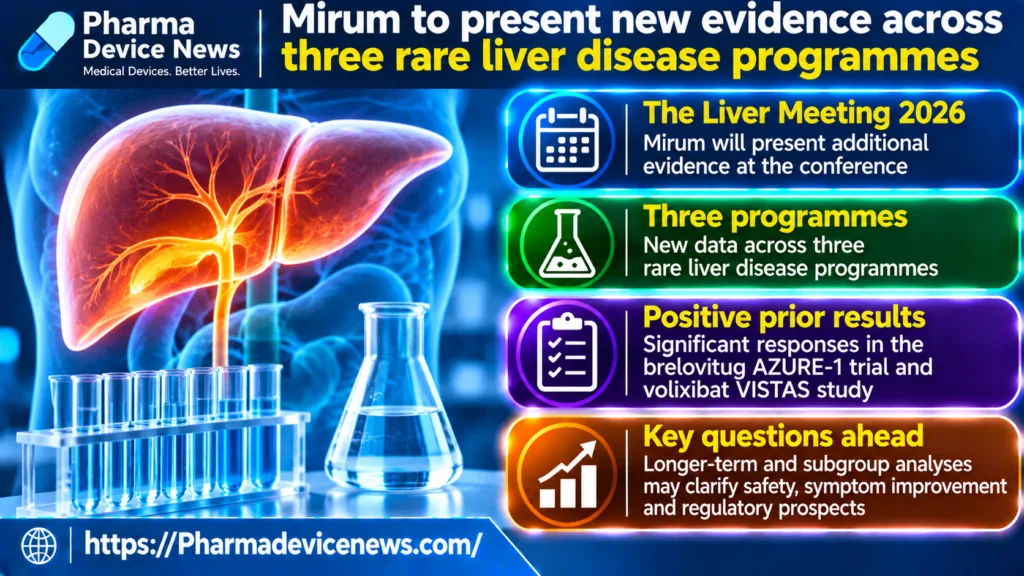
Mirum Pharmaceuticals, Inc. (NASDAQ: MIRM) has announced plans to present new clinical and real-world evidence from its rare liver disease portfolio at the American Association for the Study of Liver Diseases’ The Liver Meeting 2026, taking place from November 5 to 9 in Denver, Colorado. The programme will include detailed findings from the Phase 3 AZURE-1 study of brelovitug in chronic hepatitis delta, additional analyses of volixibat in primary sclerosing cholangitis and research involving the company’s approved medicine LIVMARLI in rare paediatric cholestatic disorders.
The presentations follow several important clinical milestones reported earlier in 2026. In September, Mirum disclosed that brelovitug achieved the primary combined endpoint of hepatitis delta viral response and normalisation of alanine aminotransferase in 56% of patients receiving 300 mg weekly and 45% receiving 900 mg every four weeks, compared with none in the delayed-treatment group. In May, the company reported that volixibat significantly reduced cholestatic itching in primary sclerosing cholangitis, with a 1.64-point placebo-adjusted improvement on the study’s primary symptom measure.
The November conference will provide further evidence concerning longer treatment exposure, patients with cirrhosis, inflammatory bowel disease and the wider effects of cholestatic itching on daily life. However, the newly scheduled analyses should be distinguished from the numerical results already disclosed. Brelovitug and volixibat remain investigational, and successful clinical endpoints do not establish that either medicine has received marketing approval.
Why is The Liver Meeting 2026 important for Mirum Pharmaceuticals’ rare disease strategy?
Mirum’s conference programme covers three different development and commercial opportunities rather than a single treatment candidate. Brelovitug is being investigated as an antiviral approach for chronic hepatitis delta, volixibat targets cholestatic pruritus in adult liver diseases and LIVMARLI is an established medicine for selected paediatric cholestatic conditions. The combination reflects a strategy focused on specialist liver care while addressing several distinct medical needs.
The breadth of the programme is commercially relevant because the company already generates revenue from approved medicines. Its clinical pipeline provides opportunities to enter additional treatment markets, while research involving LIVMARLI may support expanded use and improved understanding of existing patients. However, the development prospects of the three medicines are not interchangeable.
Brelovitug faces questions about durable viral suppression and long-term liver outcomes. Volixibat must establish an acceptable benefit-risk profile for managing itching in adults with chronic cholestatic disease. LIVMARLI’s expansion strategy depends on whether its demonstrated symptom benefits justify additional regulatory indications.
Chris Peetz, chief executive officer of Mirum Pharmaceuticals, has characterised the conference presentations as evidence of continuing progress across the company’s rare liver disease portfolio. Management is seeking to build on recent clinical results while addressing the substantial unmet needs faced by patients with difficult-to-treat conditions. The decisive commercial developments will depend on regulatory decisions and subsequent treatment adoption.
What did the Phase 3 AZURE-1 study demonstrate about brelovitug in chronic hepatitis delta?
Chronic hepatitis delta is caused by the hepatitis D virus, which requires the presence of hepatitis B virus for its lifecycle. Coinfection can produce more aggressive liver disease than hepatitis B infection alone, increasing the risk of cirrhosis, hepatic decompensation and liver-related complications. Effective treatment therefore aims to suppress viral activity and reduce ongoing liver injury.
Brelovitug is an investigational fully human monoclonal antibody targeting hepatitis B surface antigen. The medicine is designed to bind viral particles and surface-antigen-containing structures associated with hepatitis B and hepatitis D infection. By targeting this biological component, Mirum is investigating whether the treatment can reduce hepatitis delta viral activity and improve biochemical evidence of liver inflammation.
The Phase 3 component of AZURE-1 enrolled 153 previously untreated patients, randomised between brelovitug 300 mg once weekly, brelovitug 900 mg once every four weeks and a delayed-treatment group. At week 24, the combined primary endpoint was achieved by 56% of patients in the weekly group and 45% in the monthly group, compared with 0% receiving delayed treatment. Both active treatment comparisons were statistically significant, with p-values below 0.0001.
The combined endpoint required a virological response together with normalisation of alanine aminotransferase, or ALT, a marker associated with liver injury. Virological response included a reduction in HDV RNA of at least two logarithmic units or an undetectable viral result under the trial’s definition. The endpoint therefore required improvement in both viral activity and a biochemical measure.
The result is meaningful because successful viral suppression alone does not necessarily establish that liver inflammation has improved. However, the findings should not be interpreted as evidence of a cure or elimination of hepatitis B infection. Longer follow-up is needed to determine whether the observed changes translate into fewer serious liver complications.
Why do the separate viral suppression and ALT results matter when interpreting brelovitug efficacy?
The Phase 3 AZURE-1 findings included several efficacy measures beyond the combined primary endpoint. At week 24, 86% of patients receiving 300 mg weekly and 85% receiving 900 mg every four weeks achieved the defined virological response. None of the patients in the delayed-treatment group met that response criterion during the corresponding period.
ALT normalisation occurred in 63% of patients receiving weekly treatment and 54% receiving treatment every four weeks. These findings indicate that biochemical improvement was observed in substantial proportions of both active treatment groups. However, the percentages were lower than those achieving virological response, demonstrating that suppression of the virus and normalisation of liver enzymes do not always occur together.
The distinction is important because individual components of a composite endpoint may have different clinical meanings. A patient could experience a substantial reduction in viral RNA without achieving normal ALT levels. Conversely, biochemical measures may change for reasons that are not fully captured by the viral response definition.
The study also reported that 17% of patients in each active treatment group had HDV RNA below the limit of quantification with target not detected at week 24. This is a more stringent virological observation than merely achieving a two-log reduction. It indicates a deeper level of suppression in a smaller proportion of patients.
None of these results establishes durable viral elimination after treatment discontinuation. Chronic hepatitis delta management may require prolonged suppression, making the sustainability of the response a central development consideration. The forthcoming longer-term findings will be important for understanding how these measures evolve with continued treatment.
How did brelovitug responses change during 48 weeks of follow-up?
Mirum previously reported 48-week findings from the Phase 2b portion of AZURE-1, involving the first 53 patients enrolled in the broader programme. These participants continued treatment during an open-label extension after the initial 24-week assessment. The results suggested that several measures of viral suppression and liver-related biochemical improvement strengthened during continued exposure.
In the weekly 300 mg group, the proportion meeting the combined virological and ALT endpoint increased from 45% at week 24 to 55% at week 48. The corresponding proportion in the 900 mg every-four-weeks group increased from 35% to 55%. These observations suggest that some patients achieved additional improvement with longer treatment.
The depth of viral suppression also changed. In the weekly group, 80% had HDV RNA below the lower limit of quantification at week 48, compared with 45% at week 24. In the every-four-weeks group, the corresponding figures were 40% and 10%. These differences demonstrate that virological response depth was influenced by treatment duration and regimen.
However, the 48-week analysis involved only 20 patients in each active-treatment group for the reported comparisons. The small population limits precision, while the open-label extension design differs from the original controlled assessment. The findings support continued investigation but do not establish that every patient will experience progressive improvement.
At The Liver Meeting, Mirum will present additional results from continued treatment, including a planned oral presentation on November 8. The analysis may provide further detail about durability and differences between dosing regimens. Those data will be important for determining which schedule offers the most appropriate balance between efficacy, convenience and safety.
What is the significance of studying brelovitug in patients with cirrhosis?
Cirrhosis represents advanced liver scarring and can be associated with serious complications, including portal hypertension, fluid accumulation and impaired liver function. Patients with chronic hepatitis delta are at particular risk of progressive liver damage. Effective antiviral treatment in this population could potentially have substantial clinical importance.
However, people with cirrhosis may respond differently to treatment and may face additional safety considerations. Their physiological reserve can be reduced, and changes in liver function may influence the consequences of adverse events. Clinical studies must therefore assess both antiviral activity and tolerability in patients with advanced disease.
The AZURE-1 programme included patients with cirrhosis and clinically significant portal hypertension. Mirum has reported that the overall Phase 3 efficacy findings were observed across a relatively broad population. At the November conference, a separate poster will examine biochemical and virological responses among patients with cirrhosis during extended treatment.
The analysis could provide evidence about whether brelovitug maintains activity in people with more advanced liver disease. However, improvements in viral RNA and ALT do not automatically establish reversal of cirrhosis. Assessing long-term outcomes would require additional evidence involving liver function, complications and disease progression.
The clinical importance of this subgroup also has commercial implications. A medicine with an acceptable profile in patients with advanced disease could address a population with limited treatment options. Nevertheless, any future authorised indication will depend on the evidence assessed by regulators.
What safety findings could influence the regulatory assessment of brelovitug?
The Phase 3 AZURE-1 study reported an encouraging short-term safety profile through week 24. Treatment-emergent adverse events occurred in 45.8% of patients receiving 300 mg weekly and 61.5% receiving 900 mg every four weeks. The delayed-treatment group reported adverse events in 27.6% of participants.
No grade 3 or higher adverse events were reported in either active treatment group during the evaluated period. Serious adverse events and treatment discontinuations due to adverse events were also absent in the active treatment groups. These findings support further development but do not establish the long-term safety profile of the medicine.
Injection-site reactions occurred in approximately 10.2% of weekly-treated patients and 18.5% of those receiving the four-weekly regimen. Flu-like symptoms were reported in 5.1% and 10.8%, respectively. These events may influence patient experience, particularly if prolonged treatment is necessary.
The relationship between dosing schedule and tolerability will be important. Monthly injections may reduce treatment frequency, but their safety and efficacy must be considered alongside the higher dose administered at each occasion. A less frequent regimen is not automatically preferable if meaningful differences in response or adverse events emerge.
The company expects to report findings from the separate Phase 3 AZURE-4 study later in 2026. Mirum has identified AZURE-1 and AZURE-4 as central components of its planned US registration package, with a biologics licence application targeted for the first half of 2027. These milestones remain conditional on the complete clinical evidence and regulatory requirements.
How did volixibat perform in the VISTAS study of primary sclerosing cholangitis?
Primary sclerosing cholangitis is a chronic disease involving inflammation and scarring of the bile ducts. The condition can impair bile flow and contribute to liver injury, while patients may experience symptoms including fatigue and severe itching. Cholestatic pruritus can substantially affect sleep, concentration and quality of life.
Volixibat is an investigational oral inhibitor of the ileal bile acid transporter, or IBAT. The transporter normally helps return bile acids from the intestine to the liver as part of enterohepatic circulation. Blocking this process can increase bile acid elimination and potentially reduce the physiological effects associated with their accumulation.
The Phase 2b VISTAS study enrolled 158 patients, divided into groups according to baseline itching severity. The primary analysis involved 111 patients with moderate to severe pruritus, while another 47 participants had milder symptoms. Patients received volixibat 20 mg twice daily or placebo.
In the primary analysis population, volixibat produced a 2.72-point reduction from baseline in itching severity and a 1.64-point placebo-adjusted improvement. The difference was statistically significant, with a p-value below 0.0001. Mirum also reported that improvement was evident within two weeks and that favourable changes occurred among patients with milder baseline symptoms.
These findings support the medicine’s ability to reduce a burdensome symptom. However, pruritus improvement does not establish that volixibat prevents cirrhosis, reverses bile duct damage or alters the long-term progression of primary sclerosing cholangitis. Its development should therefore be assessed according to the symptom-based indication under investigation.
Why is inflammatory bowel disease an important factor in volixibat treatment?
Primary sclerosing cholangitis is frequently associated with inflammatory bowel disease, including ulcerative colitis. This relationship creates additional complexity because patients may experience intestinal symptoms alongside liver-related disease. A treatment designed to change bile acid transport could potentially influence gastrointestinal function.
IBAT inhibitors commonly produce gastrointestinal adverse events, including diarrhoea and abdominal discomfort. These effects arise partly because the medicines increase the amount of bile acids entering the lower intestine. For patients already managing inflammatory bowel disease, tolerability can therefore become an important consideration.
Mirum will present a VISTAS subgroup analysis examining pruritus improvement among patients with inflammatory bowel disease. The presentation is scheduled for November 8 and will address whether treatment reduced itching without worsening inflammatory bowel disease activity. This is a clinically relevant question because symptom relief would be less attractive if accompanied by deterioration in another chronic condition.
However, the November 2 announcement does not disclose the full numerical subgroup results. It states that the analysis supports itching improvement without worsening IBD activity, but the size of the subgroup and detailed outcomes must be evaluated when the presentation becomes available. A small subgroup may not be sufficient to exclude uncommon gastrointestinal complications.
The broader VISTAS safety findings also require attention. Mirum previously reported gastrointestinal adverse events and elevations in liver laboratory measurements, including ALT and bilirubin, consistent with the need for careful monitoring. These risks will form part of any future regulatory benefit-risk assessment.
Why is the FDA’s request for further volixibat evidence important despite the positive VISTAS results?
Volixibat has received FDA Breakthrough Therapy designation for cholestatic pruritus associated with primary sclerosing cholangitis. The designation reflects the potential significance of the treatment for a serious condition with substantial unmet need. However, it does not establish that the evidence already generated is sufficient for approval.
Following a pre-New Drug Application meeting during 2026, the FDA recommended that Mirum conduct a Phase 3 study. This is an important distinction because the company had designed VISTAS with regulatory input and regarded it as potentially pivotal. The agency’s recommendation indicates that questions remain concerning the evidence required for marketing authorisation.
Mirum has indicated that it intends to continue discussions with the FDA before a potential New Drug Application submission in the first half of 2027. However, the proposed filing date is not evidence that the regulator has agreed to review or approve the medicine without additional studies. The company’s final regulatory strategy remains subject to further engagement.
The new conference analyses may strengthen understanding of the VISTAS dataset, particularly regarding different itching severity levels, sleep and fatigue. Nevertheless, supportive analyses do not automatically replace the need for a further controlled trial if the FDA determines that additional efficacy evidence is necessary.
This uncertainty matters commercially because an extra Phase 3 programme could extend development timelines and increase expenditure. The attractive Phase 2b efficacy findings therefore coexist with a meaningful regulatory execution risk.
How could LIVMARLI expand beyond Alagille syndrome and progressive familial intrahepatic cholestasis?
LIVMARLI, containing maralixibat, is already approved in the United States for treatment of cholestatic pruritus in patients with Alagille syndrome aged three months or older and in patients with progressive familial intrahepatic cholestasis aged 12 months or older. European indications and age thresholds differ, reflecting jurisdiction-specific regulatory decisions.
The medicine also inhibits the ileal bile acid transporter, although its approved indications and evidence base are distinct from those of investigational volixibat. LIVMARLI has established commercial use in rare paediatric liver diseases, where severe itching can disrupt sleep and affect children and caregivers. Its development programme continues to investigate additional disease populations.
In October 2026, Mirum announced positive findings from the Phase 3 EXPAND study in rare cholestatic liver disorders, including biliary atresia. The trial achieved its primary endpoint, with a 0.98-point placebo-adjusted improvement in observer-reported itching severity and a p-value of 0.0004. The company also reported an approximately 69% placebo-adjusted reduction in serum bile acids.
The results support further regulatory development, with Mirum planning a supplemental New Drug Application in the first half of 2027. However, LIVMARLI has not yet received approval for every condition included in EXPAND. Existing authorisations should therefore not be extended to biliary atresia or other additional diseases without a regulatory decision.
At The Liver Meeting, Mirum will present additional research involving LIVMARLI’s effects on caregiver burden, treatment response in patients with compound heterozygous genetic variants and the burden of itching in biliary atresia. These findings may provide useful context for clinical management and future expansion.
Why does caregiver burden matter in rare paediatric cholestatic liver diseases?
Cholestatic pruritus can be particularly challenging in children because symptoms may interfere with sleep, behaviour and daily activities. Younger patients may have difficulty communicating the severity of itching, while caregivers must manage repeated discomfort and treatment requirements. The consequences can extend across the household.
Caregiver burden may involve disrupted sleep, reduced work productivity and emotional strain associated with a child’s chronic illness. Measuring these effects can provide information beyond conventional laboratory tests and disease severity classifications. Such outcomes may be relevant to understanding the practical value of symptom-directed therapy.
Mirum’s conference programme includes a 12-month follow-up analysis examining caregiver burden among families of patients receiving maralixibat for Alagille syndrome or progressive familial intrahepatic cholestasis. The company has not disclosed the detailed numerical findings in its November announcement. The presentation will be important for assessing whether reported changes are sufficiently consistent and meaningful.
The programme also includes research concerning the underrecognised burden of pruritus in biliary atresia. This is relevant because the condition can cause significant liver-related morbidity, while symptom management remains an important component of care. However, evidence that itching is burdensome does not establish that a particular treatment is effective in every patient.
For Mirum, patient-reported and caregiver-related outcomes may strengthen understanding of the real-world consequences of its treatments. Nevertheless, these measures must be evaluated alongside efficacy, safety and appropriate clinical study design.
What do Mirum’s financial results reveal about its ability to support multiple rare disease programmes?
Mirum’s existing commercial portfolio provides an important financial foundation for further development. In the second quarter of 2026, the company reported net product sales of $176.2 million, compared with $127.8 million a year earlier. LIVMARLI contributed $128.7 million, representing growth of approximately 46%, while the company’s bile acid medicines business generated $47.5 million.
The company raised its full-year 2026 net product sales guidance to between $680 million and $700 million. At June 30, it reported approximately $561.3 million in unrestricted cash, cash equivalents and investments. These figures indicate an established revenue base and financial resources to support clinical activity, although development and commercial expansion continue to generate substantial expenditure.
Mirum’s pipeline requires investment across several programmes. Brelovitug is advancing through Phase 3 development, volixibat faces additional regulatory discussions, and LIVMARLI’s expansion opportunities require submission preparation and potential launch spending. The company must also support existing commercial operations.
The second-quarter results included substantial research expenditure and acquisition-related costs. These obligations highlight the importance of allocating capital carefully even when sales are growing. Strong commercial revenue reduces some financing dependence but does not eliminate the risks associated with expensive clinical development.
Mirum is scheduled to report third-quarter 2026 financial results on November 3, one day after the conference preview announcement. Those figures will provide a more current view of sales, expenditure and financial capacity. The previously reported second-quarter balance should not be treated as the company’s latest cash position after the third-quarter results become available.
How did Mirum Pharmaceuticals shares perform ahead of the AASLD presentations?
Mirum shares closed at $85.00 on October 30, 2026, declining 1.61% from the previous close of $86.39. The stock had gained approximately 0.68% on October 29 and had traded at $80.39 on October 23, illustrating significant movement over the preceding week.
The company’s 52-week trading range was approximately $63.23 to $130.00, highlighting substantial differences in market valuation over the preceding year. These movements reflect broader expectations concerning rare disease revenue, clinical development, regulatory progress and financing. They should not be attributed to one scientific programme without supporting evidence.
The November 2 conference announcement followed the October 30 regular trading session. Consequently, that closing price does not represent a confirmed market reaction to the newly announced presentation schedule. Investors will need to consider subsequent trading alongside the financial results scheduled for November 3.
Mirum’s valuation is influenced by a combination of commercial performance and pipeline opportunities. LIVMARLI already generates substantial revenue, while brelovitug and volixibat could potentially create additional income if approved. However, successful clinical endpoints do not guarantee timely regulatory authorisation or attractive commercial returns.
The most meaningful upcoming catalysts are therefore the company’s third-quarter financial results, the additional AASLD analyses and future regulatory developments. For brelovitug, the separate AZURE-4 study represents an important clinical milestone, while volixibat’s regulatory pathway remains less settled.
What evidence and regulatory milestones will determine Mirum’s next phase of growth?
For brelovitug, the immediate priority is completing the Phase 3 evidence package. AZURE-1 has met its primary endpoint, but AZURE-4 remains relevant to the intended registration strategy. Long-term viral suppression, biochemical improvement and safety in patients with advanced disease will influence the regulator’s overall assessment.
Volixibat faces a different challenge. The VISTAS study demonstrated meaningful relief of cholestatic itching, but the FDA has recommended additional Phase 3 evidence. Mirum must determine whether its existing clinical package can support the proposed application or whether another controlled investigation is necessary.
LIVMARLI’s expansion programme has already generated positive Phase 3 results in additional rare cholestatic diseases. Its next milestone will involve preparing and submitting the necessary regulatory evidence. Approval for additional indications could broaden commercial opportunities, but the existing study results cannot be treated as an authorisation.
Across all three programmes, safety and long-term treatment requirements remain central. Chronic liver diseases often require prolonged management, and patients may have substantial underlying medical complications. Durable benefit must therefore be weighed against treatment-related risks and the practical burden of therapy.
Mirum Pharmaceuticals enters The Liver Meeting 2026 with a stronger clinical evidence base than it possessed earlier in the year. Brelovitug has achieved statistically significant antiviral and biochemical responses, volixibat has demonstrated relief of severe itching, and LIVMARLI has progressed towards potential use in additional paediatric liver diseases.
The remaining challenge is converting these findings into approved indications and sustainable commercial opportunities. The conference presentations may clarify durability, patient subgroups and symptom-related benefits, but regulatory decisions and long-term outcomes will ultimately determine the value of Mirum’s expanding portfolio.