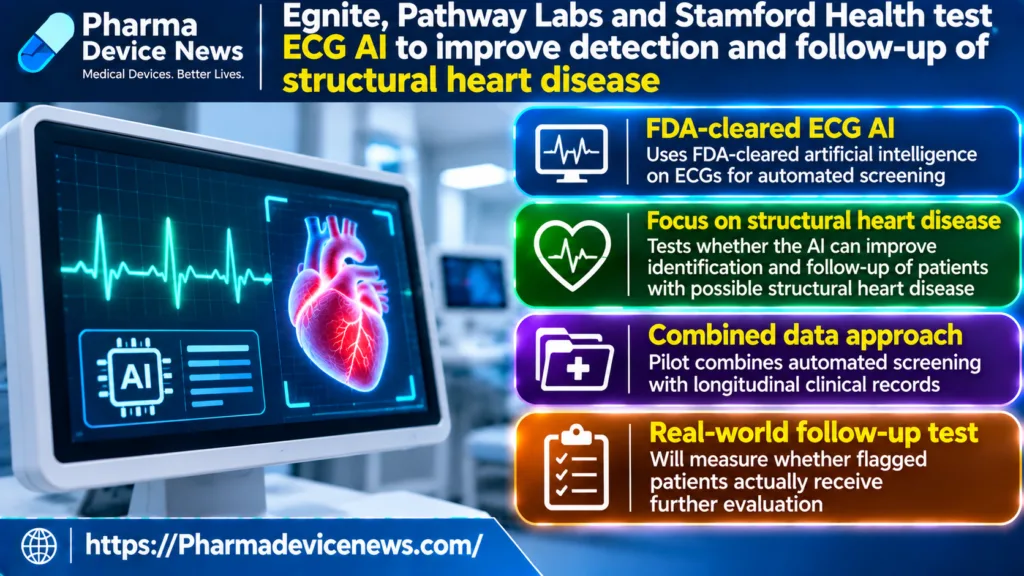
Egnite, Inc., Pathway Labs and Stamford Health have launched a clinical pilot combining artificial intelligence-based electrocardiogram analysis with an established cardiovascular patient management platform to identify individuals who may have previously undetected structural heart disease. Announced on October 29, 2026, the programme will deploy Pathway Labs’ FDA-cleared EchoNext technology within Egnite’s CardioCare platform at Stamford Health in Connecticut, with the objective of improving referral and follow-up for patients who may benefit from echocardiography.
The partnership addresses a significant limitation of standalone AI screening systems: identifying a patient at risk does not guarantee that the individual receives further testing or appropriate treatment. EchoNext will analyse routine 12-lead ECG recordings for patterns associated with structural cardiac abnormalities, while CardioCare will assess the findings alongside previous diagnoses, laboratory results and other clinical information. The integrated workflow is designed to identify patients who appear suitable for additional cardiac imaging and help care teams manage the subsequent evaluation process.
The pilot will measure downstream outcomes, including echocardiogram completion rates and time to specialist assessment, rather than relying exclusively on the accuracy of the AI algorithm. However, the organisations have not disclosed a planned enrolment target, trial duration or initial outcome results. The collaboration therefore represents an implementation and clinical workflow evaluation, not proof that AI screening has already reduced cardiovascular complications or improved survival.
Why are Egnite, Pathway Labs and Stamford Health combining ECG screening with a patient management platform?
Routine electrocardiograms are widely used because they provide information about the heart’s electrical activity through a relatively inexpensive and non-invasive procedure. Clinicians commonly use ECGs to investigate abnormal rhythms, conduction problems and other cardiovascular abnormalities. However, structural conditions involving heart valves, ventricular function or chamber dimensions can be difficult to identify using conventional ECG interpretation alone.
Echocardiography provides direct imaging of cardiac structures and is generally more suitable for evaluating suspected valve disease and several other structural abnormalities. The challenge is determining which patients should receive additional imaging, particularly when symptoms are absent, vague or attributed to other conditions. Some individuals may undergo ECG testing for unrelated reasons without being referred for an echocardiogram.
Pathway Labs developed EchoNext to identify electrical patterns associated with possible structural heart disease. The technology can examine existing ECG recordings and generate notifications indicating that further evaluation may be appropriate. However, a positive screening result does not establish a diagnosis or automatically determine which medical intervention is needed.
Egnite’s CardioCare platform is intended to address the next stage of the pathway. It examines the AI finding in the context of the patient’s broader clinical record, helping care teams identify individuals whose history and test results support additional assessment. This integrated approach could reduce the burden of acting on every automated alert without sufficient clinical context.
The underlying question is whether pairing detection with workflow management can improve patient care more effectively than deploying a screening algorithm independently. The Stamford Health pilot is designed to generate evidence about that practical distinction.
How does Pathway Labs’ EchoNext AI detect signs of structural heart disease from a routine ECG?
EchoNext uses a machine-learning model to analyse digital 12-lead ECG waveform information and selected patient characteristics. Its underlying technology was developed through research at NewYork-Presbyterian and Columbia University Irving Medical Center. The model was trained using a large collection of linked ECG and echocardiography records to identify patterns associated with structural abnormalities.
The system is designed to screen for several conditions rather than focus exclusively on one diagnosis. Its authorised outputs include an overall structural heart disease notification and additional indicators associated with left or right ventricular dysfunction, aortic stenosis, valvular regurgitation, pulmonary hypertension and left ventricular hypertrophy. These findings may suggest that an echocardiogram or other clinical evaluation is warranted.
The approach differs from conventional ECG interpretation because the algorithm examines complex waveform relationships that may not be obvious from standard measurements. Electrical activity can indirectly reflect changes in heart structure, but the relationship is not sufficiently specific to replace cardiac imaging. The technology therefore aims to help clinicians identify patients who might otherwise remain unrecognised.
EchoNext received FDA 510(k) clearance on June 8, 2026, under clearance number K260332. The agency classified it as cardiovascular machine learning-based notification software. The regulatory decision allows the software to be marketed for its authorised screening function but does not classify it as an independent diagnostic replacement for echocardiography.
The intended population is also defined. EchoNext is cleared for adults aged 18 or older, and its stated indications exclude patients with implanted pacemakers. Its results should not be used to rule out structural heart disease or substitute for a complete clinical assessment.
What did the published EchoNext research demonstrate about screening accuracy and generalisability?
A peer-reviewed study published in Nature in July 2025 described the development and evaluation of EchoNext using more than one million linked electrocardiogram and cardiac imaging records. The investigators examined whether a deep learning model could detect multiple structural heart abnormalities from ECG information. The research included internal testing, external validation and assessment of how clinicians performed with and without AI assistance.
In internal testing, the model achieved an area under the receiver operating characteristic curve of approximately 0.85 for the composite structural heart disease outcome. This measure evaluates the algorithm’s ability to distinguish between individuals with and without the targeted condition across different classification thresholds. It does not mean that 85% of patients will receive the correct diagnosis during routine care.
Performance was also assessed in geographically separate healthcare systems. External validation results were generally lower than those observed in the development environment, demonstrating that model accuracy can change when a technology is applied to different patient populations. This is an important consideration for hospitals adopting AI systems developed elsewhere.
The FDA clearance evidence included a multicentre retrospective evaluation involving more than 100,000 patients. Reported performance for the overall structural heart disease screening output included sensitivity of approximately 74% and specificity of approximately 75%. Performance varied for individual disease categories, meaning the tool’s ability to identify one abnormality cannot automatically be assumed to apply equally to every condition.
These results establish that the model can identify meaningful cardiovascular signals, but they also demonstrate the possibility of false-positive and false-negative findings. The Stamford Health pilot will therefore need to evaluate how the algorithm behaves in its local population and whether clinical review improves the selection of patients for further testing.
Why can an accurate ECG AI algorithm still fail to improve patient care without clinical follow-up?
A screening tool creates value only when the information it produces influences appropriate clinical action. If an AI system identifies possible structural heart disease but the finding is not reviewed, the patient may receive no benefit. Conversely, large numbers of unfiltered alerts can increase workloads and lead to unnecessary investigations.
The problem becomes especially important when screening is applied to a large population. Even an algorithm with useful sensitivity and specificity may generate numerous false-positive findings, particularly when the condition being sought is relatively uncommon. The proportion of positive alerts corresponding to genuine disease can therefore change substantially according to the screened population.
CardioCare is intended to reduce this problem by incorporating additional clinical information before patients are prioritised. The platform can examine the presence of previous diagnoses, relevant laboratory findings and other indicators within the longitudinal medical record. This allows the workflow to focus on patients who may have a stronger clinical rationale for echocardiography.
However, additional filtering creates its own trade-off. If the criteria are too restrictive, some patients with genuine disease could be deprioritised. If the criteria are too broad, the system could overwhelm clinicians with referrals. The appropriate balance must be evaluated using actual patient outcomes and operational performance.
This is why the pilot’s planned measures extend beyond algorithm accuracy. Echocardiogram completion and time to specialist assessment can indicate whether the system is changing clinical activity. Nevertheless, increased testing alone does not establish better health outcomes unless it leads to appropriate diagnosis and treatment.
What does Stamford Health’s experience with CardioCare reveal about the existing clinical workflow?
Stamford Health has used Egnite’s CardioCare platform since 2022. According to the organisation, the system has helped its clinicians identify and evaluate nearly 300 patients with significant heart disease who were not previously on a pathway towards treatment. This provides context for why the hospital is expanding its existing cardiovascular workflow with ECG-based artificial intelligence.
Arzhang Fallahi, director of structural heart services at Stamford Health, has identified the potential to extend screening across the tens of thousands of ECGs performed by the healthcare system each year. The objective is to identify additional patients who might benefit from follow-up before their disease becomes more advanced. However, the organisation has not disclosed how many new patients it expects EchoNext to flag.
The earlier identification of nearly 300 patients should also be interpreted carefully. The figure reflects the existing CardioCare programme, not results from the newly launched EchoNext pilot. It cannot be attributed to the Pathway Labs algorithm, which is only now being incorporated into the workflow.
David Hsi, chief of cardiology and co-director of Stamford Health’s Heart and Vascular Institute, has described the ECG integration as an expansion of the institution’s existing AI-supported cardiac imaging activities. The clinical rationale involves using familiar diagnostic information more systematically rather than introducing an entirely new screening procedure.
The pilot could provide useful evidence about how a community-based healthcare system implements AI technology at scale. Its success will depend on whether new alerts produce timely and clinically appropriate follow-up without overwhelming staff or imaging capacity.
How will Egnite’s CardioCare platform identify patients who are ready for echocardiography?
The integration begins when EchoNext analyses an eligible ECG and identifies patterns associated with possible structural heart disease. CardioCare then examines the finding alongside longitudinal patient information available within the health system. The combined assessment is intended to produce a more focused group of patients who may benefit from additional imaging.
Egnite describes this group as echo-ready patients. The term refers to individuals whose combined clinical information supports consideration of echocardiographic evaluation, rather than everyone receiving an AI-generated positive result. This distinction is important because the platform is intended to support clinical prioritisation, not simply distribute alerts.
The workflow also tracks patients after the initial finding. Care teams can monitor whether an echocardiogram is completed, whether specialist assessment occurs and how the patient progresses towards an appropriate treatment decision. These capabilities address the operational gap between detecting a possible disease and completing the diagnostic process.
However, the platform should not be treated as an automated diagnostic or treatment system. Egnite explicitly states that CardioCare is not intended to diagnose, cure, mitigate, treat or prevent cardiovascular disease. Its function is to organise clinical information and support the implementation of established care pathways.
The system’s value will depend on whether care teams act on the information effectively. A technically successful integration could still have limited impact if imaging appointments are unavailable, patients do not attend follow-up or the referrals do not identify actionable disease.
Why are echocardiogram completion rates and time to specialist evaluation more meaningful than the number of AI alerts?
A large volume of AI-generated alerts may appear to demonstrate successful screening, but it does not establish clinical benefit. Screening programmes must consider whether patients subsequently receive appropriate evaluation and whether the resulting diagnoses influence care. The practical value of the system depends on completing this sequence.
The Stamford Health pilot will measure echocardiogram completion rates. This can help determine whether the integrated workflow improves the proportion of flagged patients who receive imaging. However, the result must be interpreted alongside the number of patients selected, the indications for testing and the findings of the completed examinations.
Time to specialist evaluation is another important measure because delays can postpone diagnosis and treatment. Shorter referral intervals may be valuable for patients with significant valve disease or ventricular dysfunction, particularly when symptoms are progressing. Nevertheless, the clinical importance of faster review depends on the severity of the underlying condition.
Additional outcomes could eventually strengthen the evidence package. These might include the proportion of completed echocardiograms identifying significant abnormalities, the number of patients receiving guideline-directed treatment and the rate of unnecessary referrals. The October announcement does not confirm that all these outcomes are formal pilot endpoints.
Longer-term patient outcomes would provide a still stronger assessment. Demonstrating that earlier identification reduces hospitalisation or improves survival would require suitable study design and follow-up. The present pilot is an initial implementation evaluation rather than a definitive clinical outcomes trial.
Why is Edwards Lifesciences funding a pilot involving Egnite and Pathway Labs?
Edwards Lifesciences Corporation (NYSE: EW) is contributing funding to the pilot as part of a collaboration with Egnite and Pathway Labs to support earlier identification of patients with structural heart disease. The company develops technologies used in the treatment of heart valve disease and other structural cardiovascular conditions. Earlier identification of affected patients is therefore strategically relevant to the care pathways in which its products operate.
The relationship reflects an important feature of the cardiovascular technology market. A medical device manufacturer may benefit commercially when health systems identify eligible patients more consistently, even if the screening technology is developed by a separate company. However, the potential alignment of commercial interests also makes appropriate clinical governance important.
The pilot should not be interpreted as a programme to direct every flagged patient towards a particular Edwards Lifesciences product. Patients identified through EchoNext may have different conditions, and many will not require an intervention involving a replacement valve or another structural heart device. Treatment decisions must remain based on clinical evidence and individual patient needs.
The companies have not disclosed the amount of Edwards Lifesciences’ funding or the commercial terms of the collaboration. There is also no announcement establishing an equity investment, acquisition or exclusive long-term distribution arrangement. The disclosed relationship concerns financial support for the clinical pilot.
For investors, the collaboration may illustrate growing interest in diagnostic-to-treatment pathways, but its financial contribution is not quantifiable. Edwards Lifesciences’ participation is more directly relevant to its longer-term structural heart strategy than to immediate revenue expectations.
How large is Egnite’s cardiovascular data network, and what does that mean for future deployment?
Egnite reports that CardioCare is deployed across more than 80 heart programmes, supported by information drawn from more than 1,200 cardiovascular care facilities within its network. The company also maintains a research registry containing de-identified electronic health record information from approximately 15.7 million patients and six million echocardiography reports. These figures indicate an established infrastructure for cardiovascular workflow management and observational research.
The scale of the network could support broader deployment of integrated screening technologies if the Stamford Health pilot demonstrates practical value. Existing clinical relationships may reduce some of the challenges associated with introducing a new algorithm across multiple institutions. However, deployment requires local compatibility, workflow design and appropriate data governance.
Egnite has described Pathway Labs as the first external algorithm partner to become operational within this integrated screening approach. The platform is designed to accommodate information from different screening sources, potentially allowing additional tools to be incorporated in the future. The announcement does not identify confirmed agreements with further algorithm developers.
A large data network also creates responsibilities concerning privacy, system performance and appropriate use of clinical information. Algorithms may behave differently across hospitals with distinct patient populations and ECG acquisition systems. Local validation and performance monitoring will therefore remain important even when a model has received FDA clearance.
The company’s commercial opportunity may involve increasing adoption of its workflow software as health systems seek to translate AI-generated findings into actionable care pathways. However, the pilot does not include disclosed subscription revenue, contract value or expected sales growth.
What could prevent the ECG AI pilot from delivering better structural heart disease outcomes?
The first potential limitation is algorithm performance in routine practice. EchoNext has been evaluated in large clinical datasets, but sensitivity and specificity vary by condition and population. False-positive findings could increase unnecessary imaging, while false-negative results could contribute to misplaced reassurance if the software is used beyond its intended role.
The second challenge is follow-up capacity. A health system may identify additional patients with suspected disease without having sufficient imaging appointments or specialist resources to evaluate them promptly. In that situation, better screening might increase the queue rather than shorten the journey to diagnosis.
A third concern involves the appropriate interpretation of clinical information. CardioCare can help prioritise patients, but it cannot replace physicians’ judgement about symptoms, history and the need for investigation. Maintaining meaningful human oversight is essential when recommendations are influenced by automated systems.
Data integration is another practical consideration. Incomplete clinical records, incompatible ECG formats or inconsistent documentation can affect the quality of a workflow. Successful software deployment requires more than installing an algorithm; it depends on reliable access to relevant patient information.
The pilot’s success should therefore be assessed through the entire care pathway. A rise in appropriate echocardiography completion, shorter referral times and evidence of clinically meaningful diagnoses would provide stronger support for expansion than the volume of AI alerts alone.
Egnite, Pathway Labs and Stamford Health have initiated an important test of how artificial intelligence can be incorporated into everyday cardiovascular care. EchoNext provides an FDA-cleared screening mechanism, while CardioCare supplies the clinical context and follow-up infrastructure needed to act on relevant findings. The decisive question is whether this combination can help more patients reach appropriate diagnosis and treatment without creating unnecessary testing or clinical workload.