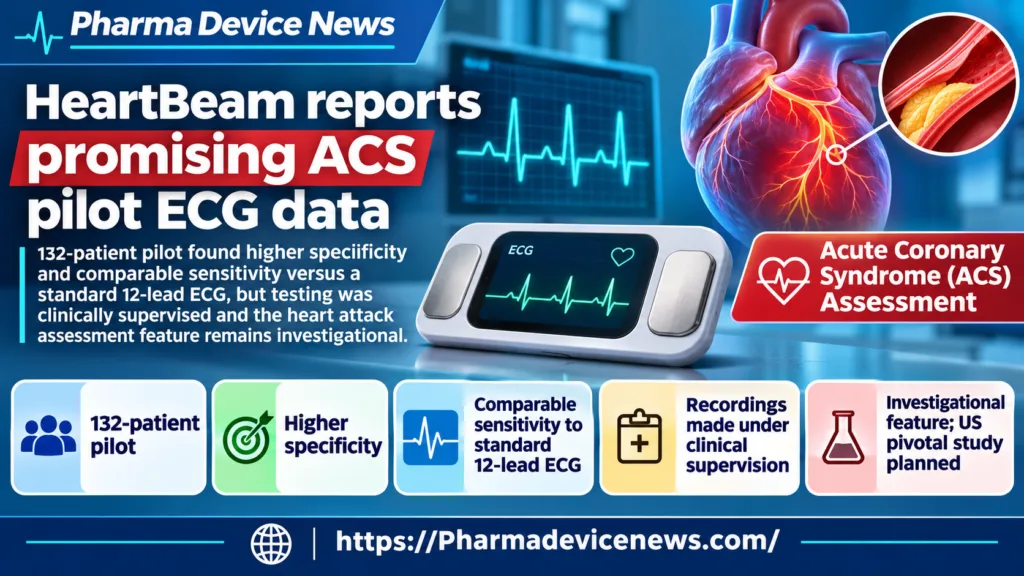
HeartBeam, Inc. (NASDAQ: BEAT) has reported positive findings from its ALIGN-ACS pilot study, showing that its portable, patient-operated three-dimensional electrocardiogram system achieved 81.8% specificity when assessing acute coronary syndrome, compared with 71.4% for a conventional 12-lead ECG. The results, announced on November 2, 2026, and presented at Transcatheter Cardiovascular Therapeutics in San Diego, involved 132 adults evaluated at two emergency departments in Belgrade, Serbia.
The investigational device demonstrated 60.2% sensitivity for acute coronary syndrome, compared with 63.0% for standard ECG, while sensitivity for ST-elevation myocardial infarction reached 82.9%, versus 83.8% for the conventional approach. All participants successfully recorded their own HeartBeam ECGs without prior training, although recordings were obtained under clinical supervision rather than independently at home. The company intends to use the findings to design a US pivotal study expected to begin in the first quarter of 2027.
The results establish a potentially important technical milestone for HeartBeam’s ambition to move clinically useful cardiac recordings beyond hospitals. However, describing the device as equally accurate to a conventional ECG requires qualification because accuracy encompasses several measures, and the study did not establish that either technology can safely exclude a heart attack on its own. The HeartBeam System has existing FDA clearance for arrhythmia assessment, but its proposed heart attack assessment function remains investigational.
What did the 132-patient ALIGN-ACS study establish about HeartBeam’s diagnostic accuracy?
ALIGN-ACS was designed to evaluate whether ECG recordings obtained by patients using the HeartBeam System could support the assessment of acute coronary syndrome. The study enrolled 132 adults presenting to emergency departments at two cardiology centres in Belgrade. Participants recorded their own ECGs with HeartBeam, while conventional 12-lead ECG recordings were also obtained for comparison.
Eight cardiologists independently interpreted recordings from both systems without knowing each patient’s final diagnosis. Their assessments were compared with diagnoses established by a separate panel of three cardiologists reviewing the available clinical information. This design provided an opportunity to evaluate whether the device captured signals that clinicians could interpret meaningfully.
The principal reported finding was higher specificity with HeartBeam. At 81.8%, its specificity exceeded the 71.4% observed with conventional ECG. Specificity measures how often a test correctly identifies people who do not have the condition being investigated, making it relevant to unnecessary positive findings.
However, sensitivity was numerically lower with HeartBeam. The device achieved 60.2% sensitivity for acute coronary syndrome, compared with 63.0% for standard ECG. Sensitivity measures the proportion of affected patients correctly identified, so the difference is clinically important even if the reported values are broadly similar.
The company did not provide a complete statistical non-inferiority analysis or confidence intervals in its announcement. Consequently, the findings should be interpreted as evidence of comparable observed performance in a small pilot rather than definitive proof of diagnostic equivalence across clinical settings.
Why is 60.2% sensitivity an important limitation for remote heart attack assessment?
Acute coronary syndrome encompasses conditions caused by sudden reductions in blood supply to the heart, including myocardial infarction and unstable angina. Diagnosis often requires consideration of symptoms, clinical findings, repeated ECG recordings and cardiac biomarkers such as troponin. An ECG is essential to assessment but does not independently identify every affected patient.
HeartBeam’s reported sensitivity of 60.2% means that approximately six out of ten acute coronary syndrome cases were identified under the study’s assessment conditions. Conversely, a substantial proportion were not identified through the interpreted recordings. The conventional ECG comparator also missed cases, with sensitivity of 63.0%.
This distinction is particularly important for a device intended to be used when patients first experience concerning symptoms. A patient who receives a reassuring ECG interpretation could still be experiencing acute coronary syndrome. The technology must therefore be incorporated into a clinical pathway that prevents false reassurance or delays in seeking urgent medical evaluation.
Higher specificity can reduce some unnecessary positive findings, but it cannot compensate automatically for missed disease. The consequences of a false-negative result may be particularly serious when rapid treatment is needed. Any home-use pathway must address how symptoms are assessed and when emergency services should be contacted regardless of the ECG result.
The study does not establish that HeartBeam can safely rule out a heart attack. Its potential role is more appropriately described as providing additional electrical information to clinicians during remote assessment. That distinction will be critical to future clinical development and regulatory review.
How did HeartBeam perform when identifying ST-elevation myocardial infarction?
ST-elevation myocardial infarction, commonly called STEMI, is a particularly time-sensitive form of heart attack often associated with acute coronary artery blockage. ECG interpretation plays an important role in identifying patients who may need urgent coronary intervention. Rapid recognition can influence the time between symptom onset and treatment.
In ALIGN-ACS, HeartBeam achieved 82.9% sensitivity for STEMI, compared with 83.8% for conventional 12-lead ECG. The difference between the observed percentages was relatively small, suggesting that the portable system captured clinically relevant electrical information in many patients with this diagnosis.
However, neither percentage represents perfect detection. Some STEMI cases were not identified through the recordings, reinforcing the importance of clinical assessment and appropriate emergency care. The announcement also does not provide detailed STEMI-specific sample sizes or confidence intervals, limiting conclusions about statistical equivalence.
The results are nonetheless relevant because HeartBeam’s principal development objective involves capturing an ECG during the earliest stages of symptoms, potentially before the patient arrives at a healthcare facility. If a patient-operated system can provide an interpretable recording promptly, it may help clinicians assess urgency. The clinical benefit would depend on what happens after the recording is transmitted and reviewed.
The next pivotal study will need to evaluate performance in a sufficiently large population, including patients with different symptoms and underlying cardiac conditions. Evidence from emergency department testing alone cannot establish how reliably the system will perform during unsupervised use.
Why does cardiologist agreement matter for the clinical usefulness of HeartBeam’s 3D ECG?
HeartBeam reported stronger agreement among the eight participating cardiologists when they interpreted its recordings than when they reviewed conventional ECGs. The analysis used Fleiss’ kappa, a statistical measure of agreement between multiple reviewers that accounts for agreement expected by chance. The reported kappa was 0.73 for HeartBeam and 0.54 for standard 12-lead ECG.
This difference suggests that clinicians reached more consistent interpretations using the HeartBeam recordings under the study conditions. Such consistency may be valuable when assessments are performed remotely or across healthcare facilities with differing levels of experience. However, agreement and diagnostic correctness are separate concepts.
Clinicians can agree with one another while still arriving at an incorrect conclusion. Stronger agreement therefore does not automatically establish higher sensitivity, specificity or improved patient outcomes. The final diagnostic assessment remains necessary to determine whether interpretations are accurate.
The result may also be influenced by how the recordings were presented and the study’s interpretation process. It is not clear from the announcement whether equivalent patterns would emerge with different clinicians, broader patient populations or real-world reporting systems. Further validation will be needed before generalising the finding.
For HeartBeam, consistency could become an important element of its value proposition if subsequent research demonstrates that clinicians can interpret remote recordings reliably. Nevertheless, its relevance to actual treatment decisions must be established through clinical workflows rather than reader agreement alone.
How does HeartBeam’s cable-free 3D ECG differ from conventional 12-lead recordings?
Conventional 12-lead ECGs use multiple electrodes positioned on the chest and limbs to capture the heart’s electrical activity from several perspectives. These recordings provide information about rhythm, conduction and patterns that may suggest myocardial injury. Their interpretation forms part of standard cardiovascular assessment.
HeartBeam has developed a compact device approximately the size of a credit card that captures electrical information from three non-coplanar directions. The system can use the resulting signals to synthesise a 12-lead ECG representation through software. This approach aims to reduce the equipment and preparation required to obtain information normally associated with larger ECG systems.
The company emphasises the ability of patients to record signals themselves without cables or extensive electrode placement. That design could potentially make repeat recordings more practical outside conventional medical facilities. However, recording quality and the patient’s ability to use the device during symptoms remain important considerations.
The technology is not identical to a traditional 12-lead ECG in how it captures the underlying electrical signals. Its clinical value therefore depends on validation showing that the synthesised information supports the intended assessment. The ALIGN-ACS findings provide early evidence but do not establish universal interchangeability.
Portability may be particularly useful when symptoms are intermittent or arise away from healthcare facilities. Nevertheless, convenience should not obscure the limitations of any single ECG recording. Some acute cardiac conditions may produce subtle, transient or non-diagnostic electrical changes, making further clinical evaluation essential.
What does the 100% patient-recording success rate prove about usability?
All 132 participants successfully obtained their own HeartBeam recordings without prior device training. This result is relevant because patient-operated medical technologies must be usable by people who may have little experience with diagnostic equipment. Complicated setup procedures can reduce the usefulness of a device intended for rapid assessment.
The finding suggests that the device’s recording process was manageable within the pilot environment. It also supports the feasibility of obtaining patient-generated ECG information using a compact system rather than conventional clinical equipment. However, the study was conducted under clinical supervision.
Home use introduces circumstances not fully represented by the pilot. Patients may be alone, frightened, in pain or experiencing breathlessness when attempting a recording. Lighting, positioning, movement and access to a phone or communication network could also influence performance.
The pilot did not demonstrate that every participant could independently record and transmit an ECG during a genuine emergency without assistance. Nor did it measure whether device use reduced delays in calling emergency services or receiving hospital treatment. Those outcomes are more directly related to the company’s proposed clinical application.
A future study should therefore examine both recording success and the subsequent care pathway. The ability to generate data is only one part of a remote cardiac assessment service. Its practical benefit will depend on timely interpretation and appropriate medical action.
Why is FDA Breakthrough Device designation different from approval for heart attack detection?
HeartBeam received FDA Breakthrough Device designation for its heart attack assessment technology. The programme is intended to facilitate the development and review of qualifying devices that may offer advantages in diagnosing or treating serious conditions. It can provide opportunities for more structured engagement with the regulator.
However, Breakthrough Device designation does not establish that the technology has satisfied the requirements for marketing authorisation. It also does not mean that the FDA has determined the device is sufficiently accurate for independent heart attack assessment. The underlying clinical evidence must still support the intended indication.
HeartBeam’s existing regulatory position is more limited. Its core 3D ECG technology received FDA clearance for arrhythmia assessment in December 2024, followed by clearance of its 12-lead ECG synthesis software for arrhythmia assessment in December 2025. These authorisations do not extend automatically to identifying acute coronary syndrome or myocardial infarction.
The company intends to begin a US pivotal study during the first quarter of 2027. Results from ALIGN-ACS will help inform that programme’s design, potentially including the choice of endpoints and the methods used to evaluate diagnostic performance. No results from the planned US study are yet available.
Future regulatory review will need to consider the complete intended use, including how clinicians interpret the findings and how patients are directed towards emergency care. The risk of missed heart attacks makes the clinical pathway especially important.
Can HeartBeam reduce the time between heart attack symptoms and emergency treatment?
HeartBeam’s long-term objective is to make clinically meaningful ECG recordings available at the first sign of concerning symptoms, including when patients are at home. The concept addresses a recognised problem in cardiovascular care: some patients delay seeking emergency treatment because they are uncertain whether symptoms indicate a heart attack. Earlier medical evaluation can be important when acute coronary blockage is present.
A portable device could potentially provide additional information to a clinician before the patient reaches hospital. If the recording suggests a serious abnormality, a healthcare professional might recommend urgent evaluation. This could support faster decision-making in selected situations.
However, the proposed benefit depends on access to rapid interpretation and an effective communication pathway. A recording that remains unreviewed or leads to delayed action would provide limited value. A system designed for emergency use must also prevent users from treating an inconclusive result as reassurance that no serious condition exists.
The pilot did not measure reductions in symptom-to-door time, emergency department arrival time or time to coronary intervention. It therefore cannot establish that HeartBeam currently accelerates treatment. Those outcomes would require prospective evaluation under real-world conditions.
The system’s most plausible near-term role is as an adjunct to appropriate medical assessment. It must not encourage patients with possible heart attack symptoms to postpone emergency care while waiting for a device result.
What are the financial and investor implications for HeartBeam after ALIGN-ACS?
HeartBeam is a publicly traded medical technology company developing portable ECG systems for arrhythmia monitoring and potential future heart attack assessment. Its commercial strategy includes initial deployment of its FDA-cleared arrhythmia technology and longer-term expansion into acute cardiac assessment. The new pilot results strengthen the clinical development rationale for that expansion.
However, the company’s financial position creates significant execution risk. At June 30, 2026, HeartBeam reported approximately $8.7 million in cash and cash equivalents. Its regulatory filing stated that available liquidity was insufficient to fund operations for the following 12 months under then-current assumptions, raising substantial doubt about its ability to continue as a going concern without additional capital.
Management has been pursuing an initial commercial launch of the arrhythmia-focused system and had reported signed agreements across four targeted US markets. Nevertheless, the company had not generated revenue from the HeartBeam System during the first half of 2026. It also expected no material commercial revenue during the full year.
HeartBeam shares closed at $0.55 on October 30, 2026, up approximately 2.1% during the session. The stock’s 52-week trading range was approximately $0.36 to $4.00, highlighting substantial volatility. Because the ALIGN-ACS findings were announced on November 2, the preceding closing price should not be characterised as a reaction to the new results.
The planned pivotal trial will require additional investment in clinical operations, device supply and regulatory preparation. Consequently, the scientific opportunity must be assessed alongside financing requirements and potential shareholder dilution. Positive pilot findings do not eliminate the need for additional capital.
What must HeartBeam demonstrate before its 3D ECG can be used for heart attack assessment at home?
The first requirement is a larger clinical study establishing diagnostic performance in the intended population. ALIGN-ACS provides encouraging evidence of higher specificity and similar observed sensitivity to conventional ECG, but the small pilot does not establish definitive equivalence or suitability for independent use. The planned US pivotal study must address these limitations.
The second requirement is demonstrating practical performance outside supervised hospital environments. Patients must be able to capture interpretable recordings reliably during concerning symptoms, and the results must reach appropriately qualified clinicians. The complete workflow must be sufficiently dependable for a time-sensitive clinical application.
Safety is equally important. A remote screening tool with incomplete sensitivity can create risks if patients interpret a negative or inconclusive result as proof that a heart attack is not occurring. Appropriate warnings, triage instructions and clinical oversight will be central to its design.
Regulatory authorisation and commercial readiness represent further hurdles. Even if the pivotal study is successful, the company must complete the applicable FDA process and establish a financially sustainable system for deploying and supporting the technology. The current announcement does not provide a commercial launch date for heart attack assessment.
HeartBeam has demonstrated that a compact, patient-operated ECG device can generate clinically interpretable recordings under supervised conditions, with promising specificity and reader agreement. However, its approximately 60% sensitivity for acute coronary syndrome reinforces the limits of relying on ECG interpretation alone. The decisive test will be whether a larger study supports a safe clinical workflow that provides useful early information without delaying emergency care.