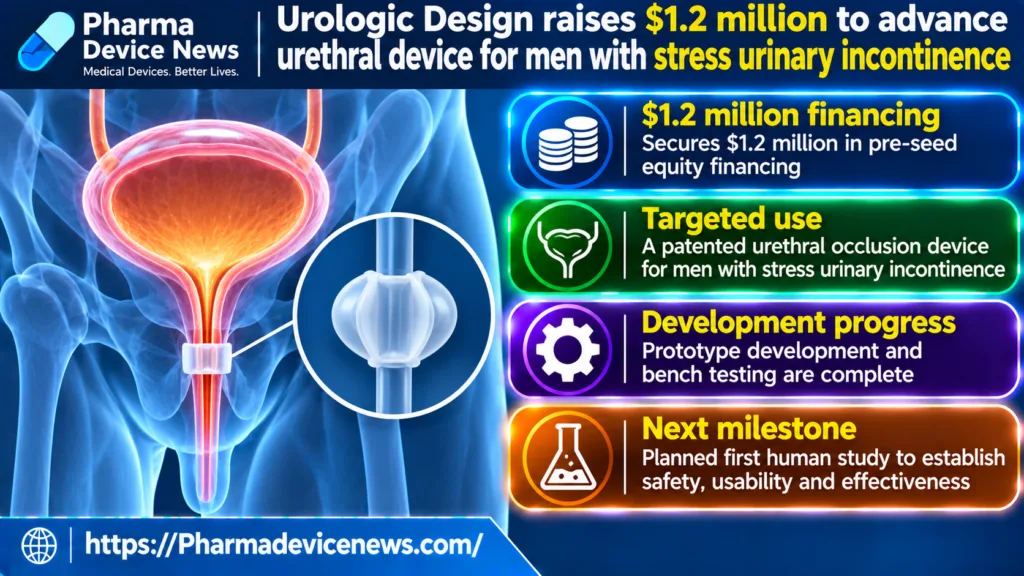
Urologic Design, a Connecticut-based medical technology startup, has completed an oversubscribed $1.2 million pre-seed financing round to advance a patented urethral occlusion device intended to help men manage stress urinary incontinence without relying exclusively on absorbent products or undergoing invasive surgery. Announced on October 29, 2026, the equity financing will support further product engineering, testing, regulatory preparation and development of the company’s first clinical investigation involving patients with urinary leakage.
The investment was led by Angel Investor Forum, with participation from HBS Alumni Angels of Boston, Haven Founders Fund, Connecticut Innovations, Yale Angels and individual investors. Urologic Design has already produced a working prototype, secured intellectual property protection and completed extensive bench testing. It is now preparing an initial clinical study involving a small group of men with stress urinary incontinence, marking a planned transition from laboratory evaluation towards human feasibility assessment.
The company’s development strategy targets an important gap in male continence care. Patients may rely on pads or other conservative management options, while some eventually undergo procedures involving slings or artificial urinary sphincters. However, the new device has not yet demonstrated safety or effectiveness in humans, and Urologic Design has not announced FDA marketing authorisation, commercial availability or a confirmed clinical trial start date.
Why has Urologic Design raised $1.2 million to develop a male urinary incontinence device?
Urinary incontinence can substantially affect daily activities, emotional wellbeing and social participation, particularly when leakage is difficult to predict or control. Patients may modify their routines, limit travel or physical activity and rely on absorbent products to manage episodes. These measures can provide practical protection but may not offer the level of control or convenience that every patient requires.
Urologic Design is developing a urethral occlusion device intended to provide an additional management option. Its stated objective is to create a temporary approach that offers greater control over leakage while avoiding some of the burdens associated with existing products or surgical treatment. The company has identified men with stress urinary incontinence as the initial population for evaluation.
The $1.2 million financing provides resources to advance this concept towards clinical testing. According to the company, the funding will support refinement of the prototype, additional research and development, regulatory work and preparation for a first-in-human study. These activities represent important development stages but do not establish that the product is ready for commercial distribution.
Matthew Stannard, life sciences lead at Angel Investor Forum, has identified the product’s positioning between absorbent management and surgery as an important reason for the investment. The investor sees potential in a technology addressing a recognised unmet need. Nevertheless, the commercial and clinical assumptions underlying the investment remain to be tested in patients.
For Urologic Design, the immediate objective is not large-scale sales growth but generating sufficient evidence to support the next development stage. Successful completion of early human evaluation could help determine whether the device merits larger studies and additional financing.
What is male stress urinary incontinence, and why can existing treatment options be difficult?
Stress urinary incontinence occurs when increases in pressure inside the abdomen lead to involuntary urine leakage. Episodes may occur during coughing, sneezing, lifting or physical activity, particularly when the urinary sphincter mechanism cannot maintain adequate closure. The condition differs from urgency urinary incontinence, which involves leakage associated with a sudden compelling need to urinate.
In men, stress urinary incontinence is commonly associated with changes in urinary sphincter function after prostate surgery, including procedures performed for prostate cancer. The severity and duration of symptoms vary substantially. Some individuals experience gradual improvement, while others continue to have leakage that affects everyday life.
Conservative management can include pelvic floor muscle training, absorbent products and selected external continence devices. These approaches differ in their intended function and suitability. A patient with mild intermittent leakage may have different needs from someone experiencing persistent high-volume incontinence.
Surgical interventions may be considered when conservative approaches provide inadequate control. Male urethral slings and artificial urinary sphincters are among the established options for appropriately selected patients. However, surgery introduces procedural risks, recovery requirements and the possibility of subsequent device-related complications.
This creates a potential opportunity for technologies offering additional choices between conservative management and invasive treatment. The clinical value of such a device would depend on whether it provides reliable leakage control while remaining comfortable, manageable and safe.
How is Urologic Design’s patented urethral occlusion technology intended to control urinary leakage?
Urologic Design describes its first product as a patented urethral occlusion device for men. Urethral occlusion refers to restricting the passage of urine through the urethra, the channel that carries urine from the bladder to the outside of the body. In principle, controlling this passage could help prevent involuntary leakage during activities that increase abdominal pressure.
The company’s development concept involves a temporary means of managing urinary leakage. This distinguishes its stated strategy from permanently implanted devices intended to provide long-term mechanical control through surgery. However, the October announcement does not provide a complete technical description of the prototype.
Important design details remain undisclosed, including the exact positioning of the device, how it is applied or removed, and how normal urination is accommodated. The company also has not disclosed materials, dimensions, patient operating instructions or the anticipated duration of use. These details should not be inferred from the general term urethral occlusion.
The absence of such information limits direct comparison with commercially available devices. Some established continence products apply external pressure, while others require surgical placement or different mechanical mechanisms. Urologic Design’s device cannot reliably be classified as equivalent to any particular product category without additional technical information.
The intended advantage is greater flexibility for patients seeking a manageable alternative to pads or surgery. However, the practical value will depend on how easily the device can be used and whether it provides dependable control without interfering with normal urinary function.
Why is avoiding urethral injury and urinary retention central to the device’s development?
A device designed to restrict urinary leakage must achieve a delicate balance. It needs to provide sufficient control to reduce involuntary urine loss while avoiding excessive pressure or obstruction. Inadequate control could leave patients experiencing continued leakage, while excessive restriction could create safety concerns.
Potential risks associated with urethral occlusion technologies may include discomfort, pressure-related tissue injury, difficulty urinating and urinary retention. Depending on the device design and use conditions, irritation or other urinary tract complications may also be relevant. These are development considerations rather than adverse events established for Urologic Design’s prototype.
The company will need to evaluate how the device interacts with urethral anatomy during normal activities. Movement, changes in body position and repeated application may influence performance. The appropriate testing requirements will depend on the product’s final mechanical configuration and intended use.
Patient variability creates another challenge. Urethral anatomy, previous prostate surgery and the severity of sphincter dysfunction may differ substantially between individuals. A device that functions appropriately in one patient may require a different configuration or may not be suitable for another.
These considerations make human feasibility testing important. Laboratory studies can demonstrate mechanical function under controlled conditions, but they cannot fully reproduce the effects of normal movement, individual anatomy and repeated use. Early clinical evaluation will need to examine safety and usability alongside leakage control.
What does the completed working prototype and extensive bench testing establish?
Urologic Design has confirmed that it has developed a working prototype and conducted extensive bench testing. This indicates that the company has progressed beyond the initial design concept and has begun evaluating the physical performance of its technology. Intellectual property protection has also been secured, supporting its ownership of aspects of the innovation.
Bench testing can provide valuable information about mechanical operation, durability and consistency. Depending on the device, manufacturers may assess repeated actuation, material behaviour and other characteristics relevant to intended performance. These studies can identify design weaknesses before a product is exposed to patients.
However, the announcement does not identify the specific tests completed, their acceptance criteria or the measured results. It also does not confirm that all applicable biocompatibility and product validation requirements have been satisfied. The phrase extensive bench testing therefore indicates development progress without allowing an independent assessment of the underlying evidence.
Prototype completion is similarly distinct from manufacturing readiness. An early product may function successfully under laboratory conditions while requiring additional engineering to support reliable production and repeated clinical use. Design refinement can remain necessary even after initial mechanical feasibility has been established.
The next stage will involve determining whether the product performs safely and consistently in the intended clinical environment. Human testing will provide information that cannot be obtained through bench studies alone, particularly concerning patient comfort and practical use.
Why is the first-in-human study an important milestone for Urologic Design?
The company is preparing an initial clinical study involving a small cohort of men with stress urinary incontinence. This will represent the first disclosed opportunity to evaluate the device’s performance directly in the intended patient population. Its objectives are likely to include determining whether the concept is feasible and whether any safety or usability problems emerge.
However, the October announcement does not provide a complete trial protocol. The number of participants, treatment duration, recruitment locations and specific clinical endpoints remain undisclosed. Consequently, it would be premature to describe the planned study as a pivotal trial or assume that it will establish definitive effectiveness.
Early device studies often focus on feasibility because the manufacturer must determine whether a product can be used as intended. Investigators may examine practical aspects such as application, removal, patient comfort and changes in leakage. The actual measures used by Urologic Design will depend on its final protocol and regulatory arrangements.
The small proposed sample will limit the ability to detect uncommon complications or estimate long-term success rates. Even if the first patients report favourable outcomes, a larger investigation would be needed to establish whether the findings are reproducible across different users and disease severities.
The results may also influence subsequent product design. Feedback from clinicians and patients can identify problems that are difficult to anticipate during laboratory development. A willingness to refine the product based on these observations could be important to its longer-term development.
How could Urologic Design’s product differ from absorbent pads, external clamps and surgical implants?
Absorbent pads are widely used because they can manage leakage without requiring an invasive procedure. However, they do not prevent urine from escaping and must be changed according to use. Some patients may find the associated maintenance, discomfort or visibility inconvenient.
External penile compression devices aim to reduce leakage by applying pressure to restrict urine flow. They may provide an alternative for selected patients, but comfort, proper use and tissue safety are important considerations. The appropriate duration and method of use depend on the product and medical guidance.
Surgical approaches offer different mechanisms. Male slings provide support to the urethral region, while artificial urinary sphincters use an implanted system intended to provide mechanical continence control. These procedures may be effective for selected patients, but they involve surgery and potential device-related complications.
Urologic Design is seeking a position between these existing categories. Its stated goal is a simple, temporary solution rather than a conventional absorbent product or invasive operation. However, the company has not disclosed enough technical information to establish precisely how its product compares with an external compression device.
The eventual clinical advantage will depend on results that matter to patients. These may include the degree of leakage control, comfort, ease of use, reliability and the ability to urinate normally. Without human data, no claim of superiority over pads, clamps, slings or artificial sphincters is justified.
Why is David Hesse’s urology experience relevant to the company’s development strategy?
Urologic Design was founded in 2022 by David Hesse, a urologist and associate professor at Yale School of Medicine. Hesse serves as the company’s co-founder and chief scientific officer. His clinical background includes urological oncology, prostate surgery and the management of conditions affecting urinary function.
This experience is relevant because stress urinary incontinence can occur following prostate cancer treatment. Physicians working with affected patients may have direct insight into the limitations of conservative management and the trade-offs involved in surgical treatment. Such experience can help identify problems that warrant technological investigation.
Hesse has explained that Urologic Design was established to develop a temporary solution intended to improve dignity and day-to-day control for patients managing leakage. His assessment provides the clinical rationale behind the company. However, professional expertise does not independently validate the safety or effectiveness of the resulting device.
The company’s next challenge is converting that clinical insight into evidence-based product development. Appropriate testing must demonstrate that the proposed mechanical solution works consistently and is acceptable to patients. Regulatory compliance and manufacturing controls will also become increasingly important.
The involvement of a clinician-founder may support study design and engagement with specialist urologists. Nevertheless, independent assessment remains essential, particularly when evaluating a technology developed by an organisation whose leadership has a direct commercial interest.
What does the $1.2 million pre-seed financing mean for the company’s financial position?
The investment was led by Angel Investor Forum, a Connecticut-based angel investment organisation. Other participants included HBS Alumni Angels of Boston, Haven Founders Fund, Connecticut Innovations, Yale Angels and individual investors. Urologic Design described the round as oversubscribed, indicating that investor demand exceeded the original fundraising target.
The financing was structured as equity investment rather than a disclosed grant or commercial licensing payment. This distinction matters because equity investors receive an ownership interest, while the company obtains capital to support development. The announcement does not disclose the valuation, shareholding percentages or other terms of the financing.
At the pre-seed stage, $1.2 million can support important activities such as engineering, testing and regulatory preparation. However, it is unlikely that the financing alone establishes sufficient resources for every future stage of clinical development and commercialisation. The actual funding requirements will depend on the regulatory pathway, the extent of necessary testing and the company’s manufacturing strategy.
The involvement of several investor groups may also provide access to expertise and professional networks. This could be useful when the company seeks clinical partners or additional financing. However, participation by investors does not guarantee future investment commitments or commercial success.
Urologic Design remains privately held and has not disclosed revenue, profitability or a product sales forecast. Its financial position is therefore best understood in terms of early development funding rather than an established commercial operating business.
What regulatory requirements must Urologic Design address before selling its urinary incontinence device?
Medical devices intended to manage urinary incontinence are subject to regulatory requirements that depend on their design, intended use and associated risks. In the United States, the FDA determines the appropriate marketing pathway according to applicable device classifications and regulatory criteria. A product’s classification cannot be assumed solely from a general description of its function.
Urologic Design has confirmed that the new financing will support regulatory work. However, the company has not disclosed a specific FDA submission, regulatory classification or clearance decision for its lead product. It has also not announced that the device is authorised for routine patient use.
The proposed first-in-human investigation must be conducted under the applicable clinical research and oversight requirements. The precise regulatory arrangements will depend on the final study design and product characteristics. Approval of an eventual commercial product would remain separate from permission to perform clinical research.
Safety evidence will be particularly important because the product is designed to interact with urinary function. Regulators may need to assess mechanical reliability, materials, tissue effects and other risks associated with the intended use. The evidence required will depend on the final design rather than the broad commercial positioning.
Manufacturing controls will become increasingly relevant as development advances. A prototype that performs appropriately in a laboratory must eventually be produced consistently under suitable quality requirements. Urologic Design has not yet disclosed commercial manufacturing arrangements or a launch timetable.
Could a temporary male incontinence device address a commercially meaningful healthcare market?
Urinary incontinence affects a large population and creates substantial demand for management products and clinical services. Urologic Design has cited approximately 25 million people living with urinary incontinence in the United States as context for the broader unmet need. However, that estimate covers urinary incontinence generally and should not be treated as the number of men eligible for the company’s device.
The initial target population is narrower: men with stress urinary incontinence who may benefit from a temporary urethral occlusion approach. The size of the eventual market will depend on the product’s indication, patient selection criteria and how it compares with existing management options. A patient with urgency incontinence, for example, may not have the same treatment needs.
The product’s commercial proposition could be attractive if it provides reliable control without requiring surgery. However, convenience alone is unlikely to determine adoption. Patients and clinicians will evaluate comfort, safety, usability, effectiveness and cost before changing established management strategies.
Reimbursement may also influence uptake. Some continence products are purchased directly by patients, while other treatments involve insurance coverage and specialist procedures. Urologic Design has not disclosed its intended pricing, distribution or reimbursement model.
These uncertainties limit estimates of future sales. The company has identified a substantial healthcare problem, but it has not yet established the proportion of patients who would be suitable for its technology or willing to adopt it.
What must Urologic Design prove before its device can become a credible alternative to existing treatment?
The first requirement is a successful initial human feasibility study. The company must demonstrate that patients can use the device as intended and that its mechanical function produces appropriate control of urinary leakage. Safety and comfort will be central because a product used repeatedly must remain acceptable during ordinary daily activity.
The second requirement is evidence of consistent performance across different patients. Stress urinary incontinence varies in severity and underlying cause, particularly following prostate treatment. The device may prove suitable for a particular subgroup rather than every patient experiencing leakage.
Longer-term evaluation will also be necessary. Repeated use could reveal issues not observed during initial testing, including discomfort, mechanical wear or changes in effectiveness. Proper assessment should examine both clinical outcomes and patient-reported experience.
Regulatory progress, manufacturing readiness and a sustainable commercial model will represent additional hurdles. Even a clinically promising product must be produced consistently, distributed appropriately and supported with clear instructions. The company will also need sufficient capital to complete these activities.
Urologic Design has secured early investor backing for an approach targeting a meaningful gap in male continence care. Its patented prototype and completed bench testing provide a foundation for clinical investigation, but the technology has not yet established effectiveness in patients. The next decisive milestone will be whether the first human study demonstrates that temporary urethral occlusion can offer practical, comfortable and safe control of urinary leakage without the limitations the company is seeking to address.