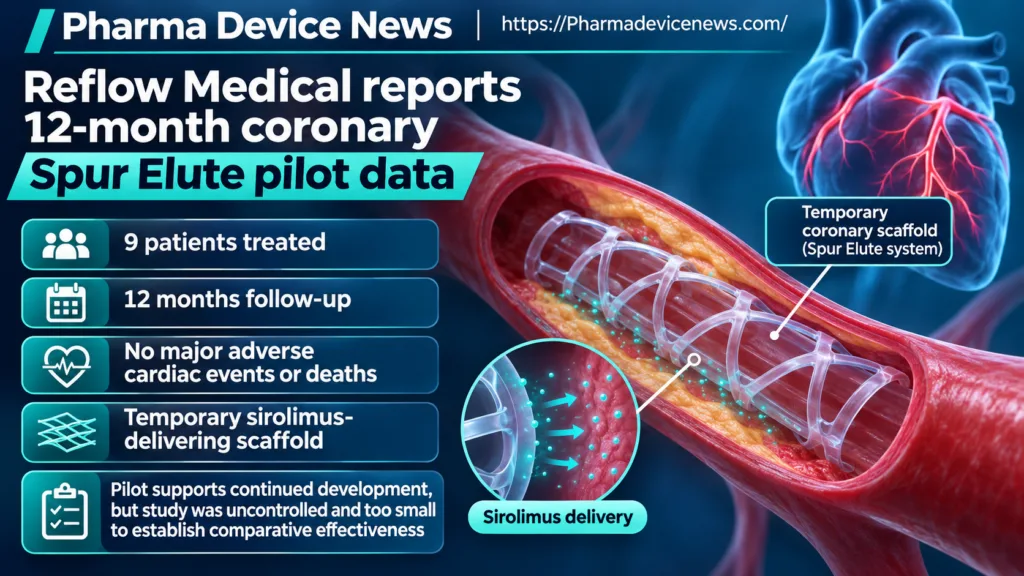
Reflow Medical, Inc. has reported encouraging one-year safety and clinical findings for its investigational coronary Spur Elute Sirolimus-Eluting Retrievable Stent System, with all nine participants in the first-in-human DEEPER CORONARY study remaining free from reported major adverse cardiac events and all-cause mortality through 12 months. Presented on November 1, 2026, at Transcatheter Cardiovascular Therapeutics in San Diego, the results extend the initial six-month observations for a device designed to treat coronary in-stent restenosis without leaving another permanent metallic implant inside the artery.
The single-centre pilot study also reported successful device delivery and lesion treatment in all nine patients. Mean residual narrowing immediately after treatment was 13.3%, while the mean acute lumen gain was 1.8 millimetres. All participants experienced an improvement in angina severity, with a median improvement of three classes on the Canadian Cardiovascular Society grading system.
However, the results come from a small, uncontrolled clinical investigation, and the company has not reported a direct comparison with established treatments such as drug-coated balloons or contemporary drug-eluting stents. The findings establish preliminary procedural feasibility and provide reassuring observations over one year, but they do not prove that Spur Elute reduces recurrent restenosis or cardiovascular events. The coronary system remains investigational and is not authorised for routine commercial use.
Why is Reflow Medical targeting coronary in-stent restenosis with a retrievable stent?
Coronary in-stent restenosis occurs when a segment of artery previously treated with a stent becomes narrowed again. The process can involve tissue growth inside the original implant, changes in the vessel wall or mechanical factors associated with the existing stent. Recurrent narrowing may reduce blood flow to the heart muscle and produce symptoms such as chest pain or reduced exercise tolerance.
Treating restenosis can become increasingly complicated when patients have already received multiple metallic stents in the same arterial segment. Additional layers may restrict the available space inside the vessel and complicate future interventions. The physical characteristics of earlier implants can also influence the effectiveness of subsequent treatment.
Conventional approaches include balloon-based techniques, drug-coated balloons and additional drug-eluting stents, depending on the cause and characteristics of the restenosis. Each strategy involves trade-offs concerning mechanical expansion, drug delivery and the amount of permanent material remaining in the artery. The optimal approach depends on the anatomy and the mechanism underlying the recurrent narrowing.
Reflow Medical is investigating a different design that combines temporary mechanical support with local delivery of an antiproliferative medicine. Its Spur Elute system is intended to expand the narrowed region, facilitate drug transfer and then be removed entirely. This approach seeks to address both immediate lumen gain and subsequent tissue regrowth without adding another permanent stent layer.
The concept is particularly relevant to patients in whom repeated implantation has already created a complex arterial environment. However, its theoretical advantage must be tested against existing treatments before clinicians can determine whether avoiding additional metal improves long-term outcomes.
How does the Spur Elute Sirolimus-Eluting Retrievable Stent System work?
The investigational Spur Elute device incorporates a temporary self-expanding scaffold with radially expandable structures designed to engage the vessel wall. Reflow Medical describes these structures as creating microchannels intended to facilitate drug penetration into the treated tissue. The system also includes an integrated balloon, with both the scaffold and balloon carrying a sirolimus-based formulation.
The treatment is designed to combine mechanical and pharmacological effects during a single intervention. Expansion of the scaffold provides temporary support to the artery, while the balloon assists with lumen enlargement and contact between the drug-coated components and vessel tissue. The system can maintain a degree of coronary perfusion while the balloon is deflated, according to the company.
Sirolimus is an antiproliferative medicine used in coronary device technology to reduce excessive tissue growth following intervention. Its intended role in Spur Elute is to limit the biological processes that can contribute to renewed narrowing. However, successful drug transfer depends on tissue contact, formulation characteristics and the amount of medicine delivered to the vessel wall.
After the treatment steps are completed, the entire device is retrieved. This means the patient is not left with an additional metallic scaffold from the Spur Elute procedure. The approach differs fundamentally from implanting another permanent drug-eluting stent, although the original stent responsible for the restenosis remains in place.
The company believes that microchannel creation and direct sirolimus delivery may improve tissue exposure. Nevertheless, the October and November disclosures do not provide quantitative drug-concentration measurements or demonstrate that the microchannels produce superior clinical outcomes. Those mechanisms remain part of the development rationale.
What did the DEEPER CORONARY study establish about acute procedural success?
The first-in-human DEEPER CORONARY investigation was conducted at a single centre in New Zealand under the leadership of principal investigator Scott Harding of Wellington Hospital. The study enrolled nine patients requiring treatment for coronary in-stent restenosis. Its principal purpose was to evaluate initial safety and procedural feasibility rather than establish superiority over an approved treatment.
Reflow Medical reported successful device delivery in all nine procedures. Lesion success was also achieved in every participant, using a definition requiring less than 30% residual stenosis following treatment. The mean residual stenosis was 13.3%, indicating that the treated segments had substantially less narrowing immediately after intervention.
Mean acute lumen gain was 1.8 millimetres. This measurement reflects the immediate enlargement of the treated vessel lumen, an important procedural objective when restoring coronary blood flow. However, acute enlargement is not the same as durable freedom from restenosis, because tissue changes may develop after the intervention.
The reported procedural results support the technical feasibility of deploying and retrieving the system in selected patients. Nevertheless, a nine-patient study cannot establish how consistently the device will perform across different coronary anatomies, lesion lengths or stent configurations. Wider evaluation will be needed to identify anatomical or procedural circumstances that may limit its use.
The company also has not disclosed a complete patient-level account of lesion complexity in its latest announcement. Such information would help clinicians understand how representative the treated cases are of the broader population experiencing difficult or recurrent restenosis.
How meaningful is the absence of major adverse cardiac events after 12 months?
Reflow Medical reported that all nine treated patients completed one-year follow-up without a major adverse cardiac event or death. The company also reported no unanticipated adverse device effects or device-related serious adverse events during the evaluated period. These findings extend the six-month observations presented at EuroPCR in May 2026.
The absence of adverse events is encouraging because coronary interventions can be associated with complications involving myocardial infarction, repeat procedures and other cardiovascular outcomes. Follow-up beyond the initial hospital stay provides additional information about events that may emerge after the acute procedure. Completing assessments in all nine patients also avoids loss to follow-up within this small cohort.
However, observing no events among nine patients does not establish that the true event risk is zero. With such a small sample, clinically important event rates may remain undetected simply because relatively few individuals were treated. Larger studies are required to estimate the frequency of complications with reasonable precision.
The definition of major adverse cardiac events is also relevant. Cardiovascular studies may use different combinations of death, myocardial infarction and repeat revascularisation when constructing composite endpoints. Reflow Medical’s announcement does not provide the complete endpoint definition or independent adjudication details, limiting the ability to compare its results with other clinical studies.
The reported findings should therefore be described as 100% observed freedom from events within the treated nine-patient population. They do not establish a 100% probability of success for future patients or demonstrate a lower complication rate than alternative treatments.
What does the improvement in Canadian Cardiovascular Society angina class reveal about patient benefit?
The Canadian Cardiovascular Society classification system is used to describe the severity of angina symptoms and the extent to which physical activity triggers chest discomfort. Higher classes generally indicate greater limitation, while lower classes correspond to less severe symptoms. Changes in classification can therefore provide useful information about a patient’s experience following coronary intervention.
Reflow Medical reported improvement in angina class among all nine participants, with a median improvement of three classes. This suggests that the treated patients experienced substantial symptom improvement over the evaluated period. Such changes are clinically relevant because relief from chest pain and improved daily functioning are important goals of coronary revascularisation.
However, the announcement does not provide detailed baseline and follow-up classifications for each participant. It also does not specify all concurrent medical treatments or changes in other clinical circumstances that might have influenced symptoms. These limitations make it difficult to attribute the complete improvement exclusively to the investigational device.
A single-arm study also cannot distinguish the effects of Spur Elute from those potentially achievable with another successful restenosis treatment. Restoring arterial patency through established interventions can improve angina, making a comparator important when assessing relative benefit. A future controlled trial could help determine whether the new technology provides additional value.
The symptom findings reinforce the technical results, but they should not be interpreted as evidence that Spur Elute reverses coronary artery disease or prevents future cardiovascular events. Continued clinical monitoring remains necessary.
Why is avoiding another permanent metallic layer potentially important in coronary restenosis treatment?
Patients undergoing repeated coronary interventions may accumulate multiple layers of metallic stents within the same arterial segment. This can affect vessel flexibility, available lumen diameter and the practicality of subsequent treatment. The presence of several layers can also complicate imaging interpretation and the mechanical correction of an underexpanded original stent.
A temporary scaffold offers a theoretical advantage because it does not increase the permanent metal burden. The vessel receives mechanical support during the procedure and local drug treatment, but the device is removed before the intervention is completed. This could be useful when operators are reluctant to place another implant inside an already complex stented segment.
However, removing the scaffold also creates a potential trade-off. A permanent stent continues supporting the artery after the procedure, while a retrieved device cannot provide ongoing mechanical reinforcement. The immediate and long-term results therefore depend on whether the treated vessel maintains adequate lumen dimensions after the temporary support is removed.
An effective drug-delivery strategy could potentially reduce tissue regrowth without requiring a permanent implant. Drug-coated balloons already reflect this general principle, although their design and pharmacological delivery methods differ from the Spur Elute system. Establishing an advantage over these alternatives would require appropriately designed comparisons.
The relevant clinical question is not simply whether less metal remains in the artery. It is whether the combined treatment approach produces sustained lumen enlargement, fewer repeat interventions and acceptable safety. Those outcomes will determine whether the design creates a meaningful improvement in care.
How does Spur Elute differ from established drug-coated balloon and drug-eluting stent treatments?
Drug-eluting stents provide continuous mechanical support while delivering an antiproliferative medicine through a coating or other drug-release system. They are established technologies for selected coronary lesions, including certain situations involving restenosis. However, placing another permanent stent can be undesirable when multiple layers are already present.
Drug-coated balloons deliver medication during a temporary balloon inflation without leaving a new metallic implant. Their effectiveness depends on lesion preparation, adequate expansion and drug transfer to the vessel wall. They provide a different balance between immediate mechanical intervention and longer-term pharmacological effect.
Spur Elute seeks to combine several characteristics of these approaches. Its temporary scaffold provides structural support during treatment, while the microchannel structures and drug-coated components aim to enhance delivery of sirolimus. The system is then retrieved, avoiding the addition of another permanent metallic layer.
The approach is technically differentiated, but it has not yet been established as clinically superior. Different restenosis mechanisms may require different strategies, and a treatment effective in one lesion type may be less useful in another. Intravascular imaging and careful lesion assessment remain important for selecting the appropriate intervention.
Future studies will need to examine whether the technology reduces the likelihood of recurrent narrowing compared with relevant contemporary alternatives. Without comparative clinical evidence, the company’s design claims remain hypotheses supported by early procedural feasibility.
Why are one-year angiographic findings and repeat revascularisation rates important for later development?
The central challenge in coronary restenosis treatment is maintaining an adequately open artery over time. Immediate improvement in lumen diameter may be followed by renewed tissue growth or other changes that reduce blood flow. A durable treatment should therefore provide sustained clinical and anatomical benefit.
Follow-up angiography can provide information about recurrent narrowing, while intravascular imaging can help assess vessel and stent characteristics. Measures such as late lumen loss or binary restenosis may be relevant in comparative device studies. However, their interpretation depends on when imaging is performed and the specific study definitions.
Reflow Medical’s November announcement reports procedural measurements and freedom from major adverse cardiac events, but it does not disclose a comprehensive one-year angiographic analysis or quantitative late lumen loss. The absence of reported clinical events should not be interpreted as evidence that no recurrent anatomical narrowing occurred. Restenosis may develop without immediately producing a major cardiovascular event.
Repeat target lesion revascularisation is another important outcome because it reflects the need to treat the same arterial segment again. A device capable of reducing repeat intervention requirements could create meaningful benefits for patients and healthcare systems. However, a nine-patient pilot lacks the statistical power needed to establish such a reduction against standard treatment.
The next development programme should therefore connect procedural success with longer-term anatomical and clinical outcomes. This would provide a clearer assessment of whether the retrievable scaffold concept addresses the underlying problem of recurrent restenosis.
What is the regulatory status of coronary Spur Elute compared with Reflow Medical’s peripheral products?
Reflow Medical’s coronary Spur Elute Sirolimus-Eluting Retrievable Stent System remains investigational. The company explicitly identified this status in its November 1 announcement. It has not reported FDA marketing clearance or approval for routine coronary use of the system.
The company has a separate portfolio of peripheral vascular devices, including its Spur Peripheral Retrievable Stent System. That product has received FDA De Novo authorisation and European CE marking. Its regulatory status should not be confused with the investigational coronary drug-eluting platform, even though both involve elements of Reflow’s proprietary retrievable scaffold technology.
Reflow also markets other cleared devices, including selected coronary microcatheters and peripheral crossing technologies. These products provide an established commercial presence in endovascular care. However, authorisation of one device does not establish that a related device with different indications and drug-delivery characteristics is authorised.
The regulatory distinction is particularly relevant because Spur Elute combines mechanical intervention with sirolimus delivery. The company must generate the appropriate evidence to support the safety and effectiveness of the complete system. The requirements and pathway for potential future marketing will depend on regulatory assessment.
The current study therefore supports continued development rather than immediate commercial availability. Hospitals cannot interpret the positive one-year findings as permission to adopt the investigational coronary system outside applicable research arrangements.
What could Spur Elute mean for Reflow Medical’s wider cardiovascular business?
Reflow Medical is a privately held medical technology developer headquartered in San Clemente, California. Its portfolio includes devices for coronary and peripheral vascular interventions, with a particular emphasis on complex disease and difficult-to-treat lesions. The company’s retrievable scaffold platform represents an effort to extend its technology into areas where permanent implantation may be undesirable.
The one-year DEEPER CORONARY findings strengthen the preliminary evidence supporting the coronary programme. Completing follow-up in every participant and observing no reported major adverse cardiac events are encouraging development milestones. However, the dataset remains too small to support a reliable forecast of commercial demand or future approval.
The company has also made progress in the peripheral vascular market. Its authorised Spur Peripheral system has received a US Medicare New Technology Add-on Payment arrangement for eligible inpatient cases beginning October 1, 2026. The potential additional payment can reach $2,596.75 under the applicable programme, subject to eligibility and reimbursement requirements.
However, that reimbursement development concerns the peripheral product, not the investigational coronary Spur Elute system. It does not establish payment eligibility or commercial pricing for the coronary technology. The two businesses must therefore be assessed separately.
Reflow has not disclosed a financing transaction, valuation or revenue outlook associated with the latest study. The longer-term commercial opportunity will depend on whether the company can progress from initial feasibility to larger clinical investigations capable of supporting regulatory review.
What must Reflow Medical demonstrate before Spur Elute can become an established coronary restenosis treatment?
The first requirement is confirming procedural safety and feasibility across a larger, more diverse patient population. The nine-patient pilot provides useful initial evidence but cannot characterise uncommon complications or performance across a broad range of lesion anatomies. Multicentre evaluation would help determine whether outcomes remain consistent among different operators.
The second requirement is demonstrating durable anatomical benefit. Investigators must assess whether the treated coronary segment remains adequately open and whether repeat intervention becomes necessary. Quantitative imaging and clinically meaningful follow-up will help establish whether the device’s combined mechanical and pharmacological approach has lasting value.
A third requirement is comparison with established treatment options. Drug-coated balloons and drug-eluting stents already provide relevant alternatives for selected cases of in-stent restenosis. Demonstrating an advantage in complex or multilayer lesions could create a clearer clinical role for Spur Elute.
Regulatory approval and commercial economics will form the final development challenges. The company must establish a suitable clinical evidence package and ensure that device manufacturing, drug coating and retrieval performance remain consistent. Hospitals will subsequently evaluate cost, procedural complexity and reimbursement alongside clinical benefit.
Reflow Medical has achieved an encouraging early development milestone by reporting one-year follow-up without major adverse cardiac events or deaths among nine patients. The retrievable scaffold concept offers an interesting approach to combining arterial expansion with local sirolimus delivery while avoiding additional permanent metal. Its future will depend on whether larger studies demonstrate that this technical differentiation results in durable reductions in restenosis and repeat coronary interventions.