Gilead Sciences has agreed to acquire Ouro Medicines, a San Francisco-based clinical-stage biotechnology company, in a deal valued at up to $2.18 billion, anchored by a $1.675 billion upfront cash payment and contingent milestone payments of up to $500 million. The acquisition centres on OM336, known by its international non-proprietary name gamgertamig, a BCMAxCD3 bispecific T cell engager currently in Phase 1/2 development for severe antibody-mediated autoimmune diseases including autoimmune haemolytic anaemia and immune thrombocytopenia. The move extends Gilead Sciences’ inflammation portfolio beyond its established HIV and oncology franchises and signals a deliberate pivot toward immune-mediated disease, a therapeutic area where several competitors have already staked meaningful positions.
Why BCMA is attracting acquisition capital in autoimmune disease in 2026
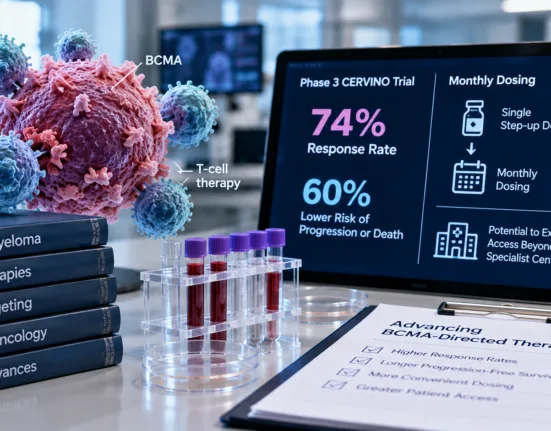
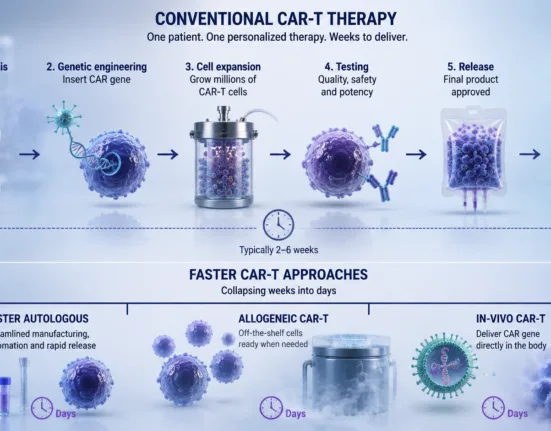
BCMA, or B cell maturation antigen, has for years been the dominant target in multiple myeloma, where agents such as belantamab mafodotin and bispecific antibodies from Johnson & Johnson and Pfizer have established commercial precedent. The extension of BCMA-directed therapy into autoimmune diseases is a newer and still largely unproven hypothesis, though one that has attracted substantial clinical and investor interest following observations that BCMA-expressing long-lived plasma cells are key drivers of pathogenic autoantibody production in diseases such as systemic lupus erythematosus, myasthenia gravis, and the two conditions targeted by gamgertamig. T cell engagers redirect a patient’s circulating T cells to eliminate these plasma cells without requiring ex vivo cell manufacturing, which is the central bottleneck for CAR-T therapies. That manufacturing distinction matters enormously for scalability and cost of goods and explains why several developers have pursued T cell engagers as the more commercially deployable sibling to CAR-T in this setting.
Gilead Sciences is not entering this space without an existing anchor. The U.S.-based biopharmaceutical company already holds axicabtagene ciloleucel and brexucabtagene autoleucel in its oncology CAR-T portfolio, both of which are approved for haematological malignancies. The acquisition of gamgertamig allows Gilead to extend the logic of B cell elimination into inflammatory indications while positioning the molecule alongside, rather than in direct competition with, its CAR-T assets. The press release framing explicitly makes this point, describing T cell engagers as complementary to CAR-T rather than substitutes, a strategic presentation that regulators and payers will scrutinise when reimbursement discussions eventually commence.
What the Phase 1/2 data shows and what it does not yet confirm
The clinical evidence supporting this transaction remains early-stage. Gamgertamig has shown what Gilead describes as transformative efficacy and a differentiated safety profile following a single treatment cycle in Phase 1/2 studies conducted in autoimmune haemolytic anaemia and immune thrombocytopenia. Both indications carry FDA Orphan Drug Designation and Fast Track Designation, which provides regulatory pathway advantages but does not accelerate the underlying evidentiary requirements for full approval. Registrational studies are not expected to begin until 2027, meaning investors and clinicians are being asked to price in a minimum of three to four years before a plausible approval, and longer before any meaningful commercial revenue. The Phase 1/2 designation also means the dataset is simultaneously assessing safety dose ranges and preliminary efficacy signals, which is standard for early development but does not constitute proof of superiority over existing standards of care.
The orphan disease context is clinically significant. Autoimmune haemolytic anaemia and immune thrombocytopenia are conditions where current management relies on corticosteroids, rituximab, intravenous immunoglobulin, and in some patients, splenectomy. These are not curative approaches and are associated with chronic immunosuppression, infection risk, and in refractory cases, significant morbidity. If gamgertamig can deliver durable remission after a limited subcutaneous treatment course without ongoing immunosuppression, the clinical and health economic proposition would be genuinely differentiated. That is precisely the promise underpinning the acquisition price. The risk is that this promise has not yet been tested at the scale and rigour of a randomised registrational trial.
How the Galapagos collaboration restructures financial exposure for Gilead
The tripartite structure of this deal deserves close attention. Gilead Sciences is acquiring Ouro Medicines outright but is simultaneously in advanced discussions to enter a cost-sharing collaboration with Galapagos NV, the Belgian biopharmaceutical company with which Gilead has had a long and periodically troubled relationship. Under the proposed arrangement, Galapagos would fund 50 per cent of the upfront consideration and 50 per cent of any contingent milestone payments. Galapagos would absorb Ouro’s operating assets and retain its employees, effectively becoming the development engine for the programme. Development costs through the initiation of registrational studies would sit entirely with Galapagos, after which costs would be shared equally. In return, Gilead retains sole worldwide commercialisation rights outside Greater China, where Keymed Biosciences holds pre-existing rights, and would pay Galapagos royalties in the range of 20 to 23 per cent of net sales.
For Gilead, this structure materially limits its near-term cash exposure. The company pays approximately $837.5 million of the upfront consideration and carries no development cost liability until registrational studies commence. For Galapagos, the arrangement offers a meaningful clinical asset and a development mission at a moment when the Belgian company has been under pressure to deploy its substantial cash reserves productively. The amended legacy agreement between Gilead and Galapagos also unlocks up to $500 million of Galapagos cash for general use, including up to $150 million for share repurchases, which suggests the negotiation addressed Galapagos shareholder concerns directly. Industry observers will note that this collaboration model, in which a larger strategic partner acquires an asset and immediately shares risk with a development-stage partner, has become an increasingly common tool for managing late-stage biotech valuations where upfront prices have been driven higher by competitive M&A dynamics.
Keymed Biosciences and Greater China rights complicate the global commercial story
A structural complication for the Gilead commercialisation thesis is the pre-existing in-licensing arrangement between Ouro Medicines and Keymed Biosciences, which owns the rights to develop and commercialise gamgertamig in Greater China. China represents one of the world’s largest untapped markets for autoimmune therapies, and its exclusion from Gilead’s commercial rights is not a trivial carve-out. Keymed Biosciences, a Chinese biopharmaceutical firm, retains development and commercial autonomy in a territory that regulators, pricing authorities, and clinical infrastructure treat as a distinct ecosystem. This means Gilead and Galapagos will prosecute the global development programme with limited visibility into what is happening in the Chinese trial programme, and without the benefit of aligned commercial incentives in that geography. Regulatory watchers suggest this kind of split rights structure can create complications at the level of data harmonisation, trial design consistency, and eventually label negotiation if different regulatory agencies reach different conclusions about the evidence package.
What Gilead’s inflammation build-out reveals about its longer-term strategy
This acquisition should be read alongside Gilead’s broader efforts to build a credible inflammation and autoimmune franchise. The company has historically derived the overwhelming majority of its revenue from its HIV and viral hepatitis portfolios, with oncology representing a growth engine via its Kite Pharma subsidiary. Inflammation has been the declared strategic priority for several years, but the pipeline has been thin relative to peers such as AbbVie, Janssen, and UCB, each of which holds multi-indication franchises with deep immunology expertise. Acquiring gamgertamig gives Gilead a molecule that, if the Phase 1/2 signals hold in registrational studies, would be genuinely first-in-class in its mechanism for autoimmune indications. That novelty is strategically valuable regardless of whether the orphan disease revenue opportunity is large, because a successful approval in AIHA and ITP provides the clinical and regulatory platform from which to investigate the same mechanism in larger indications such as lupus nephritis, anti-NMDA receptor encephalitis, and pemphigus vulgaris.
The strategic risk is that Gilead is paying a premium on very early data in a mechanism that has not yet been validated in a well-controlled late-stage trial in any autoimmune condition. The bispecific T cell engager landscape in autoimmunity includes a number of developers at varying stages of clinical maturity, and competitive dynamics over the next three to five years will be shaped by which programmes reach registrational readouts first and what those results show. A failed or inconclusive registrational trial for gamgertamig would not only impair the asset but would raise broader questions about the BCMA T cell engager hypothesis in autoimmunity, at which point Gilead’s $1.675 billion upfront would look exposed. Clinicians tracking the field will watch the 2027 registrational study designs closely, particularly the choice of endpoints, comparators, and patient selection criteria, as these decisions will determine whether the dataset is capable of supporting both approval and commercial differentiation.
Manufacturing and subcutaneous delivery as differentiators worth scrutinising
One of the more underappreciated dimensions of this deal is the subcutaneous delivery format for gamgertamig. Most currently approved T cell engager therapies in oncology require intravenous administration in a clinical setting, with step dosing to manage cytokine release syndrome. If gamgertamig can be delivered subcutaneously after a limited induction period, the administration burden for patients and the infrastructure requirements for health systems would be substantially lower than the inpatient or day infusion models required for CAR-T and most bispecifics. The early data suggest this is achievable, but the safety characterisation at registrational dose levels will be the critical determinant. Any requirement for inpatient monitoring or hospitalisation following subcutaneous dosing would erode the access advantage that the delivery format is intended to provide. Manufacturing scalability for bispecific T cell engagers is also a consideration that will only become relevant after approval, but which determines the pace of commercial uptake in a competitive market.