Abbott Laboratories has presented late-breaking Heart Rhythm Society 2026 data across its TactiFlex Duo Ablation Catheter, Volt PFA System, UltiSynq CSP implantable cardioverter-defibrillator lead and AVEIR CSP leadless pacemaker system, strengthening its position in atrial fibrillation ablation and conduction system pacing. The clinical update spans complex atrial fibrillation treatment, posterior wall ablation and investigational physiologic pacing technologies, placing Abbott’s electrophysiology portfolio at the centre of a fast-changing cardiac rhythm management market.
The more important point is not that Abbott Laboratories produced several positive clinical readouts in one conference cycle. It is that the medical technology manufacturer is trying to connect two of the most consequential shifts in rhythm care: the move from thermal ablation to pulsed field ablation and the move from conventional right ventricular pacing toward more physiologic conduction system pacing. Those shifts are still uneven in adoption, still shaped by physician learning curves and still dependent on long-term evidence, but they are becoming too important for large cardiovascular device companies to treat as isolated product categories.
Why Abbott’s HRS 2026 data could matter beyond a single atrial fibrillation device update
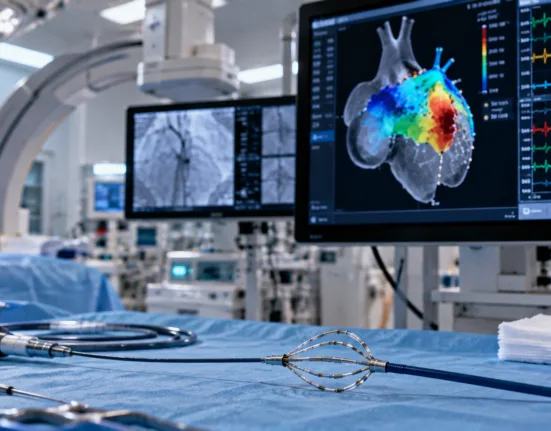
Abbott Laboratories’ six-month FlexPulse IDE results for the TactiFlex Duo Ablation Catheter are significant because they point toward a hybrid ablation strategy at a time when electrophysiologists are reassessing the balance between flexibility, safety and procedural efficiency. The catheter’s ability to support both radiofrequency energy and pulsed field ablation gives clinicians a broader toolset for complex atrial fibrillation cases, where patient anatomy, lesion durability and procedural planning can vary substantially.
The reported six-month data showed that 87 percent of patients were free from documented arrhythmias, while the study also reported a 98.3 percent safety profile and no major safety events. Just as importantly from an adoption standpoint, 93.3 percent of patients were treated exclusively with pulsed field ablation, suggesting that the non-thermal energy modality may be capable of carrying more of the procedural workload even in complex cases. That matters because pulsed field ablation has been attracting clinical interest partly due to its tissue-selective mechanism, which may reduce collateral tissue injury risks compared with some thermal approaches.
The limitation is that six-month follow-up is still early in a condition where recurrence risk, repeat procedures and real-world patient selection can shape clinical perception over time. Atrial fibrillation is a chronic, heterogeneous disorder, and short-term freedom from documented arrhythmia does not fully settle questions around durability, late recurrence, operator variability or outcomes in broader commercial practice. For Abbott Laboratories, the FlexPulse IDE data create a stronger regulatory and clinical argument, but the market will still look for longer follow-up and head-to-head practical differentiation against other pulsed field ablation platforms.
How pulsed field ablation is changing the competitive logic of atrial fibrillation treatment
The Volt PFA System data add a second layer to Abbott Laboratories’ atrial fibrillation strategy because they address posterior wall ablation, an area that has drawn interest in more advanced or persistent atrial fibrillation cases. The new six-month data from the Volt CE Mark Extension Cohort indicated positive outcomes where physicians treated the posterior wall in addition to standard treatment, with no reported patient or procedure-related complications in the dataset.
The procedural efficiency signal is also commercially relevant. Physicians cited ease of use and intuitive design, while treatment required an average of 4.1 applications per vein and 10.7 per posterior wall isolation. In electrophysiology labs, device adoption often depends not only on clinical efficacy but also on workflow impact, learning curve, procedure time, staff familiarity and confidence in reproducible lesion formation. A device that appears clinically credible but slows the lab may struggle to scale; a device that reduces procedural friction can become more attractive if durability is proven.
The unresolved question is whether posterior wall ablation with pulsed field technology will become a broadly adopted standard in selected atrial fibrillation populations or remain a physician-dependent strategy in complex cases. Clinical practice in atrial fibrillation ablation is not monolithic, and procedure design varies across centres. Abbott Laboratories has an opportunity to position Volt as part of a wider electrophysiology platform, but reimbursement, training, patient selection and comparative evidence will determine whether the data translate into routine use.
Why conduction system pacing could become Abbott’s next major rhythm care battleground
Abbott Laboratories’ conduction system pacing data may be just as strategically important as the pulsed field ablation update because they speak to a deeper change in cardiac rhythm management. Conventional pacing has historically saved lives and managed bradyarrhythmias effectively, but long-term right ventricular pacing can create non-physiologic activation patterns in some patients. Conduction system pacing, particularly left bundle branch area pacing, aims to more closely replicate the heart’s natural electrical pathways.
The ASCEND CSP IDE trial for Abbott Laboratories’ investigational UltiSynq CSP implantable cardioverter-defibrillator lead reported that the study met its pre-specified primary safety and effectiveness endpoints at three months. The data included a 97.5 percent safety profile, no lead-related major safety events, 99 percent success in meeting left bundle branch area pacing criteria and 100 percent defibrillation success. The defibrillation component is especially important because extending physiologic pacing into patients who also need implantable cardioverter-defibrillator protection could widen the clinical role of conduction system pacing beyond conventional pacemaker use cases.
The risk is that early technical success does not automatically create broad clinical adoption. Implanting leads in the conduction system can be more technically demanding than traditional approaches, and physicians will assess not only acute success rates but also lead stability, threshold performance, extraction considerations, defibrillation reliability and long-term complication rates. Abbott Laboratories has generated encouraging early data, but conduction system pacing still needs broader longitudinal evidence to become a default strategy in more ICD-eligible populations.
What the AVEIR CSP leadless pacemaker data reveal about Abbott’s long-term platform ambition
The first-in-human evaluation of the investigational AVEIR CSP leadless pacemaker system adds a different strategic dimension. Leadless pacing has already changed expectations around device size, pocket-related complications and transvenous lead burden. Combining leadless pacing with conduction system pacing points toward a more ambitious future: delivering physiologic activation without the conventional lead and pocket architecture that has defined pacemaker therapy for decades.
The one-month data from the 19-patient LEAP2 chronic early feasibility trial showed high implantation success, reliable electrical performance, functioning through the first month of follow-up and consistent communication between devices in a dual-chamber pacemaker setting. That is not yet a commercial-scale dataset, but it is a meaningful technical proof point. If leadless conduction system pacing can mature clinically, it could reshape expectations for patients who need pacing but may benefit from less invasive device architecture and more physiologic activation.
The obvious limitation is scale. A 19-patient first-in-human study is designed to test feasibility, not to answer definitive questions on safety, durability, broad physician adoption or long-term outcomes. Leadless systems must also prove reliability over time, especially where retrieval, battery longevity, device-device communication and patient eligibility are involved. Abbott Laboratories appears to be building a future-facing pacing platform, but the strongest commercial case will depend on whether larger studies confirm that the technology can be implanted consistently and deliver durable physiological benefit.
How Abbott’s electrophysiology strategy compares with the broader medtech shift toward integrated cardiac platforms
The Abbott Laboratories update sits within a wider medical device trend: large cardiovascular companies are no longer competing through single devices alone. They are increasingly competing through ecosystems that combine mapping, ablation, pacing, implantable devices, diagnostics and clinical workflow support. In that context, Abbott Laboratories’ HRS 2026 data are less about four isolated trials and more about whether the medical technology manufacturer can build a connected rhythm care platform around atrial fibrillation and pacing innovation.
This matters because electrophysiology is becoming a higher-value segment within cardiovascular devices. Atrial fibrillation prevalence continues to rise with aging populations, while hospitals and electrophysiology labs face pressure to treat more patients efficiently. At the same time, clinicians want tools that can improve safety, reduce repeat procedures and better match therapy to disease complexity. Pulsed field ablation, hybrid ablation catheters, physiologic pacing leads and leadless systems all sit within that demand curve.
However, platform ambition brings platform risk. If products remain investigational in major markets, adoption timing can be slow. If training requirements are steep, early enthusiasm may not translate into mass procedural uptake. If reimbursement does not reflect the value of newer approaches, hospitals may be cautious. For Abbott Laboratories, the competitive challenge will be to show that its rhythm care technologies are not merely clinically interesting, but operationally usable, economically rational and durable in real-world practice.
Why regulatory timing and evidence durability remain central to Abbott’s rhythm care opportunity
Regulatory status remains a key dividing line across Abbott Laboratories’ portfolio. The Volt PFA System has already secured regulatory approvals in the United States and Europe, while TactiFlex Duo has received CE Mark in Europe and is being studied for U.S. Food and Drug Administration approval. The investigational UltiSynq CSP implantable cardioverter-defibrillator lead and AVEIR CSP leadless pacemaker system remain earlier-stage technologies, making their commercial timelines more uncertain.
This creates a layered opportunity. Products with existing approvals can support near-term commercial activity, physician training and market education. Investigational products can shape the longer-term narrative around Abbott Laboratories as a rhythm care innovator, especially if they address unmet needs in physiologic pacing and device architecture. The combination gives Abbott Laboratories both present-market relevance and future pipeline optionality.
The risk is that investors and clinicians may interpret early clinical signals too aggressively. A strong conference cycle can improve perception, but regulatory review, post-market evidence and real-world utilisation often decide the true trajectory. In cardiac rhythm management, trust is built slowly because device performance is judged over years, not weeks. Abbott Laboratories has delivered meaningful evidence, but the next phase will require durability, consistency and clarity across broader patient populations.
What clinicians and industry observers are likely to watch after Abbott’s HRS 2026 update
Clinicians tracking Abbott Laboratories’ rhythm portfolio are likely to focus on three areas after HRS 2026. The first is whether the TactiFlex Duo Ablation Catheter can maintain strong outcomes at longer follow-up and secure U.S. regulatory clearance. The second is whether the Volt PFA System can show reproducible procedural efficiency and safety across varied electrophysiology lab settings. The third is whether conduction system pacing technologies can move from promising early studies into larger datasets that demonstrate long-term lead performance, pacing stability and clinical benefit.
Industry observers will also watch whether Abbott Laboratories can use these technologies to strengthen its competitive position against other major cardiovascular device manufacturers investing heavily in atrial fibrillation and cardiac rhythm management. The pulsed field ablation market is becoming crowded, and early differentiation may narrow as more systems generate clinical evidence. Abbott Laboratories may therefore need to compete not only on safety and efficacy, but on usability, procedural efficiency, portfolio integration and physician confidence.
The HRS 2026 data give Abbott Laboratories a stronger story in both ablation and pacing. The harder test begins now. In electrophysiology, innovation only wins when it becomes dependable in everyday clinical workflow. Abbott Laboratories has shown that its next-generation rhythm technologies can produce encouraging early results. The real question is whether those results can mature into a durable platform advantage in one of the fastest-moving corners of cardiovascular medtech.