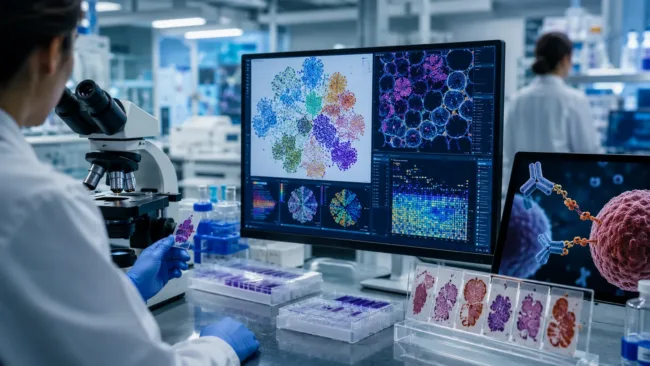
Daiichi Sankyo Company Limited has entered a collaboration with Waiv, formerly Owkin Dx, to use Waiv’s digital pathology platform for biomarker discovery in an antibody-drug conjugate program. The partnership will apply artificial intelligence to early-phase pathology and clinical data, with the aim of identifying treatment-response biomarkers before the next clinical trial phases.
Why Daiichi Sankyo’s Waiv collaboration matters for ADC development beyond one program
The collaboration matters because it targets a pressure point that has become increasingly visible across antibody-drug conjugate development: identifying who is most likely to respond before larger, more expensive trials begin. ADCs have moved from a niche oncology modality into one of the most closely watched areas of cancer drug development, but their clinical promise still depends heavily on patient selection, tumor biology, target expression, payload behavior, resistance mechanisms, and tolerability. A drug can look scientifically compelling and still struggle commercially or clinically if trial populations are too broad or if the biomarker strategy fails to distinguish likely responders from patients unlikely to benefit.
For Daiichi Sankyo Company Limited, this is not a symbolic technology partnership. The Japanese pharmaceutical group has already built substantial visibility in oncology through its ADC strategy, including deruxtecan-based assets and collaborations with global partners. Bringing Waiv into an ADC biomarker discovery program suggests that the next phase of competition is not only about the antibody, linker, payload, or target. It is also about whether developers can interpret tissue data more precisely, especially in early clinical settings where sample sizes are often limited and conventional biomarker discovery may lack statistical confidence.
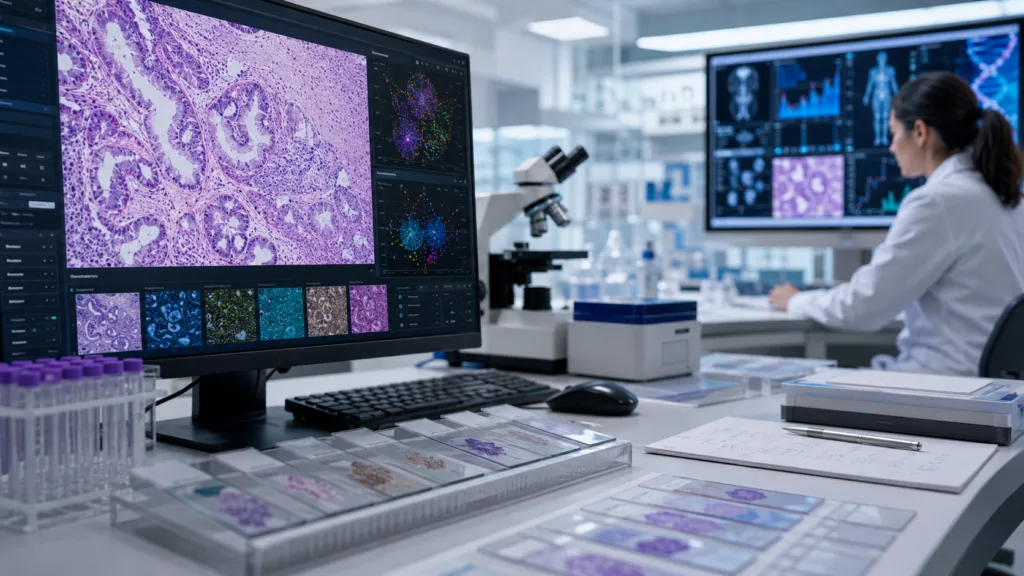
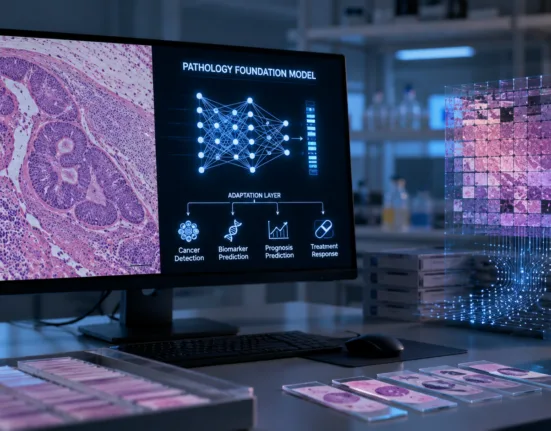
Waiv’s role is notable because the Paris-based diagnostics-focused firm is positioned around computational pathology rather than a single molecular assay. Its platform is intended to analyze whole slide images from hematoxylin and eosin stained samples and immunohistochemistry stained samples, while also incorporating tumor microenvironment analysis and outcome prediction. In practical terms, this means the partnership is trying to extract clinically meaningful signals from pathology material that is already central to oncology workflows, rather than relying only on more specialized or costly testing layers. The unresolved question is whether AI-derived patterns can become sufficiently reproducible, interpretable, and clinically validated to influence trial design or eventual companion diagnostic strategy.
How AI pathology could change early ADC biomarker discovery in small trial populations
The most interesting feature of the Daiichi Sankyo and Waiv partnership is its focus on data-constrained settings. Early-phase oncology studies often include fewer than 100 patients, especially in biomarker-enriched or heavily pretreated cancer populations. That creates a fundamental challenge for ADC developers. The signal from a Phase 1 or early Phase 2 cohort may be encouraging, but the dataset may still be too small to confidently identify which biological features truly predict response. If a later trial is designed around weak or incomplete biomarker assumptions, the development program can face avoidable risk.
AI pathology platforms are being explored because they may detect spatial and morphological signals that are difficult for standard manual review to capture at scale. These could include patterns in tumor architecture, immune-cell distribution, stromal context, heterogeneity of target expression, or other features embedded in routine pathology images. For ADCs, that matters because response is rarely determined by target positivity alone. Payload sensitivity, antigen density, internalization dynamics, local immune context, and tumor microenvironment factors can all influence whether an ADC produces durable benefit.
However, this is also where the risk sits. AI-derived biomarkers can be powerful discovery tools, but they must clear a high evidentiary bar before they can influence clinical decisions. A model that performs well retrospectively on a small dataset may not generalize across tumor types, tissue preparation practices, scanner systems, geographies, or trial populations. For regulators and clinicians, the critical issue will not be whether Waiv can identify a pattern. It will be whether that pattern remains stable, explainable, and clinically useful when tested prospectively or across external datasets.
What this reveals about Daiichi Sankyo’s broader ADC strategy and pipeline risk management
Daiichi Sankyo Company Limited’s ADC strategy has already made it one of the most closely watched oncology companies in the sector. The company’s approach has been built around improving targeted drug delivery through antibodies, cytotoxic payloads, and linker technologies designed to deliver cancer-killing agents more selectively to tumor cells. That has helped ADCs become one of the most commercially attractive areas in oncology, but it has also raised the bar for differentiation. With multiple ADC developers pursuing overlapping tumor types and targets, better biomarker selection could become a competitive advantage.
The Waiv collaboration can therefore be read as a risk-management move as much as a discovery initiative. In ADC development, late-stage disappointment can come from multiple directions. A trial may show progression-free survival benefit without enough overall survival support. A target may be present but insufficiently predictive. Toxicity may narrow the usable patient population. Manufacturing and dosing considerations may complicate adoption. Biomarkers cannot solve all of those issues, but they can improve the probability that later-stage trials are built around patients most likely to demonstrate clinically meaningful benefit.
The commercial significance is also clear. ADCs are expensive and complex therapies, and payers are likely to scrutinize incremental benefit as more products enter oncology markets. If AI-derived biomarkers can support sharper trial enrichment or eventual patient stratification, they could help companies defend pricing, improve trial efficiency, and reduce exposure to broad, noisy study populations. The limitation is that biomarker discovery does not automatically translate into a deployable diagnostic. A research-grade signal must still move through assay development, validation, regulatory review, clinical utility evidence, and adoption in real-world pathology workflows.
Why pathology-based biomarkers may complement rather than replace molecular testing in ADC trials
The Daiichi Sankyo and Waiv partnership also highlights a broader shift in precision oncology. For years, biomarker strategies have leaned heavily on genomic alterations, protein expression, or single-marker immunohistochemistry. Those tools remain essential, but they can miss the complexity of how a tumor behaves as a spatial biological system. ADC response may depend not only on whether a target is present, but also on where it is expressed, how heterogeneous that expression is, how the tumor microenvironment shapes drug activity, and whether resistant subclones are likely to dominate after treatment pressure.
Computational pathology could complement molecular testing by adding a tissue-level layer of interpretation. In an ADC program, that might help developers distinguish between patients with superficially similar biomarker profiles but different response probabilities. It could also help identify previously overlooked histopathological features that correlate with outcomes. For clinicians, such tools would be most useful if they provide actionable information without adding excessive complexity to diagnostic workflows.
The adoption challenge is substantial. Pathology laboratories vary in digital maturity, scanner infrastructure, data standards, and comfort with AI-assisted decision support. Even if a biomarker is scientifically compelling, clinical adoption will depend on workflow integration, turnaround time, reimbursement clarity, and confidence among pathologists and oncologists. Regulatory reviewers are also likely to ask how model performance is monitored over time, how bias is controlled, and how outputs are translated into trial or treatment decisions.
What clinicians, regulators, and industry observers will watch next in the Waiv collaboration
The next set of meaningful signals will come from how the collaboration progresses from discovery to validation. Industry observers will watch whether Waiv’s platform identifies candidate biomarkers that are biologically plausible, reproducible across sample types, and useful enough to influence patient stratification in future trial phases. A purely exploratory output would still be useful internally, but the higher-value outcome would be a biomarker path that can inform trial design, endpoint interpretation, or companion diagnostic planning.
Clinicians tracking the ADC field will likely focus on whether the AI-derived signals improve practical decision-making. A biomarker that only works in a narrow retrospective dataset may not change practice. A biomarker that helps identify responders earlier, reduces unnecessary exposure to toxicity, or supports rational sequencing of ADCs could have greater clinical relevance. This is especially important as oncology increasingly faces questions about how to sequence targeted therapies, immunotherapies, chemotherapy, and ADCs across lines of treatment.
Regulatory watchers will focus on evidence standards. If AI pathology is used only for discovery, the immediate regulatory implications may be limited. If the outputs later influence eligibility criteria, stratification, or companion diagnostic development, the bar rises quickly. Model transparency, locked algorithms, validation cohorts, analytical performance, clinical performance, and quality systems will become central. Waiv’s previous positioning around AI precision testing may help, but each ADC use case will still need its own evidence package.
For investors, the collaboration is unlikely to move Daiichi Sankyo Company Limited shares on its own, but it supports the longer-term thesis that the group is deepening the infrastructure around ADC development rather than relying only on asset-by-asset momentum. Daiichi Sankyo’s Tokyo-listed shares closed at 2,596 yen on May 8, 2026, down 0.15 percent for the session, while market data showed a strong year-to-date rebound. The stock sentiment remains tied to broader oncology expectations, manufacturing execution, regulatory outcomes, and the durability of ADC pipeline performance. In that context, the Waiv deal is less a headline catalyst and more a strategic capability signal.
The core takeaway is that Daiichi Sankyo Company Limited is treating biomarker discovery as a central ADC development challenge, not as a downstream diagnostic afterthought. Waiv’s computational pathology platform could help identify treatment-response signals earlier, especially where trial datasets are small and conventional biomarker approaches may be underpowered. The opportunity is meaningful, but the burden of proof remains high. For the collaboration to matter beyond discovery, its outputs will need to survive validation, regulatory scrutiny, and the practical realities of oncology diagnostics.