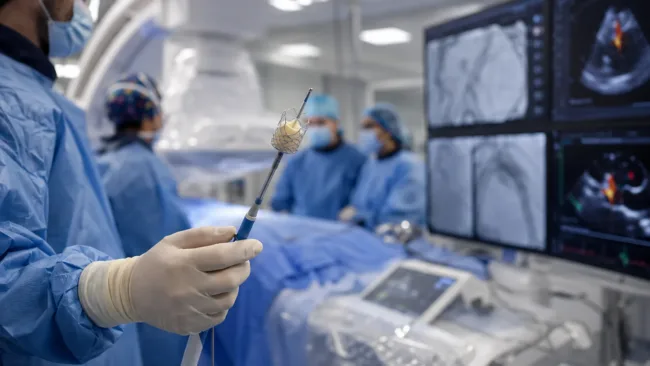
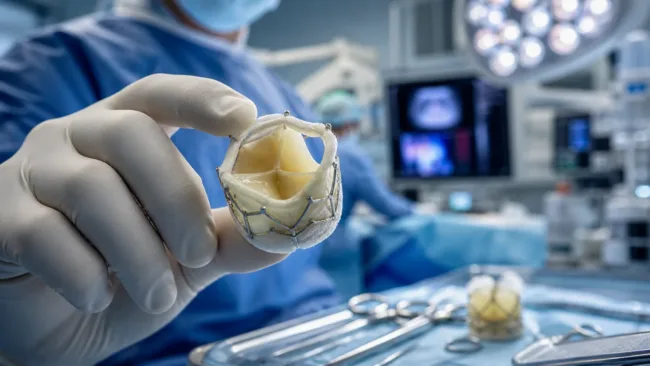
Corvention has received U.S. Food and Drug Administration 510(k) clearance for the KardiaPSI Balloon Catheter, a structural heart device indicated for balloon aortic valvuloplasty in stenotic aortic valves. The clearance gives the Flagstaff, Arizona-based medical device manufacturer a U.S. regulatory pathway into a specialized interventional cardiology segment where calcified valve anatomy continues to challenge procedural precision, device stability, and predictable dilation.
Why Corvention’s FDA-cleared KardiaPSI Balloon Catheter matters for calcified aortic valve procedures
The significance of the KardiaPSI Balloon Catheter clearance is not that balloon aortic valvuloplasty is new. It is not. The more important issue is that Corvention is positioning the device around a specific procedural pain point: how to apply sufficient dilation force in heavily calcified aortic valve anatomy without sacrificing control. That distinction matters because structural heart intervention has become increasingly dependent on procedural planning, controlled device behavior, and the ability to manage high-risk anatomy with tools that do not merely reach the lesion but perform predictably once they get there.
KardiaPSI is designed with an ultra high-pressure profile, including a 24 atm rated burst pressure and a short 2.5 cm working length. In practical terms, Corvention is not trying to compete as a generic valvuloplasty balloon supplier. It is attempting to create a more targeted tool for operators who need controlled, forceful dilation in stenotic and calcified aortic valves. That could be relevant in cases where conventional balloons may struggle to deliver the combination of radial force, sizing precision, and footprint control that physicians want during complex valve preparation or standalone balloon aortic valvuloplasty.
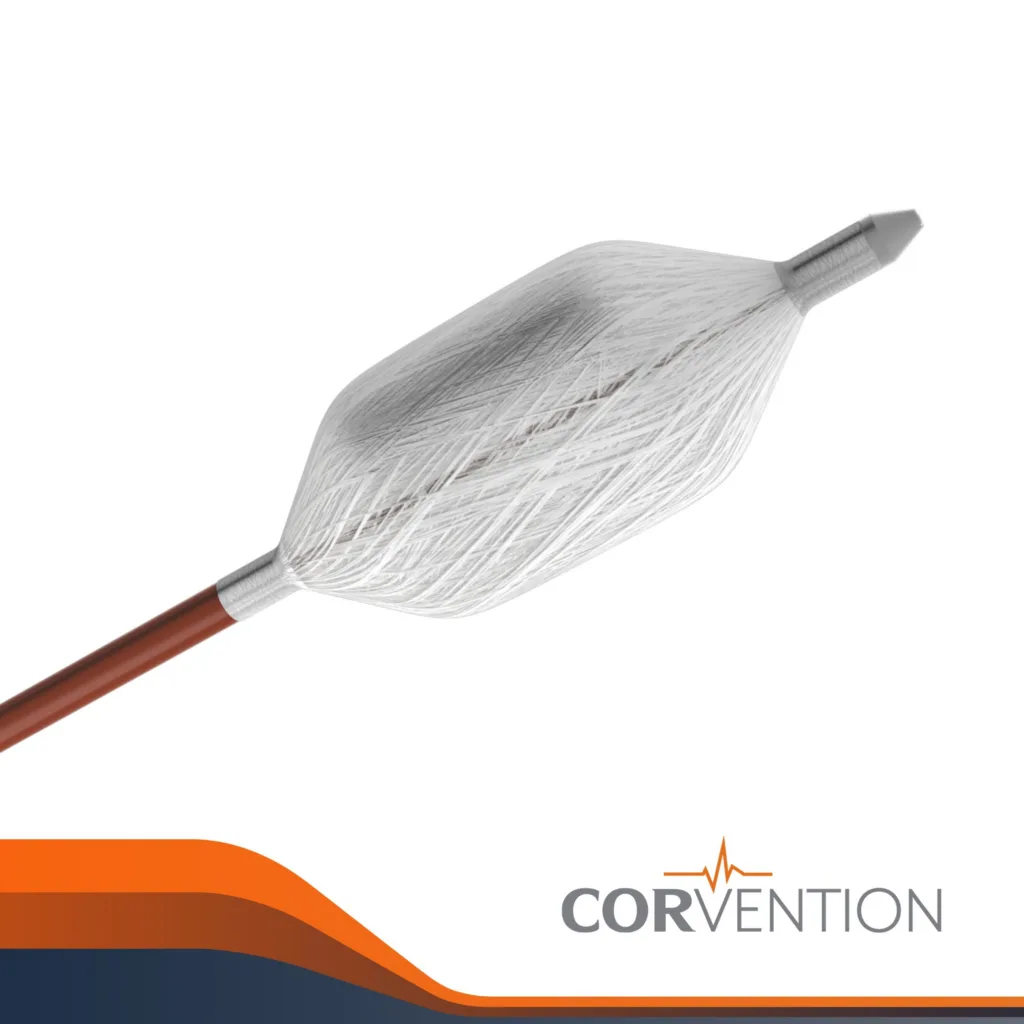
The unresolved question is whether the device’s engineering advantages translate into routine clinical preference. FDA 510(k) clearance establishes substantial equivalence for market entry, but it does not by itself prove superior outcomes, lower complication rates, or broad procedural adoption. For Corvention, the commercial test begins after clearance, when interventionalists evaluate whether the device is meaningfully different in real-world cases, whether the learning curve is manageable, and whether cath lab procurement teams see enough value to add another specialized balloon platform to inventory.
How the 24 atm design changes the conversation around balloon aortic valvuloplasty tools
The 24 atm pressure capability is central to Corvention’s commercial argument because calcified valve anatomy often creates a mismatch between the force required to modify tissue and the control required to avoid unwanted procedural effects. A high-pressure balloon is useful only if the operator can deploy that force with confidence. Corvention’s emphasis on controlled expansion and a compact working segment suggests that the device has been built for situations where excessive balloon length or imprecise interaction with adjacent structures may be undesirable.
This is where the KardiaPSI Balloon Catheter appears to be more than an incremental pressure upgrade. The short working length may help physicians concentrate treatment at the intended zone, while the ability to adjust treatment millimeter by millimeter could support more deliberate sizing decisions. In structural heart intervention, that combination of mechanical force and anatomical precision is commercially important because device choice is rarely based on one metric alone. Operators tend to care about deliverability, inflation behavior, procedural stability, deflation time, visibility, reproducibility, and how confidently the device behaves under stress.
However, high-pressure performance also invites scrutiny. Clinicians and hospital value committees will want to know where the device fits, which patient anatomies benefit most, and whether its use changes procedural time, complication profiles, or downstream treatment options. In a field shaped by transcatheter aortic valve replacement, balloon aortic valvuloplasty is often viewed through a practical lens rather than a glamour lens. The question is not whether a high-pressure BAV balloon is impressive on paper. The question is whether it solves enough real procedural friction to become a repeat-use tool in busy structural heart programs.
Why a phased commercial rollout may be as important as the regulatory clearance itself
Corvention’s decision to begin with a controlled, phased market introduction is strategically sensible. In specialized interventional device markets, early adoption depends heavily on physician training, case support, clinical confidence, and disciplined site selection. A national launch without adequate field support can create inconsistent first impressions, especially when a device is designed for complex anatomy rather than routine commodity use.
A high-touch rollout also signals that Corvention understands the realities of structural heart commercialization. Physicians adopting a new balloon platform may want case-by-case support, especially when the device is marketed around high-pressure performance and precise control. Hospitals, meanwhile, may ask whether the technology justifies shelf space, training time, and purchasing attention. The early commercial phase will likely be shaped by centers that already perform meaningful volumes of balloon aortic valvuloplasty, complex aortic valve interventions, or TAVR-adjacent procedures.
The risk is that phased commercialization can also slow visibility. For an emerging medical device manufacturer, careful rollout protects clinical execution but may limit early revenue momentum. Corvention will need to balance responsible adoption with enough commercial traction to prove that KardiaPSI is not merely a clever niche device but a scalable structural heart platform. That balance is often harder than the regulatory milestone itself.
What the clearance reveals about specialization in structural heart device innovation
The KardiaPSI Balloon Catheter clearance fits a broader pattern in structural heart innovation: device development is moving from broad procedural access toward narrower tools built around specific anatomical and mechanical challenges. As TAVR and other catheter-based interventions mature, the market increasingly rewards devices that solve targeted workflow problems rather than devices that simply replicate existing categories.
That creates an opening for companies such as Corvention. Large cardiovascular device manufacturers dominate many parts of the structural heart ecosystem, but smaller device developers can still gain relevance by addressing overlooked friction points. In this case, the friction point is not whether balloon aortic valvuloplasty can be performed. It is whether operators can perform it with better control in calcified anatomy that resists predictable dilation.
Still, specialization has a ceiling unless it is backed by evidence, usability, and repeatable demand. A device built for challenging cases may become highly valued among expert operators, but broader adoption depends on whether the use case appears frequently enough to justify routine availability. Corvention’s next task is to define the clinical and commercial sweet spot clearly: which procedures, which anatomies, which centers, and which physician profiles should drive early adoption.
Why balloon aortic valvuloplasty still has strategic relevance in the TAVR era
Balloon aortic valvuloplasty may no longer occupy the same central role it once did before the rise of transcatheter aortic valve replacement, but it remains clinically relevant. It can be used in selected cases for valve preparation, temporary symptom relief, bridge strategies, or hemodynamic assessment in high-risk patients. That continued relevance creates room for device refinement, particularly when the patient population involves advanced calcification, frailty, complex anatomy, or procedural uncertainty.
For Corvention, this means the commercial opportunity is not necessarily about replacing an entire category. It is about upgrading the toolset in situations where conventional options may be suboptimal. If KardiaPSI can demonstrate that its pressure profile and short balloon geometry help physicians achieve more controlled dilation, it could find a role in centers that already value precision tools for structural heart planning and execution.
The limitation is that the market will likely demand more than engineering claims. Physicians may want clinical experience, registry data, procedural comparisons, and practical feedback from early users. Hospital buyers may also evaluate whether the device reduces complications, improves procedural efficiency, or supports better case completion in difficult anatomy. Without those proof points, even technically differentiated devices can remain confined to enthusiastic early adopters.
What clinicians, regulators, and industry observers will watch after KardiaPSI’s clearance
The next phase for Corvention will be defined by commercialization quality, not announcement volume. Clinicians will watch how the KardiaPSI Balloon Catheter performs in real cases involving heavily calcified stenotic aortic valves. Regulators have cleared the device for its indicated use, but the medical community will look for evidence that its design features produce consistent procedural value. Industry observers will watch whether Corvention can convert a focused technical clearance into a defensible structural heart business.
The most important early signals will likely include adoption by high-volume structural heart centers, feedback from operators using the device in complex cases, and the degree to which Corvention can build training and commercial support infrastructure without overextending. If the phased launch is executed well, the KardiaPSI Balloon Catheter could become a credible example of how smaller medtech companies can still carve out meaningful positions inside mature interventional markets.
The bigger takeaway is that structural heart innovation is not only about flagship implants or breakthrough replacement technologies. Sometimes the market shifts through better procedural tools that make difficult cases more manageable. Corvention’s FDA-cleared KardiaPSI Balloon Catheter now has an opening to test that thesis in U.S. clinical practice. The clearance gets the device onto the field. The harder game begins with adoption, evidence, and trust.