DermaSensor has received a Class IIb CE Mark for the DermaSensor device, enabling commercialization across the European Economic Area for its artificial intelligence and spectroscopy-based skin lesion assessment technology. The Miami-based medical device manufacturer has also announced a feasibility study with the National Health Service to evaluate AI-assisted skin cancer assessment by general practitioners, placing the device at the intersection of European market access, primary care triage, and dermatology capacity pressures.
Why does DermaSensor’s CE Mark matter for Europe’s primary care skin cancer pathway?
The strategic importance of the CE Mark is that DermaSensor is moving beyond a United States commercialization story and into a European healthcare environment where dermatology access, cancer waiting times, and primary care workload are deeply connected. The device is designed to help qualified healthcare professionals assess suspicious skin lesions and inform whether further clinical care, such as dermatology referral or biopsy, may be needed. That positions DermaSensor less as a replacement for dermatologists and more as a frontline decision-support tool for clinicians who are often the first point of contact for patients with changing or concerning lesions.
The context matters because skin cancer pathways are under growing strain. Melanoma, basal cell carcinoma, and squamous cell carcinoma are common, and suspected skin cancer referrals can place heavy demand on specialist services. In that setting, a non-invasive tool that gives primary care clinicians an additional objective signal could be attractive to health systems trying to separate higher-risk lesions from lower-risk cases more consistently. The appeal is not only clinical. It is operational, because better risk stratification could theoretically improve referral quality, reduce avoidable specialist burden, and direct dermatology resources toward patients most likely to need urgent review.
The risk is that the CE Mark is a gateway, not an adoption guarantee. European commercialization will still depend on country-by-country procurement, clinician confidence, reimbursement mechanics, data governance, local clinical guidelines, training, and post-market evidence. A device can be authorized and still struggle if health systems do not see a clear workflow benefit. For DermaSensor, the bigger test will be whether the technology can prove that it supports better triage without creating over-referral, false reassurance, or another layer of administrative complexity for already pressured general practitioners.
What makes the DermaSensor authorization more than a routine device expansion?
The genuinely new element is the Class IIb CE Mark, which allows DermaSensor to pursue commercial access in the European Economic Area and gives the medical device manufacturer a formal route into markets that recognize CE Mark standards. That expands the company’s regulatory footprint beyond its earlier United States De Novo authorization, where the device was classified as a Class II software-aided adjunctive diagnostic device for suspicious skin lesions. The European move is therefore not simply geographic. It tests whether an AI-enabled skin cancer assessment tool can be positioned across different healthcare systems with different referral rules, payment models, and levels of primary care responsibility.
The incremental element is that DermaSensor is not introducing a wholly unfamiliar clinical concept. Clinicians already use visual inspection, dermoscopy, biopsy, and referral pathways to manage suspicious skin lesions. The device adds elastic scattering spectroscopy and an algorithmic assessment layer to that process. Its value proposition is strongest where non-dermatology clinicians need support in deciding whether a suspicious lesion should be escalated. That makes DermaSensor a triage-adjunct device rather than a definitive diagnostic authority.
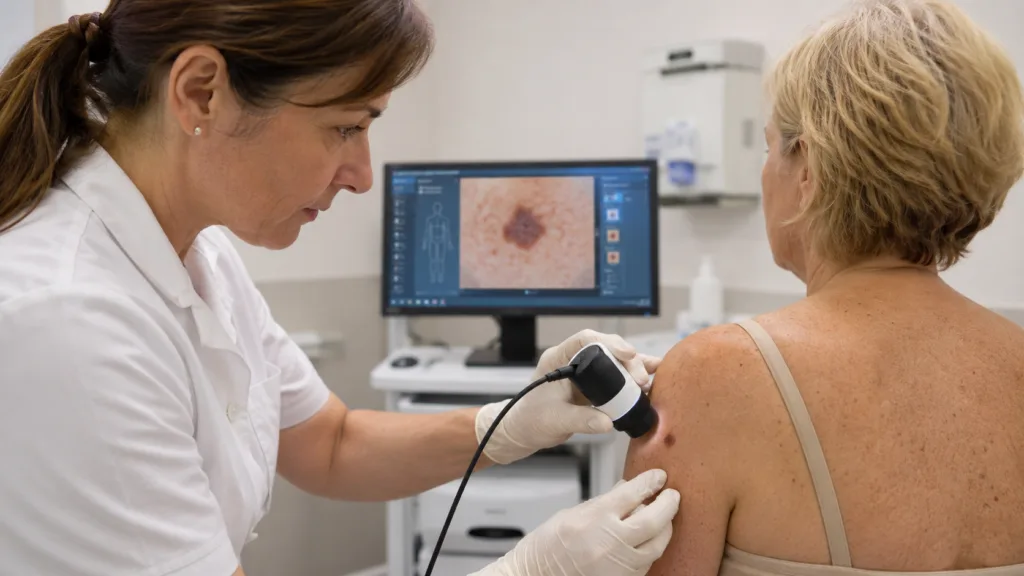
That distinction will shape adoption. A tool that assists referral decisions may be easier to integrate than a device claiming to diagnose cancer independently, because it preserves clinical judgment and specialist confirmation. However, the same limited positioning can also constrain perceived value. If clinicians and payers view the output as only one more piece of information, DermaSensor will need to show that this information changes decisions in a measurable and economically useful way. The device’s future in Europe may depend less on the headline of AI-assisted skin cancer detection and more on whether it can improve the day-to-day mechanics of referral decision-making.
How could the NHS feasibility study shape confidence in AI-assisted skin cancer assessment?
The announced NHS feasibility study may become the more important signal for European adoption because it shifts the story from regulatory access to real-world health system evaluation. The study is expected to assess the impact of AI-assisted skin cancer assessment when used by general practitioners in an NHS setting. That matters because the NHS has a large, structured primary care system, significant dermatology demand, and strong scrutiny around whether digital health tools actually improve capacity, access, and outcomes.
The clinical logic is clear. General practitioners routinely encounter suspicious lesions but are not dermatology specialists. A point-of-care device that provides an additional objective signal could help clinicians decide whether a patient needs urgent dermatology review, routine referral, monitoring, or another management route. In theory, that could reduce missed high-risk lesions while helping dermatology services focus on patients with stronger indications for specialist evaluation.
The unresolved question is whether the technology improves system performance without shifting risk elsewhere. If an AI-assisted tool increases referrals because clinicians become more cautious, the dermatology bottleneck could worsen. If it reduces referrals too aggressively, health systems will worry about missed malignancies. If it requires too much time during appointments, general practitioners may struggle to incorporate it into routine consultations. The NHS feasibility work will therefore need to answer practical questions around clinician usability, referral behavior, patient throughput, documentation, training burden, and safety governance, not only device accuracy.
Why does DermaSensor’s primary care positioning carry both commercial promise and clinical caution?
DermaSensor’s central commercial opportunity lies in moving skin cancer assessment closer to the first clinical encounter. Dermatology capacity is limited in many markets, and primary care physicians often serve as the triage layer between patient concern and specialist evaluation. A handheld device that can assess suspicious lesions in seconds gives healthcare systems a potential tool for earlier and more consistent risk assessment, especially in regions where specialist access is uneven.
That positioning is commercially attractive because it expands the addressable user base beyond dermatologists. If primary care practices, urgent care clinics, occupational health providers, and integrated health systems can use the device safely and efficiently, DermaSensor could build a broader market than a specialist-only dermatology tool. The model also fits a wider industry trend in which AI diagnostics are being pushed toward decentralized care settings, where earlier decisions can influence downstream cost and capacity.
The caution is that primary care is exactly where diagnostic support tools face the toughest implementation burden. General practitioners must manage multiple conditions in short visits, and a skin lesion assessment tool will compete with time pressures, patient expectations, clinical uncertainty, and medico-legal concerns. The device is intended to assist evaluation of suspicious lesions, not to replace full clinical assessment or confirm a diagnosis. That boundary must remain clear. The danger for any AI device in this category is either overtrust, where clinicians defer too heavily to an algorithmic result, or underuse, where the device is treated as an optional gadget rather than a structured clinical tool.
What does the United States regulatory history reveal about the device’s strengths and limits?
DermaSensor’s United States authorization provides useful context for interpreting the European expansion. The FDA authorized the device through the De Novo pathway as a Class II prescription device for physicians who are not dermatologists. In the United States indication, the device is used to evaluate lesions suggestive of melanoma, basal cell carcinoma, or squamous cell carcinoma in patients aged 40 and above, as an adjunct to clinical assessment and referral decision-making. It is not intended as a screening tool, a standalone diagnostic criterion, or a device to confirm cancer.
That regulatory framing is important because it draws a hard line between decision support and diagnosis. The device may help clinicians decide which suspicious lesions merit further investigation, but it does not remove the need for clinical judgment, biopsy where appropriate, or specialist review. From a health system perspective, that makes DermaSensor potentially useful but also dependent on careful pathway design. It is not enough for the device to produce a result. The health system must define what clinicians should do with that result.
The limitation is that regulatory authorization does not settle questions of comparative effectiveness in every care setting. A device may perform well under study conditions but face variability in routine practice because of user training, lesion selection, skin tone diversity, lighting, workflow discipline, and clinician interpretation. European health systems will likely look for evidence that the device performs consistently across population groups and clinical environments. In AI diagnostics, credibility is built not only by clearance, but by transparent performance, post-market learning, and evidence that the tool behaves reliably outside controlled study settings.
How does DermaSensor compare with existing skin cancer assessment approaches?
DermaSensor enters a diagnostic workflow that already includes visual inspection, dermoscopy, clinical history, dermatology referral, and biopsy. The device’s differentiator is that it uses spectroscopy and artificial intelligence to evaluate optical characteristics of suspicious lesions, producing a point-of-care output that can support referral decisions. This makes it different from simple imaging, because it is not merely capturing a photograph for later review. It is analyzing physical properties of the lesion and returning a classification intended to assist clinical decision-making.
Compared with traditional naked-eye assessment in primary care, the potential advantage is objectivity. Visual assessment depends heavily on training, experience, and clinician confidence. Dermoscopy can improve evaluation, but it also requires skill and practice. DermaSensor’s promise is that it can provide an additional standardized signal for non-dermatology clinicians. That could be particularly relevant in lower-resource or high-demand settings where access to specialist dermatology input is delayed.
However, comparison with existing pathways also exposes the device’s adoption challenge. Dermatologists may see the device as useful only if it improves referral quality rather than flooding clinics with false positives. General practitioners may embrace it only if the output is simple, trusted, and easy to document. Payers and public health systems may support it only if it demonstrates economic value. The competitive benchmark is therefore not only another device. The benchmark is the current referral pathway, with all its imperfections, costs, and clinical habits.
What commercial barriers could slow DermaSensor’s European rollout despite the CE Mark?
European expansion in medical devices rarely moves in a straight line. The CE Mark gives DermaSensor access to the European Economic Area, but market access still depends on national and regional buying decisions. Health systems will ask whether the device reduces unnecessary referrals, improves cancer detection, shortens time to appropriate specialist care, or helps primary care teams manage risk with greater consistency. Without clear answers, procurement could remain cautious even where clinical curiosity is strong.
Reimbursement will be another key variable. Some markets may require specific coding, local pilots, health technology assessment, or budget impact evidence before widespread adoption. Private providers may move faster if the device supports service differentiation, while public systems may demand stronger evidence that the technology delivers population-level value. This creates a familiar medtech tension. The device may be clinically interesting, but the commercial path will depend on proving that it fits real budgets and real workflows.
Distribution strategy also matters. DermaSensor has indicated that it is working with a European commercial partner and seeking additional partners, healthcare systems, and physician leaders. That could accelerate access, but it also adds execution complexity. Selling AI-enabled devices into primary care requires training, support, quality assurance, software governance, and clear clinical protocols. A poorly supported rollout could undermine confidence even if the underlying device performs well.
What should clinicians, regulators, and industry observers watch next?
Clinicians should watch whether DermaSensor’s European evidence base becomes more specific to primary care workflows rather than only device performance. The most valuable evidence will show how the tool changes referral decisions, missed cancer rates, benign referral burden, appointment flow, and patient follow-up behavior. Accuracy metrics matter, but pathway impact matters more because the device is designed to support triage rather than replace diagnostic confirmation.
Regulators and health technology evaluators will likely focus on safety boundaries, algorithm performance, clinical governance, and post-market surveillance. AI-enabled devices can raise additional concerns around dataset representativeness, performance drift, real-world bias, and updates to algorithmic systems. In skin cancer assessment, those questions are especially sensitive because lesion appearance and optical signals may vary across patient populations. The credibility of the device will depend on whether DermaSensor can show consistent performance across diverse clinical settings.
For the medical device sector, the larger signal is that AI diagnostics are moving closer to frontline care, but the market is learning to separate regulatory clearance from healthcare adoption. DermaSensor’s CE Mark gives it a credible European opening. The NHS feasibility study may determine whether the technology can move from promising device to practical infrastructure. That is the real test. In diagnostics, the hardest part is rarely producing an answer. The harder part is proving that the answer improves what clinicians do next.