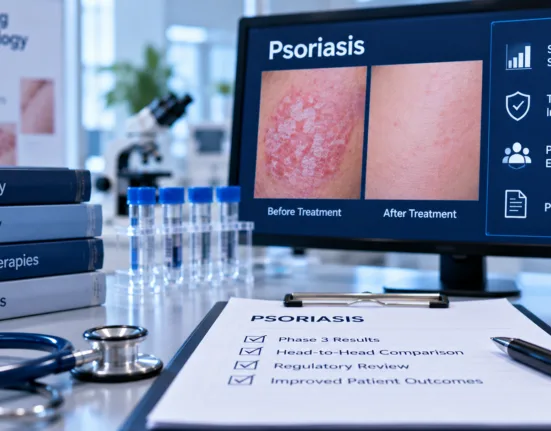
Akeso has received approval from China’s National Medical Products Administration for gumokimab, also known as AK111, as an anti-IL-17 monoclonal antibody for adults with moderate-to-severe plaque psoriasis. The approval gives the Hong Kong-listed biopharmaceutical company a second commercial psoriasis therapy and strengthens its autoimmune disease portfolio at a time when China’s biologics market is becoming more competitive, more specialized, and more sensitive to dosing convenience.
Why does gumokimab matter in China’s moderate-to-severe plaque psoriasis market?
Gumokimab matters because moderate-to-severe plaque psoriasis is a chronic immune-mediated disease where treatment success depends not only on clearing skin lesions, but on sustaining control over years of therapy. Patients with persistent plaques, itching, scaling, pain, and visible skin involvement often face a major quality-of-life burden. Biologics have changed the treatment landscape by targeting specific inflammatory pathways, yet access, durability, injection frequency, safety, and payer affordability remain central to real-world uptake.
Akeso is entering this market with an internally developed IL-17-targeting antibody at a time when Chinese biopharma companies are no longer competing only through biosimilars or late-following products. The gumokimab approval reflects a more mature domestic innovation model, where Chinese companies aim to build differentiated biologics portfolios across oncology, immunology, inflammation, and metabolic disease. In psoriasis, that means competing against established biologic mechanisms while trying to offer practical advantages for long-term disease management.
The limitation is that IL-17 inhibition is already a validated and crowded category globally. Gumokimab will not win adoption simply because it has a familiar mechanism. Dermatologists will compare it with existing IL-17 inhibitors, IL-23 inhibitors, IL-12/23 therapies, tumor necrosis factor blockers, small molecules, and domestic biologic alternatives. Akeso’s opportunity depends on whether the drug’s efficacy, dosing burden, safety profile, price, reimbursement position, and physician confidence can create a clear place in the Chinese psoriasis pathway.
What is genuinely new and what remains incremental in Akeso’s approval?
The genuinely new element is the NMPA approval of gumokimab for adult patients with moderate-to-severe plaque psoriasis, supported by one pivotal Phase III study and three supportive studies. The approval gives Akeso a fresh commercial immunology asset and expands its presence beyond ebdarokimab, its IL-12/IL-23-targeting psoriasis therapy. This matters because Akeso is building a multi-mechanism autoimmune franchise rather than depending on one biologic pathway.
The incremental element is that IL-17 is not a new therapeutic target in psoriasis. The pathway is well established, and IL-17 inhibitors are already important in moderate-to-severe plaque psoriasis treatment. Gumokimab’s strategic relevance therefore comes from execution within a validated class, not from opening an entirely new biological frontier. This is a different type of innovation race, one where the differentiators are depth of skin clearance, speed of onset, durability, safety, injection schedule, manufacturing reliability, and market access.

That distinction matters for industry readers because an approval can be commercially important without being scientifically disruptive. Gumokimab strengthens Akeso’s domestic portfolio and gives dermatologists another targeted option, but the drug’s long-term performance will depend on competitive positioning. In a chronic disease market, a new biologic must prove that it can earn physician habit and patient persistence, not just regulatory authorization.
How could gumokimab’s efficacy data shape dermatologist confidence?
Akeso reported that gumokimab achieved a PASI 75 response rate of 94.6% and a PASI 100 response rate of 47.7% at Week 12 in the pivotal study. By Week 52, the PASI 75 response rate approached 100%, while PASI 100 reached 68.9%. These figures matter because PASI 75 reflects substantial improvement, while PASI 100, or complete skin clearance, has become an increasingly important aspiration in modern psoriasis treatment.
For dermatologists, speed and depth of response can influence early prescribing. A clinically meaningful improvement by Week 2 could help support patient confidence and physician comfort, especially in individuals with high disease burden or visible lesions. Longer-term complete clearance data also matter because psoriasis treatment is not judged only at induction. Patients and clinicians need to know whether control can be maintained after the early response period.
The caution is that cross-trial comparisons can be misleading. Psoriasis biologic studies can differ in baseline severity, patient demographics, prior biologic exposure, endpoints, analysis populations, and trial design. Gumokimab’s reported efficacy profile appears strong, but physicians will interpret it against the full data package, published results, real-world experience, and local clinical guidelines. The drug’s clinical reputation will be built through everyday durability, not only headline PASI numbers.
Why could dosing burden become a meaningful commercial differentiator?
Akeso is emphasizing gumokimab’s subcutaneous dosing regimen, which requires 17 injections annually including the loading phase. The commercial logic is clear: psoriasis is lifelong, and injection burden can affect adherence, patient preference, and persistence. Patients who need biologic therapy often want treatment that fits their lives, not a regimen that constantly reminds them of disease management.
Reduced injection frequency can be especially relevant in a market where biologics are competing not only on efficacy, but also on convenience. A patient who achieves strong clearance may still discontinue or delay treatment if injections are frequent, access is inconvenient, or treatment feels burdensome. A biologic with fewer injections can therefore gain a patient-facing advantage if disease control remains stable.
The limitation is that dosing convenience is only valuable when it is backed by consistent efficacy and safety. Dermatologists will not prioritize fewer injections if they believe another therapy delivers more reliable clearance, faster control, broader real-world evidence, or stronger payer support. Dosing burden is a differentiator, not a substitute for clinical trust. Gumokimab’s opportunity is to combine convenience with durable control in a way that feels practical for long-term psoriasis care.
How does gumokimab fit into Akeso’s broader autoimmune disease strategy?
Gumokimab gives Akeso a second approved psoriasis therapy with a distinct mechanism from ebdarokimab. That is strategically important because autoimmune disease treatment is increasingly segmented by pathway, severity, comorbidity, patient preference, and prior treatment exposure. A company with multiple mechanisms can give physicians more options and build deeper specialist relationships than a company with a single immunology product.
The broader portfolio story also includes gumokimab’s supplemental application in active ankylosing spondylitis, which has been accepted for review in China. That creates potential expansion beyond dermatology into rheumatology, where IL-17 biology is also relevant. If gumokimab can move successfully into additional autoimmune indications, Akeso may be able to build a more durable franchise around inflammation rather than a single-product psoriasis launch.
The risk is that portfolio breadth can also create execution pressure. Akeso must commercialize gumokimab, support ebdarokimab, continue late-stage development of other immunology assets, and maintain investor focus on its high-profile oncology pipeline. Building an immunology franchise requires sales infrastructure, physician education, pharmacovigilance, pricing strategy, payer engagement, and manufacturing discipline. Approval is the start of that work, not the finish line.
Why does China’s biologics market make this approval commercially important?
China’s biologics market is large, fast evolving, and increasingly competitive. Domestic companies are advancing innovative antibodies, bispecifics, antibody-drug conjugates, and immune-mediated disease therapies at a much faster pace than a decade ago. For psoriasis, this creates a market where global mechanisms meet local development, local pricing pressure, and China-specific access dynamics.
Gumokimab’s approval is commercially important because Akeso has an integrated development, manufacturing, and commercialization model. That can matter in China, where speed of market access, production reliability, hospital listing, provincial procurement dynamics, physician familiarity, and affordability can influence uptake. A domestic innovator may have advantages in navigating local market realities, but it still faces tough competition from both multinational and Chinese rivals.
The unresolved question is how pricing and reimbursement will shape adoption. High-performing biologics can remain underused if cost barriers are too high. Conversely, competitive pricing can accelerate uptake but may pressure margins. Akeso will need to balance access and profitability, especially as China’s healthcare system continues to emphasize affordability and value. Gumokimab’s commercial success will depend as much on market execution as on clinical data.
What does the ankylosing spondylitis filing add to the gumokimab story?
The accepted supplemental New Drug Application for gumokimab in active ankylosing spondylitis adds a second layer to the asset’s value. IL-17 inhibition is relevant in several inflammatory diseases beyond psoriasis, and axial spondyloarthritis indications can create meaningful commercial expansion if efficacy and safety are confirmed. For Akeso, this makes gumokimab a potential multi-indication immunology product rather than a single-use dermatology asset.
The clinical logic is that diseases such as psoriasis and ankylosing spondylitis share inflammatory pathway overlap in selected patients. Many psoriasis patients also have joint symptoms or psoriatic arthritis, and dermatology-rheumatology overlap is an important part of modern immune disease care. A biologic with a broader label can become more useful to specialists managing complex patients across skin and musculoskeletal disease.
The limitation is that each indication requires its own evidence and regulatory judgment. Success in plaque psoriasis does not guarantee approval or adoption in ankylosing spondylitis. Rheumatologists will evaluate gumokimab against established IL-17 inhibitors, tumor necrosis factor blockers, JAK inhibitors, and other treatment options. If Akeso wants gumokimab to become a broader autoimmune franchise, the company will need disease-specific data that are persuasive to each specialist audience.
How does Akeso’s stock market signal frame investor expectations?
Akeso shares were recently trading around HK$88 to HK$93, with market capitalization estimates around HK$80 billion to HK$82 billion depending on source and timing. The stock remains watched by investors because Akeso has built a high-profile pipeline led by antibody-based oncology assets, including ivonescimab, while also expanding into autoimmune and inflammatory diseases. Gumokimab’s approval adds to that portfolio depth, but it is unlikely to dominate sentiment on its own.
For investors, the approval is strategically positive because it adds a commercial-stage asset and validates part of Akeso’s immunology platform. It also supports the argument that the company is not only an oncology story, even though oncology remains central to market attention. A stronger autoimmune portfolio could diversify revenue and reduce reliance on a narrower set of cancer pipeline catalysts over time.
The risk is that expectations around Akeso are already substantial. Investors will want evidence of launch traction, reimbursement progress, physician adoption, and contribution to revenue growth. A new approval can support sentiment, but the market will focus on whether Akeso can convert its broad pipeline into sustainable commercial performance. The company’s valuation depends on execution across multiple assets, not gumokimab alone.
What could go wrong after regulatory approval?
The first risk is market crowding. Psoriasis already has several effective biologic classes, and new entrants must work harder to displace existing physician habits. If dermatologists are satisfied with current options, gumokimab will need a clear reason to be chosen. Efficacy, dosing, safety, price, and access must align.
The second risk is long-term safety perception. IL-17 inhibitors are generally familiar to dermatologists, but infection risk, inflammatory bowel disease considerations, candidiasis, and other class-related concerns remain part of clinical decision-making. Gumokimab’s safety profile will need to hold up in broader real-world populations, including patients with comorbidities, prior biologic exposure, and long treatment duration.
The third risk is commercialization discipline. Launching a biologic requires more than regulatory approval. Akeso must educate clinicians, support patient access, manage supply, secure reimbursement, build prescriber confidence, and differentiate gumokimab from both imported and domestic therapies. In China’s competitive pharma market, speed and execution can matter almost as much as the molecule.
What should dermatologists, regulators, and industry observers watch next?
Dermatologists should watch real-world evidence after launch, particularly durability of complete skin clearance, treatment persistence, safety, patient satisfaction, and switching patterns from other biologics. The most useful data will show how gumokimab performs beyond trial settings and whether fewer annual injections translate into better adherence.
Regulators and market-access observers should watch the progress of gumokimab’s ankylosing spondylitis application, reimbursement decisions, and any post-marketing safety signals. A broader label could make the drug more commercially important, while payer restrictions or pricing pressure could limit the pace of uptake.
For the pharma industry, Akeso’s gumokimab approval shows that China’s domestic biologics sector is moving deeper into competitive immunology. This is no longer only a story about imported biologics entering China or Chinese companies chasing oncology breakthroughs. It is also a story about domestic firms building multi-mechanism autoimmune portfolios and competing on dosing, durability, access, and manufacturing scale. Gumokimab gives Akeso a useful new foothold. The harder test begins now, as regulatory approval turns into the daily work of winning physicians, patients, and payers in one of dermatology’s most competitive chronic disease markets.