Lantheus has received United States Food and Drug Administration (FDA) approval for Tauklarify, an injectable radioactive imaging agent used with positron emission tomography to identify tau neurofibrillary tangle pathology in adults with cognitive impairment who are being evaluated for Alzheimer’s disease.
The August 14, 2026 approval introduces a second Food and Drug Administration-approved tau PET tracer alongside Eli Lilly and Company’s Tauvid, which has been available since 2020. Tauklarify is also known by the developmental name MK-6240 and contains the fluorine-18 radiotracer florquinitau.
Approval does not mean that a Tauklarify scan independently diagnoses Alzheimer’s disease. The prescribing information warns that a negative scan does not necessarily exclude tau pathology and a positive scan does not necessarily confirm it. The result must be interpreted with the patient’s symptoms, cognitive testing, medical history and other biomarker or imaging findings.
The evidence nevertheless shows that appropriately trained readers can interpret the scans with a high level of agreement. In two blinded-reader studies involving images from more than 500 participants, inter-reader agreement reached 0.92 and 0.86, while negative percent agreement remained above 90% across readers.
The commercial effect may develop more slowly than the regulatory milestone suggests. Lantheus said it would continue using Tauklarify to support Alzheimer’s therapeutic programmes through its Pharma Solutions business while assessing the appropriate route toward broader commercial availability. An approved product is therefore not necessarily an immediately widespread product.
That cautious approach reflects the still-evolving role of tau imaging. Amyloid confirmation is already required before initiating approved anti-amyloid medicines, but current treatment labels do not generally require a tau PET scan. Tau imaging is scientifically informative and increasingly useful for staging and research, yet its value in routine clinical decision-making, reimbursement and patient management remains less firmly established.
What did the FDA approve, and what does a Tauklarify scan actually show?
Tauklarify is indicated for PET imaging of the brain in adults with cognitive impairment who are being evaluated for Alzheimer’s disease. Its approved purpose is to identify patients with tau neurofibrillary tangle pathology.
Tau is a protein that normally helps stabilize structures inside nerve cells. In Alzheimer’s disease, tau becomes abnormally modified and accumulates inside neurons, forming neurofibrillary tangles that disrupt cellular function and are associated with neurodegeneration.
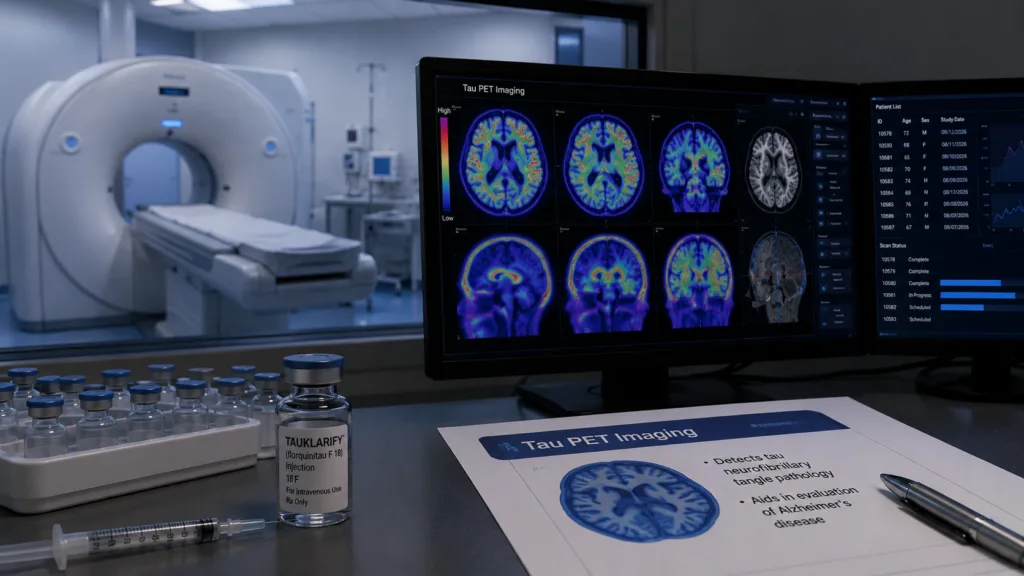
Florquinitau F 18 is designed to enter the brain and bind to aggregated tau tangles. The fluorine-18 component emits positrons as it decays, allowing a PET scanner to detect the spatial pattern of tracer retention.
Participants in the approval studies received approximately 185 megabecquerels, equivalent to five millicuries, through an intravenous injection. The resulting images were classified visually as positive or negative for clinically relevant tau pathology.
A positive scan indicates a pattern of tracer uptake consistent with tau neurofibrillary tangles associated with Alzheimer’s disease. It does not reveal every molecular process contributing to cognitive impairment, determine the precise cause of each symptom or establish how rapidly an individual will decline.
The approved indication applies only to adults who already have cognitive impairment and are undergoing an Alzheimer’s evaluation. Although cognitively unimpaired individuals were included in the development programme, Tauklarify is not approved as a general screening test for asymptomatic adults.
Its safety and effectiveness have also not been established for non-Alzheimer’s tauopathies. The label therefore does not support using Tauklarify to diagnose conditions such as progressive supranuclear palsy, corticobasal degeneration, frontotemporal dementia or chronic traumatic encephalopathy.
Why can positive and negative Tauklarify results still produce diagnostic errors?
The central limitation is that tau pathology exists along a spectrum rather than forming a perfect biological switch between absent and present.
A person in an early pathological stage may have tau deposits below the threshold required for a visually positive scan. The Food and Drug Administration label specifically warns that performance may be lower in patients at earlier points on the pathological spectrum.
A negative result consequently cannot guarantee that tau tangles are absent. It may indicate that the amount, location or intensity of tracer binding has not crossed the approved visual threshold.
A positive result creates a different interpretive problem. Tau pathology can coexist with vascular disease, Lewy body disease, amyloid deposition and other causes of cognitive decline. Detecting Alzheimer-type tau does not prove that it is the only or principal cause of the patient’s symptoms.
The pivotal studies also did not compare every scan directly with a post-mortem neuropathological examination. Instead, readers’ classifications were compared with a prespecified reference standard based on cognitive status and amyloid beta PET results.
That reference standard is clinically relevant, but it is not equivalent to examining brain tissue. Positive percent agreement and negative percent agreement should therefore not automatically be treated as definitive sensitivity and specificity against neuropathology.
Clinical interpretation must remain multimodal. A neurologist may consider structural magnetic resonance imaging, cognitive assessment, amyloid biomarkers, blood tests, cerebrospinal fluid results, medication history and other possible causes of impairment before deciding what a tau-positive or tau-negative scan means.
How persuasive were the blinded-reader studies supporting Tauklarify approval?
The approval programme included two blinded-read studies examining Tauklarify images obtained through three clinical trials. The analysed population covered mild cognitive impairment, mild Alzheimer’s disease dementia and cognitively unimpaired adults.
Readers received specific training and had no access to the participants’ clinical information or amyloid PET results. This design tested whether the Tauklarify image itself could be interpreted reproducibly without contextual clues steering the classification.
Study 1 included 279 participants. Depending on the reader, positive percent agreement ranged from 80% to 88%, while negative percent agreement ranged from 98% to 99%. The generalized Fleiss’ kappa for inter-reader agreement was 0.92, with a 95% confidence interval from 0.89 to 0.96.
Study 2 included 338 participants. Positive percent agreement ranged from 68% to 82%, and negative percent agreement ranged from 93% to 99%. Inter-reader agreement produced a kappa of 0.86, with a 95% confidence interval from 0.82 to 0.89.
The kappa results indicate that trained readers generally reached the same binary conclusion. They do not independently prove that every shared conclusion was biologically correct.
The lower positive percent agreement in Study 2 also deserves attention. At the lower end of the range, reader classifications agreed with the positive reference standard in 68% of cases. That result does not mean the remaining 32% were necessarily false negatives because the reference standard itself was not neuropathological confirmation, but it shows that positive classification was more difficult than the high overall reader agreement might imply.
Negative classifications were substantially more consistent with the reference standard. This asymmetry may reflect clearer separation at the low-tau end, variation in early or intermediate uptake patterns, differences between readers or the difficulty of applying a binary threshold to a progressive biological process.
The development programme therefore supports reproducible visual interpretation after training, while the label appropriately retains a warning about misdiagnosis and lower performance in earlier pathology.
How does Tauklarify compare with Eli Lilly and Company’s Tauvid tracer?
Tauvid, containing flortaucipir F 18, became the first Food and Drug Administration-approved tau PET imaging agent in May 2020. It is indicated for estimating the density and distribution of aggregated tau neurofibrillary tangles in adults with cognitive impairment who are being evaluated for Alzheimer’s disease.
Tauklarify enters with a broadly similar clinical purpose but a different molecule, binding profile, approved reading method and administered radioactive dose.
The recommended radioactive amount used for Tauklarify imaging is approximately 185 megabecquerels, or five millicuries. Tauvid’s recommended dose is 370 megabecquerels, or ten millicuries. That numerical difference should not be interpreted as proof that Tauklarify exposes patients to exactly half the radiation because absorbed dose also depends on tracer distribution, clearance and organ-specific dosimetry.
Both agents carry warnings about misinterpretation and cumulative radiation exposure. Both require access to a PET scanner, an appropriately equipped radiopharmacy and readers trained in the tracer’s specific visual interpretation method.
A prospective multicentre HEAD Study has provided a direct research comparison. Participants underwent both MK-6240 and flortaucipir PET imaging within a 45-day period, reducing the uncertainty associated with comparing tracers across unrelated populations.
Among 682 participants who completed the relevant procedures, MK-6240 produced an area under the receiver-operating-characteristic curve of 0.93 for distinguishing Alzheimer-related cognitive impairment from non-Alzheimer impairment, compared with 0.86 for flortaucipir.
The tracers produced concordant tau classifications in 87% of older participants for medial temporal regions and 94% for neocortical regions. MK-6240 identified tau positivity more frequently in some amyloid-positive participants, particularly those with mild cognitive impairment or dementia.
These findings suggest that tracer selection can change who is classified as tau positive. They do not establish that using Tauklarify instead of Tauvid improves patient outcomes, produces more appropriate treatment decisions or prevents diagnostic error in routine practice.
Greater detection could represent better recognition of disease-relevant tau, but it could also be influenced by different binding characteristics, imaging thresholds and regional signal patterns. Clinical usefulness depends on whether the additional findings correspond to meaningful pathology and change management appropriately.
Where does tau PET fit beside amyloid PET and Alzheimer’s blood biomarkers?
Amyloid and tau answer related but different biological questions.
Amyloid plaques can begin accumulating many years before noticeable cognitive symptoms. Amyloid PET, cerebrospinal fluid testing and increasingly available blood biomarkers can help establish whether the Alzheimer’s biological process is present.
Approved anti-amyloid medicines such as Leqembi require confirmation of amyloid beta pathology before treatment. Tau confirmation is not listed as the required eligibility biomarker, although tau burden may influence prognosis and the likely stage of disease.
Tau tends to show a closer relationship with the location and severity of neurodegeneration and cognitive impairment than amyloid burden alone. A tau PET image may therefore provide additional information after an amyloid-positive result, helping clinicians understand how far the disease process may have progressed.
That does not mean every person with suspected Alzheimer’s disease requires both scans. Performing an amyloid PET study followed by tau PET increases cost, appointment burden and cumulative radiation exposure.
Blood biomarkers could eventually help determine who needs imaging. A lower-cost blood test could be used as an initial triage tool, while PET is reserved for ambiguous cases, clinical-trial enrolment or situations in which the distribution of pathology may influence a decision.
Tauklarify’s strongest near-term role may be as a complementary test rather than a replacement for amyloid imaging, magnetic resonance imaging, cerebrospinal fluid analysis or clinical evaluation.
Why could clinical trials adopt Tauklarify faster than ordinary memory clinics?
MK-6240 was already being used extensively in Alzheimer’s research before approval. Pharmaceutical developers can use tau PET to select participants, stratify patients according to pathological burden and examine whether an experimental treatment changes tau accumulation.
This creates a defined initial customer base. A trial sponsor may value standardized imaging even when no routine clinical reimbursement pathway exists because the scan supports protocol endpoints and drug-development decisions.
Tau PET could be particularly relevant to therapies directly targeting tau. Developers need a biomarker capable of showing whether an experimental medicine reaches the intended biological process, reduces accumulation or alters the spatial progression of tangles.
Anti-amyloid programmes may also use tau imaging. The current Leqembi prescribing information describes an MK-6240 tau PET substudy in which treatment-related differences favoured Leqembi in several temporal regions, although not across every assessed brain region.
Routine memory clinics face a different calculation. A clinician needs to know whether the additional scan will change diagnosis, treatment, counselling or follow-up sufficiently to justify its cost and logistical demands.
Lantheus has not announced a firm timetable for broad commercial availability. Its decision to continue supporting therapeutic programmes while assessing a wider launch indicates that research use may remain the more immediate opportunity.
What operational and radiation constraints must imaging centres manage?
Fluorine-18 has a physical half-life of approximately 110 minutes. That is long enough to permit regional distribution from qualified production facilities, but short enough to create strict manufacturing, transport and scheduling requirements.
Each dose must be produced, quality tested, transported and administered within a limited period. Delays involving the radiopharmacy, courier, PET scanner or patient can reduce the amount of usable radioactivity.
Facilities must use trained personnel, dose calibrators, shielding and compliant radioactive-material handling procedures. The scan also requires a reader trained specifically in Tauklarify interpretation rather than assuming that experience with amyloid PET or Tauvid automatically transfers.
Patients should be adequately hydrated before and after administration and encouraged to urinate frequently to reduce radiation exposure. Breastfeeding must be interrupted temporarily, with expressed milk discarded for at least four hours after administration.
The label also advises avoiding CYP1A2 inducers, including tobacco smoking, for at least seven days before Tauklarify administration. Imaging centres will need to identify relevant medicines and smoking exposure during scheduling rather than discovering the issue when the dose has already arrived.
Reported adverse reactions were uncommon in the 1,734-person safety population. Headache occurred in 0.7%, nausea in 0.2%, while injection-site reactions, dizziness and abdominal discomfort were each reported in 0.1%.
Low adverse-reaction rates do not remove the cumulative radiation consideration. A patient undergoing several nuclear-imaging studies should have each examination justified by a meaningful diagnostic or management question.
Could reimbursement become a larger obstacle than FDA approval?
Food and Drug Administration approval establishes that Tauklarify can legally be marketed for its labelled use. It does not guarantee that Medicare, private insurers or other payers will cover the tracer and associated PET procedure broadly.
Lantheus has not disclosed the final price, reimbursement assumptions, product-specific coding strategy or expected number of commercial imaging sites. Those details will strongly influence whether Tauklarify moves beyond academic centres and sponsored clinical studies.
Tau PET currently has a narrower clinical role than amyloid confirmation because there is no approved therapy whose label specifically requires a positive tau scan. Payers may consequently ask whether the result changes treatment rather than merely adding biological information.
The economics involve more than the injected agent. A complete examination includes radiopharmaceutical production, transport, PET scanner time, technical staff, image interpretation and the clinical consultation needed to explain the result.
Access may also be uneven. Major academic centres with established dementia and molecular-imaging programmes can integrate a new tracer more easily than community clinics located far from an appropriate fluorine-18 distribution network.
Broader adoption may require clearer appropriate-use recommendations, consistent payer decisions, evidence of changed clinical management and a distribution model that reaches patients outside metropolitan research centres.
What additional evidence could establish Tauklarify as a routine Alzheimer’s tool?
The most useful next studies would move beyond agreement between trained image readers and examine what happens after the result reaches a clinician.
Researchers could assess how often Tauklarify changes the working diagnosis, medication plan, eligibility for treatment, counselling or decision to pursue further tests. A scan that provides interesting information but rarely alters care will remain difficult to justify routinely.
Longitudinal studies should determine how well regional tau patterns predict cognitive decline, functional loss and transition from mild cognitive impairment to dementia. That would strengthen the scan’s prognostic value without suggesting certainty for individual patients.
Direct comparisons with Tauvid should continue, particularly in diverse populations and earlier disease stages. The HEAD Study population was predominantly White, making wider demographic validation important before assuming that performance generalizes uniformly.
The approved visual read is binary, but much of tau PET’s scientific value comes from measuring burden and distribution. Additional standardization will be needed before quantitative change can function reliably across scanners, software, readers, tracers and imaging centres.
Evidence supporting treatment monitoring would be particularly consequential. Tauklarify is not automatically approved as a test proving that a therapy has worked simply because it can visualize tau. Longitudinal biomarker use requires validation showing that measured changes are reproducible and clinically meaningful.
Can Tauklarify move tau PET from research studies into Alzheimer’s care?
Tauklarify gives clinicians and researchers another approved method for visualizing one of Alzheimer’s disease’s defining pathological features in the living brain.
The approval evidence supports a reproducible reading system, especially for negative classifications. The large safety database also indicates that adverse reactions to the injected tracer were uncommon.
Important uncertainties remain visible in the label. Positive percent agreement varied across the two studies, performance may be weaker in early pathology and neither a positive nor negative scan independently settles the diagnosis.
Tauklarify also enters a market in which Tauvid already provides approved tau imaging. Its head-to-head research performance against flortaucipir is encouraging, but Lantheus must demonstrate that detecting additional tau-positive cases produces better clinical decisions rather than simply a different classification rate.
Commercial adoption will depend on reader training, radiopharmaceutical distribution, payer coverage and the emergence of treatment decisions that genuinely require tau information. Blood biomarkers may reduce unnecessary PET scans, while future tau-directed therapies could sharply increase demand for definitive imaging.
For now, the approval is most immediately valuable to Alzheimer’s drug development and specialist centres seeking a more detailed biological picture after cognitive and amyloid assessment. Broader use will come only if Tauklarify proves that seeing tau changes what clinicians can responsibly do for the patient sitting in front of them.