
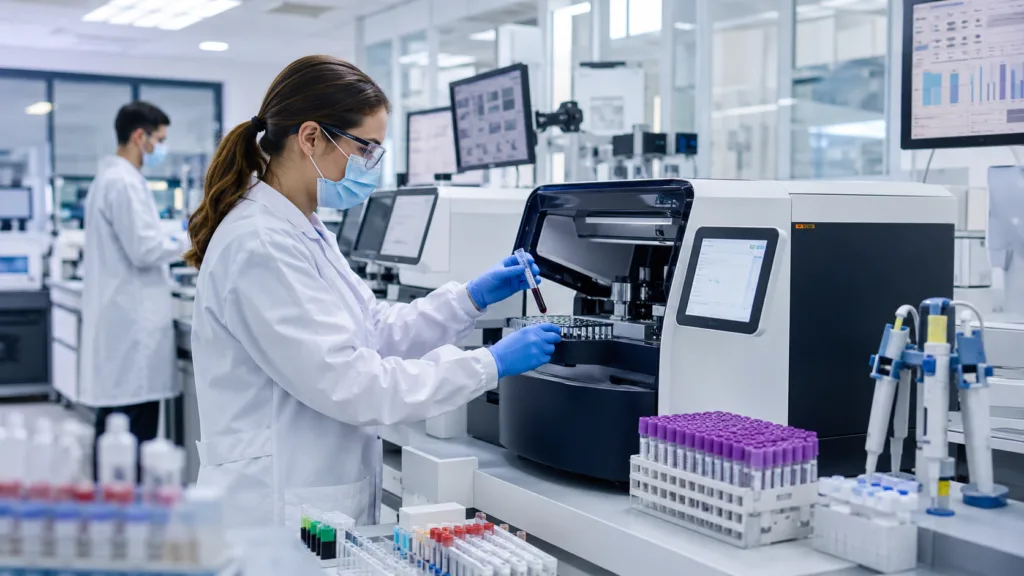
Cardio Diagnostics Holdings, Inc. (Nasdaq: CDIO) has begun processing its Epi+Gen CHD and PrecisionCHD cardiovascular blood tests at its own high-complexity Clinical Laboratory Improvement Amendments-certified laboratory in Iowa City, Iowa, replacing the third-party processing model previously used for clinical samples. The August 18, 2026 launch gives the diagnostics company direct control from sample receipt through result delivery, while shifting a critical part of its commercial infrastructure inside the business.
The operational change could become important for Cardio Diagnostics because the company is attempting to commercialize multi-omics tests while revenue remains at an exceptionally early stage. Management expects in-house processing to provide greater control over quality, turnaround time and per-test economics, and has said the laboratory could support gross margins of about 40% once sufficient scale is reached. That margin figure is an expectation rather than a demonstrated result, making testing volume one of the most important variables in determining whether vertical integration ultimately improves the economics of the business.
The distinction also matters from a regulatory perspective. CLIA certification establishes laboratory quality requirements and allows an appropriately certified laboratory to perform the relevant complexity of human diagnostic testing. It should not be interpreted as United States Food and Drug Administration approval or clearance of Epi+Gen CHD or PrecisionCHD. CMS describes the purpose of CLIA as ensuring accurate, reliable and timely laboratory testing, with requirements increasing according to test complexity.
Why does bringing Epi+Gen CHD and PrecisionCHD processing in-house matter commercially?
Cardio Diagnostics said the Iowa City operation gives it end-to-end control of the testing workflow for Epi+Gen CHD and PrecisionCHD, eliminating the outsourced clinical sample processing arrangement it previously relied upon. Its stated objective is to replace a more variable per-test external processing expense with a cost structure that management can control more directly as volumes increase.
That logic is straightforward at high volumes. An in-house laboratory can potentially spread equipment, personnel, quality-system and facility costs across a larger number of billable tests, while removing an external laboratory’s margin from the cost chain. It also gives the company more direct influence over operational changes and assay workflow.
At low volumes, however, laboratory ownership presents the opposite challenge. Fixed expenses still need to be absorbed whether the facility processes hundreds, thousands or only a small number of tests. Cardio Diagnostics reported only $5,360 of revenue in the second quarter of 2026, down from $7,475 a year earlier, while first-half revenue was $8,040 compared with $8,415 in the corresponding 2025 period. The company generated a $1.50 million second-quarter net loss and a $3.29 million loss for the first half.
Those numbers put the 40% gross-margin ambition into perspective. The laboratory may improve unit economics once volume expands, but the immediate commercial requirement is not merely cheaper processing. Cardio Diagnostics needs substantially more reimbursed, provider-paid, employer-sponsored or patient-paid testing flowing through the facility before vertical integration can demonstrate its intended economic benefit.
Its Iowa investment is also not entirely new. Securities filings show that Cardio Diagnostics signed the laboratory lease in 2023, with the lease running through November 2028, and disclosed more than $500,000 of laboratory leasehold improvements after completing the buildout. The August launch therefore represents the conversion of an infrastructure investment into active in-house clinical processing rather than the sudden creation of a new laboratory footprint.
What does high-complexity CLIA certification actually establish for Cardio Diagnostics?
CLIA regulates the quality standards under which clinical laboratory testing is performed in the United States. High-complexity laboratories face more stringent requirements around areas including personnel, laboratory oversight, testing processes and quality systems than facilities conducting only waived testing. CMS states that CLIA’s fundamental objective is the quality of patient test results.
Cardio Diagnostics said its laboratory received its federal CLIA certification after an inspection that found no deficiencies. The company has also obtained relevant out-of-state laboratory licenses for California, Maryland, Rhode Island and Pennsylvania and said it is continuing to pursue its final state license from New York, which has separate requirements.
The regulatory nuance is especially important because Cardio Diagnostics describes Epi+Gen CHD and PrecisionCHD as laboratory-developed tests. In its latest quarterly filing, the company said it believes both products fall into the LDT category.
The federal environment for laboratory-developed tests has changed materially over the past two years. The FDA issued a rule in 2024 that sought to explicitly bring laboratory-manufactured in vitro diagnostic products within its device regulatory framework, but a federal district court vacated that rule on March 31, 2025. The FDA subsequently reverted the relevant regulatory language to its pre-2024 wording in September 2025.
Consequently, the Iowa City laboratory milestone should be understood as an operational and laboratory-compliance development rather than an FDA clearance event.
How strong is the clinical evidence behind Cardio Diagnostics’ cardiovascular tests?
Epi+Gen CHD is designed to assess a patient’s three-year risk of a coronary heart disease event, including a heart attack, using integrated genetic and epigenetic information. Cardio Diagnostics currently positions the test for adults aged 35 to 75 who have not already been diagnosed with coronary heart disease or experienced certain prior cardiovascular events.
The technology has supporting peer-reviewed research. An external validation study published in Epigenomics in 2021 assessed an integrated genetic-epigenetic approach for predicting incident coronary heart disease using Framingham Heart Study and Intermountain Healthcare datasets. The study reported sensitivity and specificity of 79% and 75% in the Framingham test set and 75% and 72% in the Intermountain dataset.
PrecisionCHD addresses a different clinical question. The company positions it as an aid in detecting coronary heart disease, with its associated Actionable Clinical Intelligence report intended to provide clinicians with additional information on molecular disease drivers. Cardio Diagnostics’ SEC filings characterize PrecisionCHD as aiding in the diagnosis and management of coronary heart disease rather than as a stand-alone replacement for established cardiovascular evaluation.
A 2023 peer-reviewed Journal of the American Heart Association study evaluated the integrated genetic-epigenetic approach across multiple cohorts. Cardio Diagnostics reports from that research an average area under the receiver operating characteristic curve of 0.82, sensitivity of 79% and specificity of 76% for detection of coronary heart disease.
Those studies provide an evidence base for the underlying testing approach, but analytical and clinical validation are only part of the pathway to broad diagnostic adoption. The larger commercial question is whether further evidence demonstrates that using the tests changes clinical decision-making, improves management, produces economically meaningful outcomes and gains enough physician and payer acceptance to generate sustained testing volume.
Could faster turnaround become a meaningful advantage for the Iowa City laboratory?
Cardio Diagnostics currently reports a turnaround time of seven to ten business days from receipt of the patient’s sample at the laboratory. Management believes direct control of testing will eventually allow it to tighten that interval.
The operational advantage is credible in principle. Bringing sample processing, quality-control procedures and result generation under one organization reduces some external coordination points and gives Cardio Diagnostics greater ability to investigate delays or adjust laboratory processes.
But the practical value of a faster turnaround time will depend on where the tests fit within cardiovascular workflows. A reduction of several days becomes commercially meaningful only if physicians are ordering the tests in sufficient numbers, results reach clinicians at useful points in the care pathway and the information influences subsequent management.
The new facility therefore gives Cardio Diagnostics greater control over turnaround time, but it does not by itself establish that faster processing will increase physician ordering or improve patient outcomes.
Will reimbursement rather than laboratory capacity determine how fast Cardio Diagnostics can scale?
Reimbursement may ultimately be a larger constraint than laboratory capacity.
Cardio Diagnostics has secured American Medical Association Proprietary Laboratory Analyses codes 0439U for Epi+Gen CHD and 0440U for PrecisionCHD. The company has also obtained CMS gapfill payment rates of $854 for each test. Importantly, a payment rate is not synonymous with universal Medicare coverage. Cardio Diagnostics said in its latest quarterly filing that it continues to pursue Medicare coverage for the tests.
The company made some commercial progress in May when Atlas Healthcare Physicians began covering Epi+Gen CHD and PrecisionCHD for eligible members subject to prior authorization. Cardio Diagnostics described Atlas Healthcare Physicians as an independent physician association serving managed-care populations in Los Angeles and Orange County.
Its broader commercial strategy currently includes telemedicine and self-pay patients, smaller provider practices, employers, unions, benefits brokers and organizations that do not depend entirely on conventional reimbursement channels. Cardio Diagnostics has itself acknowledged in its SEC filings that securing payer coverage and reimbursement will be necessary to produce significantly greater testing volume and revenue growth.
That makes the Iowa City laboratory an enabling asset rather than the final commercial milestone. The company now possesses more control over how its tests are processed, but demand generation still sits further downstream with physicians, health plans, employers and patients.
Can Cardio Diagnostics support an in-house laboratory while commercial volumes remain small?
Cardio Diagnostics ended June 2026 with approximately $5.59 million in cash, compared with $5.11 million at the end of 2025. The apparent increase needs context: the business used approximately $2.90 million of cash in operating activities during the first six months while receiving about $3.69 million in net proceeds from common-stock sales.
The company has also warned that laboratory development will add costs. Its second-quarter filing anticipated expenses related to laboratory equipment, materials, facility work and personnel as internal operations expand.
This creates an important execution test. Bringing laboratory work in-house can remove outsourced processing expense, but the economics improve only if Cardio Diagnostics can push enough samples through the new infrastructure. With first-half revenue still measured in thousands of dollars while operating cash consumption runs in the millions, utilization growth is considerably more important than the laboratory’s theoretical maximum capacity.
The opportunity is therefore less about owning laboratory equipment and more about whether Cardio Diagnostics can convert scientific validation, coding progress, selected payer coverage and provider relationships into recurring test orders.
The Iowa City launch removes one operational dependency and gives Cardio Diagnostics direct control over a core part of its diagnostic platform. The next milestones will be harder to achieve and easier to measure: broader payer coverage, expanding physician adoption, higher test volumes, demonstrated reductions in per-test processing costs and evidence that the company’s targeted 40% gross margin can emerge as laboratory utilization increases.