Akeso, Inc. has received clinical-trial clearance from the Center for Drug Evaluation of China’s National Medical Products Administration for AK157D1, allowing the company to move its internally developed B7-H3-targeting antibody-drug conjugate into a Phase 1 study involving patients with advanced malignant solid tumors. The regulatory step makes AK157D1 Akeso’s third next-generation ADC to enter clinical development after its TROP2/Nectin-4 bispecific ADC AK146D1 and HER3-targeting AK138D1, while the company also plans eventual combination development with its immuno-oncology bispecific antibodies ivonescimab and cadonilimab.
The August 21 development should be framed as authorization to begin clinical testing rather than an approval of AK157D1 as a cancer treatment. Human efficacy and safety data have not yet been reported, and Akeso’s assertions of potent antitumor activity and favorable tolerability currently come from preclinical studies.
What makes the programme notable at such an early stage is the target. B7-H3 has moved rapidly from an experimental immune-oncology antigen into one of the more competitive ADC targets, with Daiichi Sankyo and Merck & Co., Inc.’s ifinatamab deruxtecan already reaching US regulatory review in previously treated extensive-stage small cell lung cancer. AK157D1 therefore enters first-in-human development at a point when the central question is shifting from whether B7-H3 can be drugged to whether individual ADC designs can create sufficiently differentiated efficacy and safety profiles.
How is AK157D1 constructed and what is Akeso trying to improve?
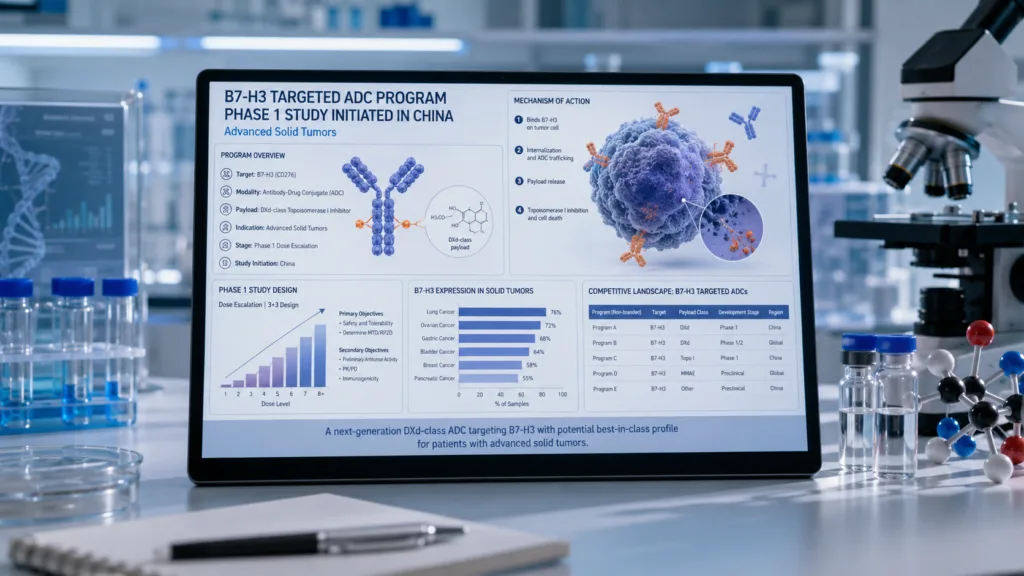
AK157D1 consists of a recombinant humanized IgG1/kappa monoclonal antibody directed against B7-H3 that is site-specifically conjugated to a DXd payload, a camptothecin-derived topoisomerase I inhibitor. Akeso uses a maleimidocaproyl-alanine-alanine-alanine linker attached to interchain cysteine residues to connect the antibody and cytotoxic component.
The basic ADC logic is familiar. The antibody is designed to recognize B7-H3 on a tumor cell, internalization brings the conjugate into the cell, and release of the cytotoxic payload can inhibit topoisomerase I, disrupting DNA replication and ultimately killing susceptible cancer cells.
What differentiates one ADC from another is far more complicated than the antigen name. Antibody affinity, epitope, drug-to-antibody ratio, linker stability, payload potency, intracellular release, membrane permeability and bystander effects can all influence how much therapeutic exposure reaches a tumor and how much toxicity appears in healthy tissues.
Akeso has not yet disclosed the full clinical pharmacology that would establish where AK157D1 sits on those parameters in humans. Its early claim is that the proprietary design generated strong antitumor activity with a favorable safety profile in preclinical testing. The company specifically hopes to address hematologic toxicity and interstitial lung disease, two adverse-event categories that can constrain topoisomerase I ADCs.
Those statements remain hypotheses until dose-escalation data appear. Animal toxicology can guide selection of a first-in-human starting dose, but it cannot reliably predict the complete frequency or severity of ADC toxicities in cancer patients receiving repeated treatment.
Why has B7-H3 become such an attractive solid-tumor target?
B7-H3, also known as CD276, is a transmembrane member of the B7 protein family that is expressed at elevated levels across multiple cancers while generally showing more restricted expression in normal tissue. Akeso identifies non-small cell lung cancer, small cell lung cancer, prostate cancer, esophageal cancer, nasopharyngeal carcinoma, colorectal cancer, breast cancer and glioblastoma among tumor types where B7-H3 can be highly expressed.
That broad expression profile is valuable for an ADC because a target present across several tumor types can potentially support a franchise rather than a single narrow indication.
B7-H3 has also been associated with aggressive disease and poorer prognosis in several cancers, although its biological role is complex and remains incompletely defined. For ADC development, however, the immediate requirement is not necessarily that blocking B7-H3 itself provides a therapeutic effect. The antigen can function primarily as a delivery address that allows the antibody to carry a highly potent cytotoxic drug preferentially toward cancer cells.
The target’s potential has become more credible as rival clinical programmes advance. Daiichi Sankyo’s ifinatamab deruxtecan is also a B7-H3-directed ADC carrying a DXd topoisomerase I payload and has generated sufficient clinical evidence in extensive-stage small cell lung cancer to reach US regulatory review. Daiichi Sankyo reported in 2026 that the programme’s filing had been accepted in the United States for second-line or later treatment.
That competitor validates B7-H3 commercially while simultaneously raising the standard AK157D1 will eventually have to meet.
How similar is AK157D1 to ifinatamab deruxtecan?
At a high level, the programmes share two important characteristics: both target B7-H3 and both use a topoisomerase I inhibitor from the DXd class.
Ifinatamab deruxtecan comprises a humanized anti-B7-H3 IgG1 antibody attached to an exatecan-derived topoisomerase I inhibitor using Daiichi Sankyo’s proprietary DXd ADC technology. AK157D1 likewise uses a humanized IgG1 antibody and a DXd payload, although Akeso has described a different linker architecture and its own site-specific conjugation design.
Superficial similarity does not mean the drugs will behave identically. Two ADCs against the same antigen can produce different pharmacokinetics, tumor penetration, payload release and safety because of differences in antibody binding, conjugation chemistry and drug-to-antibody ratio.
The clinical maturity gap, however, is substantial. Ifinatamab has completed important Phase 2 development and reached the US filing stage in small cell lung cancer, whereas AK157D1 has only received permission to begin Phase 1.
Akeso therefore cannot compete through timing in that first indication. Its opportunity is to demonstrate differentiation, potentially through a different therapeutic window, broader activity across B7-H3-positive tumors or combinations with the company’s existing bispecific immunotherapies.
Why is Akeso planning combinations with ivonescimab and cadonilimab so early?
Akeso describes its oncology strategy as combining an “IO2.0” portfolio of bispecific antibodies with an “ADC2.0” pipeline.
Ivonescimab targets PD-1 and VEGF, while cadonilimab targets PD-1 and CTLA-4. Both are designed to influence the immune tumor microenvironment through mechanisms different from the direct cytotoxicity produced by an ADC.
The scientific rationale for combinations is that the ADC can kill tumor cells and release tumor antigens while checkpoint-directed therapy reduces immunological suppression, potentially producing complementary antitumor effects. That concept is being explored widely across the ADC industry and is not unique to Akeso.
The company may nevertheless possess an internal development advantage because it controls both sides of several potential combinations. Rather than depending on another pharmaceutical company to supply a checkpoint inhibitor, Akeso can design studies pairing its ADC assets with its own bispecific medicines and potentially retain more control over development strategy.
Akeso is already taking this approach with AK146D1. The TROP2/Nectin-4 ADC has moved into a Phase 2 breast cancer study in combination with ivonescimab, creating a clinical template that could eventually be extended to AK157D1 if the B7-H3 programme establishes an acceptable monotherapy dose and safety profile.
Combination plans should still remain secondary during early Phase 1 development. Before adding another active agent, investigators need to understand AK157D1’s own pharmacokinetics, dose-limiting toxicities and recommended dose range sufficiently well to interpret what happens when therapies are combined.
What will the first Phase 1 dataset need to show?
The first objective is tolerability.
Topoisomerase I ADCs can produce clinically important adverse events including cytopenias, nausea and other gastrointestinal effects, while interstitial lung disease has emerged as a particularly important class-related concern for some deruxtecan-containing ADCs. Akeso specifically cites hematologic toxicity and interstitial lung disease among limitations it intends AK157D1’s design to address.
That means early investigators will likely pay close attention to neutropenia, anemia, thrombocytopenia and pulmonary events as dose escalates. The real test of Akeso’s preclinical safety claims will be whether clinically active exposure can be reached without toxicity narrowing the therapeutic window.
Pharmacokinetics and dose proportionality will be equally important. An ADC must remain sufficiently stable in circulation to reach the tumor without releasing excessive payload systemically, while still releasing enough drug after internalization to kill cancer cells.
Antitumor responses will be exploratory in an initial dose-escalation study, but they can influence development direction dramatically. Responses occurring across multiple B7-H3-expressing cancers would support broad expansion cohorts, while particularly strong activity in one tumor could justify a more focused strategy.
Biomarker work will also matter. B7-H3 expression is not uniform across all tumors or patients, and understanding whether response correlates with expression level could help Akeso define later eligibility criteria and avoid exposing patients unlikely to benefit.
Is Akeso building too many ADC programmes at once?
AK157D1 joins a rapidly expanding pipeline.
AK146D1 targets both TROP2 and Nectin-4, AK138D1 targets HER3, AK157D1 targets B7-H3 and the company says the bispecific ADC AK158D1 is also expected to enter clinical development. Akeso reports more than 50 innovative pipeline assets overall, with 27 already in clinical trials.
Breadth can be strategically useful because ADC development remains difficult to predict from preclinical results. Running several target and chemistry combinations increases the chance that at least one will show a compelling therapeutic window.
The cost is organizational complexity. Each programme requires manufacturing, toxicology, regulatory interaction, clinical operations and eventually increasingly expensive expansion studies. Akeso will need to prioritize quickly when early human data reveal which assets deserve larger investment.
The company’s existing bispecific portfolio may help provide that prioritization framework. An ADC that not only works alone but also pairs effectively with ivonescimab or cadonilimab could fit naturally into Akeso’s broader cancer-treatment strategy.
For AK157D1, however, that debate is still ahead. Clinical-trial clearance simply gives Akeso permission to start answering the first questions.
The programme enters a B7-H3 field that is no longer speculative and a DXd ADC field that has already produced major global oncology medicines. That simultaneously lowers target risk and raises competitive expectations.
Akeso’s task now is to show why another B7-H3 topoisomerase I ADC is needed. The answer will not come from the target name or the preclinical description. It will come from whether AK157D1 can produce meaningful tumor responses at exposures patients can tolerate, and whether its proprietary chemistry translates into the wider therapeutic window the company is promising.