For pharmaceutical developers, making a tablet is usually simpler than creating an injectable medicine. Peptides reverse that logic. These molecules can be exceptionally potent and biologically precise, yet the gastrointestinal tract is designed to break proteins and peptides into smaller components rather than deliver intact therapeutic molecules into the bloodstream. Stomach acid, digestive enzymes, mucus and the epithelial barrier collectively create an obstacle course that explains why insulin, many peptide hormones and numerous biologic medicines have historically required injection.
Oral semaglutide changed expectations by demonstrating that a GLP-1 peptide could achieve sufficient systemic exposure from a tablet to become a major commercial medicine. The achievement has encouraged another wave of investment in permeation enhancers, protective formulations, nanoparticles and ingestible delivery devices, but it has also created a risk of assuming that a successful semaglutide tablet proves most peptides can follow the same path. A detailed 2026 analysis argues the opposite: semaglutide may represent an unusually favorable boundary case because exceptional potency, a roughly week-long half-life and time-integrated pharmacology compensate for oral bioavailability that remains extremely low.
Why does the digestive system make peptides so difficult to deliver as tablets?
Peptides encounter chemical and physical barriers before reaching systemic circulation. Gastric acidity can destabilize susceptible molecules, proteases are designed to cleave peptide bonds, mucus can slow diffusion and the intestinal or gastric epithelium tightly restricts passage of large hydrophilic molecules. Even a peptide that survives enzymatic destruction may therefore reach the absorptive surface and still fail to cross it in meaningful quantities.
Small-molecule drugs are often sufficiently lipophilic or structurally suited to cross epithelial membranes naturally. Peptides generally are not, which is why developers investigate permeation enhancers that temporarily increase membrane transport, enzyme inhibitors that protect the therapeutic molecule, pH-modifying agents, encapsulation technologies and mechanical devices that physically deliver drug across the gastrointestinal wall.
Every solution introduces another problem. Increasing epithelial permeability too aggressively can raise safety questions, higher oral doses can make manufacturing expensive, formulation complexity can reduce reliability and variability in food intake or gastric emptying can produce inconsistent exposure between doses and patients.
How does SNAC allow semaglutide to cross the stomach?
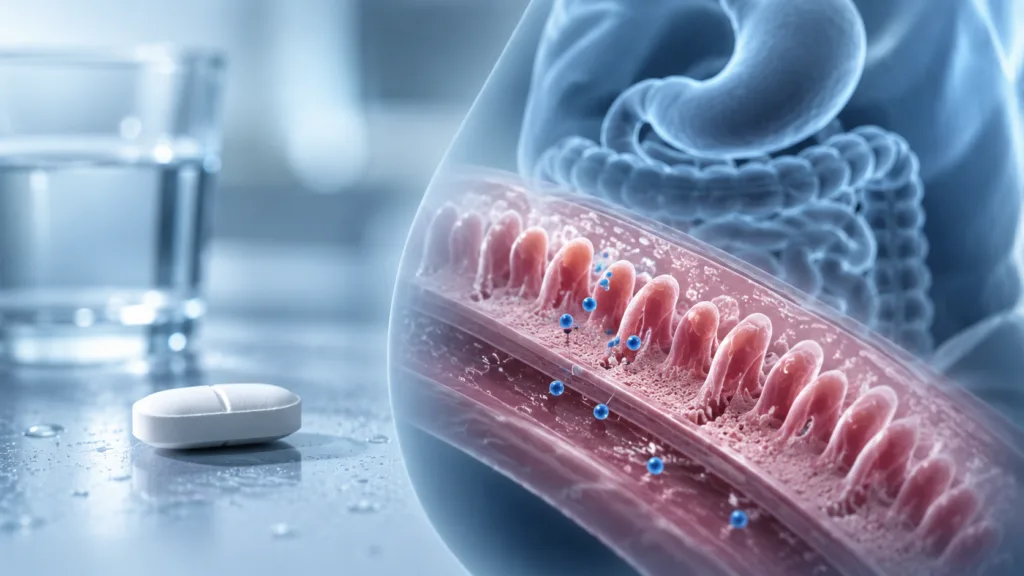
Oral semaglutide is co-formulated with sodium N-(8-[2-hydroxybenzoyl]amino) caprylate, usually abbreviated SNAC. Rather than simply protecting the tablet until it reaches the intestine, the formulation promotes semaglutide absorption primarily through the stomach. SNAC creates a locally less acidic environment around the dissolving tablet, reducing degradation, promoting semaglutide monomerization and facilitating transcellular movement across gastric epithelial membranes.
The result is pharmacologically sufficient but still remarkably inefficient absorption. Published analyses have placed oral semaglutide bioavailability around the low single-digit percentage range and often approximately 1%, demonstrating that the commercial success of the medicine does not mean the gastrointestinal barrier has been overcome in the conventional sense. Instead, enough drug gets through for semaglutide’s pharmacology to tolerate the inefficiency.
Administration conditions illustrate that fragility. Oral semaglutide formulations have historically required fasting, limited water around dosing and a waiting period before food or other oral medicines because relatively modest changes in the stomach environment can affect exposure. This is very different from an ordinary tablet whose absorption remains predictable despite routine variation in meals.
Why is semaglutide unusually well suited to survive inefficient oral absorption?
Semaglutide combines several favorable characteristics rarely found together. It is highly potent, meaning only a relatively small systemic concentration is needed for therapeutic activity, and structural modifications give the peptide an elimination half-life of approximately one week. Once a small fraction of an oral dose reaches circulation, repeated administration can therefore build and maintain clinically useful exposure despite poor absorption from each individual tablet.
The molecule also has a relatively wide therapeutic window compared with drugs for which modest fluctuations in systemic concentration could immediately produce dangerous toxicity or treatment failure. These characteristics make variability easier to tolerate.
A peptide with a short half-life and narrow therapeutic window faces a much tougher problem. If only 1% of a tablet is absorbed and the absorbed drug disappears from circulation within a few hours, simply increasing the oral dose can become impractical because enormous quantities of expensive peptide would need to be manufactured and swallowed. Variability between doses could then make some tablets ineffective while others produce excessive exposure.
This is why oral semaglutide should be treated as proof that oral peptide delivery can work under the right pharmacological conditions, not proof that injection can now be engineered away from most peptide medicines.
Are there successful oral peptides beyond semaglutide?
Oral octreotide provides another instructive example. MYCAPSSA uses a transient permeability-enhancing formulation involving sodium caprylate to permit gastrointestinal absorption of octreotide in patients with acromegaly. Its success demonstrates that SNAC is not the only approach capable of moving a therapeutic peptide across the gastrointestinal barrier.
The trade-off again illustrates the broader challenge. Oral bioavailability remains very low and substantially more peptide is required orally than would be necessary through an injectable route. Commercial viability therefore depends on whether the convenience advantage and clinical use case can justify the manufacturing and dosing inefficiency.
Other technologies attempt to solve the problem mechanically rather than chemically. Ingestible capsules are being developed that orient themselves inside the stomach or intestine and use microneedles or other mechanisms to inject drug through the gastrointestinal wall after the patient swallows the device. These approaches could theoretically produce injection-like absorption without requiring a patient to handle a needle, but manufacturing complexity, reliability, cost and regulatory classification become more complicated.
Why does low bioavailability become an economic problem as well as a pharmacology problem?
Biologic peptides are usually more expensive to manufacture per gram than conventional small-molecule tablets. If an injectable medicine requires one milligram but an oral formulation needs tens or hundreds of milligrams to achieve comparable systemic exposure, manufacturing cost can become a fundamental limitation long before researchers exhaust formulation ideas.
High dose requirements also increase tablet size and place more permeation enhancer or other excipients into the gastrointestinal tract. A formulation that works scientifically can therefore fail commercially because the amount of active pharmaceutical ingredient consumed per patient makes the product uneconomic.
The situation becomes even more difficult for chronic diseases affecting millions of people. A seemingly modest increase in peptide required per daily tablet becomes enormous when multiplied across years of treatment and a global patient population.
This is one reason drug developers increasingly need to select peptide candidates for oral delivery before investing heavily in formulation. Potency, half-life, therapeutic index and required systemic exposure may determine whether a molecule is economically capable of becoming a pill before engineers begin designing the pill itself.
Will oral peptides eventually eliminate injections?
Probably not, but they can widen patient choice significantly. Injectable formulations can deliver peptides with excellent and predictable bioavailability and increasingly offer once-weekly or even longer dosing intervals, reducing much of the inconvenience that originally motivated oral development. An oral medicine requiring daily fasting and carefully controlled administration is not automatically more convenient than one injection every week.
The more realistic future is a portfolio of delivery options. Some molecules will remain best suited to injection, some exceptionally potent and long-lived peptides may become tablets, and others could use inhaled, buccal, transdermal or ingestible-device approaches.
The major lesson from semaglutide is therefore more subtle than “peptides can now be pills.” It demonstrates that drug delivery can sometimes compensate for very poor absorption when molecular pharmacology is unusually favorable. The next generation of oral peptide development will succeed by identifying which molecules share enough of those characteristics, rather than assuming that a clever absorption enhancer can turn any injectable biologic into an ordinary tablet.