GE HealthCare Technologies Inc. has received U.S. Food and Drug Administration 510(k) clearance for MIM Contour ProtégéAI+ 2.0, an AI-enabled auto-contouring software designed to support radiation oncology treatment planning. The cleared software expands clinical capabilities with new and updated anatomical models, positioning GE HealthCare deeper in the push to automate one of the most time-intensive steps in cancer radiotherapy workflows.
Why could GE HealthCare’s MIM Contour ProtégéAI+ 2.0 clearance matter for radiation oncology teams?
The clearance matters because contouring remains one of the operational bottlenecks in radiation therapy planning. Before a patient receives radiation treatment, clinicians must define tumours and organs at risk on imaging scans so that radiation can be targeted precisely while limiting exposure to healthy tissue. This process is clinically critical, but it can also be labour-intensive, variable and dependent on specialist expertise.
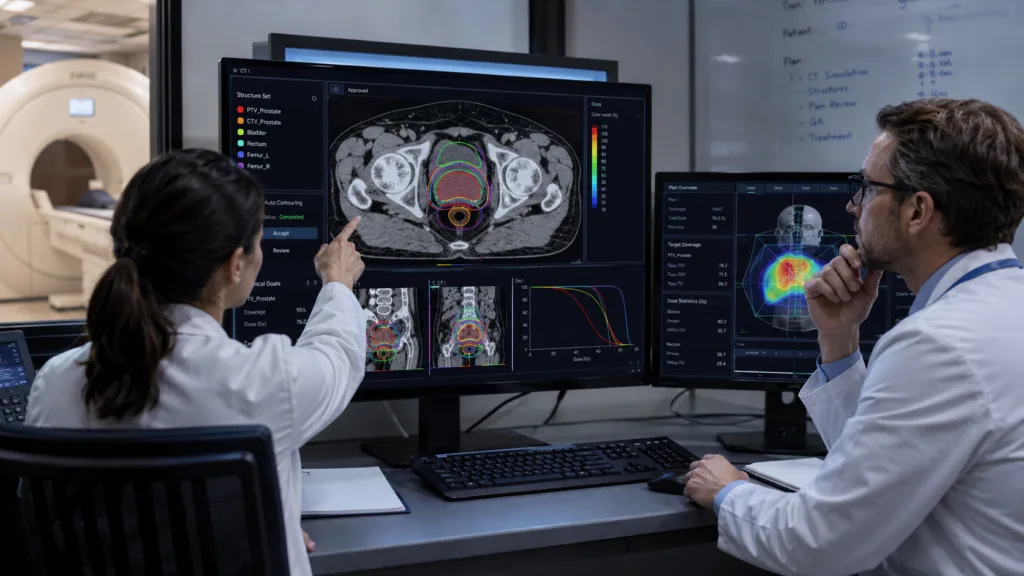
MIM Contour ProtégéAI+ 2.0 addresses that pressure point by using artificial intelligence to support automated contour generation. The immediate clinical relevance is workflow efficiency. If AI can produce reliable initial contours, radiation oncology teams may be able to spend less time on repetitive manual segmentation and more time reviewing, refining and personalising treatment plans. That is meaningful in a specialty where delays between diagnosis, simulation and treatment can affect patient experience and care coordination.
The limitation is that auto-contouring is not the same as automated treatment planning. Radiation oncologists and dosimetrists still need to review contours, adapt them to clinical context and ensure that planning decisions reflect patient-specific anatomy and disease characteristics. The software can reduce workload, but it cannot remove professional accountability. Adoption will depend on whether clinical teams trust the contours enough to accelerate workflow without creating new review burdens.
How does AI auto-contouring fit into the wider shift toward precision radiation therapy?
Precision radiation therapy depends on both accuracy and speed. Modern oncology increasingly uses advanced imaging, adaptive planning and personalised dose strategies, but these approaches often increase the planning workload. As treatment becomes more precise, the number of structures that must be contoured can rise, and the tolerance for segmentation error becomes smaller. That is where AI-assisted contouring becomes strategically important.
GE HealthCare’s software fits into a broader industry move toward connecting imaging, planning and workflow automation. The MIM software portfolio already sits close to oncology imaging and radiation therapy workflows, giving the medical technology company a logical entry point for AI-enabled treatment planning support. By expanding model coverage across brain magnetic resonance and pelvic computed tomography applications, MIM Contour ProtégéAI+ 2.0 can address clinical areas where anatomical accuracy is especially important.
The risk is that radiation therapy AI tools must prove consistency across scanners, imaging protocols, patient body types, tumour presentations and institutional planning standards. Auto-contouring models may perform well in one environment and require more correction in another. For hospitals, the value proposition will be strongest if the software produces contours that are not merely fast, but also reproducible across users and acceptable within local clinical protocols.
Why does the Predetermined Change Control Plan make this clearance more strategically important?
One of the most interesting aspects of this clearance is the inclusion of a Predetermined Change Control Plan. In practical terms, this framework can allow certain future software or model updates to be implemented within a pre-agreed regulatory structure. For AI-enabled medical software, that matters because model performance, clinical applications and training datasets can evolve more quickly than traditional device hardware cycles.
This is strategically important for GE HealthCare because radiation oncology AI is not a static market. New anatomical sites, updated model architectures, improved imaging inputs and better workflow integration can all shape future product value. A regulatory framework that supports controlled updates may help the company keep the software relevant while maintaining oversight. That gives the clearance more significance than a single version upgrade.
The limitation is that update flexibility increases the importance of governance. Hospitals will want to know when models change, how changes are validated, what documentation supports updated performance and whether local quality assurance processes need to be repeated. A Predetermined Change Control Plan can help with regulatory agility, but it does not eliminate the need for transparency, clinician education and post-market performance monitoring.
How could the software change clinical workflow without replacing clinician judgment?
The most realistic impact of MIM Contour ProtégéAI+ 2.0 is not that it replaces contouring specialists. It is that it changes where human expertise is applied. Instead of drawing structures from scratch in every case, clinicians may increasingly review AI-generated contours, correct where needed and focus more attention on complex cases, edge conditions and treatment strategy. That could be valuable in busy radiation oncology departments facing staff shortages and rising cancer caseloads.
For departments with experienced teams, the benefit may be faster throughput and greater consistency. For centres with less specialised planning resources, the tool may help standardise initial contouring quality and reduce dependence on manual variation. In both cases, the confirmed development supports a broader transition from manual-first planning to AI-assisted planning.
The risk is workflow complacency. If users become too dependent on automated contours, subtle errors could carry clinical consequences. Organs at risk must be delineated accurately because incorrect contours can influence dose constraints and treatment safety. The strongest adoption model will likely be one in which AI is treated as a productivity accelerator and quality-support layer, not as a substitute for expert review.
What does this clearance reveal about the competitive direction of radiation oncology software?
Radiation oncology software is moving toward integrated ecosystems rather than isolated planning tools. Vendors are competing on how well they can connect imaging, contouring, planning, quality assurance and treatment delivery. GE HealthCare’s clearance reinforces that direction because MIM Contour ProtégéAI+ 2.0 is positioned within a broader oncology software and imaging strategy, rather than as a standalone AI widget.
This matters competitively because health systems want technology that fits into existing clinical pathways. A contouring tool that integrates with established imaging and planning environments can be easier to adopt than a disconnected application that forces clinicians to manage extra workflow steps. GE HealthCare’s acquisition of MIM Software also gives the group a stronger software layer around its imaging and oncology ambitions.
The risk is that the radiation oncology software market is highly specialised and already includes strong competitors across treatment planning systems, imaging platforms and AI segmentation tools. GE HealthCare will need to prove that its auto-contouring software is not only accurate, but also easy to deploy, interoperable and economically justified. In this market, winning depends on clinical trust and workflow fit, not just FDA clearance.
Why are brain and pelvis models clinically relevant in radiation therapy planning?
The new MR brain model and updated CT male pelvis model are clinically meaningful because both regions can be demanding for radiation therapy planning. Brain radiotherapy requires careful delineation of sensitive structures where small differences in contouring can influence dose decisions. Pelvic radiotherapy, particularly in male patients, requires accurate identification of organs at risk and target-adjacent anatomy in an area where shape, position and treatment protocols can vary.
These model expansions suggest GE HealthCare is targeting high-value clinical areas rather than generic automation. Brain and pelvic radiation workflows are common enough to matter operationally, but complex enough to benefit from consistency support. If the software reduces routine contouring time while maintaining acceptable quality, it could create measurable workflow gains in departments handling high volumes of neuro-oncology and prostate or pelvic cancer cases.
The limitation is that anatomical model coverage can also create expectations for wider applicability. Hospitals may ask when other disease sites, imaging inputs and patient subgroups will be supported. A software platform that grows too slowly may lose competitive momentum. A platform that expands too quickly without robust validation may face trust issues. GE HealthCare will need to balance clinical breadth with performance credibility.
How could reimbursement and hospital economics shape adoption?
Auto-contouring software is often purchased as an operational efficiency tool rather than a separately reimbursed clinical intervention. That means hospitals will assess the technology through productivity, quality and capacity metrics. If MIM Contour ProtégéAI+ 2.0 reduces planning time, shortens treatment start timelines or frees specialist staff for higher-value work, the financial argument strengthens.
The economic context is important because radiation oncology departments face pressure to handle complex cases while managing staffing constraints and capital budgets. Software that improves throughput without requiring major hardware replacement can be attractive. GE HealthCare can position the tool as part of a broader move toward efficient precision oncology infrastructure, especially for centres that already use MIM software or GE HealthCare imaging platforms.
The risk is that return on investment may differ by site. Large academic centres with high case volumes may capture meaningful time savings. Smaller centres may find the benefit less dramatic if case mix or staffing patterns reduce the operational impact. Hospitals will likely want local validation, workflow pilots and clear implementation support before committing broadly.
What does this mean for GE HealthCare’s broader oncology and AI strategy?
For GE HealthCare Technologies Inc., MIM Contour ProtégéAI+ 2.0 supports a strategic shift toward software-driven healthcare technology. The group is not competing only on scanners, imaging equipment or hardware refresh cycles. It is trying to build connected care pathways where imaging, AI, data management and clinical workflow tools create recurring value.
This is particularly relevant in oncology because cancer care is becoming more data-intensive and workflow-dependent. Diagnosis, staging, treatment planning, image-guided intervention and follow-up all require coordination across specialists and systems. AI-enabled contouring fits neatly into that strategy because it is close to a real clinical bottleneck and can be integrated into the pathway between imaging and treatment.
The limitation is that investors and customers increasingly expect tangible proof from healthcare AI. Broad AI narratives are no longer enough. GE HealthCare must show that tools such as MIM Contour ProtégéAI+ 2.0 can improve productivity, strengthen customer retention and support software revenue. The clearance is useful, but sustained commercial value will depend on adoption, upgrade cycles and measurable clinical workflow impact.
What does GE HealthCare’s stock performance suggest about investor expectations?
GE HealthCare Technologies Inc. shares recently traded at $64.67, giving the U.S.-listed medical technology company a market capitalisation of about $29.55 billion. That valuation reflects investor expectations for a diversified imaging, ultrasound, patient monitoring and pharmaceutical diagnostics business that is increasingly trying to grow through precision care, software and artificial intelligence.
The MIM Contour ProtégéAI+ 2.0 clearance is unlikely to move the equity story by itself, but it reinforces a larger investment narrative. GE HealthCare wants to show that its installed base and clinical relationships can become channels for AI-enabled workflow tools. In medical technology, software-led upgrades can support recurring revenue, customer stickiness and higher-margin growth if adoption scales.
The risk is that the market may discount individual AI clearances unless they translate into visible commercial traction. Investors will watch whether GE HealthCare can convert regulatory wins into revenue growth, whether AI tools improve competitive differentiation, and whether software margins can become a more meaningful part of the business mix. The clearance helps the story, but execution will decide the financial impact.
What should clinicians, hospitals and industry observers watch next?
Clinicians should watch how the auto-contouring software performs in routine clinical settings, especially across complex cases and varied imaging protocols. The key measures will include contour quality, time saved, correction burden, user confidence and whether the tool supports consistent treatment planning across different clinicians and departments.
Hospitals should watch implementation requirements. Even a strong AI tool can underperform if it is poorly integrated into existing software, planning systems and quality assurance processes. Clinical governance will matter. Departments need clear rules on review responsibility, model update validation and documentation. AI contouring will be most useful where it is embedded into disciplined clinical workflow, not treated as a shortcut.
Industry observers should watch whether GE HealthCare expands the software into more anatomical models, deeper oncology workflow integration and broader radiation therapy partnerships. The competitive field is moving quickly, and the strongest platforms will likely be those that combine regulatory clearance, clinical trust, interoperability and an upgrade path for future AI models.
Could AI contouring become routine infrastructure in cancer radiotherapy?
MIM Contour ProtégéAI+ 2.0 points toward a future in which AI contouring becomes a routine layer of radiation therapy planning rather than a special feature. That future is plausible because contouring is repetitive, time-consuming and clinically important. It is exactly the type of workflow where AI can be valuable if the technology is reliable and properly governed.
The most balanced view is that GE HealthCare’s clearance is a meaningful step, not a final answer. The software can help reduce one of radiation oncology’s operational pain points, but it still depends on expert review, local validation and careful deployment. Its success will be measured less by the fact of clearance and more by whether radiation oncology teams use it every day because it genuinely saves time without weakening clinical confidence.
If GE HealthCare can prove that combination of speed, consistency and trust, MIM Contour ProtégéAI+ 2.0 could become part of the everyday infrastructure of precision radiotherapy. If the real-world correction burden is high or workflow integration is uneven, adoption may remain selective. The opportunity is clear. The next test is clinical normalisation.